

Read the brain, read the mind
 |
Description
Book Introduction
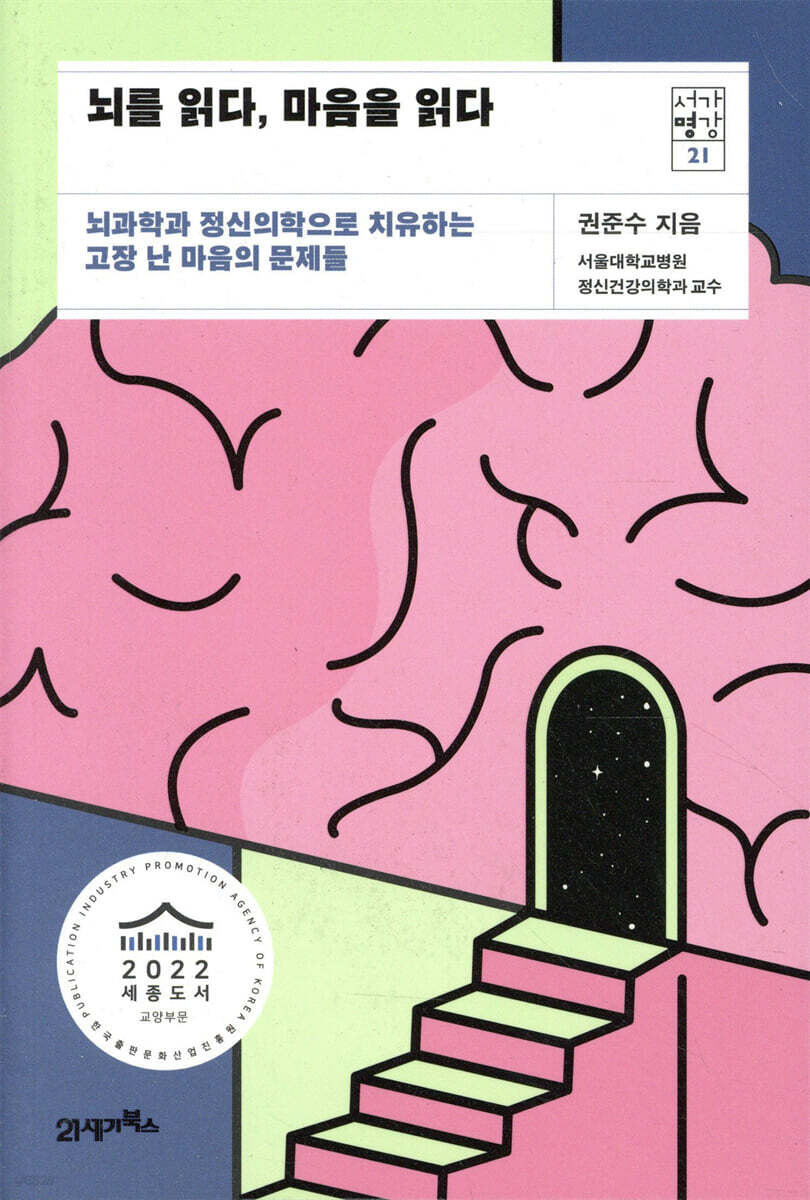
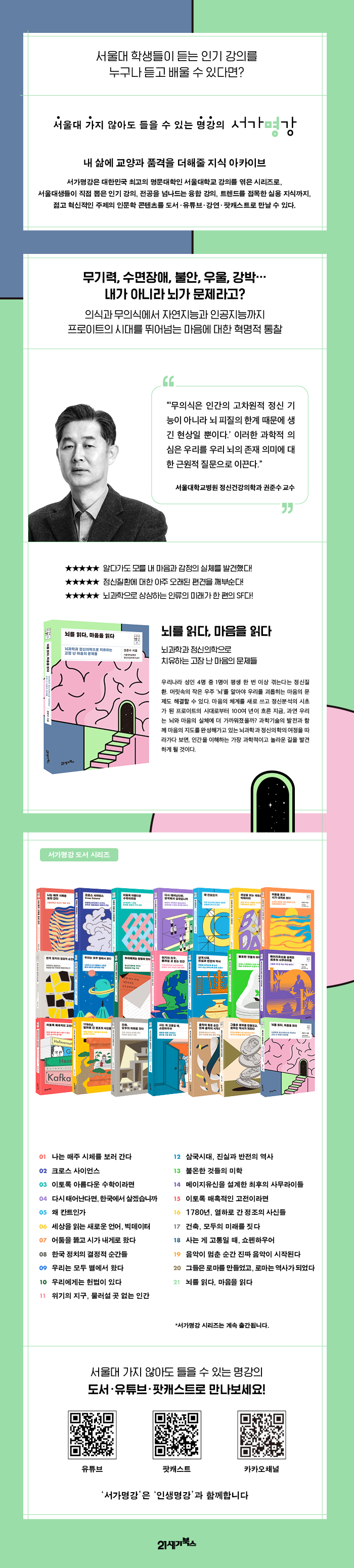
"Seogamyeonggang": A famous lecture you can attend without going to Seoul National University. Healing the Problems of a Broken Mind with Brain Science and Psychiatry Discover Korea's finest lectures in book form! The 21st volume in the "Seogamyeonggang" series, featuring carefully curated lectures by current Seoul National University faculty, has been published. The Seoga Myunggang series, which transcribes the lectures of Seoul National University's top professors in various fields, including history, philosophy, science, medicine, and art, into books, provides readers with the expansion of knowledge and the joy of learning. 『Reading the Brain, Reading the Mind』 is a book written by Professor Kwon Jun-su, a professor of psychiatry at Seoul National University Hospital and a world-renowned expert in brain imaging. It contains insights into the human mind and brain that he has explored for 35 years across clinical and research settings. From 'medicine', which identifies and treats mental illness that goes beyond the daily lives of individuals and destroys society, to 'neuroscience', which reveals the true nature of the 'brain', the small universe inside our heads, it unfolds unique and interesting stories that help us understand the human mind by going back and forth between these two fields. As you read this book, you will learn what the human brain is and what it means to us, and furthermore, you will discover clues to solving the countless mental problems that plague us. |
- You can preview some of the book's contents.
Preview
index
Classification of Academic Studies Before Reading This Book
Main keywords
Introduction: A World Discovered Across the Freudian Era
Part 1: Where is your heart?
A very old question surrounding the mind
Beyond imagination, facing the reality of the brain
Our body and mind grow together with our brain.
Genetics vs. Environment: Truths and Misconceptions About the Brain
Part 2: The Brain That Hurts Me and Threatens Others
A society dominated by matters of the heart
Depression, the sad brain that rocks life
Schizophrenia, a sick brain that has lost its emotional cord
A Reasonable Defense for an Unrecognized Disease
Part 3: Happiness is in the head, not the heart.
From Freud to Foucault: The Birth of Psychoanalysis
Scientific discoveries that correct misconceptions
How to solve problems of the mind
The surest way to create a happy brain
Part 4: The Future of the Mind: Reading from the Front Lines of Science
Artificial intelligence threatens unique human capabilities
It's the brain, not inspiration, that makes a genius.
From the Age of Psychoanalysis to the Age of Artificial Intelligence
Science in the human mind
The Secret of a Heart That Doesn't Break Easily
annotation
References
Main keywords
Introduction: A World Discovered Across the Freudian Era
Part 1: Where is your heart?
A very old question surrounding the mind
Beyond imagination, facing the reality of the brain
Our body and mind grow together with our brain.
Genetics vs. Environment: Truths and Misconceptions About the Brain
Part 2: The Brain That Hurts Me and Threatens Others
A society dominated by matters of the heart
Depression, the sad brain that rocks life
Schizophrenia, a sick brain that has lost its emotional cord
A Reasonable Defense for an Unrecognized Disease
Part 3: Happiness is in the head, not the heart.
From Freud to Foucault: The Birth of Psychoanalysis
Scientific discoveries that correct misconceptions
How to solve problems of the mind
The surest way to create a happy brain
Part 4: The Future of the Mind: Reading from the Front Lines of Science
Artificial intelligence threatens unique human capabilities
It's the brain, not inspiration, that makes a genius.
From the Age of Psychoanalysis to the Age of Artificial Intelligence
Science in the human mind
The Secret of a Heart That Doesn't Break Easily
annotation
References
Detailed image
Into the book
For psychiatrists since Sigmund Freud, the unconscious has been an unshakable framework for understanding the human mind.
Didn't we say that what is visible above the surface of the ice floating on the sea is consciousness, and that the larger part below the surface is the unconscious?
(Omitted) This vast unconsciousness became the basis of existence and an unshakable absolute foundation for psychiatrists.
However, my idea that 'it is nothing more or less than an inevitable phenomenon due to the limitations of the cerebral cortex' brought great confusion to the paradigm of understanding psychological phenomena that I had taken for granted as a psychiatrist.
What does the existence of our brain really mean?
--- p.14~15
Franz Gall, a French neuroanatomist of Austrian origin, proposed the hypothesis that the human brain is the organ of the mind and that each area of the cerebral cortex controls mental functions.
According to this, if one function of the brain is used a lot, the area of the cerebral cortex responsible for that function becomes larger than other areas, and as each area grows in size, a bump may form on the skull.
Simply put, the brain is divided into 35 regions related to psychological functions such as compassion, creativity, and sadness, so it is possible to judge a person's personality by looking at the shape of the skull.
This excited many people at the time who hoped to unravel the mysteries of the brain.
It is also said that employers at the time asked job applicants to undergo a skull diagnosis before hiring them.
--- p.25
Oedipus, from Greek mythology, is a tragic figure who became blind as a result of failing to avoid an oracle that predicted that he would kill his father and marry his mother.
His life has been the subject of heated debates among many philosophers about free will and fate, and today it also leads to questions about the brain.
Is it really me, with my free will, who's the problem, or is it my innate brain? Those who believe in libertarianism, like American philosopher Robert Cain, believe that we are free to decide our thoughts and actions.
In contrast, those who believed in determinism, including the 18th-century French Enlightenment thinker Baron d'Ol'Bacque, believed that all events, including will and action, resulted from causal relationships.
Everything that happens is a result of something that came before.
Looking at it today, human behavior can be explained by brain activity, and brain activity can be explained by signal transmission of brain neurons.
In other words, for libertarians, I am the problem, and for determinists, the brain is the problem.
--- p.70~71
Underneath the outward appearance of mental symptoms such as depression or anxiety lies a cognitive dysfunction.
There are problems with various cognitive functions such as concentration, memory, spatial perception, reality judgment, and problem solving skills.
These cognitive functions are influenced by specific neural circuits.
And these neural circuits are made up of nerve cells and are composed of proteins.
Ultimately, if we trace back the mental phenomena that are revealed on the surface, we find the most primitive being, genes.
In other words, treatment of depression or anxiety disorders goes beyond the superficial mental phenomena and is connected to all stages, such as improving cognitive function and activating the functions of neural circuits and nerve cells.
--- p.140~141
For Go experts, understanding the situation while playing Go is a very specialized skill.
By practicing placing black and white stones alternately and analyzing all possible scenarios and placing stones in the best possible locations, you will gradually be able to judge the situation just by looking at the shape of the stones.
This also takes the form of pattern recognition, holistic recognition.
When you become an expert at something, you can understand the situation by looking at the overall picture or shape without having to analyze it one by one. This is called 'intuition'.
Baduk is a game that requires the utmost intuition, and Lee Sedol's defeat to AlphaGo shattered the belief that intuition was a uniquely human ability.
Didn't we say that what is visible above the surface of the ice floating on the sea is consciousness, and that the larger part below the surface is the unconscious?
(Omitted) This vast unconsciousness became the basis of existence and an unshakable absolute foundation for psychiatrists.
However, my idea that 'it is nothing more or less than an inevitable phenomenon due to the limitations of the cerebral cortex' brought great confusion to the paradigm of understanding psychological phenomena that I had taken for granted as a psychiatrist.
What does the existence of our brain really mean?
--- p.14~15
Franz Gall, a French neuroanatomist of Austrian origin, proposed the hypothesis that the human brain is the organ of the mind and that each area of the cerebral cortex controls mental functions.
According to this, if one function of the brain is used a lot, the area of the cerebral cortex responsible for that function becomes larger than other areas, and as each area grows in size, a bump may form on the skull.
Simply put, the brain is divided into 35 regions related to psychological functions such as compassion, creativity, and sadness, so it is possible to judge a person's personality by looking at the shape of the skull.
This excited many people at the time who hoped to unravel the mysteries of the brain.
It is also said that employers at the time asked job applicants to undergo a skull diagnosis before hiring them.
--- p.25
Oedipus, from Greek mythology, is a tragic figure who became blind as a result of failing to avoid an oracle that predicted that he would kill his father and marry his mother.
His life has been the subject of heated debates among many philosophers about free will and fate, and today it also leads to questions about the brain.
Is it really me, with my free will, who's the problem, or is it my innate brain? Those who believe in libertarianism, like American philosopher Robert Cain, believe that we are free to decide our thoughts and actions.
In contrast, those who believed in determinism, including the 18th-century French Enlightenment thinker Baron d'Ol'Bacque, believed that all events, including will and action, resulted from causal relationships.
Everything that happens is a result of something that came before.
Looking at it today, human behavior can be explained by brain activity, and brain activity can be explained by signal transmission of brain neurons.
In other words, for libertarians, I am the problem, and for determinists, the brain is the problem.
--- p.70~71
Underneath the outward appearance of mental symptoms such as depression or anxiety lies a cognitive dysfunction.
There are problems with various cognitive functions such as concentration, memory, spatial perception, reality judgment, and problem solving skills.
These cognitive functions are influenced by specific neural circuits.
And these neural circuits are made up of nerve cells and are composed of proteins.
Ultimately, if we trace back the mental phenomena that are revealed on the surface, we find the most primitive being, genes.
In other words, treatment of depression or anxiety disorders goes beyond the superficial mental phenomena and is connected to all stages, such as improving cognitive function and activating the functions of neural circuits and nerve cells.
--- p.140~141
For Go experts, understanding the situation while playing Go is a very specialized skill.
By practicing placing black and white stones alternately and analyzing all possible scenarios and placing stones in the best possible locations, you will gradually be able to judge the situation just by looking at the shape of the stones.
This also takes the form of pattern recognition, holistic recognition.
When you become an expert at something, you can understand the situation by looking at the overall picture or shape without having to analyze it one by one. This is called 'intuition'.
Baduk is a game that requires the utmost intuition, and Lee Sedol's defeat to AlphaGo shattered the belief that intuition was a uniquely human ability.
--- p.190
Publisher's Review
Lethargy, sleep disturbance, anxiety, depression, obsessive compulsive disorder…
The problem isn't me, it's my 'brain'?
How much do we truly understand about mental illness, a condition that affects one in four adults in Korea at least once in their lifetime? While Korea has grown into a global economic powerhouse, it also has one of the highest suicide rates in the world.
Moreover, recently, 'Corona Blue' has emerged as a new social issue in the era of infectious diseases.
The dark shadow that has enveloped society is no longer a problem for individuals to deal with, but a problem that everyone must solve together.
The author of this book scientifically elucidates serious mental problems confirmed in clinical and research settings, captures the changes occurring in the living human brain, and provides an easy-to-understand explanation of the causes and treatments of psychiatric symptoms through brain science.
In psychiatry, diagnosing mental problems by dividing them into “normal” and “abnormal” is not simple.
Unlike internal and surgical diseases, there is no clear diagnostic method for psychiatric diseases.
It is neuroscience that provides a useful methodology at this time.
In particular, with the development of brain imaging, methods for examining the living brain and distinguishing between normal and abnormal brains have become more diverse.
The author, who is producing world-class research results in the field of brain imaging, explains in an easy-to-understand way, using visual materials, that the cause of mental illness is not a problem of individual free will, but a problem of the 'brain'.
Moreover, this book meticulously weaves together the great moments of discovery that created crucial turning points in the development of psychiatry and brain science, and suggests the direction in which cutting-edge science and technology are headed, leading us on a surprising and unique intellectual journey.
In a society filled with stress, people struggle to find happiness, but the more they obsess over happiness, the more unhappy they become.
For those people, this book tells them that the way to become happy is actually very simple.
It is about making the brain, which governs the mind, healthy.
From consciousness and unconsciousness to natural intelligence and artificial intelligence
A new world discovered beyond the era of Freud!
Since Freud discovered the 'unconscious', the unconscious has provided an unshakable paradigm in psychiatry for understanding the human mind.
And we have believed that the unconscious, a higher-dimensional natural intelligence that only humans possess, is an intellectual ability.
However, the author, who has been observing the development and research results of brain science from the forefront, raises questions about this.
“Could the unconscious be a phenomenon resulting from the limitations of the cerebral cortex rather than a higher-level human mental function?” The author argues that this very scientific doubt will not only be the first step toward discovering the true meaning of our brain, but will also guide us toward resolving the problems of the mind.
More than a century after Freud's era of analyzing the mind, we now live in an era where we desire not only to understand the brain but also to manipulate it. As AI becomes embedded not only in our everyday lives but also within our brains, how will we accept and understand this? As medicine and technology advance together, blurring boundaries, the mysteries of the human brain, a tiny organ weighing just 1.4 kilograms, are gradually being revealed.
When will we get closer to the reality of the brain and mind?
Through this book, written at the crossroads of this time, we can guess how the future of brain science will change individuals and society.
This book, which delves into the development of therapeutic technologies that awaken depressed brain cells, the surprising changes that artificial intelligence technology will bring to brain health and daily life, and even the prospects for future technologies, invites you to take a step closer to understanding the true nature of the mind.
Main contents of the text
Part 1 briefly retraces human history to see how human perception of mind and spirit has evolved.
It vividly conveys the first historical moment when mankind discovered and studied the 'brain' through science.
It also helps us understand the structure and function of the brain, a microcosm as mysterious as the infinite universe.
You will find answers to the question, 'What is the brain and what does it mean to humans?'
Part 2 provides a psychiatric and neuroscientific explanation of mental illness, the dark shadow that covers our society, and examines its impact on individuals' daily lives and society, as well as the attitudes toward mental illness from both individual and societal perspectives.
In Part 3, we briefly review the birth and development of psychoanalysis and explore the link between the brain and the mind.
We also consider how to solve mental problems and restore happiness through treatment of the brain, the organ that governs the mind.
In Part 4, we will look into the future of the mind and brain by examining the hottest issues and latest cases in neuroscience, from the event where artificial intelligence defeated natural intelligence in the AlphaGo vs. human match to an AI app that manages mental health and the neural chip Elon Musk is developing.
It will be an interesting time to predict what the future will be like when humans and AI coexist.
The problem isn't me, it's my 'brain'?
How much do we truly understand about mental illness, a condition that affects one in four adults in Korea at least once in their lifetime? While Korea has grown into a global economic powerhouse, it also has one of the highest suicide rates in the world.
Moreover, recently, 'Corona Blue' has emerged as a new social issue in the era of infectious diseases.
The dark shadow that has enveloped society is no longer a problem for individuals to deal with, but a problem that everyone must solve together.
The author of this book scientifically elucidates serious mental problems confirmed in clinical and research settings, captures the changes occurring in the living human brain, and provides an easy-to-understand explanation of the causes and treatments of psychiatric symptoms through brain science.
In psychiatry, diagnosing mental problems by dividing them into “normal” and “abnormal” is not simple.
Unlike internal and surgical diseases, there is no clear diagnostic method for psychiatric diseases.
It is neuroscience that provides a useful methodology at this time.
In particular, with the development of brain imaging, methods for examining the living brain and distinguishing between normal and abnormal brains have become more diverse.
The author, who is producing world-class research results in the field of brain imaging, explains in an easy-to-understand way, using visual materials, that the cause of mental illness is not a problem of individual free will, but a problem of the 'brain'.
Moreover, this book meticulously weaves together the great moments of discovery that created crucial turning points in the development of psychiatry and brain science, and suggests the direction in which cutting-edge science and technology are headed, leading us on a surprising and unique intellectual journey.
In a society filled with stress, people struggle to find happiness, but the more they obsess over happiness, the more unhappy they become.
For those people, this book tells them that the way to become happy is actually very simple.
It is about making the brain, which governs the mind, healthy.
From consciousness and unconsciousness to natural intelligence and artificial intelligence
A new world discovered beyond the era of Freud!
Since Freud discovered the 'unconscious', the unconscious has provided an unshakable paradigm in psychiatry for understanding the human mind.
And we have believed that the unconscious, a higher-dimensional natural intelligence that only humans possess, is an intellectual ability.
However, the author, who has been observing the development and research results of brain science from the forefront, raises questions about this.
“Could the unconscious be a phenomenon resulting from the limitations of the cerebral cortex rather than a higher-level human mental function?” The author argues that this very scientific doubt will not only be the first step toward discovering the true meaning of our brain, but will also guide us toward resolving the problems of the mind.
More than a century after Freud's era of analyzing the mind, we now live in an era where we desire not only to understand the brain but also to manipulate it. As AI becomes embedded not only in our everyday lives but also within our brains, how will we accept and understand this? As medicine and technology advance together, blurring boundaries, the mysteries of the human brain, a tiny organ weighing just 1.4 kilograms, are gradually being revealed.
When will we get closer to the reality of the brain and mind?
Through this book, written at the crossroads of this time, we can guess how the future of brain science will change individuals and society.
This book, which delves into the development of therapeutic technologies that awaken depressed brain cells, the surprising changes that artificial intelligence technology will bring to brain health and daily life, and even the prospects for future technologies, invites you to take a step closer to understanding the true nature of the mind.
Main contents of the text
Part 1 briefly retraces human history to see how human perception of mind and spirit has evolved.
It vividly conveys the first historical moment when mankind discovered and studied the 'brain' through science.
It also helps us understand the structure and function of the brain, a microcosm as mysterious as the infinite universe.
You will find answers to the question, 'What is the brain and what does it mean to humans?'
Part 2 provides a psychiatric and neuroscientific explanation of mental illness, the dark shadow that covers our society, and examines its impact on individuals' daily lives and society, as well as the attitudes toward mental illness from both individual and societal perspectives.
In Part 3, we briefly review the birth and development of psychoanalysis and explore the link between the brain and the mind.
We also consider how to solve mental problems and restore happiness through treatment of the brain, the organ that governs the mind.
In Part 4, we will look into the future of the mind and brain by examining the hottest issues and latest cases in neuroscience, from the event where artificial intelligence defeated natural intelligence in the AlphaGo vs. human match to an AI app that manages mental health and the neural chip Elon Musk is developing.
It will be an interesting time to predict what the future will be like when humans and AI coexist.
GOODS SPECIFICS
- Publication date: December 29, 2021
- Page count, weight, size: 236 pages | 308g | 128*188*20mm
- ISBN13: 9788950998608
- ISBN10: 8950998602
You may also like
카테고리
korean


korean

![GQ KOREA Mark (Monthly): December [2025]](http://librairie.coreenne.fr/cdn/shop/files/8ef265dbbfbf186523ed75ba7319009d.jpg?v=1765340328&width=3840)


