

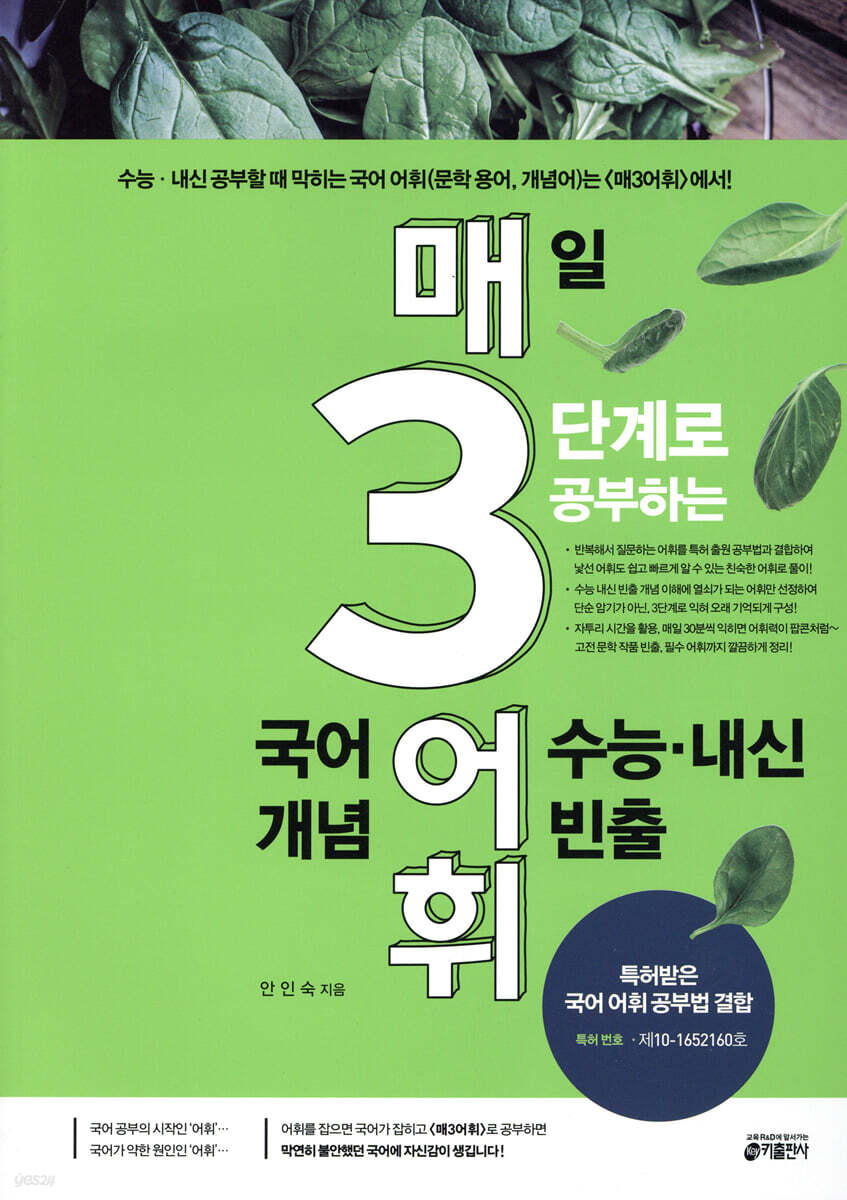
Daily 3-Step Study of Frequently Appearing Korean Vocabulary (Concepts) for the College Scholastic Ability Test and Internal Exams
 |
Description
Book Introduction
Unlike existing vocabulary dictionaries, 『Every 3 Vocabulary』 is a textbook organized to help you easily learn familiar vocabulary by recalling it. We avoid the study method of blindly memorizing the meaning of vocabulary, and instead structure it so that you can recall familiar vocabulary and learn it so that you can easily understand the meaning of unfamiliar vocabulary. Now, instead of just memorizing words, let's easily understand and apply the meaning of vocabulary using 'familiar vocabulary'! strict-origin-when-cross-origin" allowfullscreen> |
- You can preview some of the book's contents.
Preview
index
- Structure and features of 『Every 3 Vocabulary』
- Ten Commandments for Effectively Studying 『Every 3 Vocabulary』
- [Index] Quickly find frequently used Korean vocabulary (including Chinese character idioms)
[Part 1] Korean Vocabulary: Frequently Used Words
[Part 2] Korean Frequently Used Chinese Character Idioms
- Frequently occurring “proverbs” related to Chinese character idioms
[Appendix] Korean Frequently Used "Classical Vocabulary"
- Frequently used vocabulary in 'classical poetry'
- Frequently appearing vocabulary in 'classic novels'
- [Index] Quickly find frequently appearing Korean classical vocabulary
- Ten Commandments for Effectively Studying 『Every 3 Vocabulary』
- [Index] Quickly find frequently used Korean vocabulary (including Chinese character idioms)
[Part 1] Korean Vocabulary: Frequently Used Words
[Part 2] Korean Frequently Used Chinese Character Idioms
- Frequently occurring “proverbs” related to Chinese character idioms
[Appendix] Korean Frequently Used "Classical Vocabulary"
- Frequently used vocabulary in 'classical poetry'
- Frequently appearing vocabulary in 'classic novels'
- [Index] Quickly find frequently appearing Korean classical vocabulary
Detailed image

Publisher's Review
The key to solving vocabulary problems is not to memorize dictionary definitions, but to (1) extract the core meaning from the context, (2) think of a familiar word that can be used to infer the meaning of the word, and (3) substitute it with another word.
This '3-step vocabulary solution' helps you easily find the correct answer to questions asking about dictionary and contextual meanings of unfamiliar words.
With this in mind, I've categorized all the vocabulary that students frequently ask about or think they know but don't know the exact meaning of, which slows down their reading speed.
Then, we created a vocabulary database that could engrave the meaning of each word by breaking down the syllables that make up the word into pieces.
Using this, I applied for a patent for a ‘method for creating Chinese character learning materials using a database’ and a ‘Chinese character learning textbook’ composed of Chinese characters (patent application number 10-2014-0077772, 10-2014-0077776), and at the same time, I wrote ‘Every 3 Vocabulary’, which is learned in 3 stages every day.
Memorizing all dictionary definitions to learn the meaning of vocabulary is not only impossible, but it also does not last long and has limited applicability.
Therefore, unlike existing vocabulary dictionaries, 『Mae3 Vocabulary』 is structured to help you easily learn familiar vocabulary by recalling it.
In the case of the word 'parallel arrangement', rather than memorizing the dictionary definition (to place two or more things side by side in one place), it is better to think of 'to arrange in parallel' (병) and 'to arrange in parallel' (치) and learn it as 'to arrange in parallel'. This is because not only will it be remembered for a long time, but when you come across the word 'parallel use', you can apply it as 'to use in parallel'.
In this way, 『Every 3 Vocabulary』 avoids the study method of unconditionally memorizing the meaning of vocabulary, and instead allows students to recall familiar vocabulary and learn it so that they can easily understand the meaning of unfamiliar vocabulary.
It presents a fundamental solution for students who are weak in Korean.
For students who struggle with Korean compared to other subjects and often struggle to finish problems due to time constraints, vocabulary is a common enemy! Instead of memorizing vocabulary, let's use familiar vocabulary to easily understand and apply its meaning!
Structure and characteristics of each 3rd word
1.
Explanations using familiar vocabulary that makes it easy to learn even unfamiliar vocabulary!
2.
Rather than simple memorization, it is structured in 3 steps so that you can remember it for a long time!
3.
A selection of only the most frequently used vocabulary words you must know for the Korean language test!
4.
A vocabulary book that makes you study before using the dictionary function to look up vocabulary!
5.
Unlike the dictionary, it even includes college entrance exam terms (concept words) that are linked to vocabulary!
6.
Use your spare time to do 30 minutes a day and finish in 4 weeks!
7.
Learn familiar vocabulary in the explanations and improve your vocabulary by leaps and bounds!
8.
From frequently used vocabulary in classical literature to essential vocabulary, all at a glance!
This '3-step vocabulary solution' helps you easily find the correct answer to questions asking about dictionary and contextual meanings of unfamiliar words.
With this in mind, I've categorized all the vocabulary that students frequently ask about or think they know but don't know the exact meaning of, which slows down their reading speed.
Then, we created a vocabulary database that could engrave the meaning of each word by breaking down the syllables that make up the word into pieces.
Using this, I applied for a patent for a ‘method for creating Chinese character learning materials using a database’ and a ‘Chinese character learning textbook’ composed of Chinese characters (patent application number 10-2014-0077772, 10-2014-0077776), and at the same time, I wrote ‘Every 3 Vocabulary’, which is learned in 3 stages every day.
Memorizing all dictionary definitions to learn the meaning of vocabulary is not only impossible, but it also does not last long and has limited applicability.
Therefore, unlike existing vocabulary dictionaries, 『Mae3 Vocabulary』 is structured to help you easily learn familiar vocabulary by recalling it.
In the case of the word 'parallel arrangement', rather than memorizing the dictionary definition (to place two or more things side by side in one place), it is better to think of 'to arrange in parallel' (병) and 'to arrange in parallel' (치) and learn it as 'to arrange in parallel'. This is because not only will it be remembered for a long time, but when you come across the word 'parallel use', you can apply it as 'to use in parallel'.
In this way, 『Every 3 Vocabulary』 avoids the study method of unconditionally memorizing the meaning of vocabulary, and instead allows students to recall familiar vocabulary and learn it so that they can easily understand the meaning of unfamiliar vocabulary.
It presents a fundamental solution for students who are weak in Korean.
For students who struggle with Korean compared to other subjects and often struggle to finish problems due to time constraints, vocabulary is a common enemy! Instead of memorizing vocabulary, let's use familiar vocabulary to easily understand and apply its meaning!
Structure and characteristics of each 3rd word
1.
Explanations using familiar vocabulary that makes it easy to learn even unfamiliar vocabulary!
2.
Rather than simple memorization, it is structured in 3 steps so that you can remember it for a long time!
3.
A selection of only the most frequently used vocabulary words you must know for the Korean language test!
4.
A vocabulary book that makes you study before using the dictionary function to look up vocabulary!
5.
Unlike the dictionary, it even includes college entrance exam terms (concept words) that are linked to vocabulary!
6.
Use your spare time to do 30 minutes a day and finish in 4 weeks!
7.
Learn familiar vocabulary in the explanations and improve your vocabulary by leaps and bounds!
8.
From frequently used vocabulary in classical literature to essential vocabulary, all at a glance!
GOODS SPECIFICS
- Date of issue: July 10, 2014
- Page count, weight, size: 248 pages | 684g | 210*297*17mm
- ISBN13: 9788974578640
- ISBN10: 8974578646
- Reference book for use in grades: High school common
- Reference book usage semester: Common semester
- Reference book difficulty: Medium Reference book difficulty guide
You may also like
카테고리
korean


korean

![GQ KOREA Mark (Monthly): December [2025]](http://librairie.coreenne.fr/cdn/shop/files/8ef265dbbfbf186523ed75ba7319009d.jpg?v=1765340328&width=3840)


