

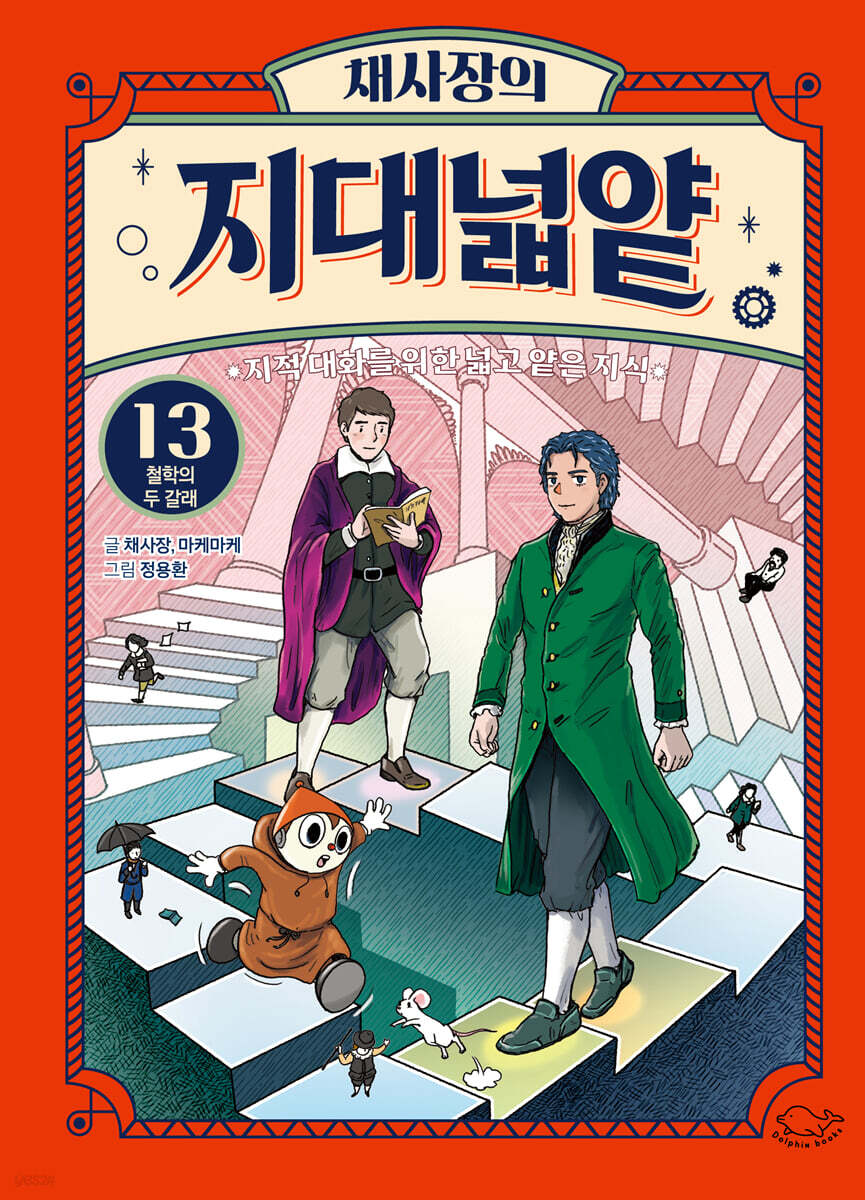
Cha Sa-jang's Wide and Shallow Land 13: The Two Branches of Philosophy
 |
Description
Book Introduction
An amazing reading experience that expands a child's thinking and nurtures their inner self.
A philosophical journey with President Chae
Understanding the pulse of philosophy that is difficult to grasp through textbooks
“A must-read for elementary school students recommended by education experts!”
“My child’s favorite book that makes you wait for the next volume while reading!”
“A book I confidently recommend to anyone I care about!”
Why do children need liberal arts? Author Chae Sa-jang explains that liberal arts is the humanities, or, simply put, "broad yet shallow knowledge."
It is not only basic knowledge that improves children's grades, but also knowledge that helps them understand themselves and the world they live in.
The question of whether children can understand 'me' and 'the world' was a groundless one.
Through the "Chae Sa-jang's Wide and Shallow Land" series, children gained knowledge that spread widely, and parents realized that these books were different from simple educational comics.
Both children and parents enjoy the joy of broadening their horizons and engaging in rich intellectual conversations.
Now our intellectual journey has passed through history, economics, politics, social ethics, and science, and has finally reached the core of philosophy.
Philosophy is the knowledge that expands the world the most.
To study well, to build good relationships, and to live well in reality, you must know the essence of humanity and life.
Philosophers have not stopped asking questions since ancient times.
'Who am I?' 'What is the world?' 'Where does truth lie?'
This persistent question may have been pushed aside by school and daily life, but it becomes even more urgent in these turbulent times.
In today's society, where complex political and social conditions, difficult economic situations, conflicts between humans and machines, the confusion of the real and the fake, and the life for show and the life that exists are intertwined, this becomes the most crucial question.
The more chaotic a society becomes, the more we need to think about the basics.
What questions should we ask and what answers should we pursue? What perspective should we have and how should we live? This is why philosophy is so crucial for children of this age.
A philosophical journey with President Chae
Understanding the pulse of philosophy that is difficult to grasp through textbooks
“A must-read for elementary school students recommended by education experts!”
“My child’s favorite book that makes you wait for the next volume while reading!”
“A book I confidently recommend to anyone I care about!”
Why do children need liberal arts? Author Chae Sa-jang explains that liberal arts is the humanities, or, simply put, "broad yet shallow knowledge."
It is not only basic knowledge that improves children's grades, but also knowledge that helps them understand themselves and the world they live in.
The question of whether children can understand 'me' and 'the world' was a groundless one.
Through the "Chae Sa-jang's Wide and Shallow Land" series, children gained knowledge that spread widely, and parents realized that these books were different from simple educational comics.
Both children and parents enjoy the joy of broadening their horizons and engaging in rich intellectual conversations.
Now our intellectual journey has passed through history, economics, politics, social ethics, and science, and has finally reached the core of philosophy.
Philosophy is the knowledge that expands the world the most.
To study well, to build good relationships, and to live well in reality, you must know the essence of humanity and life.
Philosophers have not stopped asking questions since ancient times.
'Who am I?' 'What is the world?' 'Where does truth lie?'
This persistent question may have been pushed aside by school and daily life, but it becomes even more urgent in these turbulent times.
In today's society, where complex political and social conditions, difficult economic situations, conflicts between humans and machines, the confusion of the real and the fake, and the life for show and the life that exists are intertwined, this becomes the most crucial question.
The more chaotic a society becomes, the more we need to think about the basics.
What questions should we ask and what answers should we pursue? What perspective should we have and how should we live? This is why philosophy is so crucial for children of this age.
- You can preview some of the book's contents.
Preview
index
Prologue Two Rays of Light
1.
Descartes' Dream
- Rationalism
[Chairman Cha's Key Notes] The dawn of modern times has dawned.
[Master's Report] The Philosopher Who Led Rationalism
[Break time] Find the different picture
2.
Breakfast with bacon
- Empiricism
[Chairman Cha's Key Notes] Knowledge is Power
[Master's Report] Philosophers Who Led Empiricism
[Break time] Induction and Deduction
3.
Kant's Special Class
- Idealism
[Chairman Cha's Key Notes] A Long-Run Debate Ends
[Master's Report] Kant's Life and Philosophy
[Break time] Hidden picture game
4.
God is dead
- Skepticism
[Cha Sa-jang's Key Notes] Nietzsche Criticizes Western Society
[Master's Report] What is Postmodernism?
[Break time] What if my day repeated forever?
5.
Sartre's Umbrella
- Existentialism
[Cha Sa-jang's Key Notes] Diverse and Colorful Ideologies and Thoughts
[Master's Report] Philosophers Who Led Modern Philosophy
[Break time] Crossword puzzle
Epilogue Now, here, in my life
Final Summary
Philosophy section summary
1.
Descartes' Dream
- Rationalism
[Chairman Cha's Key Notes] The dawn of modern times has dawned.
[Master's Report] The Philosopher Who Led Rationalism
[Break time] Find the different picture
2.
Breakfast with bacon
- Empiricism
[Chairman Cha's Key Notes] Knowledge is Power
[Master's Report] Philosophers Who Led Empiricism
[Break time] Induction and Deduction
3.
Kant's Special Class
- Idealism
[Chairman Cha's Key Notes] A Long-Run Debate Ends
[Master's Report] Kant's Life and Philosophy
[Break time] Hidden picture game
4.
God is dead
- Skepticism
[Cha Sa-jang's Key Notes] Nietzsche Criticizes Western Society
[Master's Report] What is Postmodernism?
[Break time] What if my day repeated forever?
5.
Sartre's Umbrella
- Existentialism
[Cha Sa-jang's Key Notes] Diverse and Colorful Ideologies and Thoughts
[Master's Report] Philosophers Who Led Modern Philosophy
[Break time] Crossword puzzle
Epilogue Now, here, in my life
Final Summary
Philosophy section summary
Detailed image

Publisher's Review
Now, here, the great teaching that protects me unfolds.
In times when the answer is not visible,
We need a compass to guide our lives.
The terminology of philosophy is unfamiliar and the process of thinking is complex.
It would be a difficult task for a child to understand in detail the deep thoughts and arguments of every philosopher.
However, it is quite possible for even elementary school students to grasp the vast stream of discourse.
Author Chae Sa-jang divides the perspectives on important truths in the history of philosophy into three major categories: absolutism, relativism, and skepticism.
To most easily understand the flow of Western philosophy, we must grasp the larger context centered on these three positions.
The dawn of modernity dawned with the Renaissance.
The age of reason has now begun.
As philosophers explored how to arrive at truth, rationalism, which emphasized rational reasoning, and empiricism, which prioritized experience and observation, developed.
In this way, the two major strands of philosophy complement each other while opposing each other.
Finally, Kant's idealism synthesizes rationalism and empiricism, settling a long and drawn-out debate.
In modern times, philosophy has taken on an aspect bordering on skepticism.
Nietzsche took up a hammer and sought to destroy the grand narratives deeply embedded in Western culture, while existentialists, including Sartre, sought to focus on the existence of human beings themselves, rather than reason or God.
The 21st century seems to be a time when diverse ideologies and ideas are respected.
However, on the other hand, modern people are forced into endless competition within uniform values, and thoughts that differ from others become the subject of conflict and exclusion.
While experiencing limitless technological advancements, we also feel powerless in the face of desire and power.
What children really need in the era they will live in may not be technology or theory, but a philosophical perspective.
Will humanity's reason and experience truly shine like a beacon during this time? I hope children will find the light that illuminates their future through their reading experiences.
An instant bestseller
Boy's Korea's Best Children's Book Selection
The Best Children's Humanities Books, Proven by Reader Reviews
We live in an age where more learning materials than ever are available through books and media.
Today's children take in a lot of information, but they may not have the time or energy to synthesize that knowledge and digest it into their own thoughts.
What we need more than anything is to connect the flow of knowledge and make it our own.
Speaking 'my thoughts' is not something that can be studied by memorization.
For children who need to understand hidden meanings and contexts and apply them to real life, this book will be an excellent teacher and discussion forum.
As important as knowledge is the power of thinking.
1.
Korea's first full-fledged humanities story comic for children!
It conveys only the core knowledge of the humanities and sciences in an easy and fun way, making the difficult and complex humanities easier to understand and connect into a single thread.
2.
Providing the 'real knowledge' needed to survive in the world.
It covers the things we learn in school, such as absolutism, relativism, skepticism, Aristotle's syllogism, rationalism, and empiricism, but also provides real knowledge that is not taught in school.
3.
A cultural comic format you've never seen before, 100% worth collecting!
Unlike previous educational comics, this one uses text and illustrations to provide not only fragmented information, but also fosters the ability to think independently and see the world through perspectives.
4.
Brain-stimulating stories + mind-stimulating knowledge
Through the story of the protagonist Alpha struggling to survive in the world with his whole body, you can experience a unique reading experience that is a story that awakens your mind and knowledge that touches your heart.
5.
A knowledge series that explains everything about the world and life.
The key is to see the forest! It helps children broaden their understanding of the world and provides wisdom beyond knowledge, teaching them how to live in the future.
How to read this book
1.
If you follow the main character's steps in the story, you can understand the flow of information.
2.
Let's find out whether the philosophical ideas I learned fall under absolutism, relativism, or skepticism.
3.
Find the key words of philosophy in [Chairman Cha's Key Notes].
4.
Let's connect the knowledge that you are curious about by looking at [Master's Report].
5.
It's more fun to summarize a book briefly in [Final Summary] and discuss it with people around you.
# Appendix [Chronology of Philosophy]
Get a glimpse into the flow of philosophy that has continued alongside the history of mankind!
In times when the answer is not visible,
We need a compass to guide our lives.
The terminology of philosophy is unfamiliar and the process of thinking is complex.
It would be a difficult task for a child to understand in detail the deep thoughts and arguments of every philosopher.
However, it is quite possible for even elementary school students to grasp the vast stream of discourse.
Author Chae Sa-jang divides the perspectives on important truths in the history of philosophy into three major categories: absolutism, relativism, and skepticism.
To most easily understand the flow of Western philosophy, we must grasp the larger context centered on these three positions.
The dawn of modernity dawned with the Renaissance.
The age of reason has now begun.
As philosophers explored how to arrive at truth, rationalism, which emphasized rational reasoning, and empiricism, which prioritized experience and observation, developed.
In this way, the two major strands of philosophy complement each other while opposing each other.
Finally, Kant's idealism synthesizes rationalism and empiricism, settling a long and drawn-out debate.
In modern times, philosophy has taken on an aspect bordering on skepticism.
Nietzsche took up a hammer and sought to destroy the grand narratives deeply embedded in Western culture, while existentialists, including Sartre, sought to focus on the existence of human beings themselves, rather than reason or God.
The 21st century seems to be a time when diverse ideologies and ideas are respected.
However, on the other hand, modern people are forced into endless competition within uniform values, and thoughts that differ from others become the subject of conflict and exclusion.
While experiencing limitless technological advancements, we also feel powerless in the face of desire and power.
What children really need in the era they will live in may not be technology or theory, but a philosophical perspective.
Will humanity's reason and experience truly shine like a beacon during this time? I hope children will find the light that illuminates their future through their reading experiences.
An instant bestseller
Boy's Korea's Best Children's Book Selection
The Best Children's Humanities Books, Proven by Reader Reviews
We live in an age where more learning materials than ever are available through books and media.
Today's children take in a lot of information, but they may not have the time or energy to synthesize that knowledge and digest it into their own thoughts.
What we need more than anything is to connect the flow of knowledge and make it our own.
Speaking 'my thoughts' is not something that can be studied by memorization.
For children who need to understand hidden meanings and contexts and apply them to real life, this book will be an excellent teacher and discussion forum.
As important as knowledge is the power of thinking.
1.
Korea's first full-fledged humanities story comic for children!
It conveys only the core knowledge of the humanities and sciences in an easy and fun way, making the difficult and complex humanities easier to understand and connect into a single thread.
2.
Providing the 'real knowledge' needed to survive in the world.
It covers the things we learn in school, such as absolutism, relativism, skepticism, Aristotle's syllogism, rationalism, and empiricism, but also provides real knowledge that is not taught in school.
3.
A cultural comic format you've never seen before, 100% worth collecting!
Unlike previous educational comics, this one uses text and illustrations to provide not only fragmented information, but also fosters the ability to think independently and see the world through perspectives.
4.
Brain-stimulating stories + mind-stimulating knowledge
Through the story of the protagonist Alpha struggling to survive in the world with his whole body, you can experience a unique reading experience that is a story that awakens your mind and knowledge that touches your heart.
5.
A knowledge series that explains everything about the world and life.
The key is to see the forest! It helps children broaden their understanding of the world and provides wisdom beyond knowledge, teaching them how to live in the future.
How to read this book
1.
If you follow the main character's steps in the story, you can understand the flow of information.
2.
Let's find out whether the philosophical ideas I learned fall under absolutism, relativism, or skepticism.
3.
Find the key words of philosophy in [Chairman Cha's Key Notes].
4.
Let's connect the knowledge that you are curious about by looking at [Master's Report].
5.
It's more fun to summarize a book briefly in [Final Summary] and discuss it with people around you.
# Appendix [Chronology of Philosophy]
Get a glimpse into the flow of philosophy that has continued alongside the history of mankind!
GOODS SPECIFICS
- Date of issue: April 30, 2025
- Page count, weight, size: 164 pages | 153*210*20mm
- ISBN13: 9791193487211
- ISBN10: 1193487218
- KC Certification: Certification Type: Conformity Confirmation
You may also like
카테고리
korean


korean

![GQ KOREA Mark (Monthly): December [2025]](http://librairie.coreenne.fr/cdn/shop/files/8ef265dbbfbf186523ed75ba7319009d.jpg?v=1765340328&width=3840)


