

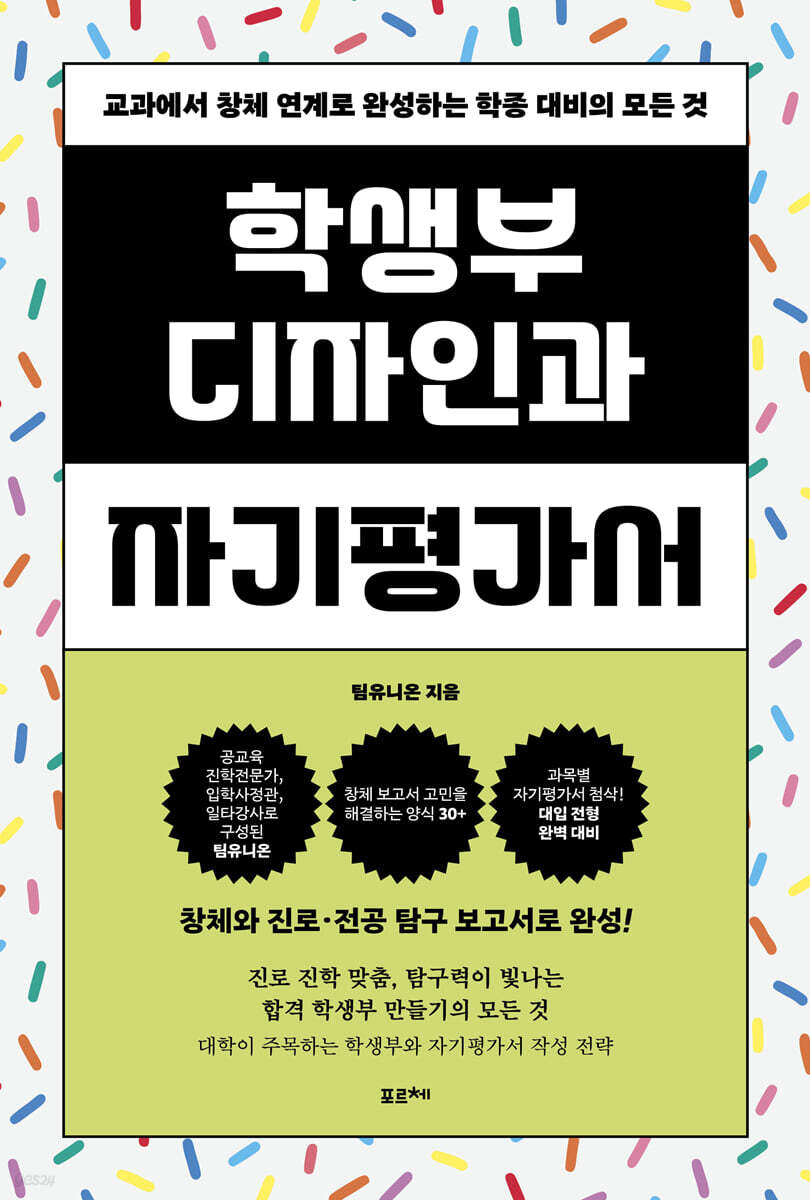
Student Department Design and Self-Evaluation
 |
Description
Book Introduction
The key to college admissions in 2028: Student portfolio design that will lead to acceptance!
From student portfolio design strategies selected by universities to writing self-evaluations tailored to university advancement.
A roadmap for admission to prestigious universities, suggested by admissions experts Team Union.
Students stay up late at night worrying about their performance and self-evaluations, and their parents worry alongside them.
To address these concerns, this book guides both students and parents to clearly understand the college admissions process and strategically prepare for school life.
It provides specific, practical examples, including admission strategies for each type of school, understanding the criteria for school type evaluation, how to cultivate inquiry skills through topic exploration and reading, and even how to design student records and write self-evaluations.
Starting with the 2028 school year, the importance of the student record (school life record) will increase.
In college admissions, where simple performance-based evaluations such as awards and certificates have disappeared, self-directed exploration, the context of activities, and the growth process have become core evaluation criteria.
In reality, the proportion of comprehensive student records (Hakjong) is increasing, especially in top universities, and the reflection of student records in regular admissions is also strengthening.
This book provides concrete strategies to help students design their own activities to adapt to these changes and effectively demonstrate their career paths and capabilities.
It includes case studies and report writing methods that can be applied directly to actual school settings, such as creative writing, special features, and career activities, and details practical know-how, such as tips for writing subject-specific self-evaluations, how to use key keywords for student record design, and examples before and after revision.
From student portfolio design strategies selected by universities to writing self-evaluations tailored to university advancement.
A roadmap for admission to prestigious universities, suggested by admissions experts Team Union.
Students stay up late at night worrying about their performance and self-evaluations, and their parents worry alongside them.
To address these concerns, this book guides both students and parents to clearly understand the college admissions process and strategically prepare for school life.
It provides specific, practical examples, including admission strategies for each type of school, understanding the criteria for school type evaluation, how to cultivate inquiry skills through topic exploration and reading, and even how to design student records and write self-evaluations.
Starting with the 2028 school year, the importance of the student record (school life record) will increase.
In college admissions, where simple performance-based evaluations such as awards and certificates have disappeared, self-directed exploration, the context of activities, and the growth process have become core evaluation criteria.
In reality, the proportion of comprehensive student records (Hakjong) is increasing, especially in top universities, and the reflection of student records in regular admissions is also strengthening.
This book provides concrete strategies to help students design their own activities to adapt to these changes and effectively demonstrate their career paths and capabilities.
It includes case studies and report writing methods that can be applied directly to actual school settings, such as creative writing, special features, and career activities, and details practical know-how, such as tips for writing subject-specific self-evaluations, how to use key keywords for student record design, and examples before and after revision.
- You can preview some of the book's contents.
Preview
index
prolog
1.
Perspectives on Curriculum and Student Assessment
What kind of students do universities want?
Student portfolio design determines college admissions.
How to design activities
2.
How to Use the Career-Advancement Program
Creative experiential activity program
Subject-specific tax programs
3.
Student Department Design and Build-up
Counting the Abilities in Your Student Profile with the Major Guidebook
Building your student portfolio based on the college guidebook
4.
Key Strategies for Self-Assessment
Basic principles for writing a self-evaluation
Essential Keyword Strategies for Self-Evaluation Forms
Points to check when writing a self-evaluation form
Tips for Writing Subject-Specific Self-Evaluation Forms
5.
Examples of writing and revising self-evaluations by subject
Korean: Writing and revising a self-evaluation form
Writing and Editing a Self-Evaluation
Mathematics: Writing and Revising a Self-Assessment
Society: Writing and Editing a Self-Evaluation
Science: Writing and Revising a Self-Assessment
1.
Perspectives on Curriculum and Student Assessment
What kind of students do universities want?
Student portfolio design determines college admissions.
How to design activities
2.
How to Use the Career-Advancement Program
Creative experiential activity program
Subject-specific tax programs
3.
Student Department Design and Build-up
Counting the Abilities in Your Student Profile with the Major Guidebook
Building your student portfolio based on the college guidebook
4.
Key Strategies for Self-Assessment
Basic principles for writing a self-evaluation
Essential Keyword Strategies for Self-Evaluation Forms
Points to check when writing a self-evaluation form
Tips for Writing Subject-Specific Self-Evaluation Forms
5.
Examples of writing and revising self-evaluations by subject
Korean: Writing and revising a self-evaluation form
Writing and Editing a Self-Evaluation
Mathematics: Writing and Revising a Self-Assessment
Society: Writing and Editing a Self-Evaluation
Science: Writing and Revising a Self-Assessment
Detailed image

Into the book
The process itself of specifying the question about the research topic and pushing it to the end is becoming the center of evaluation.
In addition, learning attitude, sincerity, and participation are evaluated as equally important as inquiry activities related to classes.
Students and parents must first understand these evaluation criteria so they can develop practical strategies accordingly.
--- p.7, from "Prologue"
What we recommend is to include 2-3 activity items per 500 characters.
Thinking about it this way, it determines to some extent the number of important activities I must do from a student department design perspective.
If you diligently attend school, your special abilities and special skills will be naturally filled in through performance evaluations.
Ultimately, four or five research papers per year from the creative body are sufficient for students to ponder on topics that they are interested in.
--- p.21, from “Student Department Design Determines College Admissions”
The end of the exploration of the major department lies in reflecting on one's current self and making plans.
By exploring various majors, you should examine whether you have the level and ability to enter them, and if not, reflect on what efforts you should make.
It would also be a good idea to make a macro-level plan for graduating from high school.
Rather than limiting it to academic studies, it's also a great idea to write a report that fits your career path or participate in a camp organized by your school.
--- p.64, from “Creative Experience Activity Program”
When designing a student portfolio, subject-based in-depth exploration activities can be utilized as described above.
While students cannot plan their own performance assessments, some subjects may allow students to design additional activity reports themselves.
In addition to the follow-up activities in the curriculum, students can design follow-up activities that lead to creativity.
As mentioned above, the core of design is to link, expand, and deepen activities in the curriculum.
--- p.70, from “Special Programs by Subject”
The reason why you must use the major guidebook in particular is because it clearly states what kind of students the university and department are trying to select when applying.
I applied to a biotechnology program because I wanted to become a researcher who develops new drug treatments, but that university might not have a curriculum related to new drug treatments at all.
Then is there any reason to select that student?
--- p.319, from “Counting the Abilities in Your Student Profile with a Major Guidebook”
It is not desirable for students to describe themselves as having “excellent scientific thinking skills” or “excellent humanistic imagination” in their self-evaluation forms.
Rather than simply evaluating themselves as excellent, students should demonstrate their efforts by including essential keywords such as "I tried to think creatively" and "I was able to develop my knowledge information processing skills" through a certain process.
In addition, learning attitude, sincerity, and participation are evaluated as equally important as inquiry activities related to classes.
Students and parents must first understand these evaluation criteria so they can develop practical strategies accordingly.
--- p.7, from "Prologue"
What we recommend is to include 2-3 activity items per 500 characters.
Thinking about it this way, it determines to some extent the number of important activities I must do from a student department design perspective.
If you diligently attend school, your special abilities and special skills will be naturally filled in through performance evaluations.
Ultimately, four or five research papers per year from the creative body are sufficient for students to ponder on topics that they are interested in.
--- p.21, from “Student Department Design Determines College Admissions”
The end of the exploration of the major department lies in reflecting on one's current self and making plans.
By exploring various majors, you should examine whether you have the level and ability to enter them, and if not, reflect on what efforts you should make.
It would also be a good idea to make a macro-level plan for graduating from high school.
Rather than limiting it to academic studies, it's also a great idea to write a report that fits your career path or participate in a camp organized by your school.
--- p.64, from “Creative Experience Activity Program”
When designing a student portfolio, subject-based in-depth exploration activities can be utilized as described above.
While students cannot plan their own performance assessments, some subjects may allow students to design additional activity reports themselves.
In addition to the follow-up activities in the curriculum, students can design follow-up activities that lead to creativity.
As mentioned above, the core of design is to link, expand, and deepen activities in the curriculum.
--- p.70, from “Special Programs by Subject”
The reason why you must use the major guidebook in particular is because it clearly states what kind of students the university and department are trying to select when applying.
I applied to a biotechnology program because I wanted to become a researcher who develops new drug treatments, but that university might not have a curriculum related to new drug treatments at all.
Then is there any reason to select that student?
--- p.319, from “Counting the Abilities in Your Student Profile with a Major Guidebook”
It is not desirable for students to describe themselves as having “excellent scientific thinking skills” or “excellent humanistic imagination” in their self-evaluation forms.
Rather than simply evaluating themselves as excellent, students should demonstrate their efforts by including essential keywords such as "I tried to think creatively" and "I was able to develop my knowledge information processing skills" through a certain process.
--- p.351, from “Essential Keyword Strategies for Self-Evaluation Forms”
Publisher's Review
Creative activities and subject-specific special design that attract the attention of top universities!
Everything you need to know about creating a perfect career-focused student portfolio, starting from the first year of high school.
Depth and connectivity, rather than quantity of activity, are now the key to evaluation.
Activities that are fragmentary or unrelated to one's career path or major, or expressions that make it difficult to find communication and cooperation, are likely to be seen as activities without context from the evaluator's perspective.
If the selection process includes an interview, it becomes difficult to answer the questions properly.
This is because questions are asked based on the content written in the student record.
Therefore, the student record should show evidence of proactive planning of career path and capabilities.
This book guides you through practical examples, formats, and sentence structures on how to organize practical items such as autonomous activities, clubs, special activities, and career activities.
In particular, practicality has been increased by adding activities and report forms that can be implemented within schools.
It includes practical templates for team-based inquiry activities, small group projects, and inquiry reports, empowering students to design and implement their own activities.
Universities focus on academics, career paths, and community capacity.
A Guide to Writing a Self-Evaluation to Turn Your Extracurricular Activities into Your Strengths
The best college entrance consulting in one book!
Self-evaluations are a key document that captures your learning, exploration, and growth experiences in class.
However, in reality, most students often end up with vague expressions such as 'I worked hard' or 'It was a good experience.'
Only by transforming these sentiment-based expressions into structured "competency keywords" can students fully demonstrate their competitiveness and strengths.
To do this, we need to add strategies so that university evaluators can empathize with what students learned in class, the process of inquiry, and the changes and growth they achieved as individuals.
This method is guided through real-world examples and comparisons before and after modifications.
It also includes useful sentence templates that reflect assessment keywords that should be used differently for each subject, such as thinking and expressive skills for Korean, problem-solving and reasoning skills for mathematics, and integrated analysis for social studies.
If you read and work on this book along with Team Union's "Absolute Principle for Successful Student Records: Exploration," you will be able to further develop the power to design your own high school life.
Let's cultivate the ability to transform all subject activities into effective narratives so that evaluators can fully understand students' strengths.
In the changing college admissions environment, it is ultimately the ‘prepared students’ who survive.
Let's not waste time in despair anymore.
If you prepare strategically to meet the evaluation criteria, you can create a sufficiently competitive student portfolio.
If you prepare step by step from now on, the results will definitely follow.
Everything you need to know about creating a perfect career-focused student portfolio, starting from the first year of high school.
Depth and connectivity, rather than quantity of activity, are now the key to evaluation.
Activities that are fragmentary or unrelated to one's career path or major, or expressions that make it difficult to find communication and cooperation, are likely to be seen as activities without context from the evaluator's perspective.
If the selection process includes an interview, it becomes difficult to answer the questions properly.
This is because questions are asked based on the content written in the student record.
Therefore, the student record should show evidence of proactive planning of career path and capabilities.
This book guides you through practical examples, formats, and sentence structures on how to organize practical items such as autonomous activities, clubs, special activities, and career activities.
In particular, practicality has been increased by adding activities and report forms that can be implemented within schools.
It includes practical templates for team-based inquiry activities, small group projects, and inquiry reports, empowering students to design and implement their own activities.
Universities focus on academics, career paths, and community capacity.
A Guide to Writing a Self-Evaluation to Turn Your Extracurricular Activities into Your Strengths
The best college entrance consulting in one book!
Self-evaluations are a key document that captures your learning, exploration, and growth experiences in class.
However, in reality, most students often end up with vague expressions such as 'I worked hard' or 'It was a good experience.'
Only by transforming these sentiment-based expressions into structured "competency keywords" can students fully demonstrate their competitiveness and strengths.
To do this, we need to add strategies so that university evaluators can empathize with what students learned in class, the process of inquiry, and the changes and growth they achieved as individuals.
This method is guided through real-world examples and comparisons before and after modifications.
It also includes useful sentence templates that reflect assessment keywords that should be used differently for each subject, such as thinking and expressive skills for Korean, problem-solving and reasoning skills for mathematics, and integrated analysis for social studies.
If you read and work on this book along with Team Union's "Absolute Principle for Successful Student Records: Exploration," you will be able to further develop the power to design your own high school life.
Let's cultivate the ability to transform all subject activities into effective narratives so that evaluators can fully understand students' strengths.
In the changing college admissions environment, it is ultimately the ‘prepared students’ who survive.
Let's not waste time in despair anymore.
If you prepare strategically to meet the evaluation criteria, you can create a sufficiently competitive student portfolio.
If you prepare step by step from now on, the results will definitely follow.
GOODS SPECIFICS
- Date of issue: July 16, 2025
- Page count, weight, size: 452 pages | 776g | 152*225*28mm
- ISBN13: 9791194634348
- ISBN10: 1194634346
You may also like
카테고리
korean


korean

![GQ KOREA Mark (Monthly): December [2025]](http://librairie.coreenne.fr/cdn/shop/files/8ef265dbbfbf186523ed75ba7319009d.jpg?v=1765340328&width=3840)


