

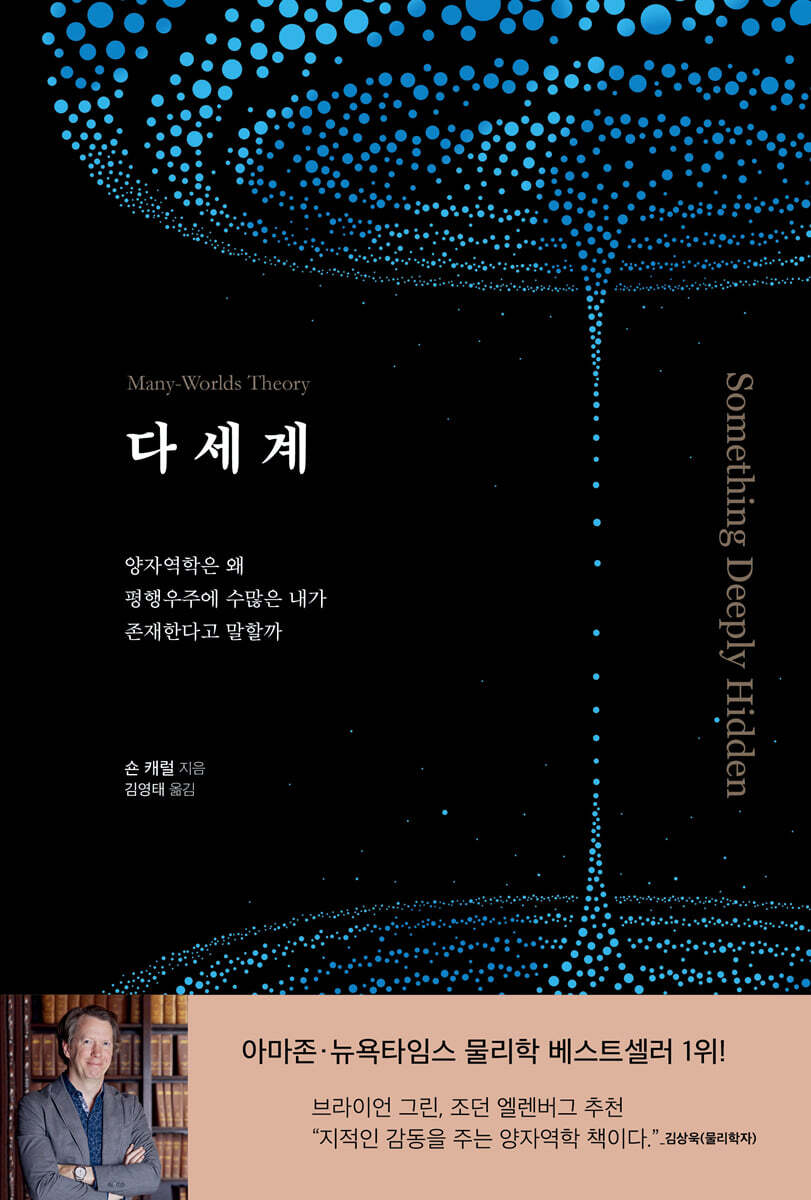
Multiverse
 |
Description
Book Introduction
Recommended by Brian Greene and Jordan Ellenberg
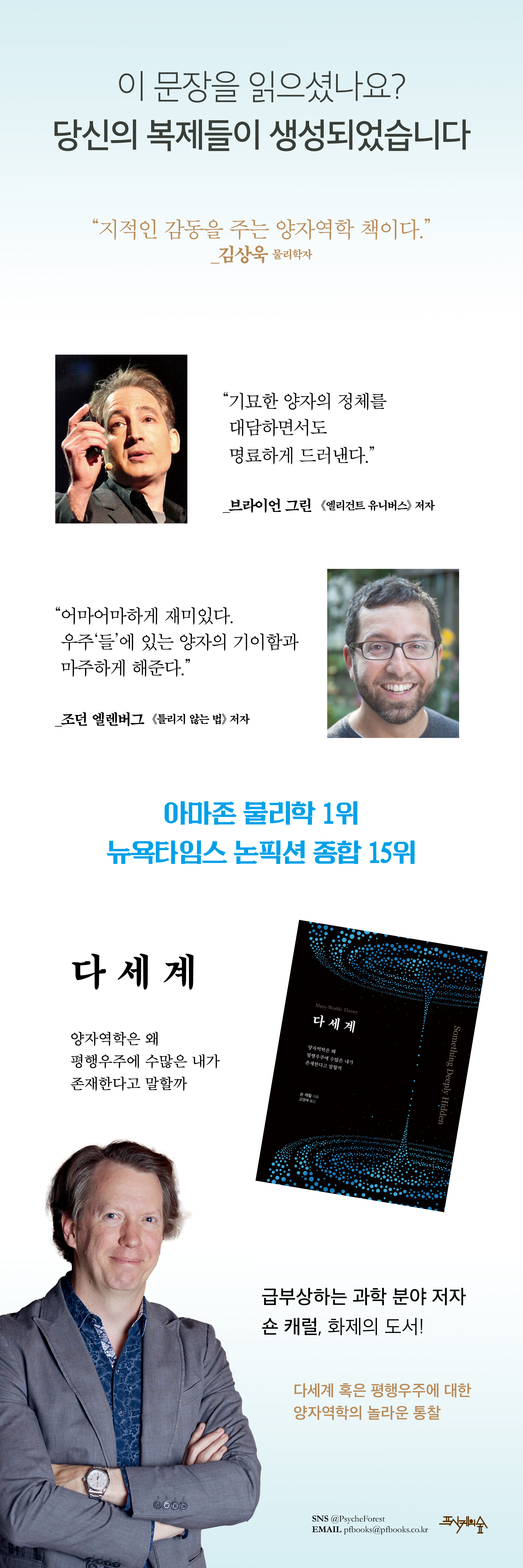
"A book on quantum mechanics that provides intellectual inspiration." - Kim Sang-wook (physicist)
About multiverses or parallel universes
Amazing insights from quantum mechanics
Sean Carroll's "Many Worlds" has been published, surprising the American bestseller charts.
Unusually for a classic science book on quantum mechanics, it ranked 15th in the New York Times' "Non-Fiction" section and 1st in Amazon's "Science" section immediately after its publication, and continues to receive widespread support from science readers.
Praised by authors such as Brian Greene and Jordan Ellenberg, this book rivals Carlo Rovelli's work and opens up a new horizon for quantum mechanics.
In this book, author Sean Carroll approaches quantum mechanics from a completely new perspective, particularly through the 'many-worlds theory'.
According to him, the world we live in is not unique, and different worlds are replicated and come into existence at every moment.
The so-called parallel universes are firmly supported by many-world quantum mechanics.
This book precisely attacks the points that mainstream quantum mechanics has arbitrarily made, and easily overcomes the traditional difficulties of quantum mechanics through many-worlds theory.
In the process, readers will be able to see almost everything surrounding quantum mechanics, from its history and present to its bold theories.
This is an “intellectually moving quantum mechanics book” by one of the most promising science authors of our time (recommended by physicist Sang-wook Kim).
"A book on quantum mechanics that provides intellectual inspiration." - Kim Sang-wook (physicist)
About multiverses or parallel universes
Amazing insights from quantum mechanics
Sean Carroll's "Many Worlds" has been published, surprising the American bestseller charts.
Unusually for a classic science book on quantum mechanics, it ranked 15th in the New York Times' "Non-Fiction" section and 1st in Amazon's "Science" section immediately after its publication, and continues to receive widespread support from science readers.
Praised by authors such as Brian Greene and Jordan Ellenberg, this book rivals Carlo Rovelli's work and opens up a new horizon for quantum mechanics.
In this book, author Sean Carroll approaches quantum mechanics from a completely new perspective, particularly through the 'many-worlds theory'.
According to him, the world we live in is not unique, and different worlds are replicated and come into existence at every moment.
The so-called parallel universes are firmly supported by many-world quantum mechanics.
This book precisely attacks the points that mainstream quantum mechanics has arbitrarily made, and easily overcomes the traditional difficulties of quantum mechanics through many-worlds theory.
In the process, readers will be able to see almost everything surrounding quantum mechanics, from its history and present to its bold theories.
This is an “intellectually moving quantum mechanics book” by one of the most promising science authors of our time (recommended by physicist Sang-wook Kim).
- You can preview some of the book's contents.
Preview
index
Prologue: Don't Be Afraid
Part 1: Bizarre
Chapter 1 What's Going On?
Chapter 2: The Brave Theory
Chapter 3 Why do you think this?
Chapter 4: What We Cannot Know Because It Doesn't Exist
Chapter 5 I hate entanglement
Part 2 split
Chapter 6: The Splitting of the Universe
Chapter 7: Order and Disorder
Chapter 8: Will Ontological Commitments Make Me Look Fat?
Chapter 9 Other Methods
Chapter 10: The Human Aspect
Part 3: Space and Time
Chapter 11: Why does space exist?
Chapter 12: The World of Vibration
Chapter 13: Breathing in a Vacuum
Chapter 14 Beyond Space and Time
Epilogue: Everything is Quantum
Appendix: The Story of Virtual Particles
Acknowledgements
Translator's Note
Read more
References
Search
Part 1: Bizarre
Chapter 1 What's Going On?
Chapter 2: The Brave Theory
Chapter 3 Why do you think this?
Chapter 4: What We Cannot Know Because It Doesn't Exist
Chapter 5 I hate entanglement
Part 2 split
Chapter 6: The Splitting of the Universe
Chapter 7: Order and Disorder
Chapter 8: Will Ontological Commitments Make Me Look Fat?
Chapter 9 Other Methods
Chapter 10: The Human Aspect
Part 3: Space and Time
Chapter 11: Why does space exist?
Chapter 12: The World of Vibration
Chapter 13: Breathing in a Vacuum
Chapter 14 Beyond Space and Time
Epilogue: Everything is Quantum
Appendix: The Story of Virtual Particles
Acknowledgements
Translator's Note
Read more
References
Search
Detailed image
Into the book
Quantum mechanics is like a recipe that can only be safely used in certain prescribed circumstances.
The predictions were surprisingly accurate, and the experimental data proved this, leading to victory.
But if you dig deeper and ask why, there is no answer.
--- p.9
Physicist David Mermin summarized the attitude toward teaching young students in modern quantum mechanics textbooks simply:
“Shut up and do the math!” Whatever one’s stance on the foundations of quantum mechanics, all decent physicists spend a lot of time doing the math.
So, if we were to shorten Mermin's admonition, it would be "Shut up!"
--- p.35
The public knows that Einstein lost the Bohr-Einstein debate.
We know that Einstein, who was a creative rebel in his youth, became conservative in his old age and was unable to accept or even understand the new quantum theory.
The above is completely untrue.
Einstein was right when he argued that physics needed to do more than just "shut up and do math."
The idea that Einstein did not understand quantum mechanics is a very wrong idea.
--- p.40
A way to break away from classical thinking is to abandon the idea that electrons exist in specific locations.
Since electrons are in a state where all positions are superimposed, they are not in a specific position until you actually observe them being there.
In quantum terms, the only thing that actually exists is the wave function.
Classical position and velocity are merely physical quantities that can be observed when exploring the wave function.
--- p.44
If atoms follow the rules of quantum mechanics and cameras are made of atoms, then cameras should also follow the rules of quantum mechanics.
If that's the case, then you and I too must follow the rules of quantum mechanics.
It is right to assume that we are quantum from head to toe.
--- p.46
What is described as an extremely concise version of quantum mechanics is often called the 'Everett-world' or 'many-worlds' quantum theory, after Hugh Everett, who first proposed it in 1957.
Everett's theory proposed that there is only one type of quantum evolution.
In exchange for this vast increase in the theory's elegance, we simply have to accept that it describes numerous replicating 'universes'.
Although each universe is slightly different, each universe actually exists in some sense.
--- p.50
The most surprising implication contained in pure Everett quantum mechanics is the existence of many worlds.
But it also has the corresponding advantage of clarity and insight.
Ultimately, as we will see when we turn to quantum field theory and quantum gravity, freeing ourselves from the burden of so-called classical experience and placing the wave function at the center of things as it should be is of immense help when grappling with the profound problems of modern physics.
--- p.52
Heisenberg's matrix mechanics was impressive, but it suffered from what was called a marketing problem.
The mathematics involved was too abstract and difficult to understand.
Einstein's reaction to matrix mechanics was representative.
“It must have been calculated by the wizard.
“This theory is very ingenious, but it is protected by great complexity, making it difficult to prove wrong.” (This is what the man who described spacetime with non-Euclidean geometry said.)
--- p.75
Good equations have a significant impact on physicists.
It elevates a very good idea into a rigid and unforgiving theoretical framework.
Intolerance may sound like a bad trait to an individual, but in scientific theory, the more intolerant you are, the better.
Because it is an attribute that enables accurate predictions.
--- p.79
You know who hated interpreting the results of the Schrödinger equation in terms of probabilities? It was Schrödinger himself.
“I hate this equation.
“I regret being involved in this,” he complained.
The point of the famous 'Schrödinger's cat' thought experiment wasn't to say, "Wow, quantum mechanics is so mysterious."
Actually, I was going to say, “Wow, quantum mechanics probably can’t be right.”
--- p.83
The police stopped Werner Heisenberg for speeding.
“Do you know how much you were speeding?” the police officer asked.
“No,” Heisenberg answered.
“But I know exactly where I am.”
--- p.87
The uncertainty principle is not a statement about the limits of our knowledge about systems.
We can know the quantum state exactly, and that's all we need to know.
Given the wave function, thinking that “there is something we don’t know about” is just an outdated relic of our instinctive assertion that what we observe is real.
--- p.92
The wave function splits through decoherence, splitting one world into two, and I, who was once one person, become two people.
It is meaningless to ask who is the 'real me'.
Likewise, it is meaningless to try to know which branch the 'I' will be on before the branching occurs.
Both people have the right to think of themselves as 'me'.
--- p.170
Imagine a lethal device that operates on quantum measurements.
Let's assume that quantum measurements give a 50 percent chance of a bullet being fired at close range into the head, and a 50 percent chance of not being fired.
According to many-worlds theory, there are two branches of the wave function.
People on one side live and people on the other side die.
In a sense, even if I keep repeating this eerie process, 'I' can live forever.
--- p.259
Quantum mechanics has nothing to do with free will.
It's natural to think that the two might be related.
This is because free will is often contrasted with determinism, which holds that the future is completely determined by the present state of the universe.
In textbook quantum mechanics, measurement results are truly random and therefore not deterministic.
Could quantum mechanics open a loophole for free will to sneak in? But this idea is gravely mistaken.
I don't even know where to start discussing this.
--- p.271
To understand this answer, it's helpful to turn to an old thought experiment: Schrödinger's cat.
A sealed box contains a cat and a container of sleeping gas.
Although Schrödinger's original script called for poison ("I think it was because my father hated cats," Schrödinger's daughter Ruth recalled), there was no need to kill the cat.
--- p.301
Actually, it is possible.
It is possible to literally transform the quantum state of the entire universe into any state by poking the quantum field in a small region of space.
Technically, this result is called the Reh-Schlieder theorem, but it is also called the Taj Mahal theorem.
This designation suggests that one could conduct an experiment without leaving one's room and suddenly obtain the result that a replica of the Taj Mahal would appear on the moon.
--- p.328
The idea that spacetime is a fundamental physical quantity is a very wrong idea.
Space-time is nothing more than an object with geometric shapes.
The world is a quantum state evolving in Hilbert space, and physical space emerges from this state.
--- p.380
Most recent advances in our understanding of quantum theory have been directly or indirectly driven by technological innovation.
Examples include quantum computing, quantum cryptography, and even quantum information.
We have now reached a point where it is no longer possible to draw a clear line between the quantum and classical realms.
Everything is quantum.
This situation forces physicists to take the foundations of quantum mechanics more seriously, and leads them to new insights that may help explain the emergence of space and time themselves.
The predictions were surprisingly accurate, and the experimental data proved this, leading to victory.
But if you dig deeper and ask why, there is no answer.
--- p.9
Physicist David Mermin summarized the attitude toward teaching young students in modern quantum mechanics textbooks simply:
“Shut up and do the math!” Whatever one’s stance on the foundations of quantum mechanics, all decent physicists spend a lot of time doing the math.
So, if we were to shorten Mermin's admonition, it would be "Shut up!"
--- p.35
The public knows that Einstein lost the Bohr-Einstein debate.
We know that Einstein, who was a creative rebel in his youth, became conservative in his old age and was unable to accept or even understand the new quantum theory.
The above is completely untrue.
Einstein was right when he argued that physics needed to do more than just "shut up and do math."
The idea that Einstein did not understand quantum mechanics is a very wrong idea.
--- p.40
A way to break away from classical thinking is to abandon the idea that electrons exist in specific locations.
Since electrons are in a state where all positions are superimposed, they are not in a specific position until you actually observe them being there.
In quantum terms, the only thing that actually exists is the wave function.
Classical position and velocity are merely physical quantities that can be observed when exploring the wave function.
--- p.44
If atoms follow the rules of quantum mechanics and cameras are made of atoms, then cameras should also follow the rules of quantum mechanics.
If that's the case, then you and I too must follow the rules of quantum mechanics.
It is right to assume that we are quantum from head to toe.
--- p.46
What is described as an extremely concise version of quantum mechanics is often called the 'Everett-world' or 'many-worlds' quantum theory, after Hugh Everett, who first proposed it in 1957.
Everett's theory proposed that there is only one type of quantum evolution.
In exchange for this vast increase in the theory's elegance, we simply have to accept that it describes numerous replicating 'universes'.
Although each universe is slightly different, each universe actually exists in some sense.
--- p.50
The most surprising implication contained in pure Everett quantum mechanics is the existence of many worlds.
But it also has the corresponding advantage of clarity and insight.
Ultimately, as we will see when we turn to quantum field theory and quantum gravity, freeing ourselves from the burden of so-called classical experience and placing the wave function at the center of things as it should be is of immense help when grappling with the profound problems of modern physics.
--- p.52
Heisenberg's matrix mechanics was impressive, but it suffered from what was called a marketing problem.
The mathematics involved was too abstract and difficult to understand.
Einstein's reaction to matrix mechanics was representative.
“It must have been calculated by the wizard.
“This theory is very ingenious, but it is protected by great complexity, making it difficult to prove wrong.” (This is what the man who described spacetime with non-Euclidean geometry said.)
--- p.75
Good equations have a significant impact on physicists.
It elevates a very good idea into a rigid and unforgiving theoretical framework.
Intolerance may sound like a bad trait to an individual, but in scientific theory, the more intolerant you are, the better.
Because it is an attribute that enables accurate predictions.
--- p.79
You know who hated interpreting the results of the Schrödinger equation in terms of probabilities? It was Schrödinger himself.
“I hate this equation.
“I regret being involved in this,” he complained.
The point of the famous 'Schrödinger's cat' thought experiment wasn't to say, "Wow, quantum mechanics is so mysterious."
Actually, I was going to say, “Wow, quantum mechanics probably can’t be right.”
--- p.83
The police stopped Werner Heisenberg for speeding.
“Do you know how much you were speeding?” the police officer asked.
“No,” Heisenberg answered.
“But I know exactly where I am.”
--- p.87
The uncertainty principle is not a statement about the limits of our knowledge about systems.
We can know the quantum state exactly, and that's all we need to know.
Given the wave function, thinking that “there is something we don’t know about” is just an outdated relic of our instinctive assertion that what we observe is real.
--- p.92
The wave function splits through decoherence, splitting one world into two, and I, who was once one person, become two people.
It is meaningless to ask who is the 'real me'.
Likewise, it is meaningless to try to know which branch the 'I' will be on before the branching occurs.
Both people have the right to think of themselves as 'me'.
--- p.170
Imagine a lethal device that operates on quantum measurements.
Let's assume that quantum measurements give a 50 percent chance of a bullet being fired at close range into the head, and a 50 percent chance of not being fired.
According to many-worlds theory, there are two branches of the wave function.
People on one side live and people on the other side die.
In a sense, even if I keep repeating this eerie process, 'I' can live forever.
--- p.259
Quantum mechanics has nothing to do with free will.
It's natural to think that the two might be related.
This is because free will is often contrasted with determinism, which holds that the future is completely determined by the present state of the universe.
In textbook quantum mechanics, measurement results are truly random and therefore not deterministic.
Could quantum mechanics open a loophole for free will to sneak in? But this idea is gravely mistaken.
I don't even know where to start discussing this.
--- p.271
To understand this answer, it's helpful to turn to an old thought experiment: Schrödinger's cat.
A sealed box contains a cat and a container of sleeping gas.
Although Schrödinger's original script called for poison ("I think it was because my father hated cats," Schrödinger's daughter Ruth recalled), there was no need to kill the cat.
--- p.301
Actually, it is possible.
It is possible to literally transform the quantum state of the entire universe into any state by poking the quantum field in a small region of space.
Technically, this result is called the Reh-Schlieder theorem, but it is also called the Taj Mahal theorem.
This designation suggests that one could conduct an experiment without leaving one's room and suddenly obtain the result that a replica of the Taj Mahal would appear on the moon.
--- p.328
The idea that spacetime is a fundamental physical quantity is a very wrong idea.
Space-time is nothing more than an object with geometric shapes.
The world is a quantum state evolving in Hilbert space, and physical space emerges from this state.
--- p.380
Most recent advances in our understanding of quantum theory have been directly or indirectly driven by technological innovation.
Examples include quantum computing, quantum cryptography, and even quantum information.
We have now reached a point where it is no longer possible to draw a clear line between the quantum and classical realms.
Everything is quantum.
This situation forces physicists to take the foundations of quantum mechanics more seriously, and leads them to new insights that may help explain the emergence of space and time themselves.
--- p.386
Publisher's Review
#1 Physics Book on Amazon/New York Times!
"A Fascinating Journey into Quantum Mechanics" by Brian Greene
A hot science bestseller, a must-read for physics
Sean Carroll's new book, "The Many Worlds," has been published.
His fourth book, immediately after its publication, ranked 15th in the New York Times' "Non-Fiction" category and 1st in Amazon's "Science" category.
This is an unusual reaction considering that it deals with ‘quantum mechanics’, which may be somewhat unfamiliar to general readers.
As of 2021, the book has approximately 1,500 reviews on Amazon Bookstore, a level of popularity comparable to that of Brian Greene and Carlo Rovelli, who are familiar to Korean readers.
As such, this book is considered a must-read for science, especially physics.
This is a must-read book for anyone wanting to learn about quantum mechanics, the essence of modern physics and “humanity’s greatest intellectual achievement.”
This book deals with quantum mechanics, but approaches it from the perspective of 'many-worlds' theory, a powerful alternative to standard quantum mechanics that is increasingly running into limitations.
According to many-worlds theory, the world we live in is not the only world.
Every moment, countless different worlds are replicated.
For example, in some worlds among countless worlds, “we might suddenly get the result that a replica of the Taj Mahal appears on the moon” (‘Taj Mahal theorem’).
Additionally, numerous 'I's' exist in each of the many worlds.
If we think of parallel universes, which are the subject of many science fiction works, we can roughly understand what multiverse means.
Many-worlds quantum mechanics can be described as 'extremely concise quantum mechanics' because it leaves only two elements in the theory.
These are the ‘wave function’ and the ‘Schrödinger equation.’
Standard textbook quantum mechanics, as well as alternatives such as de Broglie-Bohm theory and QBism, add additional elements.
Many-worlds theory, on the other hand, explains everything with just wave functions and the Schrödinger equation.
It is simple, elegant, and even beautiful, like Newton's clean classical mechanics.
However, in exchange for that elegance, it demands the acceptance of countless duplicate worlds.
There are countless versions of me living in slightly different worlds.
The author boldly advocates the multi-world theory, emphasizing that we should follow ‘objectivity’ rather than ‘intuition.’
And the moment you assert many-world quantum mechanics, you start answering the many questions that follow one by one.
How many worlds exist? Are other worlds "real"? If we can't observe other worlds, how can we know they exist? Where do these worlds exist, and is there enough space in the universe? And so on.
Sean Carroll even goes so far as to elaborate on the number of worlds.
Beyond the limits of textbook quantum mechanics
Facing the Bold Truth
In fact, standard textbook quantum mechanics has been successful since the Copenhagen School, led by Niels Bohr, took the lead in 1927.
Anyway, the calculation results were accurate.
Semiconductors and computer memory are the fruits of textbook quantum mechanics.
However, the Copenhagen School took a very cavalier attitude toward the foundations of quantum mechanics.
By setting the so-called 'Heisenberg cutting line', quantum mechanics was applied to microscopic objects of observation such as electrons, and classical mechanics was applied to macroscopic objects of observation such as cameras.
Even so, the calculation results were accurate, and it did not go against our intuitive experience.
Many-worlds quantum mechanics emphasizes objectivity over intuition.
Since macroscopic entities are ultimately composed of quanta, it is only natural that they should follow quantum mechanics rather than classical mechanics.
Therefore, many-worlds theory develops its theory under the premise that “everything is quantum.”
And the position is that the wave function and the Schrödinger equation are enough to explain these quantum systems.
The important point is that this bold stance on the foundations of quantum mechanics could lead to a breakthrough in practical research in the future.
In standard quantum mechanics, research on the foundation has been considered unnecessary speculation and has actually damaged the reputation of research careers.
However, if we want to expand the horizons of research to areas such as quantum field theory or quantum gravity, research on the foundations of quantum mechanics is absolutely important.
Many-worlds theory is the most reasonable and reliable theory among the studies on this foundation.
Let's hear what the author has to say.
“Conventional quantum mechanics is not perfect, but it has been successful so far as a reasonably consistent system.
However, it is also true that there are situations where such an approach simply cannot cope.
Success should not obscure the truth.
In particular, the study of the foundations of quantum mechanics is absolutely crucial for understanding the nature of space-time and the ultimate fate of the entire universe.
I'm going to present some new and interesting experimental proposals that make provocative suggestions about the relationship between quantum entanglement and the curvature of spacetime (that is, the phenomenon you and I know as 'gravity').
Finding a complete and robust quantum theory of gravity has been recognized as an important scientific goal in recent years.
But perhaps the answer lies not in starting by 'quantizing' gravity, but in delving deeper into quantum mechanics itself and discovering that gravity is lurking within it.”_Page 14
The definitive edition from the forefront of quantum mechanics
“It’s so damn funny.” —Jordan Ellenberg, author of “How to Be Right”
This book was originally published in the United States in 2019 under the title “Something Deeply Hidden.”
It is interpreted as “something deeply hidden,” which refers to the existence within the cosmic wave function that leads to numerous transformations.
Although the original title captures the content of this book with poetic and mysterious nuances, I thought it might feel vague to Korean readers, so I retitled the Korean version as “Multi-World.”
Translator Kim Young-tae is an expert in quantum mechanics who graduated from the Department of Physics at Seoul National University and received a doctorate in physics from UC Berkeley.
He is the co-translator of the college textbook “General Physics” and has translated or written several popular books.
After a long period of preparation and meticulous verification of the original text by the editorial department of Psyche's Forest, the Korean edition has finally been published.
In this world, will the Korean edition of this book attract readers' attention, or will it be ignored? Even if it becomes a hot topic in another parallel universe, if it's ignored in this one, I, the editor, will be deeply disheartened.
On the other hand, even if the first edition doesn't sell in another parallel universe, I, the editor, would be happy if a reprint was made in this world anyway.
From this, we can see that even if we accept the theory of many worlds and there are numerous 'me's', these 'me's' will not influence each other's lives and there will not be a major identity crisis.
As the author says, “Don’t be afraid!”
"A Fascinating Journey into Quantum Mechanics" by Brian Greene
A hot science bestseller, a must-read for physics
Sean Carroll's new book, "The Many Worlds," has been published.
His fourth book, immediately after its publication, ranked 15th in the New York Times' "Non-Fiction" category and 1st in Amazon's "Science" category.
This is an unusual reaction considering that it deals with ‘quantum mechanics’, which may be somewhat unfamiliar to general readers.
As of 2021, the book has approximately 1,500 reviews on Amazon Bookstore, a level of popularity comparable to that of Brian Greene and Carlo Rovelli, who are familiar to Korean readers.
As such, this book is considered a must-read for science, especially physics.
This is a must-read book for anyone wanting to learn about quantum mechanics, the essence of modern physics and “humanity’s greatest intellectual achievement.”
This book deals with quantum mechanics, but approaches it from the perspective of 'many-worlds' theory, a powerful alternative to standard quantum mechanics that is increasingly running into limitations.
According to many-worlds theory, the world we live in is not the only world.
Every moment, countless different worlds are replicated.
For example, in some worlds among countless worlds, “we might suddenly get the result that a replica of the Taj Mahal appears on the moon” (‘Taj Mahal theorem’).
Additionally, numerous 'I's' exist in each of the many worlds.
If we think of parallel universes, which are the subject of many science fiction works, we can roughly understand what multiverse means.
Many-worlds quantum mechanics can be described as 'extremely concise quantum mechanics' because it leaves only two elements in the theory.
These are the ‘wave function’ and the ‘Schrödinger equation.’
Standard textbook quantum mechanics, as well as alternatives such as de Broglie-Bohm theory and QBism, add additional elements.
Many-worlds theory, on the other hand, explains everything with just wave functions and the Schrödinger equation.
It is simple, elegant, and even beautiful, like Newton's clean classical mechanics.
However, in exchange for that elegance, it demands the acceptance of countless duplicate worlds.
There are countless versions of me living in slightly different worlds.
The author boldly advocates the multi-world theory, emphasizing that we should follow ‘objectivity’ rather than ‘intuition.’
And the moment you assert many-world quantum mechanics, you start answering the many questions that follow one by one.
How many worlds exist? Are other worlds "real"? If we can't observe other worlds, how can we know they exist? Where do these worlds exist, and is there enough space in the universe? And so on.
Sean Carroll even goes so far as to elaborate on the number of worlds.
Beyond the limits of textbook quantum mechanics
Facing the Bold Truth
In fact, standard textbook quantum mechanics has been successful since the Copenhagen School, led by Niels Bohr, took the lead in 1927.
Anyway, the calculation results were accurate.
Semiconductors and computer memory are the fruits of textbook quantum mechanics.
However, the Copenhagen School took a very cavalier attitude toward the foundations of quantum mechanics.
By setting the so-called 'Heisenberg cutting line', quantum mechanics was applied to microscopic objects of observation such as electrons, and classical mechanics was applied to macroscopic objects of observation such as cameras.
Even so, the calculation results were accurate, and it did not go against our intuitive experience.
Many-worlds quantum mechanics emphasizes objectivity over intuition.
Since macroscopic entities are ultimately composed of quanta, it is only natural that they should follow quantum mechanics rather than classical mechanics.
Therefore, many-worlds theory develops its theory under the premise that “everything is quantum.”
And the position is that the wave function and the Schrödinger equation are enough to explain these quantum systems.
The important point is that this bold stance on the foundations of quantum mechanics could lead to a breakthrough in practical research in the future.
In standard quantum mechanics, research on the foundation has been considered unnecessary speculation and has actually damaged the reputation of research careers.
However, if we want to expand the horizons of research to areas such as quantum field theory or quantum gravity, research on the foundations of quantum mechanics is absolutely important.
Many-worlds theory is the most reasonable and reliable theory among the studies on this foundation.
Let's hear what the author has to say.
“Conventional quantum mechanics is not perfect, but it has been successful so far as a reasonably consistent system.
However, it is also true that there are situations where such an approach simply cannot cope.
Success should not obscure the truth.
In particular, the study of the foundations of quantum mechanics is absolutely crucial for understanding the nature of space-time and the ultimate fate of the entire universe.
I'm going to present some new and interesting experimental proposals that make provocative suggestions about the relationship between quantum entanglement and the curvature of spacetime (that is, the phenomenon you and I know as 'gravity').
Finding a complete and robust quantum theory of gravity has been recognized as an important scientific goal in recent years.
But perhaps the answer lies not in starting by 'quantizing' gravity, but in delving deeper into quantum mechanics itself and discovering that gravity is lurking within it.”_Page 14
The definitive edition from the forefront of quantum mechanics
“It’s so damn funny.” —Jordan Ellenberg, author of “How to Be Right”
This book was originally published in the United States in 2019 under the title “Something Deeply Hidden.”
It is interpreted as “something deeply hidden,” which refers to the existence within the cosmic wave function that leads to numerous transformations.
Although the original title captures the content of this book with poetic and mysterious nuances, I thought it might feel vague to Korean readers, so I retitled the Korean version as “Multi-World.”
Translator Kim Young-tae is an expert in quantum mechanics who graduated from the Department of Physics at Seoul National University and received a doctorate in physics from UC Berkeley.
He is the co-translator of the college textbook “General Physics” and has translated or written several popular books.
After a long period of preparation and meticulous verification of the original text by the editorial department of Psyche's Forest, the Korean edition has finally been published.
In this world, will the Korean edition of this book attract readers' attention, or will it be ignored? Even if it becomes a hot topic in another parallel universe, if it's ignored in this one, I, the editor, will be deeply disheartened.
On the other hand, even if the first edition doesn't sell in another parallel universe, I, the editor, would be happy if a reprint was made in this world anyway.
From this, we can see that even if we accept the theory of many worlds and there are numerous 'me's', these 'me's' will not influence each other's lives and there will not be a major identity crisis.
As the author says, “Don’t be afraid!”
GOODS SPECIFICS
- Publication date: April 15, 2021
- Format: Hardcover book binding method guide
- Page count, weight, size: 424 pages | 838g | 162*232*30mm
- ISBN13: 9791189336349
- ISBN10: 1189336340
You may also like
카테고리
korean


korean

![GQ KOREA Mark (Monthly): December [2025]](http://librairie.coreenne.fr/cdn/shop/files/8ef265dbbfbf186523ed75ba7319009d.jpg?v=1765340328&width=3840)


