

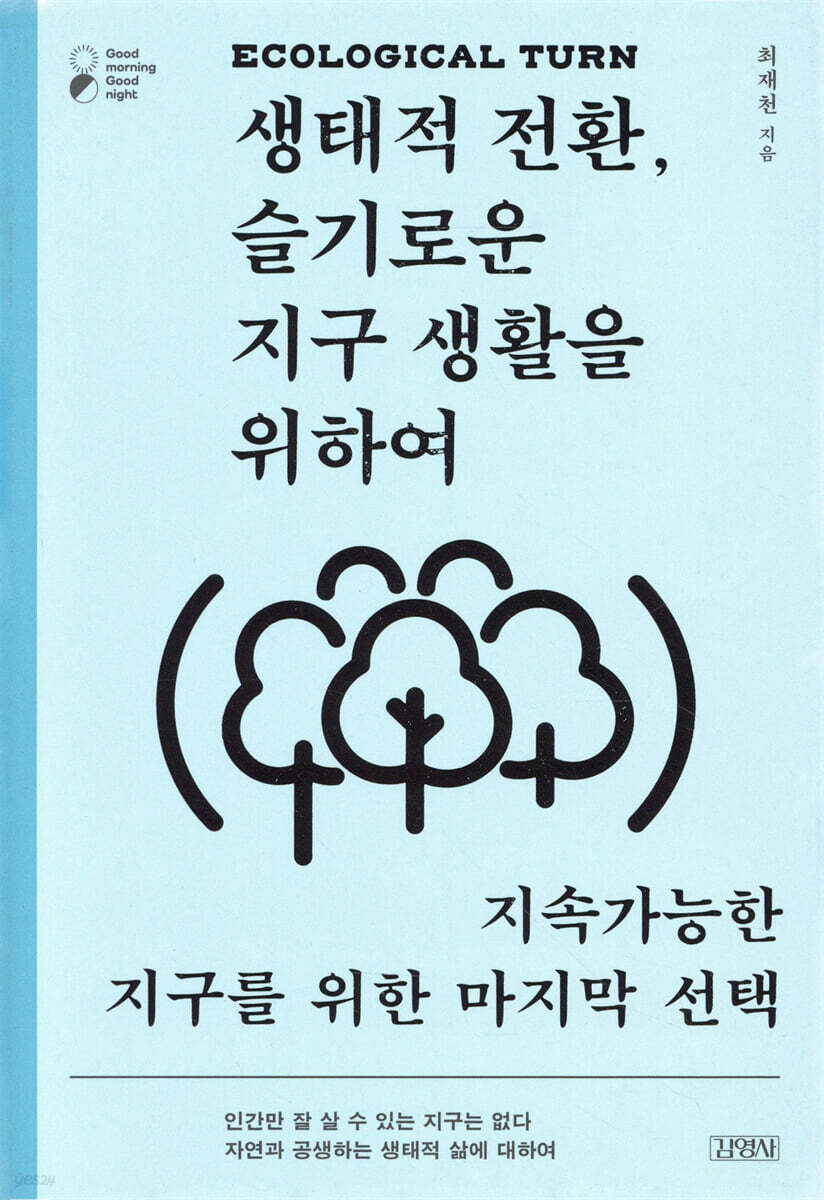
For an ecological transition and a wise life on Earth
 |
Description
Book Introduction
Today's culture, future wisdom, every day The Good Morning, Good Night series, a knowledge library that starts in the morning and ends in the evening, has been published! The "Good Morning, Good Night" series, which sets a new standard for knowledge in the 21st century, has been published. Written by the best writers, it conveys wisdom for viewing the world. We look at where we are, what changes we are facing, and what we need to prepare for. Introduction to Ecology as a 21st Century Philosophy of Life Knowledge Library "Good Morning, Good Night" "Environment" A book that recognizes that not only humans but also all living creatures on Earth are subjects of diverse lives and proposes an ecological life that coexists with nature. Professor Choi Jae-cheon, who has spent his life observing nature and practicing his knowledge and love for life, outlines the history of environmental disasters in this book and examines environmental issues that threaten human existence, from pandemics to climate crises and biodiversity depletion, revealing the core of ecology that 21st-century Earthlings must practice. In the so-called 'environmental century', where human survival itself is threatened, the only transition left for humans is an ecological transition. It criticizes the ecological sin of humans who have pursued only their own success and abundance, and emphasizes the ecological transition from the wise human, ‘Homo sapiens,’ to the human, ‘Homo symbius,’ who coexists with all living things. This is the 'Environment Edition' of the 'Good Morning, Good Night' series, a knowledge library created by the best scholars and researchers in each field for future generations. |
index
Prologue - The Troubles of an Overly Successful Animal
Chapter 1: A History of Environmental Disasters
1.
Environmental disasters recorded in the Bible
2.
Modern environmental disasters
Chapter 2: The Normalization of the Pandemic
1.
The Age of Wild Animal Suffering
2.
Ecology and Evolution of Disease
3.
Behavioral and ecological vaccines
4.
A virus that is fair to everyone
Chapter 3: The Climate Change Crisis
1.
Y2K of the climate
2.
Climate change and pandemics
3.
Smart Climate Crisis Response
Chapter 4: Depletion of Biodiversity
1.
A crisis perhaps more serious than the climate crisis
2.
The concept and current status of biodiversity
3.
Why is diversity important?
Epilogue: Ecological Sin and Ecological Transition
References
Read more
Search
Chapter 1: A History of Environmental Disasters
1.
Environmental disasters recorded in the Bible
2.
Modern environmental disasters
Chapter 2: The Normalization of the Pandemic
1.
The Age of Wild Animal Suffering
2.
Ecology and Evolution of Disease
3.
Behavioral and ecological vaccines
4.
A virus that is fair to everyone
Chapter 3: The Climate Change Crisis
1.
Y2K of the climate
2.
Climate change and pandemics
3.
Smart Climate Crisis Response
Chapter 4: Depletion of Biodiversity
1.
A crisis perhaps more serious than the climate crisis
2.
The concept and current status of biodiversity
3.
Why is diversity important?
Epilogue: Ecological Sin and Ecological Transition
References
Read more
Search
Detailed image

Into the book
Why do humans, who possess perhaps the most remarkable brains in nature and throughout the history of life on Earth, and who call themselves "wise humans, Homo sapiens," continue to destroy their own habitats so desperately? Unchecked climate change and the depletion of biodiversity are beginning to threaten our very existence.
Can we reverse the course of our lives, which only pursue abundance and convenience?
--- From "Prologue: The Troubles of Overly Successful Animals"
In my lecture, I pointed out that while other government ministries change their names every time a new government comes into power and seek innovation in their own way, the Ministry of Environment has never made such efforts, and suggested that it be renamed the “Ministry of Ecology and Environment.”
I don't know if the name "Ministry of Environment" makes it so, but somehow it seems like the department's main work is focused on post-processing and regulations.
Now, we must take proactive measures to protect the natural environment from pollution and destruction and improve the quality of life for citizens.
--- 「Chapter 1.
From “A History of Environmental Disasters”
Leopards in Gabon, Africa, normally spend 64 percent of their daily activity during the day, but in areas where human hunting is active, the nocturnal rate soars to a whopping 93 percent.
In Polish wild boars, nocturnal activity is only 48 percent in forests with few people, but in urban areas, it reaches 90 percent.
Alaskan brown bears also roam at night 76 percent of the time when ecotourism is popular, but when tourists disappear, that percentage drops to 33 percent.
--- Chapter 2.
From “The Normalization of the Pandemic”
The words of Canadian university student Anjali Apadurai to delegates from each country at the 2011 UN Climate Change Conference in Durban, South Africa, struck a chord with me.
“You have been negotiating ever since I was born.”
--- 「Chapter 3.
From “Climate Change Crisis”
As the average temperature in temperate regions has risen due to the recent effects of global warming, tropical bats are expanding their range into temperate regions.
Homo sapiens became the first animals in Earth's history to colonize nearly every corner of the planet's surface, yet we are still most concentrated in temperate zones.
Climate change is reducing the physical distance between bats and humans.
As a result, the probability of the virus spreading is bound to increase.
--- 「Chapter 3.
From “Climate Change Crisis”
Professor Diamond asserts in Guns, Germs, and Steel that “agriculture was the worst mistake in human history.”
That doesn't mean we can give up farming at this point.
But I can admit my mistakes.
We shouldn't have started out by completely eradicating diversity.
We had to find a way to farm while maintaining some degree of diversity.
--- 「Chapter 4.
From “Depletion of Biodiversity”
The core of the problem is the loss of genetic diversity and factory farming.
We rarely allow social distancing for our pets.
They are grown by sticking together closely.
So, if just one person gets infected, it's obvious that the virus will spread in an environment where genetically identical individuals are crowded together.
By increasing the genetic diversity of livestock and improving their breeding environments, we can avoid the large-scale culling that has become an annual event.
Can we reverse the course of our lives, which only pursue abundance and convenience?
--- From "Prologue: The Troubles of Overly Successful Animals"
In my lecture, I pointed out that while other government ministries change their names every time a new government comes into power and seek innovation in their own way, the Ministry of Environment has never made such efforts, and suggested that it be renamed the “Ministry of Ecology and Environment.”
I don't know if the name "Ministry of Environment" makes it so, but somehow it seems like the department's main work is focused on post-processing and regulations.
Now, we must take proactive measures to protect the natural environment from pollution and destruction and improve the quality of life for citizens.
--- 「Chapter 1.
From “A History of Environmental Disasters”
Leopards in Gabon, Africa, normally spend 64 percent of their daily activity during the day, but in areas where human hunting is active, the nocturnal rate soars to a whopping 93 percent.
In Polish wild boars, nocturnal activity is only 48 percent in forests with few people, but in urban areas, it reaches 90 percent.
Alaskan brown bears also roam at night 76 percent of the time when ecotourism is popular, but when tourists disappear, that percentage drops to 33 percent.
--- Chapter 2.
From “The Normalization of the Pandemic”
The words of Canadian university student Anjali Apadurai to delegates from each country at the 2011 UN Climate Change Conference in Durban, South Africa, struck a chord with me.
“You have been negotiating ever since I was born.”
--- 「Chapter 3.
From “Climate Change Crisis”
As the average temperature in temperate regions has risen due to the recent effects of global warming, tropical bats are expanding their range into temperate regions.
Homo sapiens became the first animals in Earth's history to colonize nearly every corner of the planet's surface, yet we are still most concentrated in temperate zones.
Climate change is reducing the physical distance between bats and humans.
As a result, the probability of the virus spreading is bound to increase.
--- 「Chapter 3.
From “Climate Change Crisis”
Professor Diamond asserts in Guns, Germs, and Steel that “agriculture was the worst mistake in human history.”
That doesn't mean we can give up farming at this point.
But I can admit my mistakes.
We shouldn't have started out by completely eradicating diversity.
We had to find a way to farm while maintaining some degree of diversity.
--- 「Chapter 4.
From “Depletion of Biodiversity”
The core of the problem is the loss of genetic diversity and factory farming.
We rarely allow social distancing for our pets.
They are grown by sticking together closely.
So, if just one person gets infected, it's obvious that the virus will spread in an environment where genetically identical individuals are crowded together.
By increasing the genetic diversity of livestock and improving their breeding environments, we can avoid the large-scale culling that has become an annual event.
--- 「Chapter 4.
From “Depletion of Biodiversity”
From “Depletion of Biodiversity”
Publisher's Review
Transition from Homo sapiens to Homo symbius
Introduction to Ecology as a 21st Century Philosophy of Life
Pandemics have become the norm, massive wildfires and prolonged monsoons continue to rage across the globe, and wildlife populations have declined by two-thirds compared to 40 years ago.
There is not much time left.
What choices should humans make to overcome this crisis, when they have nowhere else to go but Earth?
Professor Choi Jae-cheon, who has spent his life observing nature and practicing his knowledge and love for life, has published a new book titled "Ecological Transition: For a Wise Life on Earth." This book recognizes that not only humans but also all living creatures on Earth are subjects of diverse lives, and proposes an ecological life that coexists with nature.
It outlines the history of environmental disasters and examines environmental issues that threaten human existence, from pandemics to the climate crisis and biodiversity depletion, revealing the core of ecology that 21st-century Earthlings must practice.
Over the years, humanity has undergone linguistic and cultural transformations and envisioned new transformations, including technological, robotic, and information transformations.
The author argues that the only transition left for humanity in the so-called 'environmental century', where human survival itself is threatened, is an ecological transition.
It criticizes the ecological sin of humans who have pursued only their own success and abundance, and emphasizes the ecological transition from the wise human, ‘Homo sapiens,’ to the human, ‘Homo symbius,’ who coexists with all living things.
There is no Earth where only humans can live well.
About ecological life in harmony with nature
Humans, calling themselves 'Homo sapiens', have developed a rich and unique civilization.
However, the author says that due to human arrogance, the Earth has been destroyed and humans are standing on the edge of a precipice from which they can no longer retreat.
It examines the issues of pandemics, climate crisis, and biodiversity depletion in detail, warning that there is no planet that can thrive only on humans.
Global warming has brought bat habitats too close to human settlements, leading to human infections with the COVID-19 virus.
Chickens, which have lost most of their genetic diversity due to artificial selection to produce high-quality eggs, can be wiped out if just one is infected with avian influenza in a crowded environment.
According to the World Meteorological Organization, 2015-2019 was the hottest five years on record.
The atmosphere has risen by 1.1 degrees Celsius over the 200 years since industrialization began, but it rose by 0.2 degrees Celsius between 2011 and 2015 alone.
Since the rate of increase in carbon dioxide emissions between 2015 and 2019 increased by 20 percent compared to the previous five years, temperatures would have increased proportionally.
Also, we do not take the problem of biodiversity seriously, but once a species goes extinct, it can never be brought back to Earth.
Biologists say that if environmental destruction continues at the current rate, 2 percent of all living plants and animals will be extinct or at risk of premature extinction by 2030.
Now, we must abandon selfishness and greed and join hands with the creatures of Earth to survive.
This book strives to understand more about the interactions between the natural world itself and social systems, and teaches us how to live in harmony.
From avian influenza to COVID-19, the disasters caused by endless human greed.
- How much hotter has the Earth gotten in the last five years?
The biodiversity crisis may be more serious than the climate crisis.
- Starting an ecological life for a sustainable planet
Today's culture, future wisdom, every day
The Good Morning, Good Night series, a knowledge library that starts in the morning and ends in the evening, has been published!
Good Morning, Good Night sets a new standard for knowledge in the 21st century.
Written by the best writers, we share wisdom on how to view the world.
We take a look at where we are, what changes we are facing, and what we need to prepare for.
The world is changing.
The paradigm is shifting in all fields.
These are uncertain times, where we don't know what will happen tomorrow.
What choices will you make in the face of the great tide of change?
Will you fall into crisis because you can't read the changes, or will you actively respond to the changes and create opportunities?
Where do we stand, what changes are we facing, and what should we prepare for?
Leading scholars and researchers from each field have come together to create a comprehensive collection of knowledge and culture for future generations.
This knowledge library historically examines the changes and issues facing us in this era of transition across all fields, including the humanities, social sciences, economics, natural sciences, and the arts, and comprehensively examines phenomena and their essence to seek solutions and alternatives.
It is a paperback book that can be read by anyone of all generations, from students to college students and the general public, and contains core knowledge and culture in one volume, so you can keep it close by and refer to it every day.
Professors Joo Kyung-chul (historian), Park Ji-hyang (historian), Lim Hyeok-baek (political scientist), Lee Ji-sun (economist), and Choi Jae-cheon (biologist) participated in this first batch.
The series continues with science, philosophy, mathematics, society, etc.
The Good Morning, Good Night library will present a new standard for 21st-century knowledge and serve as a guide to providing wisdom for viewing the world.
We await you, seeking wisdom and insight.
Introduction to Ecology as a 21st Century Philosophy of Life
Pandemics have become the norm, massive wildfires and prolonged monsoons continue to rage across the globe, and wildlife populations have declined by two-thirds compared to 40 years ago.
There is not much time left.
What choices should humans make to overcome this crisis, when they have nowhere else to go but Earth?
Professor Choi Jae-cheon, who has spent his life observing nature and practicing his knowledge and love for life, has published a new book titled "Ecological Transition: For a Wise Life on Earth." This book recognizes that not only humans but also all living creatures on Earth are subjects of diverse lives, and proposes an ecological life that coexists with nature.
It outlines the history of environmental disasters and examines environmental issues that threaten human existence, from pandemics to the climate crisis and biodiversity depletion, revealing the core of ecology that 21st-century Earthlings must practice.
Over the years, humanity has undergone linguistic and cultural transformations and envisioned new transformations, including technological, robotic, and information transformations.
The author argues that the only transition left for humanity in the so-called 'environmental century', where human survival itself is threatened, is an ecological transition.
It criticizes the ecological sin of humans who have pursued only their own success and abundance, and emphasizes the ecological transition from the wise human, ‘Homo sapiens,’ to the human, ‘Homo symbius,’ who coexists with all living things.
There is no Earth where only humans can live well.
About ecological life in harmony with nature
Humans, calling themselves 'Homo sapiens', have developed a rich and unique civilization.
However, the author says that due to human arrogance, the Earth has been destroyed and humans are standing on the edge of a precipice from which they can no longer retreat.
It examines the issues of pandemics, climate crisis, and biodiversity depletion in detail, warning that there is no planet that can thrive only on humans.
Global warming has brought bat habitats too close to human settlements, leading to human infections with the COVID-19 virus.
Chickens, which have lost most of their genetic diversity due to artificial selection to produce high-quality eggs, can be wiped out if just one is infected with avian influenza in a crowded environment.
According to the World Meteorological Organization, 2015-2019 was the hottest five years on record.
The atmosphere has risen by 1.1 degrees Celsius over the 200 years since industrialization began, but it rose by 0.2 degrees Celsius between 2011 and 2015 alone.
Since the rate of increase in carbon dioxide emissions between 2015 and 2019 increased by 20 percent compared to the previous five years, temperatures would have increased proportionally.
Also, we do not take the problem of biodiversity seriously, but once a species goes extinct, it can never be brought back to Earth.
Biologists say that if environmental destruction continues at the current rate, 2 percent of all living plants and animals will be extinct or at risk of premature extinction by 2030.
Now, we must abandon selfishness and greed and join hands with the creatures of Earth to survive.
This book strives to understand more about the interactions between the natural world itself and social systems, and teaches us how to live in harmony.
From avian influenza to COVID-19, the disasters caused by endless human greed.
- How much hotter has the Earth gotten in the last five years?
The biodiversity crisis may be more serious than the climate crisis.
- Starting an ecological life for a sustainable planet
Today's culture, future wisdom, every day
The Good Morning, Good Night series, a knowledge library that starts in the morning and ends in the evening, has been published!
Good Morning, Good Night sets a new standard for knowledge in the 21st century.
Written by the best writers, we share wisdom on how to view the world.
We take a look at where we are, what changes we are facing, and what we need to prepare for.
The world is changing.
The paradigm is shifting in all fields.
These are uncertain times, where we don't know what will happen tomorrow.
What choices will you make in the face of the great tide of change?
Will you fall into crisis because you can't read the changes, or will you actively respond to the changes and create opportunities?
Where do we stand, what changes are we facing, and what should we prepare for?
Leading scholars and researchers from each field have come together to create a comprehensive collection of knowledge and culture for future generations.
This knowledge library historically examines the changes and issues facing us in this era of transition across all fields, including the humanities, social sciences, economics, natural sciences, and the arts, and comprehensively examines phenomena and their essence to seek solutions and alternatives.
It is a paperback book that can be read by anyone of all generations, from students to college students and the general public, and contains core knowledge and culture in one volume, so you can keep it close by and refer to it every day.
Professors Joo Kyung-chul (historian), Park Ji-hyang (historian), Lim Hyeok-baek (political scientist), Lee Ji-sun (economist), and Choi Jae-cheon (biologist) participated in this first batch.
The series continues with science, philosophy, mathematics, society, etc.
The Good Morning, Good Night library will present a new standard for 21st-century knowledge and serve as a guide to providing wisdom for viewing the world.
We await you, seeking wisdom and insight.
GOODS SPECIFICS
- Date of issue: March 1, 2021
- Page count, weight, size: 176 pages | 208g | 132*193*20mm
- ISBN13: 9788934988342
- ISBN10: 8934988347
You may also like
카테고리
korean


korean

![GQ KOREA Mark (Monthly): December [2025]](http://librairie.coreenne.fr/cdn/shop/files/8ef265dbbfbf186523ed75ba7319009d.jpg?v=1765340328&width=3840)


