

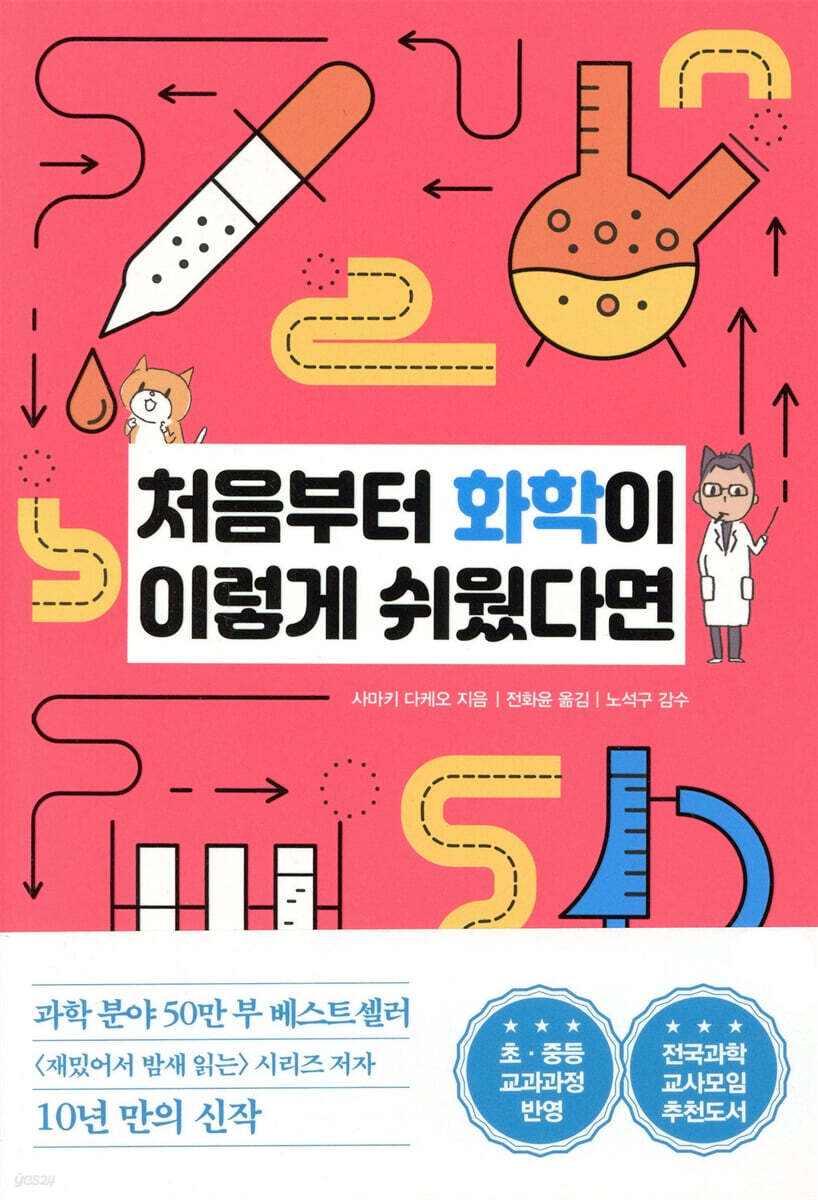
If only chemistry had been this easy from the start
 |
Description
Book Introduction
“This is the simplest chemistry book I’ve ever seen!”
A bestseller in the science field with 500,000 copies sold
The author of the "Fun to Read All Night" series releases a new book after 10 years!
- Books recommended by the National Science Teachers Association
- Reflected in elementary and secondary school curriculum
Bestselling author Takeo Samaki, who received much love from readers for 『Fun Chemistry Stories That Will Keep You Reading All Night』 and 『Fun Physics Stories That Will Keep You Reading All Night』, is back with a new science series.
The "If Science Were This Easy from the Start" series, presented for the first time in 10 years, focuses on introducing the basic principles of each field of chemistry, physics, and biology in an easy and fun way.
While other popular science books that deal with everyday scientific stories often offer fragmented knowledge, this series distinguishes itself by establishing a framework for scientific thinking by organically connecting the content and carefully selecting the core principles that readers must know.
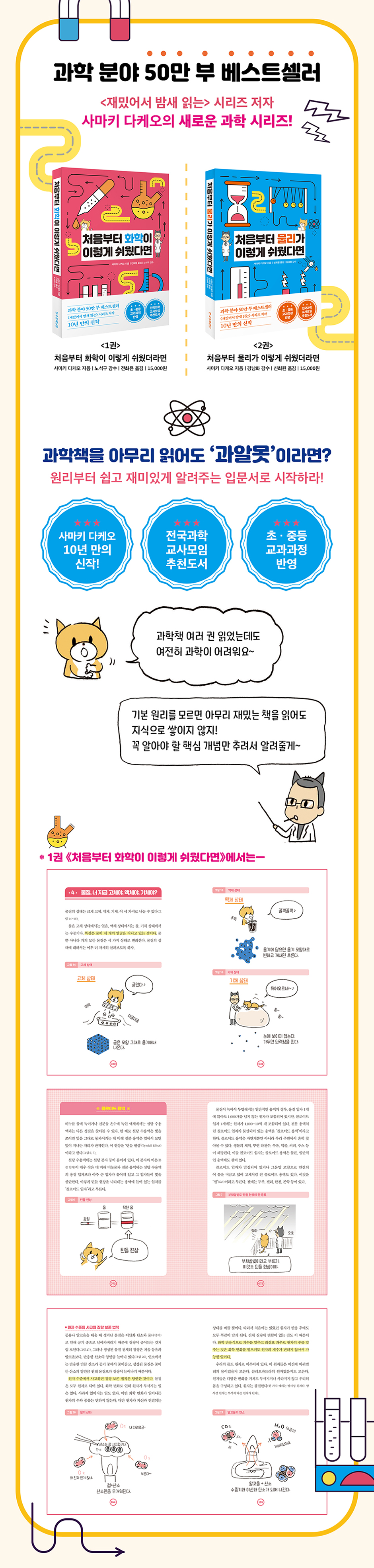
Volume 1, "If Chemistry Were This Easy from the Beginning," covers everything from the basic properties of matter to the concepts of atoms, molecules, and ions, "state changes" from solid to liquid to gas, and "chemical changes" such as combustion and reduction.
Do gases have volume? Does eating food cause you to gain exactly that much weight? Can you boil ramen without burning the paper pot? Can you dissolve salt without water? Through the rich illustrations presented by the adorable Meow and the kind Doctor, you'll learn the basic principles in a fun and engaging way, naturally finding answers to these questions.
Let's embark on a journey into the world of chemistry, which becomes even more fun once you understand the principles.
A bestseller in the science field with 500,000 copies sold
The author of the "Fun to Read All Night" series releases a new book after 10 years!
- Books recommended by the National Science Teachers Association
- Reflected in elementary and secondary school curriculum
Bestselling author Takeo Samaki, who received much love from readers for 『Fun Chemistry Stories That Will Keep You Reading All Night』 and 『Fun Physics Stories That Will Keep You Reading All Night』, is back with a new science series.
The "If Science Were This Easy from the Start" series, presented for the first time in 10 years, focuses on introducing the basic principles of each field of chemistry, physics, and biology in an easy and fun way.
While other popular science books that deal with everyday scientific stories often offer fragmented knowledge, this series distinguishes itself by establishing a framework for scientific thinking by organically connecting the content and carefully selecting the core principles that readers must know.
Volume 1, "If Chemistry Were This Easy from the Beginning," covers everything from the basic properties of matter to the concepts of atoms, molecules, and ions, "state changes" from solid to liquid to gas, and "chemical changes" such as combustion and reduction.
Do gases have volume? Does eating food cause you to gain exactly that much weight? Can you boil ramen without burning the paper pot? Can you dissolve salt without water? Through the rich illustrations presented by the adorable Meow and the kind Doctor, you'll learn the basic principles in a fun and engaging way, naturally finding answers to these questions.
Let's embark on a journey into the world of chemistry, which becomes even more fun once you understand the principles.
- You can preview some of the book's contents.
Preview
index
Author's Note
Chapter 1: Chemistry is the study of matter.
1.
What is matter?
2.
Gas also has volume?
3.
Density is an inherent property of a substance.
4.
Matter, are you a solid, a liquid, or a gas now?
Chapter 2 The world is made of atoms
1.
What is the difference between objects and matter?
2.
If you keep splitting matter, only atoms remain!
3.
Atoms, molecules, and states of matter
4.
80% of the elements are metals
5.
Gases that are invisible but accompany our daily lives
Chapter 3 When a substance is dissolved in water
1.
Cocoa is a 'water solution'
2.
What does 'melted' mean?
3.
The solute disappears along with the water
4.
The principle of 'filtration' in a cup of coffee
5.
Measuring sweetness by percent concentration
6.
How much can you melt at once?
7.
Let's filter out pure substances from a mixture.
8.
Several ways to find out what you melted
Chapter 4: Such an Interesting State Change
1.
Salt dissolves without water?
2.
From ice to water, from water to steam
3.
Goes back and forth between solid, liquid, and gas states
4.
Boundaries of state change, melting point and boiling point
5.
Melting and boiling points vary from substance to substance.
6.
Making pure substances through distillation
7.
Even if the state changes, the mass does not change.
Chapter 5: Such Interesting Chemical Changes
1.
Chemical changes, new substances are created!
2.
What happens when you split water with electricity?
3.
Element symbols are the language of chemistry
4.
Talking with Chemical Formulas and Chemical Reactions
5.
The opposite of decomposition is combination.
6.
Combustion, an intense encounter with oxygen
7.
Operation Oxygen Deprivation, Reduction
8.
Chemical Change and the Law of Conservation of Mass
9.
The mass ratio of substances is fixed
10.
Atoms are traveling around the Earth
Chapter 6: Ions Floating Around Us
1.
Why does electricity flow in water?
2.
The secret lies in moving ions
3.
The identity of ions as seen from an atom
4.
Showing the ion symbol
5.
Principle of current flow in electrolyte solution
6.
Difference between acidic and alkaline solutions
7.
What happens when you mix an acid and an alkali?
Search
Chapter 1: Chemistry is the study of matter.
1.
What is matter?
2.
Gas also has volume?
3.
Density is an inherent property of a substance.
4.
Matter, are you a solid, a liquid, or a gas now?
Chapter 2 The world is made of atoms
1.
What is the difference between objects and matter?
2.
If you keep splitting matter, only atoms remain!
3.
Atoms, molecules, and states of matter
4.
80% of the elements are metals
5.
Gases that are invisible but accompany our daily lives
Chapter 3 When a substance is dissolved in water
1.
Cocoa is a 'water solution'
2.
What does 'melted' mean?
3.
The solute disappears along with the water
4.
The principle of 'filtration' in a cup of coffee
5.
Measuring sweetness by percent concentration
6.
How much can you melt at once?
7.
Let's filter out pure substances from a mixture.
8.
Several ways to find out what you melted
Chapter 4: Such an Interesting State Change
1.
Salt dissolves without water?
2.
From ice to water, from water to steam
3.
Goes back and forth between solid, liquid, and gas states
4.
Boundaries of state change, melting point and boiling point
5.
Melting and boiling points vary from substance to substance.
6.
Making pure substances through distillation
7.
Even if the state changes, the mass does not change.
Chapter 5: Such Interesting Chemical Changes
1.
Chemical changes, new substances are created!
2.
What happens when you split water with electricity?
3.
Element symbols are the language of chemistry
4.
Talking with Chemical Formulas and Chemical Reactions
5.
The opposite of decomposition is combination.
6.
Combustion, an intense encounter with oxygen
7.
Operation Oxygen Deprivation, Reduction
8.
Chemical Change and the Law of Conservation of Mass
9.
The mass ratio of substances is fixed
10.
Atoms are traveling around the Earth
Chapter 6: Ions Floating Around Us
1.
Why does electricity flow in water?
2.
The secret lies in moving ions
3.
The identity of ions as seen from an atom
4.
Showing the ion symbol
5.
Principle of current flow in electrolyte solution
6.
Difference between acidic and alkaline solutions
7.
What happens when you mix an acid and an alkali?
Search
Detailed image
Into the book
If you eat a 1kg lunchbox, how much weight will you gain afterward? What happens if someone weighs 58.5kg and eats exactly 1kg of rice and side dishes and then weighs themselves? They'll weigh exactly 59.5kg.
If you weigh yourself immediately after a meal, you'll gain exactly 1kg. So what happens after a while? A scientist has studied weight changes to understand how food changes in the body.
This is the Italian doctor Santorio Santorio.
Santorio designed and commissioned the production of a chair-type scale that can measure weight while sitting.
And I sat on that scale all day, eating, drinking, and even going to the bathroom.
Weight fluctuated from time to time.
He measured all masses of food, drink, feces, urine, etc.
If you think about it simply, you would think that your weight would increase by the mass of food and drinks consumed minus the mass of urine and feces, but the experimental results showed that the weight gain was less than expected.
Here, Santorio says, “Some of the food consumed would have passed out of the body in a form invisible to the human eye.
So I thought that the weight gain would be less.”
So then what is it that has come out of the body?
--- From "What is Matter?"
In general, the density of a substance is lower in liquids than in solids.
This is because the solid molecules are packed more densely.
But water is different.
Ice (a solid substance of water) floats on water.
This is rarely the case among natural substances.
The phenomenon of ice floating on water that we commonly see is an exceptional case.
Water is made up of water molecules.
However, water and ice have different arrangements of molecules.
Ice has a structure with many gaps between its molecules that are arranged in a regular pattern.
However, when it becomes water, the regular structure of ice breaks down.
At this moment, more molecules enter the gaps that existed when it was ice, so the structure becomes more tightly packed than when it was ice.
In nature, water is the only substance that has gaps in the arrangement of molecules when in a solid state.
The phenomenon of ice floating on water is caused by the structure of this microscopic world.
--- From “Atoms, Molecules, and the State of Matter”
If you put coffee grounds in a filter (filter paper) and pour hot water, you can see the coffee coming out of the filter.
When coffee powder comes into contact with hot water, the ingredients inside the powder dissolve in the hot water and become coffee.
Coffee is an aqueous solution, although the solvent is very hot water.
Therefore, it passes through the filter.
The residue remains on the filter paper because it is not an aqueous solution (to be precise, the coffee solution is a mixture of a regular aqueous solution and a colloidal solution).
If you weigh yourself immediately after a meal, you'll gain exactly 1kg. So what happens after a while? A scientist has studied weight changes to understand how food changes in the body.
This is the Italian doctor Santorio Santorio.
Santorio designed and commissioned the production of a chair-type scale that can measure weight while sitting.
And I sat on that scale all day, eating, drinking, and even going to the bathroom.
Weight fluctuated from time to time.
He measured all masses of food, drink, feces, urine, etc.
If you think about it simply, you would think that your weight would increase by the mass of food and drinks consumed minus the mass of urine and feces, but the experimental results showed that the weight gain was less than expected.
Here, Santorio says, “Some of the food consumed would have passed out of the body in a form invisible to the human eye.
So I thought that the weight gain would be less.”
So then what is it that has come out of the body?
--- From "What is Matter?"
In general, the density of a substance is lower in liquids than in solids.
This is because the solid molecules are packed more densely.
But water is different.
Ice (a solid substance of water) floats on water.
This is rarely the case among natural substances.
The phenomenon of ice floating on water that we commonly see is an exceptional case.
Water is made up of water molecules.
However, water and ice have different arrangements of molecules.
Ice has a structure with many gaps between its molecules that are arranged in a regular pattern.
However, when it becomes water, the regular structure of ice breaks down.
At this moment, more molecules enter the gaps that existed when it was ice, so the structure becomes more tightly packed than when it was ice.
In nature, water is the only substance that has gaps in the arrangement of molecules when in a solid state.
The phenomenon of ice floating on water is caused by the structure of this microscopic world.
--- From “Atoms, Molecules, and the State of Matter”
If you put coffee grounds in a filter (filter paper) and pour hot water, you can see the coffee coming out of the filter.
When coffee powder comes into contact with hot water, the ingredients inside the powder dissolve in the hot water and become coffee.
Coffee is an aqueous solution, although the solvent is very hot water.
Therefore, it passes through the filter.
The residue remains on the filter paper because it is not an aqueous solution (to be precise, the coffee solution is a mixture of a regular aqueous solution and a colloidal solution).
--- From "The Principle of 'Filtration' in a Cup of Coffee"
Publisher's Review
What if I still don't know much about science no matter how much I read?
An introductory chemistry book that teaches basic principles in an easy and fun way.
Bestselling author Takeo Samaki, who received much love from readers for 『Fun Chemistry Stories That Will Keep You Reading All Night』 and 『Fun Physics Stories That Will Keep You Reading All Night』, is back with a new science series.
While the existing "Fun to Read All Night" series covered science stories from everyday life, the newly published "If Science Were This Easy from the Beginning" series covers the basic principles of each field of science in order.
There is a special reason why the author focuses on basic principles.
No matter how widely read my previous books and other popular science books are, many people still find science unfamiliar and difficult.
Since most books focus on telling stories about science in everyday life through case studies, they only briefly introduce fragmented knowledge and do not help in building up organized knowledge.
Then, no matter how enjoyable the content is to read, it will easily evaporate.
This is why science still feels difficult even after reading many science books filled with interesting stories.
Understanding the principles makes science more exciting.
The core of chemistry explained by a bestselling author!
Born from this awareness of the problem, the "If Science Were This Easy from the Beginning" series divides the core content covered in elementary and middle school science curricula into chemistry, physics, and biology, and then explains the basic principles step by step.
The book is enriched with illustrations featuring cute Meow and Doctor characters, making it even more fun to read.
Do gases have volume? Do we gain exactly that much weight when we eat food? Can we boil ramen without burning the paper pot? Can we dissolve salt without water? Volume 1, "If Chemistry Were This Easy from the Beginning," covers everything from the basic properties of matter to the concepts of atoms, molecules, and ions, "state changes" from solids to liquids to gases, and "chemical changes" like combustion and reduction.
As you learn these principles in a fun way, you will naturally find answers to the questions above and develop an eye for reading numerous popular science books more deeply.
This book will serve as an introductory book that provides a solid foundation in chemistry not only for young people who want to become familiar with chemistry, but also for adult readers interested in general science.
An introductory chemistry book that teaches basic principles in an easy and fun way.
Bestselling author Takeo Samaki, who received much love from readers for 『Fun Chemistry Stories That Will Keep You Reading All Night』 and 『Fun Physics Stories That Will Keep You Reading All Night』, is back with a new science series.
While the existing "Fun to Read All Night" series covered science stories from everyday life, the newly published "If Science Were This Easy from the Beginning" series covers the basic principles of each field of science in order.
There is a special reason why the author focuses on basic principles.
No matter how widely read my previous books and other popular science books are, many people still find science unfamiliar and difficult.
Since most books focus on telling stories about science in everyday life through case studies, they only briefly introduce fragmented knowledge and do not help in building up organized knowledge.
Then, no matter how enjoyable the content is to read, it will easily evaporate.
This is why science still feels difficult even after reading many science books filled with interesting stories.
Understanding the principles makes science more exciting.
The core of chemistry explained by a bestselling author!
Born from this awareness of the problem, the "If Science Were This Easy from the Beginning" series divides the core content covered in elementary and middle school science curricula into chemistry, physics, and biology, and then explains the basic principles step by step.
The book is enriched with illustrations featuring cute Meow and Doctor characters, making it even more fun to read.
Do gases have volume? Do we gain exactly that much weight when we eat food? Can we boil ramen without burning the paper pot? Can we dissolve salt without water? Volume 1, "If Chemistry Were This Easy from the Beginning," covers everything from the basic properties of matter to the concepts of atoms, molecules, and ions, "state changes" from solids to liquids to gases, and "chemical changes" like combustion and reduction.
As you learn these principles in a fun way, you will naturally find answers to the questions above and develop an eye for reading numerous popular science books more deeply.
This book will serve as an introductory book that provides a solid foundation in chemistry not only for young people who want to become familiar with chemistry, but also for adult readers interested in general science.
GOODS SPECIFICS
- Publication date: February 26, 2021
- Page count, weight, size: 216 pages | 410g | 140*205*15mm
- ISBN13: 9788947546935
- ISBN10: 8947546933
You may also like
카테고리
korean


korean

![GQ KOREA Mark (Monthly): December [2025]](http://librairie.coreenne.fr/cdn/shop/files/8ef265dbbfbf186523ed75ba7319009d.jpg?v=1765340328&width=3840)


