

Encyclopedia of Mathematics
 |
Description
Book Introduction
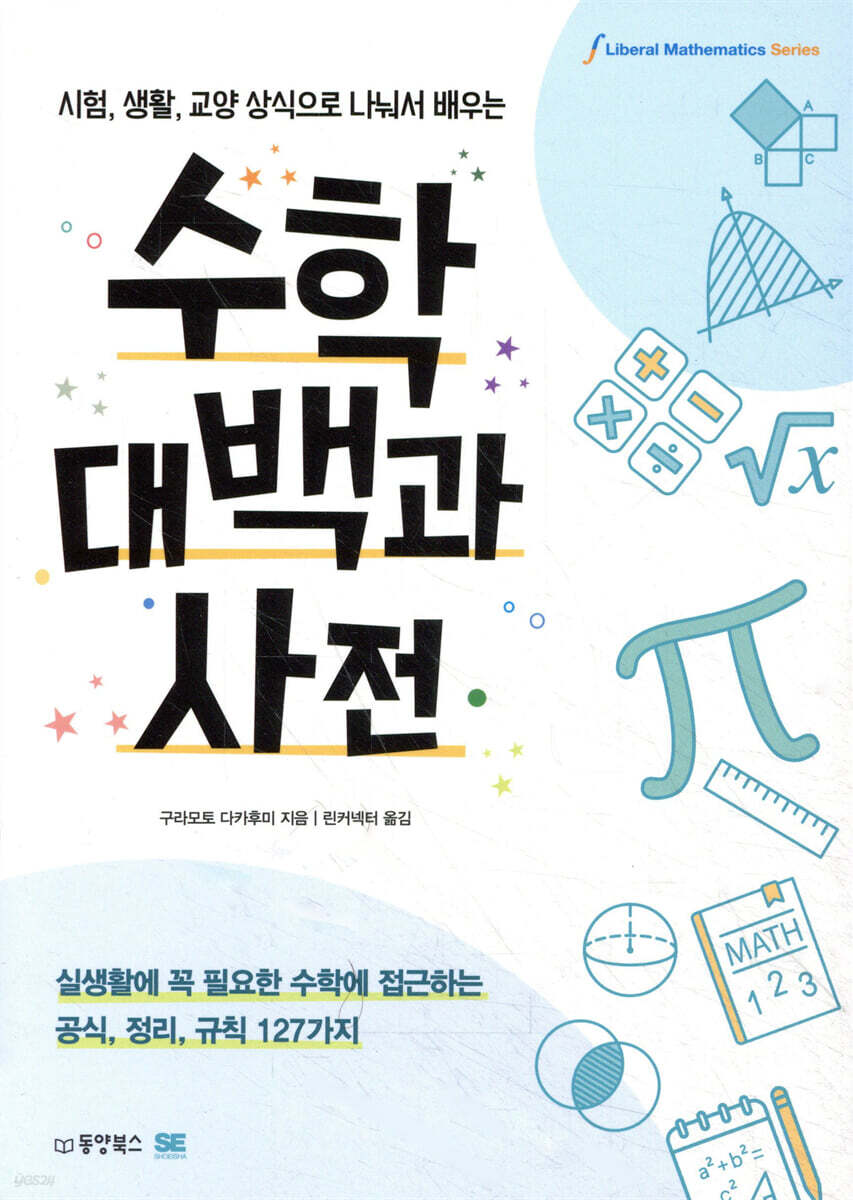
Everything about basic liberal arts mathematics, reviewed through concepts and examples.
Mathematics is receiving a lot of attention as an essential subject in all areas of real life.
Recently, the boundaries between science and humanities have been blurred, and there is a growing desire to acquire high school mathematics skills in fields such as economics and psychology.
However, the reality is that it can be scary or burdensome to open textbooks or reference books from middle and high school to try to remember math again.
This book was written to help you efficiently review the mathematical knowledge you learned but forgot.
So, I've summarized the key concepts and formulas that are frequently used in real life in a short and concise manner.
Additionally, most of the mathematical concepts introduced in this book fall within the mathematics curriculum taught in middle and high school.
If you are a student who finds math boring or difficult, it would be good to read this book to study from a new perspective.
If you need math again in various aspects, dive into the fun of practical mathematics with this book!
Mathematics is receiving a lot of attention as an essential subject in all areas of real life.
Recently, the boundaries between science and humanities have been blurred, and there is a growing desire to acquire high school mathematics skills in fields such as economics and psychology.
However, the reality is that it can be scary or burdensome to open textbooks or reference books from middle and high school to try to remember math again.
This book was written to help you efficiently review the mathematical knowledge you learned but forgot.
So, I've summarized the key concepts and formulas that are frequently used in real life in a short and concise manner.
Additionally, most of the mathematical concepts introduced in this book fall within the mathematics curriculum taught in middle and high school.
If you are a student who finds math boring or difficult, it would be good to read this book to study from a new perspective.
If you need math again in various aspects, dive into the fun of practical mathematics with this book!
- You can preview some of the book's contents.
Preview
index
Chapter 01 Reviewing Middle School Math
Introduction
The core of mathematics is extension, abstraction, and logic.
01 Positive and negative numbers
02 Irrational Numbers and Roots
03 Character expression
04 Commutative law, distributive law, associative law
05 Multiplication formulas and factorization
06 Linear Equations
07 Simultaneous equations
08 Proportionality
09 Inverse proportion
10 Properties of Shapes
11 Congruence and similarity
12 Proof
13 Pythagorean theorem
Column absolute value is distance
Chapter 02 Linear and Quadratic Functions, Equations and Inequalities
Introduction
Where can I use functions?
Why linear and quadratic functions are important
Equations and inequalities are easier to understand when graphed.
01 Definition of function
02 Linear functions and graphs
03 Quadratic functions and graphs
04 Solving Quadratic Equations
05 Imaginary solutions to quadratic equations
06 Discriminant of quadratic equations, relationship between solution and coefficients
07 Higher-order functions
08 Factor Theorem and Remainder Theorem
09 Solving Inequalities
10 Inequalities and Domains
Factoring Integers Protects Peace on the Internet
Chapter 03 Exponents and Logarithms
Introduction
Exponents are a convenient way to express very large or small numbers.
Logarithm is the opposite operation of exponentiation.
01 Index
02 Expansion of the index
03 Graphs and properties of exponential functions
04 Definition of logarithmic function
05 Graph and characteristics of logarithmic functions
06 Logarithm Base Conversion Formula
07 Common log and natural log
08 Using Log Graphs
09 Real-life units based on exponents and logarithms
Why You Shouldn't Divide by Column 0
Chapter 04 Trigonometric Functions
Introduction
A function that represents a waveform similar to a triangle
The core of trigonometry
01 Basic formulas of trigonometric functions
02 Extension and graph of trigonometric functions
03 Addition theorem and various formulas of trigonometric functions
04 radians
05 Law of Sines and Law of Cosines
06 Fourier series
07 Discrete Cosine Transform
Difference between Column 20 and 20.00
Chapter 05 Differentiation
Introduction
What is differentiation?
Can handle the concept of 'infinity'
Relationship with integrals
01 Limits and Infinity
02 Differential coefficient
03 Derivative
04 Differentiation of trigonometric functions and exponential and logarithmic functions
05 Differentiation of products and composite functions
06 Tangent formula
07 Higher order derivatives and convexity of functions
08 Mean Value Theorem and Differentiability
Isn't column dy/dx a fraction?
Chapter 06 Integration
Introduction
What is integral?
How to calculate area by integration
01 Definition of integral and basic theorems of calculus
02 Indefinite integral
03 Calculating definite integrals
04 Partial Integration
05 Substitution Integral
06 Integration and Volume
07 Length of curve
08 Relationship between position, velocity, and acceleration
Newton and Leibniz, who established the Column Calculus
Chapter 07 Advanced Calculus
Introduction
There are benefits that even high school students should know.
Differential equations are 'solutions' of functions.
Handling multivariable functions
01 Differential equations
02 Laplace Transform
03 Partial Differentiation and Multivariable Functions
04 Lagrange's multiplication method
05 Double integral
06 Line integral and area integral
Column Epsilon-Delta Argument
Chapter 08 Numerical Analysis
Introduction
A computer can't do anything unless you tell it to.
Difficulties in handling numbers
01 Linear approximation
02 Taylor series and Maclaurin series
03 Newton-Raphson method
04 Numerical Differentiation
05 Numerical Integration
06 Numerical solution of differential equations
Column Computers calculate in binary.
Chapter 09 Sequences
Introduction
Learning the concept of discrete, which means that a sequence is not a consecutive number
In a sequence, the sum is important.
01 Arithmetic sequence
02 Geometric sequence
Using 03 Sigma
04 Ignition
05 Infinite series
06 Mathematical Induction
Get familiar with the Greek letters in Column
Chapter 10: Shapes and Equations
Introduction
Represent a shape as a formula
Polar coordinates are a concept created for human convenience.
01 Equation of a straight line
02 Equation of a circle
03 Quadratic curve
04 Equation of a parallel-translated figure
05 Point symmetry and line symmetry
06 Rotation of shapes
07 Parameters
08 Polar Coordinates
09 Equations of spatial figures
Spatial awareness skills required for column mathematics
Chapter 11 Vectors
Introduction
Vectors are not just arrows
Vector multiplication can be defined in various ways.
01 Vector from the arrow perspective
02 Components of vectors and position vectors
03 Linear independence of vectors
04 Dot product of vectors
05 Vector equations of plane figures
06 Space vector
07 Vector equations of spatial figures
08 Cross product of vectors
09 Velocity vector and acceleration vector
10 Gradient, divergence, and rotation of vectors
Column The Value of Mathematical Abstraction
Chapter 12 Matrices
Introduction
A matrix is a calculation that transforms a vector into another vector.
The Relationship Between Matrices and High School Mathematics
01 Basic calculation method of matrix
02 Identity matrix, inverse matrix, determinant
03 Matrices and Systems of Equations
04 Matrices and Linear Transformations
05 Eigenvalues and Eigenvectors
06 3×3 matrix
Column Should Matrices Be Taught in High School Math?
Chapter 13 Complex Numbers
Introduction
It is people who determine what is real and what is not.
Why use the complex plane?
01 Basics of Complex Numbers
02 Complex plane and polar form
03 Euler's formula
04 Fourier Transform
05 Number of employees
Column What is imaginary time?
Chapter 14 Probability
Introduction
The key to probability is to accurately understand the nuances conveyed by a sentence.
Probability in reality and probability in mathematics
01 Number of cases
02 Permutation
03 Combination
04 Definition of probability
05 Addition Law of Probability
06 Independent implementation
07 Repeated execution
08 Conditional probability and the multiplication rule of probability
09 Bayes' Theorem
Column Monte Carlo method
Chapter 15 Basic Statistics
Introduction
The mean and standard deviation tell half the story.
The normal distribution is one of the greatest discoveries in statistics.
Prerequisites for statistics to be established
01 Average
02 Variance and standard deviation
03 Correlation coefficient
04 Probability distribution and expected value
05 Binomial distribution and Poisson distribution
06 Normal distribution
07 Skewness, Kurtosis, and Normal Probability Plot
08 Laws of Large Numbers and the Central Limit Theorem
Column data is the soul of statistics.
Chapter 16 Advanced Statistics
Introduction
We can't leave all the calculations to computers.
Statistical inference estimates the population from a sample.
Regression analysis is about predicting the future.
01 Interval estimation of the population mean
02 Estimation of the interval of the parent ratio
03 Hypothesis Testing
04 Simple Regression Analysis
05 Multiple Regression Analysis
06 Principal Component Analysis
07 Factor Analysis
What is the biggest difference between Column Mathematics and Practical Mathematics?
Introduction
The core of mathematics is extension, abstraction, and logic.
01 Positive and negative numbers
02 Irrational Numbers and Roots
03 Character expression
04 Commutative law, distributive law, associative law
05 Multiplication formulas and factorization
06 Linear Equations
07 Simultaneous equations
08 Proportionality
09 Inverse proportion
10 Properties of Shapes
11 Congruence and similarity
12 Proof
13 Pythagorean theorem
Column absolute value is distance
Chapter 02 Linear and Quadratic Functions, Equations and Inequalities
Introduction
Where can I use functions?
Why linear and quadratic functions are important
Equations and inequalities are easier to understand when graphed.
01 Definition of function
02 Linear functions and graphs
03 Quadratic functions and graphs
04 Solving Quadratic Equations
05 Imaginary solutions to quadratic equations
06 Discriminant of quadratic equations, relationship between solution and coefficients
07 Higher-order functions
08 Factor Theorem and Remainder Theorem
09 Solving Inequalities
10 Inequalities and Domains
Factoring Integers Protects Peace on the Internet
Chapter 03 Exponents and Logarithms
Introduction
Exponents are a convenient way to express very large or small numbers.
Logarithm is the opposite operation of exponentiation.
01 Index
02 Expansion of the index
03 Graphs and properties of exponential functions
04 Definition of logarithmic function
05 Graph and characteristics of logarithmic functions
06 Logarithm Base Conversion Formula
07 Common log and natural log
08 Using Log Graphs
09 Real-life units based on exponents and logarithms
Why You Shouldn't Divide by Column 0
Chapter 04 Trigonometric Functions
Introduction
A function that represents a waveform similar to a triangle
The core of trigonometry
01 Basic formulas of trigonometric functions
02 Extension and graph of trigonometric functions
03 Addition theorem and various formulas of trigonometric functions
04 radians
05 Law of Sines and Law of Cosines
06 Fourier series
07 Discrete Cosine Transform
Difference between Column 20 and 20.00
Chapter 05 Differentiation
Introduction
What is differentiation?
Can handle the concept of 'infinity'
Relationship with integrals
01 Limits and Infinity
02 Differential coefficient
03 Derivative
04 Differentiation of trigonometric functions and exponential and logarithmic functions
05 Differentiation of products and composite functions
06 Tangent formula
07 Higher order derivatives and convexity of functions
08 Mean Value Theorem and Differentiability
Isn't column dy/dx a fraction?
Chapter 06 Integration
Introduction
What is integral?
How to calculate area by integration
01 Definition of integral and basic theorems of calculus
02 Indefinite integral
03 Calculating definite integrals
04 Partial Integration
05 Substitution Integral
06 Integration and Volume
07 Length of curve
08 Relationship between position, velocity, and acceleration
Newton and Leibniz, who established the Column Calculus
Chapter 07 Advanced Calculus
Introduction
There are benefits that even high school students should know.
Differential equations are 'solutions' of functions.
Handling multivariable functions
01 Differential equations
02 Laplace Transform
03 Partial Differentiation and Multivariable Functions
04 Lagrange's multiplication method
05 Double integral
06 Line integral and area integral
Column Epsilon-Delta Argument
Chapter 08 Numerical Analysis
Introduction
A computer can't do anything unless you tell it to.
Difficulties in handling numbers
01 Linear approximation
02 Taylor series and Maclaurin series
03 Newton-Raphson method
04 Numerical Differentiation
05 Numerical Integration
06 Numerical solution of differential equations
Column Computers calculate in binary.
Chapter 09 Sequences
Introduction
Learning the concept of discrete, which means that a sequence is not a consecutive number
In a sequence, the sum is important.
01 Arithmetic sequence
02 Geometric sequence
Using 03 Sigma
04 Ignition
05 Infinite series
06 Mathematical Induction
Get familiar with the Greek letters in Column
Chapter 10: Shapes and Equations
Introduction
Represent a shape as a formula
Polar coordinates are a concept created for human convenience.
01 Equation of a straight line
02 Equation of a circle
03 Quadratic curve
04 Equation of a parallel-translated figure
05 Point symmetry and line symmetry
06 Rotation of shapes
07 Parameters
08 Polar Coordinates
09 Equations of spatial figures
Spatial awareness skills required for column mathematics
Chapter 11 Vectors
Introduction
Vectors are not just arrows
Vector multiplication can be defined in various ways.
01 Vector from the arrow perspective
02 Components of vectors and position vectors
03 Linear independence of vectors
04 Dot product of vectors
05 Vector equations of plane figures
06 Space vector
07 Vector equations of spatial figures
08 Cross product of vectors
09 Velocity vector and acceleration vector
10 Gradient, divergence, and rotation of vectors
Column The Value of Mathematical Abstraction
Chapter 12 Matrices
Introduction
A matrix is a calculation that transforms a vector into another vector.
The Relationship Between Matrices and High School Mathematics
01 Basic calculation method of matrix
02 Identity matrix, inverse matrix, determinant
03 Matrices and Systems of Equations
04 Matrices and Linear Transformations
05 Eigenvalues and Eigenvectors
06 3×3 matrix
Column Should Matrices Be Taught in High School Math?
Chapter 13 Complex Numbers
Introduction
It is people who determine what is real and what is not.
Why use the complex plane?
01 Basics of Complex Numbers
02 Complex plane and polar form
03 Euler's formula
04 Fourier Transform
05 Number of employees
Column What is imaginary time?
Chapter 14 Probability
Introduction
The key to probability is to accurately understand the nuances conveyed by a sentence.
Probability in reality and probability in mathematics
01 Number of cases
02 Permutation
03 Combination
04 Definition of probability
05 Addition Law of Probability
06 Independent implementation
07 Repeated execution
08 Conditional probability and the multiplication rule of probability
09 Bayes' Theorem
Column Monte Carlo method
Chapter 15 Basic Statistics
Introduction
The mean and standard deviation tell half the story.
The normal distribution is one of the greatest discoveries in statistics.
Prerequisites for statistics to be established
01 Average
02 Variance and standard deviation
03 Correlation coefficient
04 Probability distribution and expected value
05 Binomial distribution and Poisson distribution
06 Normal distribution
07 Skewness, Kurtosis, and Normal Probability Plot
08 Laws of Large Numbers and the Central Limit Theorem
Column data is the soul of statistics.
Chapter 16 Advanced Statistics
Introduction
We can't leave all the calculations to computers.
Statistical inference estimates the population from a sample.
Regression analysis is about predicting the future.
01 Interval estimation of the population mean
02 Estimation of the interval of the parent ratio
03 Hypothesis Testing
04 Simple Regression Analysis
05 Multiple Regression Analysis
06 Principal Component Analysis
07 Factor Analysis
What is the biggest difference between Column Mathematics and Practical Mathematics?
Detailed image
Publisher's Review
'Math dropout' = A person who only learns math in school and then gives up!
Meet the fundamentals of mathematics that will help you realize that no one is a failure.
If you ask many high school graduates if they want to look at 'math' again, they say they are bored or don't want to look at it again.
It's a given.
Math, which involves memorizing formulas to solve exam problems and focusing on test scores, is naturally boring and I don't want to look at it again.
This is the same even for mathematicians who pursue mathematics as their profession.
However, even though it was boring while learning, the math that we were forced to learn has an impact on our lives.
Whether it's calculating economic benefits, assessing work efficiency, or even understanding human relationships, we often use the mathematical logic we've learned to calculate profit relationships, whether we know it or not.
So, I think it is clear that learning math, even for entrance exams, has a positive impact.
This book is on the border between exam math and everyday math.
It clearly highlights what you need to know to solve exam problems by explaining 127 concepts.
They even say that you must memorize certain formulas to get good test scores.
However, we also do not neglect to introduce examples of how you can use mathematics in your daily life.
This book is a must-read for readers who want to kill two birds with one stone: learn math in a fun way while getting high test scores.
Features of this book
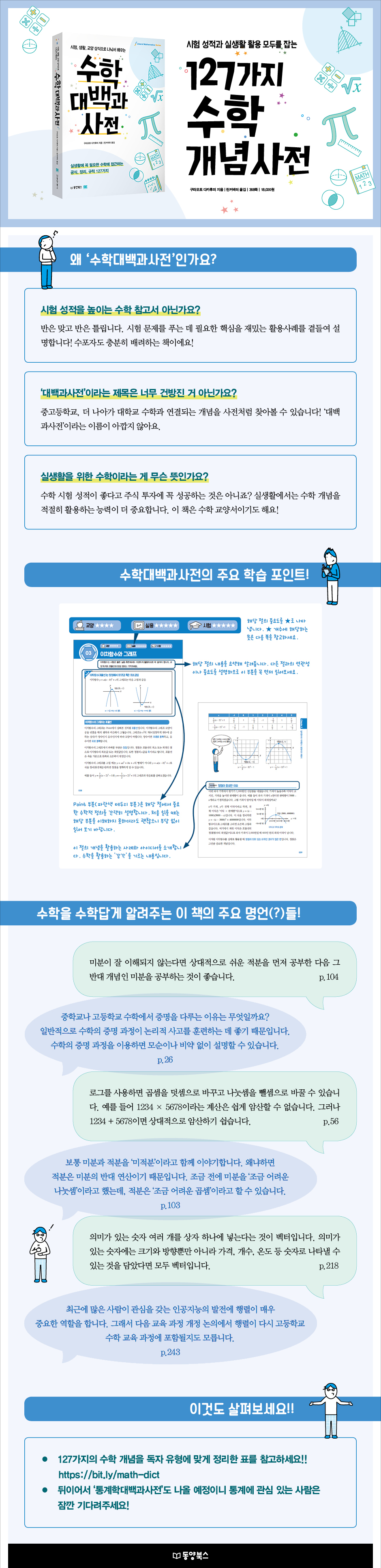
- Explains mathematical formulas and theorems that are likely to be used in various fields.
- There are several devices that help you remember math concepts efficiently and effectively.
- It's organized in a dictionary format so you can quickly find what you need.
- By introducing use cases, you can develop a sense of quickly applying mathematics in your real life.
Meet the fundamentals of mathematics that will help you realize that no one is a failure.
If you ask many high school graduates if they want to look at 'math' again, they say they are bored or don't want to look at it again.
It's a given.
Math, which involves memorizing formulas to solve exam problems and focusing on test scores, is naturally boring and I don't want to look at it again.
This is the same even for mathematicians who pursue mathematics as their profession.
However, even though it was boring while learning, the math that we were forced to learn has an impact on our lives.
Whether it's calculating economic benefits, assessing work efficiency, or even understanding human relationships, we often use the mathematical logic we've learned to calculate profit relationships, whether we know it or not.
So, I think it is clear that learning math, even for entrance exams, has a positive impact.
This book is on the border between exam math and everyday math.
It clearly highlights what you need to know to solve exam problems by explaining 127 concepts.
They even say that you must memorize certain formulas to get good test scores.
However, we also do not neglect to introduce examples of how you can use mathematics in your daily life.
This book is a must-read for readers who want to kill two birds with one stone: learn math in a fun way while getting high test scores.
Features of this book
- Explains mathematical formulas and theorems that are likely to be used in various fields.
- There are several devices that help you remember math concepts efficiently and effectively.
- It's organized in a dictionary format so you can quickly find what you need.
- By introducing use cases, you can develop a sense of quickly applying mathematics in your real life.
GOODS SPECIFICS
- Publication date: December 28, 2020
- Page count, weight, size: 368 pages | 598g | 148*210*30mm
- ISBN13: 9791157686773
- ISBN10: 115768677X
You may also like
카테고리
korean


korean

![GQ KOREA Mark (Monthly): December [2025]](http://librairie.coreenne.fr/cdn/shop/files/8ef265dbbfbf186523ed75ba7319009d.jpg?v=1765340328&width=3840)


