

A world without humans
 |
Description
Book Introduction
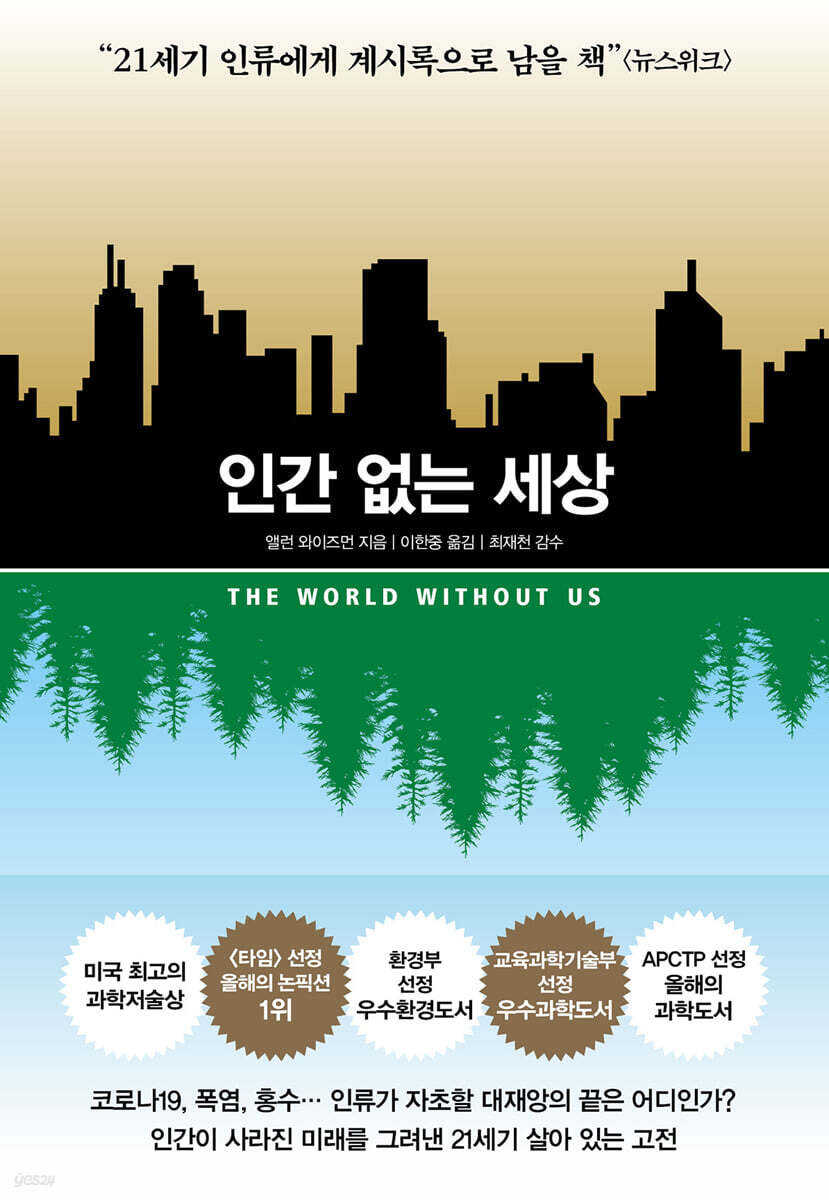
“What would happen on Earth if all humans suddenly disappeared one day?”
The revised edition of the controversial work, "A World Without Humans," which depicts a journey to find the answer to this provocative question, has been published.
This book, which swept the world's leading non-fiction awards upon its publication in 2007, continues to garner the support of many readers even now, more than 10 years after its publication, and is remembered as a living classic.
This is probably because the things predicted in this book, such as the spread of various viruses including COVID-19 that has paralyzed the world in 2020, the increasingly serious problem of microplastics, and the annual flood crisis caused by asphalt that prevents rainwater absorption, are now appearing one after another in reality.
Author Alan Wiseman embarks on a long-distance "intellectual quest" to discover what will disappear with humanity and what legacy humanity will leave behind on Earth.
He delicately describes the astonishing landscapes he encountered during his long journeys, including the Demilitarized Zone in our country, the primeval forests of the Polish-Belarusian border, the historical sites in Turkey and Northern Cyprus, Chernobyl, Micronesia, Africa, the Amazon, the Arctic, Guatemala, and Mexico.
Here, he weaves together knowledge and information from experts in various fields, including paleontologists, marine ecologists, museum curators, geologists, diamond miners, and environmental activists from the Korean Demilitarized Zone, using them as warp and weft, and weaving them together with his own unique insights.
The revised edition of the controversial work, "A World Without Humans," which depicts a journey to find the answer to this provocative question, has been published.
This book, which swept the world's leading non-fiction awards upon its publication in 2007, continues to garner the support of many readers even now, more than 10 years after its publication, and is remembered as a living classic.
This is probably because the things predicted in this book, such as the spread of various viruses including COVID-19 that has paralyzed the world in 2020, the increasingly serious problem of microplastics, and the annual flood crisis caused by asphalt that prevents rainwater absorption, are now appearing one after another in reality.
Author Alan Wiseman embarks on a long-distance "intellectual quest" to discover what will disappear with humanity and what legacy humanity will leave behind on Earth.
He delicately describes the astonishing landscapes he encountered during his long journeys, including the Demilitarized Zone in our country, the primeval forests of the Polish-Belarusian border, the historical sites in Turkey and Northern Cyprus, Chernobyl, Micronesia, Africa, the Amazon, the Arctic, Guatemala, and Mexico.
Here, he weaves together knowledge and information from experts in various fields, including paleontologists, marine ecologists, museum curators, geologists, diamond miners, and environmental activists from the Korean Demilitarized Zone, using them as warp and weft, and weaving them together with his own unique insights.
- You can preview some of the book's contents.
Preview
index
A word from the editor: For a world with humans to continue
Preface to the Korean edition: Dreaming of reconciliation between people and nature
Chronicles of a World Without Humans
Prologue_ A Question Concerning the Monkey
Chapter 1: A Journey to the Unknown World
1. The faint scent of Eden
2 The house is destroyed
3 City of Lost Humans
4 The pre-human world
5 Disappearing Animals
6 The African Paradox
Chapter 2 What They Told Me
7 Tragedy on the Island of Cyprus
8 Underground City of Cappadocia
9 Floating Plastic
10 Texas Petrochemical Regions
11 Memories of the Earth and the Soil
Chapter 3: The Legacy of Humanity
The Fate of the 12 Wonders of the World
13 Lessons from the Korean Demilitarized Zone
14 Songs of all the birds of the world
15 Radioactive Legacy
16 What we left on the terrain
Chapter 4 For a Happy Ending
17 Voluntary Human Extinction Movement and Posthumanism
18 Art is older than us
19 The Sea, the Cradle of All Life
Epilogue_ Our Earth, Our Soul
Acknowledgements
Translator's Note
References
Search
Preface to the Korean edition: Dreaming of reconciliation between people and nature
Chronicles of a World Without Humans
Prologue_ A Question Concerning the Monkey
Chapter 1: A Journey to the Unknown World
1. The faint scent of Eden
2 The house is destroyed
3 City of Lost Humans
4 The pre-human world
5 Disappearing Animals
6 The African Paradox
Chapter 2 What They Told Me
7 Tragedy on the Island of Cyprus
8 Underground City of Cappadocia
9 Floating Plastic
10 Texas Petrochemical Regions
11 Memories of the Earth and the Soil
Chapter 3: The Legacy of Humanity
The Fate of the 12 Wonders of the World
13 Lessons from the Korean Demilitarized Zone
14 Songs of all the birds of the world
15 Radioactive Legacy
16 What we left on the terrain
Chapter 4 For a Happy Ending
17 Voluntary Human Extinction Movement and Posthumanism
18 Art is older than us
19 The Sea, the Cradle of All Life
Epilogue_ Our Earth, Our Soul
Acknowledgements
Translator's Note
References
Search
Detailed image
.jpg)
Into the book
COVID-19 gave us a preview.
As the virus spread and people were confined to their homes, wild animals were roaming cities around the world.
In Australia, kangaroos gallop down the roads, and in Wales, herds of mountain goats roam the city shops.
In South Africa's Kruger National Park, dozens of lions lie down on asphalt roads to enjoy a nap, and in Santiago, Chile, pumas prowl the city center like stray cats in broad daylight.
It clearly showed us what would happen to this Earth if we disappeared.
It looks much more peaceful.
--- p.7
Let's take a look around the world we live in now.
It is to leave the houses, the city, the surrounding land, the paved land beneath them, and the soil hidden in the land, and to pick out only the humans.
Let's see what's left when we're all wiped out.
How would nature react if we were suddenly freed from the relentless pressure we exert on other living things? How quickly could the climate return to its previous state once all our hot engines were shut down? Is it even possible?
How long will it take to reclaim the lost land, to restore the verdant hues and fragrances of the pre-Adamite or pre-Homo habilis era? Can nature truly erase all the traces we've left behind? What will we do with the results of our absurd cities and civil engineering projects? Can we ever revert the countless plastics, vinyl, and toxic synthetic materials to their pure, unadulterated elements? Will those things so far removed from nature never decompose, remaining intact?
What will become of our finest creations—architecture, art, the manifestations of the spirit—will there be an infinite amount of them left, enough to last until the sun expands and burns the Earth to ashes?
Even after Earth has burned away, will we leave a faint trace in the universe? Will our light or echoes continue to spread? Will the myth of our once being here remain among the stars?
--- p.24
Manhattan was once a 70-square-kilometer expanse of land that readily absorbed water.
The roots of trees and grasses that live intertwined on this land absorb an average of 120 centimeters of rainwater per year, drinking as much as they need and releasing the rest as moisture into the air.
The water that the roots could not absorb flowed into the groundwater table, forming lakes or wetlands in some places. The water that came out of these flowed into the sea along 40 streams.
The water stream that was there is now trapped under concrete and asphalt.
--- p.53
One study looked at the correlation between the plastics ingested by sea otters and the PCBs accumulated in their adipose tissue, and the surprising finding was the amount.
Takada's research team found that the plastic pellets eaten by sea otters were concentrated to a million times more toxic than those in normal seawater.
In 2005, Moore estimated that the North Pacific Gyre, which has become a garbage dump in the Pacific, covers an area of 26 million square kilometers, almost the size of the African continent.
The swirling vortex of garbage wasn't limited to just one place.
There are six other large tropical gyres on Earth that are just as messy.
It was as if plastic, which had started as a tiny seed after World War II, had exploded like a Big Bang and continued to expand.
Even if we stop production completely right now, a huge amount of it will already be discarded and will float around for a very long time.
Moore believes plastic waste is now the most common feature of ocean surfaces around the world.
How long will they last? Can we find a gentler, less-durable alternative to plastic so the world isn't forever covered in it?
--- p.215
“Imagine a place in Korea that is like a combination of Gettysburg and Yosemite,” said Harvard University biologist E.
O. Wilson said.
He believes that while clearing mines would be extremely expensive and would prevent farming and development, the tourism revenue would be relatively higher.
“In the next 100 years, the most important thing that happened here in the last century will be this park.
“It will not only become the most cherished legacy of the Korean people, but also an example for the whole world to follow.”
--- p.321
According to several studies, one stray cat kills 28 birds a year.
Temple and Coleman found that cats living on farms kill far more than that.
After comparing their findings with all available data, the pair estimated that the roughly 2 million cats roaming free in rural Wisconsin are killing at least 7.8 million birds and possibly as many as 219 million.
That's only true in rural Wisconsin.
Nationwide, the number would amount to several billion.
Whatever the actual total, on all the continents and islands where humans have introduced cats, they still outnumber and outcompete any predator of similar size.
In a world where there were no cats, cats would adapt very well without humans taking them to places where there were no cats.
Long after we are gone, songbirds will have to deal with the descendants of the opportunists who tamed us into providing food and shelter, and who ignore our futile pleas for them to come when they call, yet show just enough interest to force us to feed them again.
--- pp.335-336
When I think of a world where the burdens we bear are lifted, a world where wild plants and animals grow beautifully everywhere, my heart feels warm.
But the pain quickly returns when I think of the loss of all the wonders brought about by human greed.
If the child, the most wondrous of all human creations, were never again to play on the green earth, what would remain of us? What within our souls is truly immortal?
As the virus spread and people were confined to their homes, wild animals were roaming cities around the world.
In Australia, kangaroos gallop down the roads, and in Wales, herds of mountain goats roam the city shops.
In South Africa's Kruger National Park, dozens of lions lie down on asphalt roads to enjoy a nap, and in Santiago, Chile, pumas prowl the city center like stray cats in broad daylight.
It clearly showed us what would happen to this Earth if we disappeared.
It looks much more peaceful.
--- p.7
Let's take a look around the world we live in now.
It is to leave the houses, the city, the surrounding land, the paved land beneath them, and the soil hidden in the land, and to pick out only the humans.
Let's see what's left when we're all wiped out.
How would nature react if we were suddenly freed from the relentless pressure we exert on other living things? How quickly could the climate return to its previous state once all our hot engines were shut down? Is it even possible?
How long will it take to reclaim the lost land, to restore the verdant hues and fragrances of the pre-Adamite or pre-Homo habilis era? Can nature truly erase all the traces we've left behind? What will we do with the results of our absurd cities and civil engineering projects? Can we ever revert the countless plastics, vinyl, and toxic synthetic materials to their pure, unadulterated elements? Will those things so far removed from nature never decompose, remaining intact?
What will become of our finest creations—architecture, art, the manifestations of the spirit—will there be an infinite amount of them left, enough to last until the sun expands and burns the Earth to ashes?
Even after Earth has burned away, will we leave a faint trace in the universe? Will our light or echoes continue to spread? Will the myth of our once being here remain among the stars?
--- p.24
Manhattan was once a 70-square-kilometer expanse of land that readily absorbed water.
The roots of trees and grasses that live intertwined on this land absorb an average of 120 centimeters of rainwater per year, drinking as much as they need and releasing the rest as moisture into the air.
The water that the roots could not absorb flowed into the groundwater table, forming lakes or wetlands in some places. The water that came out of these flowed into the sea along 40 streams.
The water stream that was there is now trapped under concrete and asphalt.
--- p.53
One study looked at the correlation between the plastics ingested by sea otters and the PCBs accumulated in their adipose tissue, and the surprising finding was the amount.
Takada's research team found that the plastic pellets eaten by sea otters were concentrated to a million times more toxic than those in normal seawater.
In 2005, Moore estimated that the North Pacific Gyre, which has become a garbage dump in the Pacific, covers an area of 26 million square kilometers, almost the size of the African continent.
The swirling vortex of garbage wasn't limited to just one place.
There are six other large tropical gyres on Earth that are just as messy.
It was as if plastic, which had started as a tiny seed after World War II, had exploded like a Big Bang and continued to expand.
Even if we stop production completely right now, a huge amount of it will already be discarded and will float around for a very long time.
Moore believes plastic waste is now the most common feature of ocean surfaces around the world.
How long will they last? Can we find a gentler, less-durable alternative to plastic so the world isn't forever covered in it?
--- p.215
“Imagine a place in Korea that is like a combination of Gettysburg and Yosemite,” said Harvard University biologist E.
O. Wilson said.
He believes that while clearing mines would be extremely expensive and would prevent farming and development, the tourism revenue would be relatively higher.
“In the next 100 years, the most important thing that happened here in the last century will be this park.
“It will not only become the most cherished legacy of the Korean people, but also an example for the whole world to follow.”
--- p.321
According to several studies, one stray cat kills 28 birds a year.
Temple and Coleman found that cats living on farms kill far more than that.
After comparing their findings with all available data, the pair estimated that the roughly 2 million cats roaming free in rural Wisconsin are killing at least 7.8 million birds and possibly as many as 219 million.
That's only true in rural Wisconsin.
Nationwide, the number would amount to several billion.
Whatever the actual total, on all the continents and islands where humans have introduced cats, they still outnumber and outcompete any predator of similar size.
In a world where there were no cats, cats would adapt very well without humans taking them to places where there were no cats.
Long after we are gone, songbirds will have to deal with the descendants of the opportunists who tamed us into providing food and shelter, and who ignore our futile pleas for them to come when they call, yet show just enough interest to force us to feed them again.
--- pp.335-336
When I think of a world where the burdens we bear are lifted, a world where wild plants and animals grow beautifully everywhere, my heart feels warm.
But the pain quickly returns when I think of the loss of all the wonders brought about by human greed.
If the child, the most wondrous of all human creations, were never again to play on the green earth, what would remain of us? What within our souls is truly immortal?
--- p.413
Publisher's Review
A living classic of the 21st century that will remain a revelation to humanity.
“What would happen on Earth if all humans suddenly disappeared one day?”
The controversial work "A World Without Humans," which depicts a journey to find the answer to this provocative question, returns in a new and revised edition.
This book, which swept the world's leading non-fiction awards upon its publication in 2007, continues to garner the support of many readers even now, more than 10 years after its publication, and is remembered as a living classic.
This is probably because the things predicted in this book, such as the spread of various viruses including COVID-19 that has paralyzed the world in 2020, the increasingly serious problem of microplastics, and the annual flood crisis caused by asphalt that prevents rainwater absorption, are now appearing one after another in reality.
To paint a more three-dimensional picture of a future without humans, world-renowned journalist Alan Wiseman traveled with experts to significant natural environments around the world, including the Demilitarized Zone in Korea, as well as Belarus, Chernobyl, the Amazon, the Arctic, and Guatemala.
As a result, the best science nonfiction was born, filled with vivid realism, abundant data, and wondrous imagination never before seen in any other book.
To highlight the value of this book, which deserves renewed attention, Professor Choi Jae-cheon of the Department of Ecological Sciences at Ewha Womans University served as editor for this revised edition, and Chairman Ahn Byeong-ok of the National Climate and Environment Council and poet Park Jun added letters of recommendation.
If you agree that "humanity's survival" is not a distant future but an immediate challenge, you too will join this line of recommenders.
The day after the humans disappeared,
Nature begins cleaning house all at once.
A new history of Earth to be recorded after the Anthropocene
It is not easy for us humans to imagine a world without humans.
But recently, sights that give us a vague idea of this have begun to appear all over the world.
The skies in Asia, which had been filled with fine dust so thick that it was difficult to even remember what color 'sky blue' was for several years, have become clear again.
The city's vibrations and noise levels have also been noticeably reduced.
In Australia, kangaroos scamper down the road, in Chile, pumas roam the city center in broad daylight, and in Wales, herds of mountain goats stalk downtown shops.
What happened?
This phenomenon occurred as people drastically reduced their outdoor activities due to the COVID-19 virus, which threatens humanity.
What's even more surprising is that this is happening in 2020, less than a year after the pandemic hit the world.
It has been clearly proven that the Earth is healing itself at a frightening rate simply by reducing human activity.
Professor Choi Jae-cheon, who supervised this revised edition of “A World Without Humans,” also listed these scenes, saying, “The Earth is unmoving.
(…) when we disappear, the air and water will become clear again, and the Earth will become a much better place to live in,” he asserts.
In that respect, Alan Wiseman's 2007 book, The World Without Us, is a kind of revelation to humanity.
According to him, after humans disappear, nature begins cleaning the house to return to its original state the very next day.
It is said that it would take less than a century for most traces of humanity to disappear, starting with the flooding of New York subway stations in just two days, turning cities into forests, collapsing buildings, and turning crops wild.
Of course, plastic or bronze sculptures will last longer, but in the end, the only things that will last forever are radio and television broadcasts.
Persistent on-site reporting, lyrical writing, and wondrous imagination!
The best reportage of our time, written with exceptional sensibility.
The reason why many people are amazed by this book is not only because of its novel subject matter, which is based on the hypothesis that "humanity would disappear all at once," but also because of the author's meticulous writing, worthy of a journalist who has won "America's Best Science Writing Award."
Alan Wiseman embarks on a long-distance 'intellectual quest' to discover what will disappear with humanity and what legacy humanity will leave behind on Earth.
He delicately describes the astonishing landscapes he encountered during his long journeys, including the Demilitarized Zone in our country, the primeval forests of the Polish-Belarusian border, the historical sites in Turkey and Northern Cyprus, Chernobyl, Micronesia, Africa, the Amazon, the Arctic, Guatemala, and Mexico.
Here, he weaves together knowledge and information from experts in various fields, including paleontologists, marine ecologists, museum curators, geologists, diamond miners, and environmental activists from the Korean Demilitarized Zone, using them as warp and weft, and weaving them together with his own unique insights.
This has earned it rave reviews from various media outlets, setting a new standard for science nonfiction, which can easily become stiff and difficult.
There is a reason why this book is even more special to us.
This is because Chapter 13 deals specifically with our country's demilitarized zone.
The DMZ is a miraculous space that demonstrates how nature, completely devastated by human-caused war, can be restored in an instant in an environment without humans.
It is an Eden-like land where Asiatic black bears, lynxes, musk deer, roe deer, and mountain goats roam, without ideology, likes and dislikes, or rich and poor.
In the preface to the Korean edition, Wiseman wrote that his visit to the DMZ gave him “the belief that people can reconcile with people, and people with nature,” and expressed “sincere gratitude to Korea for allowing me to dream such a beautiful dream.”
Wiseman tells the story without any particular exaggeration, but the more I read, the more I am reminded of the seriousness of the harm we humans are inflicting on the planet, and the perilous situation it places me and my descendants in.
In particular, information such as the fact that 500 million birds are killed every year by high-voltage power lines, that countless pieces of trash, including microplastics, flow into the ocean, affecting almost all marine life and eventually ending up in our mouths, and that it takes 35,000 years for lead, which causes the death of countless plants and animals, to be completely washed away is enough to increase feelings of guilt and anxiety.
If we do not want this book to become a true revelation, we must treat it as a confession.
We humans, highly intelligent beings, must humbly accept the fact that the only trace we can leave behind forever is the broadcast wave, and we must be more humble before the Earth, which is greater than us.
In that sense, “A World Without Humans” may be the last appeal for a “world with humans.”
“What would happen on Earth if all humans suddenly disappeared one day?”
The controversial work "A World Without Humans," which depicts a journey to find the answer to this provocative question, returns in a new and revised edition.
This book, which swept the world's leading non-fiction awards upon its publication in 2007, continues to garner the support of many readers even now, more than 10 years after its publication, and is remembered as a living classic.
This is probably because the things predicted in this book, such as the spread of various viruses including COVID-19 that has paralyzed the world in 2020, the increasingly serious problem of microplastics, and the annual flood crisis caused by asphalt that prevents rainwater absorption, are now appearing one after another in reality.
To paint a more three-dimensional picture of a future without humans, world-renowned journalist Alan Wiseman traveled with experts to significant natural environments around the world, including the Demilitarized Zone in Korea, as well as Belarus, Chernobyl, the Amazon, the Arctic, and Guatemala.
As a result, the best science nonfiction was born, filled with vivid realism, abundant data, and wondrous imagination never before seen in any other book.
To highlight the value of this book, which deserves renewed attention, Professor Choi Jae-cheon of the Department of Ecological Sciences at Ewha Womans University served as editor for this revised edition, and Chairman Ahn Byeong-ok of the National Climate and Environment Council and poet Park Jun added letters of recommendation.
If you agree that "humanity's survival" is not a distant future but an immediate challenge, you too will join this line of recommenders.
The day after the humans disappeared,
Nature begins cleaning house all at once.
A new history of Earth to be recorded after the Anthropocene
It is not easy for us humans to imagine a world without humans.
But recently, sights that give us a vague idea of this have begun to appear all over the world.
The skies in Asia, which had been filled with fine dust so thick that it was difficult to even remember what color 'sky blue' was for several years, have become clear again.
The city's vibrations and noise levels have also been noticeably reduced.
In Australia, kangaroos scamper down the road, in Chile, pumas roam the city center in broad daylight, and in Wales, herds of mountain goats stalk downtown shops.
What happened?
This phenomenon occurred as people drastically reduced their outdoor activities due to the COVID-19 virus, which threatens humanity.
What's even more surprising is that this is happening in 2020, less than a year after the pandemic hit the world.
It has been clearly proven that the Earth is healing itself at a frightening rate simply by reducing human activity.
Professor Choi Jae-cheon, who supervised this revised edition of “A World Without Humans,” also listed these scenes, saying, “The Earth is unmoving.
(…) when we disappear, the air and water will become clear again, and the Earth will become a much better place to live in,” he asserts.
In that respect, Alan Wiseman's 2007 book, The World Without Us, is a kind of revelation to humanity.
According to him, after humans disappear, nature begins cleaning the house to return to its original state the very next day.
It is said that it would take less than a century for most traces of humanity to disappear, starting with the flooding of New York subway stations in just two days, turning cities into forests, collapsing buildings, and turning crops wild.
Of course, plastic or bronze sculptures will last longer, but in the end, the only things that will last forever are radio and television broadcasts.
Persistent on-site reporting, lyrical writing, and wondrous imagination!
The best reportage of our time, written with exceptional sensibility.
The reason why many people are amazed by this book is not only because of its novel subject matter, which is based on the hypothesis that "humanity would disappear all at once," but also because of the author's meticulous writing, worthy of a journalist who has won "America's Best Science Writing Award."
Alan Wiseman embarks on a long-distance 'intellectual quest' to discover what will disappear with humanity and what legacy humanity will leave behind on Earth.
He delicately describes the astonishing landscapes he encountered during his long journeys, including the Demilitarized Zone in our country, the primeval forests of the Polish-Belarusian border, the historical sites in Turkey and Northern Cyprus, Chernobyl, Micronesia, Africa, the Amazon, the Arctic, Guatemala, and Mexico.
Here, he weaves together knowledge and information from experts in various fields, including paleontologists, marine ecologists, museum curators, geologists, diamond miners, and environmental activists from the Korean Demilitarized Zone, using them as warp and weft, and weaving them together with his own unique insights.
This has earned it rave reviews from various media outlets, setting a new standard for science nonfiction, which can easily become stiff and difficult.
There is a reason why this book is even more special to us.
This is because Chapter 13 deals specifically with our country's demilitarized zone.
The DMZ is a miraculous space that demonstrates how nature, completely devastated by human-caused war, can be restored in an instant in an environment without humans.
It is an Eden-like land where Asiatic black bears, lynxes, musk deer, roe deer, and mountain goats roam, without ideology, likes and dislikes, or rich and poor.
In the preface to the Korean edition, Wiseman wrote that his visit to the DMZ gave him “the belief that people can reconcile with people, and people with nature,” and expressed “sincere gratitude to Korea for allowing me to dream such a beautiful dream.”
Wiseman tells the story without any particular exaggeration, but the more I read, the more I am reminded of the seriousness of the harm we humans are inflicting on the planet, and the perilous situation it places me and my descendants in.
In particular, information such as the fact that 500 million birds are killed every year by high-voltage power lines, that countless pieces of trash, including microplastics, flow into the ocean, affecting almost all marine life and eventually ending up in our mouths, and that it takes 35,000 years for lead, which causes the death of countless plants and animals, to be completely washed away is enough to increase feelings of guilt and anxiety.
If we do not want this book to become a true revelation, we must treat it as a confession.
We humans, highly intelligent beings, must humbly accept the fact that the only trace we can leave behind forever is the broadcast wave, and we must be more humble before the Earth, which is greater than us.
In that sense, “A World Without Humans” may be the last appeal for a “world with humans.”
GOODS SPECIFICS
- Date of issue: September 25, 2020
- Page count, weight, size: 512 pages | 650g | 145*210*35mm
- ISBN13: 9788925589794
- ISBN10: 8925589796
You may also like
카테고리
korean


korean

![GQ KOREA Mark (Monthly): December [2025]](http://librairie.coreenne.fr/cdn/shop/files/8ef265dbbfbf186523ed75ba7319009d.jpg?v=1765340328&width=3840)


