

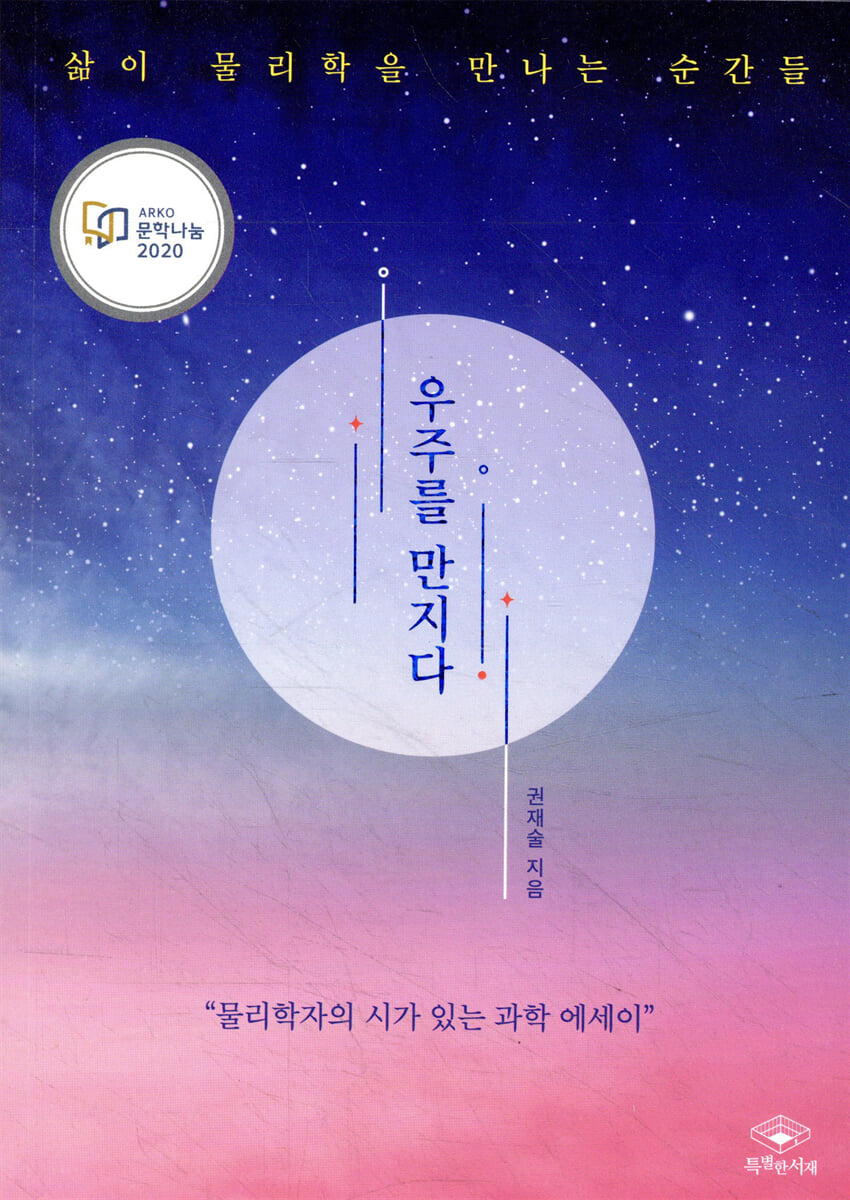
Touch the universe
 |
Description
Book Introduction
Stimulate your intellectual curiosity “Science is so easy, it’s even fun!” For those of you who find the mere mention of 'physics' difficult and distant, 'Touching the Universe' has been published, which discusses the universe from a warmer and gentler perspective. This book is a scientific essay that looks at the world we live in from the perspective of a physicist, from the microscopic world of atoms, which is far more detailed and tiny than all the grains of sand on Earth combined, to the macroscopic world beyond the universe, whose end cannot be fathomed. Not only does it offer scientific stories that stimulate readers' intellectual curiosity, but it also evokes emotions through the life reflections of a seasoned physicist, and the short, impressive poems placed at the end of each story. "Touching the Universe" is a book that easily and enjoyably explains physics topics that are familiar to us but still unfamiliar, such as solar eclipses, aliens, the theory of relativity, and Schrödinger's cat. Perhaps the common sense we knew could be turned upside down, and it could be an opportunity to recognize the world that exists before our eyes but cannot be seen. But there is no need to worry or be afraid. As the author states in the preface, he hopes that readers will not gain scientific-level knowledge through this book, but rather feel a little of the excitement scientists feel about nature and the universe. He also hopes that readers will feel free to touch and play with the universe, creating a richer and more enjoyable life, rather than becoming experts on the universe. |
- You can preview some of the book's contents.
Preview
index
Recommendation
preface
Chapter 1 One Star, One Me
One star, one star
The Wanderers
Look at the past
Counting stars
distant star
There are no boundaries
pale blue dot
Crooked Earth
The feeling of watching an eclipse
round land
The violence of names
Finding Aliens
Encounter with aliens
Chapter 2: The Dance of Atoms
Dance of the Atoms
Lavoisier's Immortality
The Secret of Avogadro's Number
Inside the visible
mortal beings
Shape of an atom
selfish atom
Maxwell's Goblin
The Inn of Molecules
entropy
dark matter
Chapter 3: God's Dice Game
Particle or wave?
There is only birth and death
Cosmic connection
deceiving God
Schrödinger's cat
God's Dice Game
Cheshire Cat's Laugh
quantum entanglement
Swap
Choice, reason for existence
Vacuum, the chaos of space
Hidden Dimension
Chapter 4 Time Travel
299792458
Memento Mori
The Birth of Time and Space
The relativity of simultaneity
wonderland
time travel
The created Einstein
Space travel, don't let go of your lover's hand
Relativity is not relative
This is the 4th dimension
curved space
Black holes aren't very black
horizon
supplement
Microscopic world, small universe
Macroscopic world, large universe
Theories that explain the world
Acknowledgements
preface
Chapter 1 One Star, One Me
One star, one star
The Wanderers
Look at the past
Counting stars
distant star
There are no boundaries
pale blue dot
Crooked Earth
The feeling of watching an eclipse
round land
The violence of names
Finding Aliens
Encounter with aliens
Chapter 2: The Dance of Atoms
Dance of the Atoms
Lavoisier's Immortality
The Secret of Avogadro's Number
Inside the visible
mortal beings
Shape of an atom
selfish atom
Maxwell's Goblin
The Inn of Molecules
entropy
dark matter
Chapter 3: God's Dice Game
Particle or wave?
There is only birth and death
Cosmic connection
deceiving God
Schrödinger's cat
God's Dice Game
Cheshire Cat's Laugh
quantum entanglement
Swap
Choice, reason for existence
Vacuum, the chaos of space
Hidden Dimension
Chapter 4 Time Travel
299792458
Memento Mori
The Birth of Time and Space
The relativity of simultaneity
wonderland
time travel
The created Einstein
Space travel, don't let go of your lover's hand
Relativity is not relative
This is the 4th dimension
curved space
Black holes aren't very black
horizon
supplement
Microscopic world, small universe
Macroscopic world, large universe
Theories that explain the world
Acknowledgements
Detailed image
Into the book
Proxima Centauri, the closest star to Earth, is about 4 light-years away.
A light year is the distance light travels in one year.
Light can travel a distance equivalent to 7 and a half times around the Earth in one second, and it can travel to the Sun, which is 150 million kilometers away, in 8 minutes.
But, with that kind of light, we have to go not for an hour, not for a day, not for a month, not for a year, but for four years.
How far away is it? Still, this is the closest star, and most are vastly farther away.
(…)
Can you imagine? Imagine stars stretching hundreds of millions, even billions of light years across the vast expanse of the sky.
How vast is the universe? You might think it's incredibly large.
But you must realize that this universe is really much bigger than you think.
Space travel? Would humans, who live less than a hundred years, dare to embark on a journey spanning hundreds of millions of years?
Still, humans dream that dream.
--- pp.19~21
The atmosphere is a guesthouse for molecules.
In that inn, only one molecule can enter a room, regardless of type.
It does not consider the size or mass of the molecule.
Just as hotel rooms don't consider the guests' height or weight, neither do the inn rooms of the molecules.
However, not just anyone can enter the luxury hotel, which is a human inn.
You may need to have money and high social status.
There is discrimination in human inn rooms.
But the inn rooms of the molecules do not consider the class of origin.
Unlike human inns, there is no discrimination.
Nature is more fair than humans.
There are many things to learn from nature.
--- p.137
Newton, who observed that light travels in a straight line, reflects when it hits something, and refracts when it passes through glass or water, argued that light is a particle.
However, light goes around obstacles, and when two lights meet, they interfere, creating colors like a rainbow.
This phenomenon means that light is a wave.
And when Maxwell discovered that light is an electromagnetic wave, it became clear that light is a wave.
But light was not a being that easily revealed its identity.
When light shines on a metal, electrons are emitted from the metal.
This phenomenon is called the photoelectric effect.
Einstein successfully explained the photoelectric effect by hypothesizing that light is a particle.
For this achievement he received the Nobel Prize.
Light is clearly a wave because it diffracts, but it is also clearly a particle because it produces the photoelectric effect.
So then, is light a particle or a wave? (…)
Light is neither a wave nor a particle.
Light is not such a simple entity that it can be defined by anything.
Just as if you call the Tao the Tao, it is no longer the Tao (道可道 非常道, 名可名 非常名), if you call light a wave, it is no longer a wave, and if you call it a particle, it is no longer a particle.
A being that cannot even be named, that is light.
--- pp.156~158
Quantum superposition can be further extended and applied to the history of life.
No one knows whether I will be successful or unsuccessful in the future.
From a quantum mechanical perspective, my current self exists in a state of superposition of success and failure.
But as time goes by, either failure or success will become reality.
All futures are in quantum superposition.
As time passes, one of these superpositions will become reality.
If I were to be reincarnated tens of thousands of times, I might end up with half of me as a failure and half as a success.
We believe that truth exists objectively.
And I believe the truth is either O or X.
But the truth is not so clearly black and white.
The truth is rather overlapping and ambiguous.
Isn't this ambiguity the mystery of truth?
--- p.178
Both Newton and Einstein explain well why objects fall, but when it comes to light, the two theories are divided.
According to Newton's theory of gravity, light has no mass and is therefore not affected by gravity.
Light is not affected by gravity, so it is not affected by the Earth or the Sun.
But according to Einstein, since space is curved around a star, even massless light should be curved.
Einstein's claim was quite surprising, but British astronomer Eddington observed that light was actually bent by the sun's gravity.
It was the moment when it was proven that space was curved.
With this, Einstein's general theory of relativity was proven, and Einstein became world-famous overnight.
Curved space cannot be seen with the eye.
It can only be seen with the heart.
"Faith is the substance of things hoped for, the evidence of things not seen," wasn't it? The space we live in is curved, but we can't see that curve.
It is a logical conclusion, but one that can be verified experimentally.
The truth is not revealed, it is hidden.
A light year is the distance light travels in one year.
Light can travel a distance equivalent to 7 and a half times around the Earth in one second, and it can travel to the Sun, which is 150 million kilometers away, in 8 minutes.
But, with that kind of light, we have to go not for an hour, not for a day, not for a month, not for a year, but for four years.
How far away is it? Still, this is the closest star, and most are vastly farther away.
(…)
Can you imagine? Imagine stars stretching hundreds of millions, even billions of light years across the vast expanse of the sky.
How vast is the universe? You might think it's incredibly large.
But you must realize that this universe is really much bigger than you think.
Space travel? Would humans, who live less than a hundred years, dare to embark on a journey spanning hundreds of millions of years?
Still, humans dream that dream.
--- pp.19~21
The atmosphere is a guesthouse for molecules.
In that inn, only one molecule can enter a room, regardless of type.
It does not consider the size or mass of the molecule.
Just as hotel rooms don't consider the guests' height or weight, neither do the inn rooms of the molecules.
However, not just anyone can enter the luxury hotel, which is a human inn.
You may need to have money and high social status.
There is discrimination in human inn rooms.
But the inn rooms of the molecules do not consider the class of origin.
Unlike human inns, there is no discrimination.
Nature is more fair than humans.
There are many things to learn from nature.
--- p.137
Newton, who observed that light travels in a straight line, reflects when it hits something, and refracts when it passes through glass or water, argued that light is a particle.
However, light goes around obstacles, and when two lights meet, they interfere, creating colors like a rainbow.
This phenomenon means that light is a wave.
And when Maxwell discovered that light is an electromagnetic wave, it became clear that light is a wave.
But light was not a being that easily revealed its identity.
When light shines on a metal, electrons are emitted from the metal.
This phenomenon is called the photoelectric effect.
Einstein successfully explained the photoelectric effect by hypothesizing that light is a particle.
For this achievement he received the Nobel Prize.
Light is clearly a wave because it diffracts, but it is also clearly a particle because it produces the photoelectric effect.
So then, is light a particle or a wave? (…)
Light is neither a wave nor a particle.
Light is not such a simple entity that it can be defined by anything.
Just as if you call the Tao the Tao, it is no longer the Tao (道可道 非常道, 名可名 非常名), if you call light a wave, it is no longer a wave, and if you call it a particle, it is no longer a particle.
A being that cannot even be named, that is light.
--- pp.156~158
Quantum superposition can be further extended and applied to the history of life.
No one knows whether I will be successful or unsuccessful in the future.
From a quantum mechanical perspective, my current self exists in a state of superposition of success and failure.
But as time goes by, either failure or success will become reality.
All futures are in quantum superposition.
As time passes, one of these superpositions will become reality.
If I were to be reincarnated tens of thousands of times, I might end up with half of me as a failure and half as a success.
We believe that truth exists objectively.
And I believe the truth is either O or X.
But the truth is not so clearly black and white.
The truth is rather overlapping and ambiguous.
Isn't this ambiguity the mystery of truth?
--- p.178
Both Newton and Einstein explain well why objects fall, but when it comes to light, the two theories are divided.
According to Newton's theory of gravity, light has no mass and is therefore not affected by gravity.
Light is not affected by gravity, so it is not affected by the Earth or the Sun.
But according to Einstein, since space is curved around a star, even massless light should be curved.
Einstein's claim was quite surprising, but British astronomer Eddington observed that light was actually bent by the sun's gravity.
It was the moment when it was proven that space was curved.
With this, Einstein's general theory of relativity was proven, and Einstein became world-famous overnight.
Curved space cannot be seen with the eye.
It can only be seen with the heart.
"Faith is the substance of things hoped for, the evidence of things not seen," wasn't it? The space we live in is curved, but we can't see that curve.
It is a logical conclusion, but one that can be verified experimentally.
The truth is not revealed, it is hidden.
--- pp.287~288
Publisher's Review
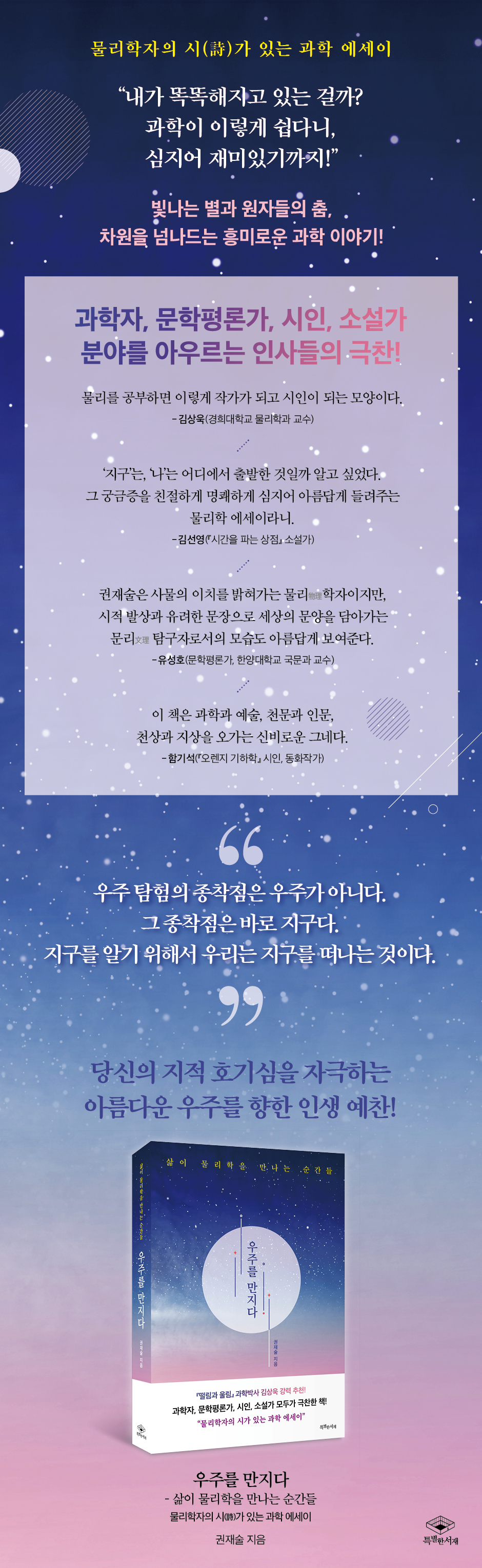
tvN's "Knowing Bros" recommendation letter from Dr. Kim Sang-wook!
“If you study physics, you will become a writer and a poet.”
Rave reviews from scientists, literary critics, poets, novelists, and others across the spectrum!
Science Essays with Poetry by Physicists
For those of you who find the mere mention of 'physics' difficult and distant, 'Touching the Universe' has been published, which discusses the universe from a warmer and gentler perspective.
This book is a scientific essay that looks at the world we live in from the perspective of a physicist, from the microscopic world of atoms, which is far more detailed and tiny than all the grains of sand on Earth combined, to the macroscopic world beyond the universe, whose end cannot be fathomed.
Not only does it offer scientific stories that stimulate readers' intellectual curiosity, but it also evokes emotions through the life reflections of a seasoned physicist, and the short, impressive poems placed at the end of each story.
『Touching the Universe』, which simultaneously captures curiosity through exploration of the infinite universe and literary value through poetry that connects the distant universe to our lives, has received rave reviews from figures across various fields, including Professor Kim Sang-wook, a science doctor from tvN's "All-Round Knowledge," novelist Kim Seon-young of "The Store That Sells Time," literary critic Yoo Seong-ho, and poet Ham Ki-seok of "Orange Geometry."
The author has successfully created a harmony between two seemingly impossible fields: literary inspiration conveyed through science.
As you float through the delicious harmony of science and literature, you will find yourself drawn into the allure of physics and space, which once seemed so vaguely difficult, and reflect on your life.
“The truth is not far away.
“You are standing on that truth.”
Physics, the Life Science Beyond the Universe It Contains
"Touching the Universe" is a book that easily and enjoyably explains physics topics that are familiar to us but still unfamiliar, such as solar eclipses, aliens, the theory of relativity, and Schrödinger's cat.
Perhaps the common sense we knew could be turned upside down, and it could be an opportunity to recognize the world that exists before our eyes but cannot be seen.
But there is no need to worry or be afraid.
As the author states in the preface, he hopes that readers will not gain scientific-level knowledge through this book, but rather feel a little of the excitement scientists feel about nature and the universe. He also hopes that readers will feel free to touch and play with the universe, creating a richer and more enjoyable life, rather than becoming experts on the universe.
There is more to the universe than your philosophy dreams of.
- William Shakespeare
To some, the field of science might seem vaguely difficult, but as you turn the pages of this book, the psychological barriers to science will become as vague as the boundary between Earth and space, and eventually crumble.
It doesn't matter if you're a 'science layman'.
The moment you close this book, you'll find yourself saying, "Science is this easy? It's even fun?!"
A celebration of life towards the beautiful universe!
“Science is so easy, it’s even fun!”
In times like these, when everyone's lives are difficult, when the present reality feels daunting, why not turn your gaze to distant places? Perhaps what we desperately need, day after day, is the universe that lies far beyond.
"Touching the Universe," which unfolds during a time when nothing can be done properly, provides readers with an opportunity to learn about the vast universe and think about our lives.
“The destination of space exploration is not space.
The final destination is Earth.
(…) In order to know the Earth, we must leave the Earth.”
"Touching the Universe" is a fun book that explains not only the universe but also the world we live in.
But as you read the book, you will realize that all of these stories are ultimately closely related to 'our lives.'
Let us willingly face the time it takes to travel into space to learn about the Earth and our lives.
As you watch the dance of shining stars and atoms, and the fascinating science stories that transcend dimensions, the joy of physics will gradually dawn on even those weary of reality.
“If you study physics, you will become a writer and a poet.”
Rave reviews from scientists, literary critics, poets, novelists, and others across the spectrum!
Science Essays with Poetry by Physicists
For those of you who find the mere mention of 'physics' difficult and distant, 'Touching the Universe' has been published, which discusses the universe from a warmer and gentler perspective.
This book is a scientific essay that looks at the world we live in from the perspective of a physicist, from the microscopic world of atoms, which is far more detailed and tiny than all the grains of sand on Earth combined, to the macroscopic world beyond the universe, whose end cannot be fathomed.
Not only does it offer scientific stories that stimulate readers' intellectual curiosity, but it also evokes emotions through the life reflections of a seasoned physicist, and the short, impressive poems placed at the end of each story.
『Touching the Universe』, which simultaneously captures curiosity through exploration of the infinite universe and literary value through poetry that connects the distant universe to our lives, has received rave reviews from figures across various fields, including Professor Kim Sang-wook, a science doctor from tvN's "All-Round Knowledge," novelist Kim Seon-young of "The Store That Sells Time," literary critic Yoo Seong-ho, and poet Ham Ki-seok of "Orange Geometry."
The author has successfully created a harmony between two seemingly impossible fields: literary inspiration conveyed through science.
As you float through the delicious harmony of science and literature, you will find yourself drawn into the allure of physics and space, which once seemed so vaguely difficult, and reflect on your life.
“The truth is not far away.
“You are standing on that truth.”
Physics, the Life Science Beyond the Universe It Contains
"Touching the Universe" is a book that easily and enjoyably explains physics topics that are familiar to us but still unfamiliar, such as solar eclipses, aliens, the theory of relativity, and Schrödinger's cat.
Perhaps the common sense we knew could be turned upside down, and it could be an opportunity to recognize the world that exists before our eyes but cannot be seen.
But there is no need to worry or be afraid.
As the author states in the preface, he hopes that readers will not gain scientific-level knowledge through this book, but rather feel a little of the excitement scientists feel about nature and the universe. He also hopes that readers will feel free to touch and play with the universe, creating a richer and more enjoyable life, rather than becoming experts on the universe.
There is more to the universe than your philosophy dreams of.
- William Shakespeare
To some, the field of science might seem vaguely difficult, but as you turn the pages of this book, the psychological barriers to science will become as vague as the boundary between Earth and space, and eventually crumble.
It doesn't matter if you're a 'science layman'.
The moment you close this book, you'll find yourself saying, "Science is this easy? It's even fun?!"
A celebration of life towards the beautiful universe!
“Science is so easy, it’s even fun!”
In times like these, when everyone's lives are difficult, when the present reality feels daunting, why not turn your gaze to distant places? Perhaps what we desperately need, day after day, is the universe that lies far beyond.
"Touching the Universe," which unfolds during a time when nothing can be done properly, provides readers with an opportunity to learn about the vast universe and think about our lives.
“The destination of space exploration is not space.
The final destination is Earth.
(…) In order to know the Earth, we must leave the Earth.”
"Touching the Universe" is a fun book that explains not only the universe but also the world we live in.
But as you read the book, you will realize that all of these stories are ultimately closely related to 'our lives.'
Let us willingly face the time it takes to travel into space to learn about the Earth and our lives.
As you watch the dance of shining stars and atoms, and the fascinating science stories that transcend dimensions, the joy of physics will gradually dawn on even those weary of reality.
GOODS SPECIFICS
- Date of issue: September 29, 2020
- Page count, weight, size: 328 pages | 436g | 141*200*20mm
- ISBN13: 9791188912872
- ISBN10: 1188912879
You may also like
카테고리
korean


korean

![GQ KOREA Mark (Monthly): December [2025]](http://librairie.coreenne.fr/cdn/shop/files/8ef265dbbfbf186523ed75ba7319009d.jpg?v=1765340328&width=3840)


