

Time Shop
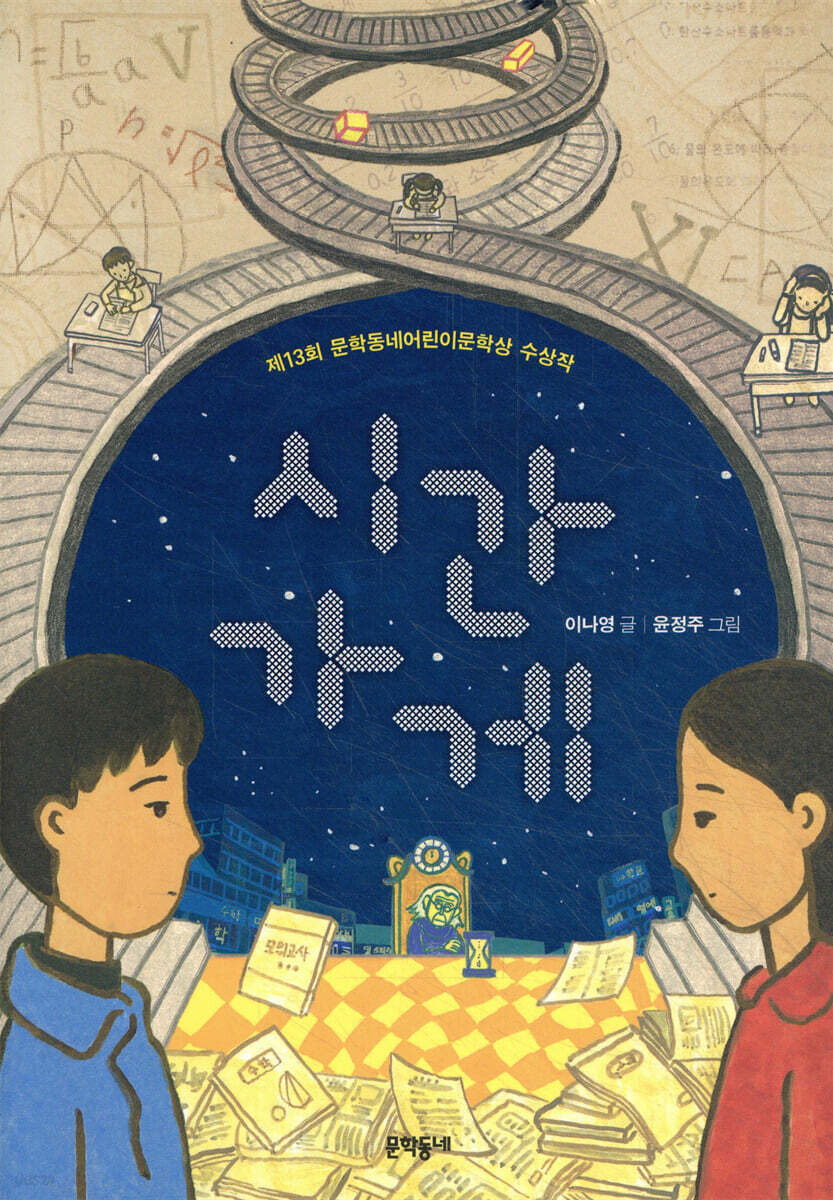 |
Description
Book Introduction
The 13th Munhakdongne Children's Literature Award winner is a story about children who postpone their "present" life for the sake of future happiness. "This clock will give you ten minutes of time a day.
It's very easy to buy time.
No need for money.
You just have to give me one happy memory each.
How about making a deal with me?" This work is truly special in that it connects with the pain of children suffering in the present reality and portrays their wishes in their favorite form, fantasy.
So, our judges unanimously decided that “Time Store” would be the winner.
This work will be remembered by many for a long time, not simply using time as a material, but rather comforting children through the dual thinking of the abstract concepts of time and memory, and addressing the issue of identity formation.
_From the review comments
About the Author
Text┃Inayoung Lee I have been reading books and writing with children for a long time.
I'm so excited to read the book I wrote with those friends.
I won the 13th Munhakdongne Children's Literature Award for "Time Store."
Illustration┃Jeongju Yoon has presented charming and unique illustrations in children's books of various genres.
He has illustrated 『Chief Hwang, Chief Poop, Chief Love』, 『Caught Im Jin-su』, 『Good Job Oh Gwang-myeong』, 『Chef Joo Byeong-guk』, 『Money Feast Commotion』, 『Invincible Joseon Firefighter』, 『Four People in the Entire School Go to the Kitchen』, and the "Word Play Poem Collection" series.
It's very easy to buy time.
No need for money.
You just have to give me one happy memory each.
How about making a deal with me?" This work is truly special in that it connects with the pain of children suffering in the present reality and portrays their wishes in their favorite form, fantasy.
So, our judges unanimously decided that “Time Store” would be the winner.
This work will be remembered by many for a long time, not simply using time as a material, but rather comforting children through the dual thinking of the abstract concepts of time and memory, and addressing the issue of identity formation.
_From the review comments
About the Author
Text┃Inayoung Lee I have been reading books and writing with children for a long time.
I'm so excited to read the book I wrote with those friends.
I won the 13th Munhakdongne Children's Literature Award for "Time Store."
Illustration┃Jeongju Yoon has presented charming and unique illustrations in children's books of various genres.
He has illustrated 『Chief Hwang, Chief Poop, Chief Love』, 『Caught Im Jin-su』, 『Good Job Oh Gwang-myeong』, 『Chef Joo Byeong-guk』, 『Money Feast Commotion』, 『Invincible Joseon Firefighter』, 『Four People in the Entire School Go to the Kitchen』, and the "Word Play Poem Collection" series.
- You can preview some of the book's contents.
Preview
Detailed image

Publisher's Review
Winner of the 13th Munhakdongne Children's Literature Award
The story of children who postponed their present lives for future happiness.
“This watch will give you ten minutes of your time each day.
It's very easy to buy time.
No need for money.
You just have to give me one happy memory each.
“How about making a deal with me?”
This work is truly special in that it connects with the pain of children suffering in reality and portrays their hopes in their favorite form, fantasy.
So, our judges unanimously decided that “Time Store” would be the winner.
This work will be remembered by many for a long time, not simply using time as a material, but rather comforting children through the dual thinking of the abstract concepts of time and memory, and addressing the issue of identity formation.
_From the review comments
Winner of the 13th Munhakdongne Children's Literature Award
A vivid fantasy fairy tale that connects with the lives and inner selves of real children.
The Munhakdongne Children's Literature Award, which has broadened the depth and breadth of children's literature by publishing bold and unique works such as 『The House Where Books Play』, which presents the essence of historical fairy tales that go beyond didacticism; 『The School of Lies』, which was praised for crossing the boundaries of children's literature with its bold thematic consciousness and writing style; 『Bonjour, Tour』, which expands the setting of the work to France and touches on the North-South problem in our society; and 『The Thirteenth Child』, which depicts the friendship between a robot and a human child and contains a profound perspective on humanity, has published another outstanding award-winning work.
"Time Store" is a work that stares directly at the elementary school students and their families of this era who have postponed their "present" lives for the future goal of college entrance exams, and asks the profound question, "Are children truly happy like this?"
The fear of falling behind, brought on by the economic crisis, and the emergence of international middle schools and national college entrance exams, have caused our anxiety to break down the Maginot Line, the consensus that "children's innocence must be preserved," and have driven even elementary school students into the college entrance exam frenzy.
Nowadays, many elementary school students grow up going from one academy to another in a competitive dilemma that is no longer an exception just because they are young.
Not only studying, but also hobbies and leisure activities are standardized and prepared as careers for future goals through the 'hands of experts' in the academy.
The family landscape has also changed.
Parents manage their children as if they were managers, meticulously planning their entrance exam strategies and even their life plans.
"Time Shop" is a work that prioritizes fantasy fun while also using reality as its material.
The main character, Yuna, who is always pressed for time and studying something she doesn't really want to do, one day encounters a time shop and makes a deal to 'sell memories to buy time.'
After that, cracks begin to appear in a child's ordinary daily life that had been tightly packed without any gaps.
"Time Store" depicts children losing their true selves due to the college entrance exam craze.
The protagonist loses ten minutes of his time every day and his memories just to become number one.
This may seem like a magical device that is impossible in reality, but it actually shows us more clearly what children are like today.
As the story progresses, this fairy tale, which seems like a fantasy that humorously depicts children's wishes, actually catches the reality of this place. _From the judges' comments
Yuna's idea that she would sell happy memories of the past to buy 'ten minutes that can be used now' is a reflection of the psychology of children who need even just ten minutes of their own time, and at the same time, it reflects the perception of adults that 'it is not a waste to sacrifice the joys of present life for a rosy future.'
The originality and thrill of the narrative, which raises timely questions based on keen observations of reality and powerfully stretches forward with a genuine message, were enough to captivate the judges.
“You have to study hard to have a comfortable future.
“It may be hard now, but you will smile later.”
I just did what my mom told me to do, I never thought about why.
I just thought it was a way for my mom and I to live happily._From the text
Yuna, a fifth grader, goes to school all day, solves workbooks, and listens to lectures according to the schedule her mother made.
Although he is ranked second in the entire school, he receives private tutoring to do well on the English academy level test, and he also attends a math academy, but he still has to receive private tutoring in math.
Mom is busy working day and night to earn money, with the sole purpose of sending Yuna to a good university in order to be proud of her late father.
Although every moment is overwhelming, Yuna endures and studies hard to please her mother.
Then one day, Yuna, who was late for school and took a different route than usual, encounters the 'Time Store' as if by fate.
Yuna, who needed a place to ask for directions, casually steps into the Time Shop.
In that bizarre space that overwhelmed the senses, with its giant tree in the center and strange writing on the wall, there was an old man with an expression on his face as if he had known Yuna would come.
What if you were offered a deal: once a day, in exchange for one happy memory, you'd gain ten minutes of your own to spend alone? Always pressed for time, Yuna accepts her grandfather's offer without hesitation and receives a special watch.
For ten minutes, when the whole world stops, Yuna is free.
And those ten minutes are used entirely to become number one.
While time stands still, he copies the answer sheet and enjoys the joy of beating his rival, Suyeong, and becoming the top student in the entire school.
The more satisfied she becomes with her test results and the more she sees her mother smiling, the more uncomfortable Yuna feels, but once she starts the temptation of trading time cannot be stopped.
However, meeting precious people like Dahyun, a friend she had lost when moving, and her maternal grandmother makes Yuna look back on her anxious happiness.
Yuna realizes that losing her memories is scarier than she thought, seeing herself unable to truly respond to the warm feelings shown by others and losing the secrets she shared with her father.
Besides, it's a big problem if someone finds out that I'm secretly buying time.
I, Yoon-ah, am an unattractive child and nothing.
Who am I?
It was a happy memory… … .
When I suddenly tried to think of it, I felt overwhelmed.
I never thought about that because it doesn't appear on the test questions._From the text
As Yuna loses the happy memories she had with someone and felt completely, she begins to forget who she is.
But paradoxically, it is while we consciously think about 'happiness' to sell our time that we first begin to truly desire something.
After moving to a neighborhood with a strong educational fervor, Yuna lost all hope for friendships and went about her daily life like a robot, trying to ignore her own feelings and opinions. A big change occurred.
Yuna, who felt the preciousness of things like happiness, memories, and time, now wants to have memories.
Because I, who has no memories, and whose heart is empty and alone, am not the real 'me'.
If I'm not happy now, will I ever be happy in the future, like my mother said? Even if I am, what's the point if I'm not happy now? - From the text
Yuna runs to the time shop because she can no longer lose the memories with her loved ones.
To Yuna, who is feeling impatient, the time shop grandfather proposes a new deal that is the complete opposite of what he has done so far… … .
Will Yuna be able to rectify this chaos? As her dealings with the Time Shop become increasingly intricate and complex, the narrative gains momentum and the tension reaches a crescendo.
When we need to revive the lives of children who have stopped
Children's small life experiences are likely to be undervalued in the face of the challenge of college entrance exams.
In our busy daily lives, there is no room for ‘play’, ‘self’, or ‘relationships’.
But such small experiences accumulate and form the self-identity of childhood.
The wisdom gained through direct encounters and experiences, and the self-identity and worldview developed through relationships with others are more valuable than anything else.
Children's and young adult literature critic Yoo Young-jin argues, "Children who fail to develop their identity fall into deeper confusion." He adds, "What can a child, empty and unfulfilled, expect of themselves and their future? The lost time and memories of a child are irretrievable, so the protagonist's efforts to reclaim those memories are doomed to disaster."
This situation is not just a problem in the work, but is an urgent reality of today.
So, what's the solution to this problem? The author suggests in his work: "Living in the present."
The author's quiet message that one must "live in the present" to truly live as oneself is slowly gaining appeal as Yuna follows in her footsteps, leaving a dull resonance that makes one reflect on oneself by the time one closes the book.
The author's hope that readers of "The Time Store" will be able to ask themselves, even if just for ten minutes, "When am I happy?" stems from respecting children not as machines controlled by adults, but as active beings who can ask questions and build relationships with the world and others.
The fairy tales that young readers are waiting for are not fantasies that focus solely on depicting the fantasy world while omitting real life, or lame works that fail to ensure the fun of a narrative.
The author's sincerity, not only keenly observing the reality surrounding children, the readers of fairy tales, but also delicately examining their hearts from their perspective and seeking to offer comfort and courage, is the greatest driving force behind this work's ability to resonate deeply with the essence of "literature" and the hearts of its readers. "The Time Store" is ready to embrace its readers and become their friend.
The story of children who postponed their present lives for future happiness.
“This watch will give you ten minutes of your time each day.
It's very easy to buy time.
No need for money.
You just have to give me one happy memory each.
“How about making a deal with me?”
This work is truly special in that it connects with the pain of children suffering in reality and portrays their hopes in their favorite form, fantasy.
So, our judges unanimously decided that “Time Store” would be the winner.
This work will be remembered by many for a long time, not simply using time as a material, but rather comforting children through the dual thinking of the abstract concepts of time and memory, and addressing the issue of identity formation.
_From the review comments
Winner of the 13th Munhakdongne Children's Literature Award
A vivid fantasy fairy tale that connects with the lives and inner selves of real children.
The Munhakdongne Children's Literature Award, which has broadened the depth and breadth of children's literature by publishing bold and unique works such as 『The House Where Books Play』, which presents the essence of historical fairy tales that go beyond didacticism; 『The School of Lies』, which was praised for crossing the boundaries of children's literature with its bold thematic consciousness and writing style; 『Bonjour, Tour』, which expands the setting of the work to France and touches on the North-South problem in our society; and 『The Thirteenth Child』, which depicts the friendship between a robot and a human child and contains a profound perspective on humanity, has published another outstanding award-winning work.
"Time Store" is a work that stares directly at the elementary school students and their families of this era who have postponed their "present" lives for the future goal of college entrance exams, and asks the profound question, "Are children truly happy like this?"
The fear of falling behind, brought on by the economic crisis, and the emergence of international middle schools and national college entrance exams, have caused our anxiety to break down the Maginot Line, the consensus that "children's innocence must be preserved," and have driven even elementary school students into the college entrance exam frenzy.
Nowadays, many elementary school students grow up going from one academy to another in a competitive dilemma that is no longer an exception just because they are young.
Not only studying, but also hobbies and leisure activities are standardized and prepared as careers for future goals through the 'hands of experts' in the academy.
The family landscape has also changed.
Parents manage their children as if they were managers, meticulously planning their entrance exam strategies and even their life plans.
"Time Shop" is a work that prioritizes fantasy fun while also using reality as its material.
The main character, Yuna, who is always pressed for time and studying something she doesn't really want to do, one day encounters a time shop and makes a deal to 'sell memories to buy time.'
After that, cracks begin to appear in a child's ordinary daily life that had been tightly packed without any gaps.
"Time Store" depicts children losing their true selves due to the college entrance exam craze.
The protagonist loses ten minutes of his time every day and his memories just to become number one.
This may seem like a magical device that is impossible in reality, but it actually shows us more clearly what children are like today.
As the story progresses, this fairy tale, which seems like a fantasy that humorously depicts children's wishes, actually catches the reality of this place. _From the judges' comments
Yuna's idea that she would sell happy memories of the past to buy 'ten minutes that can be used now' is a reflection of the psychology of children who need even just ten minutes of their own time, and at the same time, it reflects the perception of adults that 'it is not a waste to sacrifice the joys of present life for a rosy future.'
The originality and thrill of the narrative, which raises timely questions based on keen observations of reality and powerfully stretches forward with a genuine message, were enough to captivate the judges.
“You have to study hard to have a comfortable future.
“It may be hard now, but you will smile later.”
I just did what my mom told me to do, I never thought about why.
I just thought it was a way for my mom and I to live happily._From the text
Yuna, a fifth grader, goes to school all day, solves workbooks, and listens to lectures according to the schedule her mother made.
Although he is ranked second in the entire school, he receives private tutoring to do well on the English academy level test, and he also attends a math academy, but he still has to receive private tutoring in math.
Mom is busy working day and night to earn money, with the sole purpose of sending Yuna to a good university in order to be proud of her late father.
Although every moment is overwhelming, Yuna endures and studies hard to please her mother.
Then one day, Yuna, who was late for school and took a different route than usual, encounters the 'Time Store' as if by fate.
Yuna, who needed a place to ask for directions, casually steps into the Time Shop.
In that bizarre space that overwhelmed the senses, with its giant tree in the center and strange writing on the wall, there was an old man with an expression on his face as if he had known Yuna would come.
What if you were offered a deal: once a day, in exchange for one happy memory, you'd gain ten minutes of your own to spend alone? Always pressed for time, Yuna accepts her grandfather's offer without hesitation and receives a special watch.
For ten minutes, when the whole world stops, Yuna is free.
And those ten minutes are used entirely to become number one.
While time stands still, he copies the answer sheet and enjoys the joy of beating his rival, Suyeong, and becoming the top student in the entire school.
The more satisfied she becomes with her test results and the more she sees her mother smiling, the more uncomfortable Yuna feels, but once she starts the temptation of trading time cannot be stopped.
However, meeting precious people like Dahyun, a friend she had lost when moving, and her maternal grandmother makes Yuna look back on her anxious happiness.
Yuna realizes that losing her memories is scarier than she thought, seeing herself unable to truly respond to the warm feelings shown by others and losing the secrets she shared with her father.
Besides, it's a big problem if someone finds out that I'm secretly buying time.
I, Yoon-ah, am an unattractive child and nothing.
Who am I?
It was a happy memory… … .
When I suddenly tried to think of it, I felt overwhelmed.
I never thought about that because it doesn't appear on the test questions._From the text
As Yuna loses the happy memories she had with someone and felt completely, she begins to forget who she is.
But paradoxically, it is while we consciously think about 'happiness' to sell our time that we first begin to truly desire something.
After moving to a neighborhood with a strong educational fervor, Yuna lost all hope for friendships and went about her daily life like a robot, trying to ignore her own feelings and opinions. A big change occurred.
Yuna, who felt the preciousness of things like happiness, memories, and time, now wants to have memories.
Because I, who has no memories, and whose heart is empty and alone, am not the real 'me'.
If I'm not happy now, will I ever be happy in the future, like my mother said? Even if I am, what's the point if I'm not happy now? - From the text
Yuna runs to the time shop because she can no longer lose the memories with her loved ones.
To Yuna, who is feeling impatient, the time shop grandfather proposes a new deal that is the complete opposite of what he has done so far… … .
Will Yuna be able to rectify this chaos? As her dealings with the Time Shop become increasingly intricate and complex, the narrative gains momentum and the tension reaches a crescendo.
When we need to revive the lives of children who have stopped
Children's small life experiences are likely to be undervalued in the face of the challenge of college entrance exams.
In our busy daily lives, there is no room for ‘play’, ‘self’, or ‘relationships’.
But such small experiences accumulate and form the self-identity of childhood.
The wisdom gained through direct encounters and experiences, and the self-identity and worldview developed through relationships with others are more valuable than anything else.
Children's and young adult literature critic Yoo Young-jin argues, "Children who fail to develop their identity fall into deeper confusion." He adds, "What can a child, empty and unfulfilled, expect of themselves and their future? The lost time and memories of a child are irretrievable, so the protagonist's efforts to reclaim those memories are doomed to disaster."
This situation is not just a problem in the work, but is an urgent reality of today.
So, what's the solution to this problem? The author suggests in his work: "Living in the present."
The author's quiet message that one must "live in the present" to truly live as oneself is slowly gaining appeal as Yuna follows in her footsteps, leaving a dull resonance that makes one reflect on oneself by the time one closes the book.
The author's hope that readers of "The Time Store" will be able to ask themselves, even if just for ten minutes, "When am I happy?" stems from respecting children not as machines controlled by adults, but as active beings who can ask questions and build relationships with the world and others.
The fairy tales that young readers are waiting for are not fantasies that focus solely on depicting the fantasy world while omitting real life, or lame works that fail to ensure the fun of a narrative.
The author's sincerity, not only keenly observing the reality surrounding children, the readers of fairy tales, but also delicately examining their hearts from their perspective and seeking to offer comfort and courage, is the greatest driving force behind this work's ability to resonate deeply with the essence of "literature" and the hearts of its readers. "The Time Store" is ready to embrace its readers and become their friend.
GOODS SPECIFICS
- Date of issue: January 3, 2013
- Page count, weight, size: 204 pages | 395g | 150*220*20mm
- ISBN13: 9788954620260
- ISBN10: 8954620264
You may also like
카테고리
korean


korean

![GQ KOREA Mark (Monthly): December [2025]](http://librairie.coreenne.fr/cdn/shop/files/8ef265dbbfbf186523ed75ba7319009d.jpg?v=1765340328&width=3840)


