

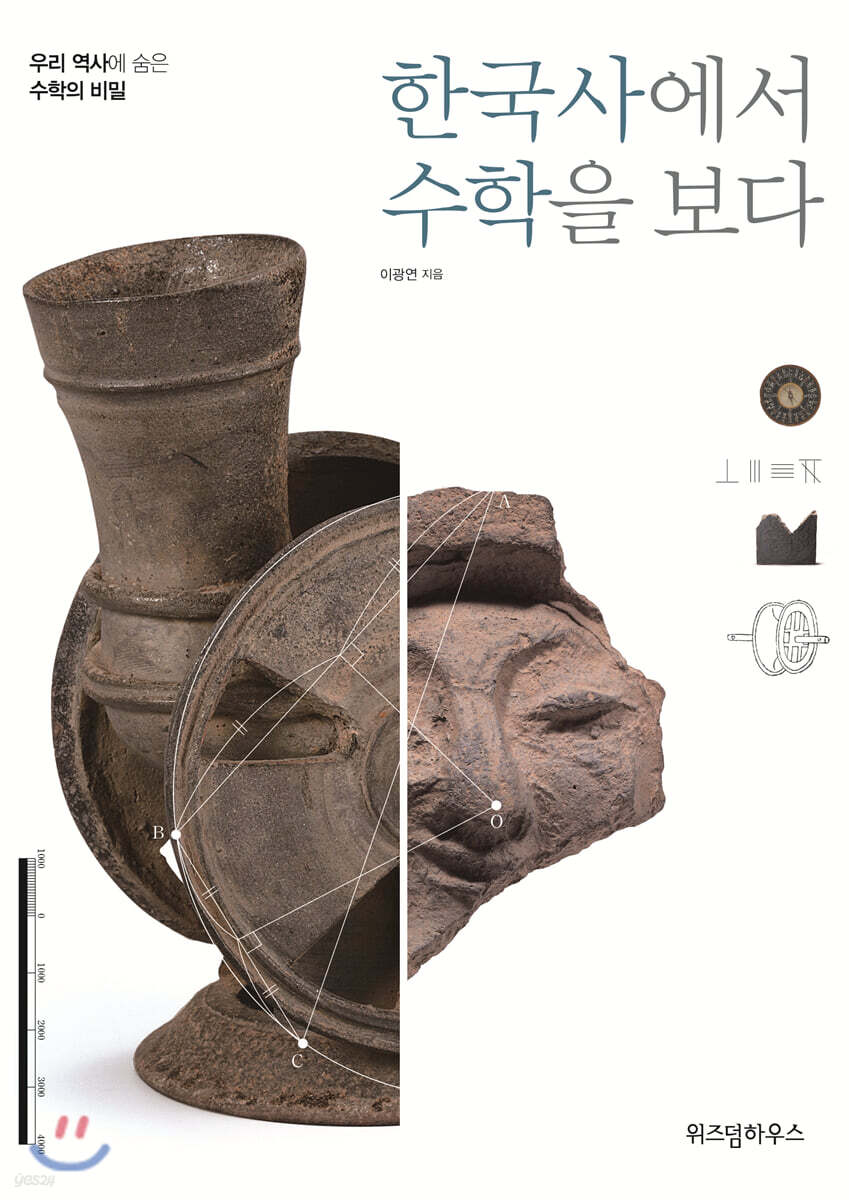
Seeing mathematics in Korean history
 |
Description
Book Introduction
From prehistoric times hundreds of thousands of years ago to the fall of the Korean Empire in 1910
Our people living on the Korean Peninsula have been with mathematics! From the very beginning of history on the Korean Peninsula, various aspects of mathematics are hidden in the institutions, languages, games, inventions, and buildings created by our ancestors. What mathematical secrets can we find in Korean history? This book focuses on over 20 fascinating topics in Korean history, providing a clear and easy-to-understand explanation of how our ancestors used their mathematical wisdom to shape history. This book offers a previously unknown charm of mathematics to liberal arts students and a liberal arts education to science students who find history boring. It is essential content for this era to instill integrated thinking and values in people from youth to adults. |
- You can preview some of the book's contents.
Preview
index
preface
Representative tools of the prehistoric era: the golden ratio and the sphere of revolution _8
The Founding of Gojoseon and the Dangun Myth: The Number 3_20
Dolmens are Bronze Age tombs: The Paradox of the Wheel _34
Yutnori, a very ancient game: Number of cases and probability _44
King Gaero of Baekje's Love of Go: A Showdown Between Humans and Artificial Intelligence _54
The Sui Dynasty's massive invasion of Goguryeo: The mathematical meaning of a million-strong army _64
Ancient Music and Instruments: The Three-Part Profit and Loss Method _76
Silla Artifacts from Wolji Pond in Gyeongju: Restoration of the 14-sided Jureunggu and Artifacts _88
Feng Shui in the Goryeo Founding Myth: Yin-Yang and the Five Elements and Various Formations _100
King Gwangjong of Goryeo introduced the civil service examination system: Goryeo's mathematics exam questions _112
Gyerim Yusa, a record of Goryeo travels written by a Song envoy: Pronunciation and reading of numbers by Goryeo people _124
Haeinsa Temple Tripitaka Koreana Woodblocks in Hapcheon: 50 Million Characters and Probability Calculations _134
Gyeongbokgung Palace, Joseon's Royal Palace: Cycloids and Tiles _146
Taejong's Advisor Ha Ryun: Seunggyeongdo and Origami _160
King Sejong, who studied mathematics himself: Joseon's Academic and Industrial Studies 172
The very, very unique Hunminjeongeum: Mathematical and scientific letters _184
Joseon's Constitution, Gyeongguk Daejeon: Weights and Measures _198
Artist Shin Saimdang's Insect Paintings: Insects and Minorities _210
Joseon's Great Swordsman Im Kkeok-jeong: The Law of Manghaedo and Distance Measurement _222
Yi Sun-sin and the Imjin War: Crane-wing Formation and Dohundo _236
Joseon as reflected in Hamel's Journal: Choi Seok-jeong's Gusuryak _246
King Jeongjo and Jeong Yak-yong, who built the new city of Hwaseong: Cranes and pulleys _260
Kim Jeong-ho's Daedongyeojido, a Compilation of Joseon Cartography: 100-Li Scale and Scale _270
Hague Envoy Lee Sang-seol's "New Book of Arithmetic": A Bridge Between Traditional and Modern Mathematics _282
References
Representative tools of the prehistoric era: the golden ratio and the sphere of revolution _8
The Founding of Gojoseon and the Dangun Myth: The Number 3_20
Dolmens are Bronze Age tombs: The Paradox of the Wheel _34
Yutnori, a very ancient game: Number of cases and probability _44
King Gaero of Baekje's Love of Go: A Showdown Between Humans and Artificial Intelligence _54
The Sui Dynasty's massive invasion of Goguryeo: The mathematical meaning of a million-strong army _64
Ancient Music and Instruments: The Three-Part Profit and Loss Method _76
Silla Artifacts from Wolji Pond in Gyeongju: Restoration of the 14-sided Jureunggu and Artifacts _88
Feng Shui in the Goryeo Founding Myth: Yin-Yang and the Five Elements and Various Formations _100
King Gwangjong of Goryeo introduced the civil service examination system: Goryeo's mathematics exam questions _112
Gyerim Yusa, a record of Goryeo travels written by a Song envoy: Pronunciation and reading of numbers by Goryeo people _124
Haeinsa Temple Tripitaka Koreana Woodblocks in Hapcheon: 50 Million Characters and Probability Calculations _134
Gyeongbokgung Palace, Joseon's Royal Palace: Cycloids and Tiles _146
Taejong's Advisor Ha Ryun: Seunggyeongdo and Origami _160
King Sejong, who studied mathematics himself: Joseon's Academic and Industrial Studies 172
The very, very unique Hunminjeongeum: Mathematical and scientific letters _184
Joseon's Constitution, Gyeongguk Daejeon: Weights and Measures _198
Artist Shin Saimdang's Insect Paintings: Insects and Minorities _210
Joseon's Great Swordsman Im Kkeok-jeong: The Law of Manghaedo and Distance Measurement _222
Yi Sun-sin and the Imjin War: Crane-wing Formation and Dohundo _236
Joseon as reflected in Hamel's Journal: Choi Seok-jeong's Gusuryak _246
King Jeongjo and Jeong Yak-yong, who built the new city of Hwaseong: Cranes and pulleys _260
Kim Jeong-ho's Daedongyeojido, a Compilation of Joseon Cartography: 100-Li Scale and Scale _270
Hague Envoy Lee Sang-seol's "New Book of Arithmetic": A Bridge Between Traditional and Modern Mathematics _282
References
Detailed image
Into the book
Being able to make pottery using a potter's wheel means understanding the principle of rotation.
In mathematics, a solid of revolution is a three-dimensional figure that rotates once around a straight line as an axis.
For example, a column or cone that can be seen when a rectangular or right triangle-shaped piece of paper is attached to a wooden chopstick and turned is a solid of revolution.
---p.
15 Representative tools of the prehistoric era: the golden ratio and the sphere of revolution
For our ancestors, 3 was the first number to which the word 'all' could be attached, and it was a number that represented the whole because it included the beginning, middle, and end.
The power of three is universal and represents the tripartite nature of the world, consisting of sky, earth, and sea.
3 is the human body.
soul .
It represents spirit, birth, life, and death, beginning, middle, and end, past, present, and future, and the three phases of the moon (crescent, half, and full moon).
Also, the basis of 3 is heaven, earth and man, and yesterday (past), today (present) and tomorrow (future).
---p.
31 The Founding of Gojoseon and the Dangun Myth: Among the Numbers 3
The Hwangjonggwan, which Park Yeon created to obtain Hwangjongum, also influenced weights and measures.
In pre-modern societies, the length of one cheok varied slightly from era to era and region to region.
Sejong felt the need to reorganize the weights and measures system as it became disorganized.
So, based on the Hwangjonggwan created by Park Yeon, Hwangjongcheok was established.
The Hwangjong-gwan is 9 chi plus 1 chi to make 1 chi (尺, ja), and is called Hwangjong-cheok.
---p.
85 Ancient Music and Instruments: From the Three-Part Profit and Loss Method
A broken, round artifact, such as the 'Smile of Silla', can be restored to its round shape by using the circumcenter of a triangle.
To restore a broken triangle using mathematics, you must understand how to construct a perpendicular bisector and the circumcenter of a triangle.
---p.
97 Silla relics from Gyeongju Wolji: 14-sided tombstone and restoration of relics
A major characteristic of the Goryeo founding myth is that it sanctifies royal authority through the medieval science of feng shui.
Feng Shui considers the universe, nature, various human-made structures, and human life within this environment as a single organism.
The life principles of these organisms maintain a strict orderly system, and because they are repeatedly applied in the same way in both the macro and micro worlds, the principle is expressed in a complex numerical system, which is the essence of Feng Shui.
---p.
103 Feng Shui in the Goryeo founding myth: Among the five elements of yin and yang and various formations
There is something else that is mathematically most surprising in the Haeinsa Tripitaka Koreana.
Among the 52,396,888 characters in the Tripitaka Koreana, there are only 158 typos, which is an astonishing result that the probability of typos is only (%).
Even though numerous people worked on it, there are almost no errors, and the level of handwriting and engraving is astonishing, as if it were created by a single person.
---p.
141 Haeinsa Tripitaka Koreana woodblocks made during the Mongol invasion: 50 million characters and probability calculations
Sejong not only studied mathematics by solving problems himself, but also encouraged officials, including the nobility, to study science and engineering.
It is said that when the Gyeongsang-do governor donated 100 volumes of the mathematics book “Yang Hui’s Mathematical Methods” published in Song China, they were evenly distributed to the Jiphyeonjeon, the Ministry of Taxation, and the Seopsan-guk (習算局) of the Seoungwan.
In this way, Sejong realized the importance of mathematics as a fundamental discipline, so he studied mathematics himself, encouraged scholars and researchers, and even had scholars conduct research and investigations.
---p.
176 King Sejong, who studied mathematics himself: Joseon's industrial and academic world
《Gusuryak》 contains the origin and fundamentals of numbers, methods of representing fractions and their calculations, the sum of series added using rules, and simultaneous equations.
Also, the shapes of the mountain branches and the method of arranging the mountain branches for addition, subtraction, and multiplication are explained in the 'Numbers' section.
---p.
252 Joseon as reflected in Hamel's Journal: From Choi Seok-jeong's Gusuryak
Kim Jeong-ho devised a number of symbols to facilitate quick and easy recognition of the numerous place names, numbering approximately 11,700, and organized these symbols into a kind of legend called a "map chart" to aid users' understanding.
In mathematics, a solid of revolution is a three-dimensional figure that rotates once around a straight line as an axis.
For example, a column or cone that can be seen when a rectangular or right triangle-shaped piece of paper is attached to a wooden chopstick and turned is a solid of revolution.
---p.
15 Representative tools of the prehistoric era: the golden ratio and the sphere of revolution
For our ancestors, 3 was the first number to which the word 'all' could be attached, and it was a number that represented the whole because it included the beginning, middle, and end.
The power of three is universal and represents the tripartite nature of the world, consisting of sky, earth, and sea.
3 is the human body.
soul .
It represents spirit, birth, life, and death, beginning, middle, and end, past, present, and future, and the three phases of the moon (crescent, half, and full moon).
Also, the basis of 3 is heaven, earth and man, and yesterday (past), today (present) and tomorrow (future).
---p.
31 The Founding of Gojoseon and the Dangun Myth: Among the Numbers 3
The Hwangjonggwan, which Park Yeon created to obtain Hwangjongum, also influenced weights and measures.
In pre-modern societies, the length of one cheok varied slightly from era to era and region to region.
Sejong felt the need to reorganize the weights and measures system as it became disorganized.
So, based on the Hwangjonggwan created by Park Yeon, Hwangjongcheok was established.
The Hwangjong-gwan is 9 chi plus 1 chi to make 1 chi (尺, ja), and is called Hwangjong-cheok.
---p.
85 Ancient Music and Instruments: From the Three-Part Profit and Loss Method
A broken, round artifact, such as the 'Smile of Silla', can be restored to its round shape by using the circumcenter of a triangle.
To restore a broken triangle using mathematics, you must understand how to construct a perpendicular bisector and the circumcenter of a triangle.
---p.
97 Silla relics from Gyeongju Wolji: 14-sided tombstone and restoration of relics
A major characteristic of the Goryeo founding myth is that it sanctifies royal authority through the medieval science of feng shui.
Feng Shui considers the universe, nature, various human-made structures, and human life within this environment as a single organism.
The life principles of these organisms maintain a strict orderly system, and because they are repeatedly applied in the same way in both the macro and micro worlds, the principle is expressed in a complex numerical system, which is the essence of Feng Shui.
---p.
103 Feng Shui in the Goryeo founding myth: Among the five elements of yin and yang and various formations
There is something else that is mathematically most surprising in the Haeinsa Tripitaka Koreana.
Among the 52,396,888 characters in the Tripitaka Koreana, there are only 158 typos, which is an astonishing result that the probability of typos is only (%).
Even though numerous people worked on it, there are almost no errors, and the level of handwriting and engraving is astonishing, as if it were created by a single person.
---p.
141 Haeinsa Tripitaka Koreana woodblocks made during the Mongol invasion: 50 million characters and probability calculations
Sejong not only studied mathematics by solving problems himself, but also encouraged officials, including the nobility, to study science and engineering.
It is said that when the Gyeongsang-do governor donated 100 volumes of the mathematics book “Yang Hui’s Mathematical Methods” published in Song China, they were evenly distributed to the Jiphyeonjeon, the Ministry of Taxation, and the Seopsan-guk (習算局) of the Seoungwan.
In this way, Sejong realized the importance of mathematics as a fundamental discipline, so he studied mathematics himself, encouraged scholars and researchers, and even had scholars conduct research and investigations.
---p.
176 King Sejong, who studied mathematics himself: Joseon's industrial and academic world
《Gusuryak》 contains the origin and fundamentals of numbers, methods of representing fractions and their calculations, the sum of series added using rules, and simultaneous equations.
Also, the shapes of the mountain branches and the method of arranging the mountain branches for addition, subtraction, and multiplication are explained in the 'Numbers' section.
---p.
252 Joseon as reflected in Hamel's Journal: From Choi Seok-jeong's Gusuryak
Kim Jeong-ho devised a number of symbols to facilitate quick and easy recognition of the numerous place names, numbering approximately 11,700, and organized these symbols into a kind of legend called a "map chart" to aid users' understanding.
---p.
278 Kim Jeong-ho's Daedongyeojido, a compilation of Joseon cartography: from the 100-ri scale and scale
278 Kim Jeong-ho's Daedongyeojido, a compilation of Joseon cartography: from the 100-ri scale and scale
Publisher's Review
A high-level meeting of humanities and natural sciences!
Professor Lee Gwang-yeon, the author, has been explaining mathematics in an easy and fun way through various books.
He is an author who constantly thinks about how mathematics can be made more accessible to the general public.
In his previous book, "Mathematics Meets World History," he selected twenty-eight exciting scenes from world history and explained in an interesting way how mathematics brought about changes in those scenes.
This time, we are presenting exciting mathematical theories that fit 24 topics of Korean history, including people, events, and relics.
As a mathematician, it may be natural to explain mathematics in an easy and fun way, but the author's diverse interests, including his knowledge of world history and Korean history, are also interesting.
For those who are interested in both mathematics and history, this could be a fun opportunity to study mathematics through the lens of other disciplines.
As you read Korean history stories with interest, mathematics comes naturally to you.
King Gaero of Baekje lost his life because he loved baduk so much.
During the Joseon Dynasty, King Sejong studied mathematics more diligently than anyone else.
Shin Saimdang painted and embroidered all kinds of grass and insects on an eight-panel folding screen.
Lee Sang-seol, who was dispatched as a special envoy to The Hague, created a mathematics book himself.
As we follow the stories of King Sejong, Lady Shin Saimdang, and Lee Sang-seol, we discover that interesting mathematics is embedded in their lives.
Additionally, mathematicians who lived during the Goryeo and Joseon Dynasties imported Chinese mathematics books, memorized them, and used them in their systems and daily lives.
If you listen to the stories of the math books and study methods they studied, the math we study today may not seem so difficult.
Uncovering the mathematical secrets hidden in our history, often overlooked.
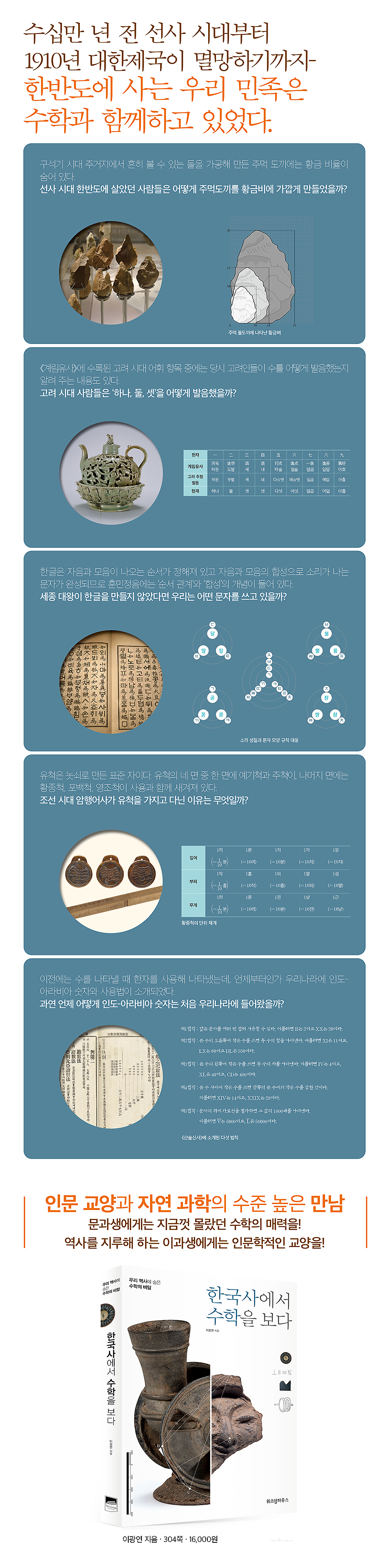
How did people in the Goryeo Dynasty pronounce "one, two, three"? If King Sejong the Great hadn't created Hangul, what alphabet would we be using today? And when were Hindu-Arabic numerals first introduced to Korea? This book offers insights into mathematics related to Korean history, often overlooked.
Through the Goryeo people's reading of numbers in "Gyerim Yusa" and "Hunminjeongeum Eonhae," we can see what mathematical and scientific principles were used to create Hangul.
It also introduces the contents related to Indo-Arabic numerals that appear in the “New Book of Arithmetic.”
Additionally, it is rich in various photographic materials and mathematical images to help readers easily understand history and mathematics, making it visually enjoyable to read.
Professor Lee Gwang-yeon, the author, has been explaining mathematics in an easy and fun way through various books.
He is an author who constantly thinks about how mathematics can be made more accessible to the general public.
In his previous book, "Mathematics Meets World History," he selected twenty-eight exciting scenes from world history and explained in an interesting way how mathematics brought about changes in those scenes.
This time, we are presenting exciting mathematical theories that fit 24 topics of Korean history, including people, events, and relics.
As a mathematician, it may be natural to explain mathematics in an easy and fun way, but the author's diverse interests, including his knowledge of world history and Korean history, are also interesting.
For those who are interested in both mathematics and history, this could be a fun opportunity to study mathematics through the lens of other disciplines.
As you read Korean history stories with interest, mathematics comes naturally to you.
King Gaero of Baekje lost his life because he loved baduk so much.
During the Joseon Dynasty, King Sejong studied mathematics more diligently than anyone else.
Shin Saimdang painted and embroidered all kinds of grass and insects on an eight-panel folding screen.
Lee Sang-seol, who was dispatched as a special envoy to The Hague, created a mathematics book himself.
As we follow the stories of King Sejong, Lady Shin Saimdang, and Lee Sang-seol, we discover that interesting mathematics is embedded in their lives.
Additionally, mathematicians who lived during the Goryeo and Joseon Dynasties imported Chinese mathematics books, memorized them, and used them in their systems and daily lives.
If you listen to the stories of the math books and study methods they studied, the math we study today may not seem so difficult.
Uncovering the mathematical secrets hidden in our history, often overlooked.
How did people in the Goryeo Dynasty pronounce "one, two, three"? If King Sejong the Great hadn't created Hangul, what alphabet would we be using today? And when were Hindu-Arabic numerals first introduced to Korea? This book offers insights into mathematics related to Korean history, often overlooked.
Through the Goryeo people's reading of numbers in "Gyerim Yusa" and "Hunminjeongeum Eonhae," we can see what mathematical and scientific principles were used to create Hangul.
It also introduces the contents related to Indo-Arabic numerals that appear in the “New Book of Arithmetic.”
Additionally, it is rich in various photographic materials and mathematical images to help readers easily understand history and mathematics, making it visually enjoyable to read.
GOODS SPECIFICS
- Date of issue: June 18, 2020
- Page count, weight, size: 304 pages | 502g | 152*215*30mm
- ISBN13: 9791190786782
- ISBN10: 1190786788
You may also like
카테고리
korean


korean

![GQ KOREA Mark (Monthly): December [2025]](http://librairie.coreenne.fr/cdn/shop/files/8ef265dbbfbf186523ed75ba7319009d.jpg?v=1765340328&width=3840)


