

What is Chemistry
 |
Description
Book Introduction
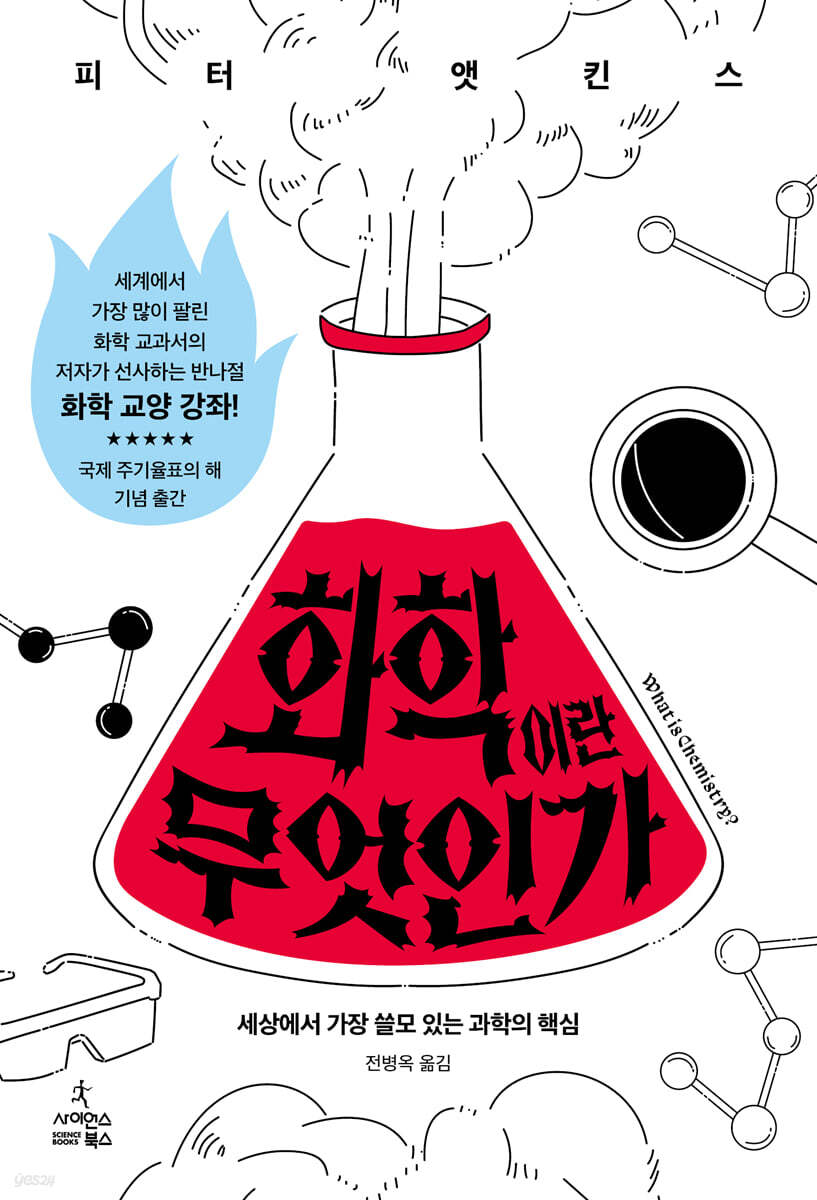
What is Chemistry? is fundamentally intended to provide readers with a concise and clear introduction to the fascinating, intellectually, and economically significant world of chemistry.
At the same time, it aims to dispel vague aversions toward chemistry by showing adult readers who have only bad memories of chemistry, as well as young students who harbor a vague fear of chemistry, what it is like to see nature, the universe, materials, and the world through the eyes of a chemist.
Between reductionist physics, which pursues the smallest elementary particles and the simplest fundamental equations, and biology, which deals with life phenomena full of diversity and complexity that cannot be reduced to a single equation or particle, Peter Atkins explains the fascinating world of chemistry, which studies the transformation process in which atoms meet to create other atoms or molecules, and synthesizes molecules that have never existed in nature since the beginning of time, from its origins to its principles and future in a short book that can be read in half a day.
At the same time, it aims to dispel vague aversions toward chemistry by showing adult readers who have only bad memories of chemistry, as well as young students who harbor a vague fear of chemistry, what it is like to see nature, the universe, materials, and the world through the eyes of a chemist.
Between reductionist physics, which pursues the smallest elementary particles and the simplest fundamental equations, and biology, which deals with life phenomena full of diversity and complexity that cannot be reduced to a single equation or particle, Peter Atkins explains the fascinating world of chemistry, which studies the transformation process in which atoms meet to create other atoms or molecules, and synthesizes molecules that have never existed in nature since the beginning of time, from its origins to its principles and future in a short book that can be read in half a day.
- You can preview some of the book's contents.
Preview
index
Recommendation from Lee Deok-hwan (Professor Emeritus, Sogang University) 5
Preface 9
Chapter 1: Where Does Chemistry Come From and What Does It Explore? 17
Chapter 2: Principles of Chemistry, Part 1: Atoms and Molecules 37
Chapter 3: Principles of Chemistry, Part 2: Energy and Entropy 63
Chapter 4 Chemical Reactions 81
Chapter 5: Experimental Techniques in Chemistry 109
Chapter 6: What Chemistry Has Achieved 131
Chapter 7: Where is Chemistry Going? 159
Glossary 172
Translator's Note 178
Search 183
Preface 9
Chapter 1: Where Does Chemistry Come From and What Does It Explore? 17
Chapter 2: Principles of Chemistry, Part 1: Atoms and Molecules 37
Chapter 3: Principles of Chemistry, Part 2: Energy and Entropy 63
Chapter 4 Chemical Reactions 81
Chapter 5: Experimental Techniques in Chemistry 109
Chapter 6: What Chemistry Has Achieved 131
Chapter 7: Where is Chemistry Going? 159
Glossary 172
Translator's Note 178
Search 183
Detailed image
Into the book
A central theme of chemistry is the process by which one substance changes (in form and properties) into another substance, but atoms themselves do not change.
Therefore, when a substance changes, it does not mean that the atoms that are the basic materials change, but that the atoms that were bonded to each other change their pairs.
Chemists are a kind of couple managers who study the meeting and parting of these atoms.
Chemistry, based on the excellent knowledge provided by physicists, is devoted to its original task of studying the transformation of matter, that is, the reactions that occur between molecules.
We explore life phenomena, create things, and build buildings.
To do this, minerals are mined from the ground and useful liquids (such as oil) are extracted.
Sometimes we capture gases from the air and convert them into useful substances we want.
The conversion process varies.
We pour the raw materials into molds to create shapes, and we hammer them or glue them together.
In some cases, they are simply burned.
It is all related to the structure and reactions of molecules, so it is the field of chemistry.
While it may be difficult to find chemists in factories where such practices actually occur, the knowledge systems and information developed by chemists play a significant role in the foundation of these practices.
All are deeply related to modern technological innovation and industrial development.
Looking at it this way, we can see that chemistry has a huge impact on industry and the economy, interacting at almost every point.
---From Chapter 1, “Where did chemistry come from and what does it explore?”
So, what information can we glean from the periodic table that makes it so important? The table provides incredibly valuable information about the structural properties of elements and their atoms.
Although it is only one table, it contains so much information that it is often spent a lot of time explaining it in chemistry classes.
In fact, how could anyone learn about over 100 atoms and their properties without a well-organized table like this? The usefulness of being able to determine a certain atom's properties to some extent simply by looking at where it is located in the table is invaluable.
Mendeleev, who organized the periodic table, is said to have come up with this table while writing a chemistry textbook, so it can be said that he had students in mind from the beginning.
As you navigate the following chapters with this knowledge, you'll find yourself thinking very similarly to the chemists.
For example, it becomes possible to predict which combinations will be easy to form and which will be difficult to form.
The report of all this information is the periodic table.
If you happen to see a periodic table on a bookshelf or on a science lab wall, I hope you'll nod meaningfully as you savor the power of this simple table.
---From "Chapter 2 Principles of Chemistry, Part 1: Atoms and Molecules"
Atoms are one of the great streams that run through the world of chemistry.
And we're about to embark on a journey to explore another great stream, one that's surprisingly ordinary: energy.
Chemists believe that the answer to why and how chemical reactions occur and why chemical bonds occur in different ways lies in energy.
In terms of chemical bonding, substances before the reaction release some of their energy to the surroundings as they find new partners and bond.
So, it is common for the energy level of the compound after the reaction to be lower than before the reaction.
In this process, the total amount of energy does not change, and the system only becomes more disordered.
It's similar to when you buy something and take out the money that was neatly organized in your wallet and hand it to the store owner.
The money just moves from one person to another, but the total amount of money doesn't change.
Money is dispersed around and spreads more freely.
This is what makes the economy go round.
So far, we have looked at the relationship between energy and reaction, that is, how energy can be both the whip and the carrot that leads to reaction.
In a natural environment that wants to become disordered—where entropy increases—if left alone, energy that enables this is a good carrot.
On the other hand, there is a hill to climb to get to the desired state, and energy acts as a whip to help you overcome this hill.
---From "Chapter 3 Principles of Chemistry, Part 2: Energy and Entropy"
Even when we cook in the kitchen, we can observe chemical reactions, and countless chemical reactions are taking place inside our bodies right now.
We live with chemical reactions.
So, this knowledge has been accumulating for a long time, but here I would like to unravel the story by asking one important question.
"What exactly is a chemical reaction?" Or, to put it another way, "What are all these mysterious things chemists do when they shake, stir, boil, and pour other solutions into their solutions?"
The atoms around us are quite cunning and will easily swap partners for even a small profit.
The substances before this exchange process are called reactants, and the newly created substances after the exchange process are called products.
Since products and reactants are merely a change in the combination of atoms, no new atoms can be created or destroyed.
Therefore, the law of conservation of mass, which states that the net mass of reactants and products is equal, is established.
While combustion and explosion can occur in an instant from a small spark, the complex web of medicines requires enormous effort, elaborate planning, a high level of knowledge, and above all, a fair amount of luck to create.
It is not uncommon for people to dedicate their entire lives to a single creation.
---From "Chapter 4 Chemical Reactions"
Without chemistry, we would never have escaped the Stone Age.
All the useful substances that make our daily lives comfortable and enriching were developed based on the knowledge accumulated in chemistry.
In the broadest sense, chemists explore the processes by which one substance is transformed into another, based on their understanding of matter.
They discovered that natural resources such as crude oil and ore could be turned into raw materials, producing materials such as fossil fuels and iron.
They figured out how to collect gases and separate nitrogen from the air to make fertilizer.
They also produced new materials that could be used as textiles and succeeded in supplying key raw materials needed for advanced technologies.
It was all the chemists' contribution.
Since the origin of mankind, the importance of the following four substances has been constantly emphasized.
Let's resume our journey by looking at what chemistry has accomplished with these substances.
These four substances are earth, air, fire, and water.
To summarize, the aspirations of green chemistry are as follows.
It is not sustainable for the chemical industry to continue to develop in its current state.
However, this does not mean that we can artificially reduce industrial production and abandon the civilization we have built.
As a company, we will not accept a decline in profits.
Therefore, it is inevitable that a conflict will arise between environmental responsibility and corporate interests.
The key is to recognize risks before they occur and find proactive solutions.
This is everyone's responsibility, and those who have more to gain should bear more responsibility.
---From "Chapter 6 What Chemistry Has Achieved"
The molecules dealt with in this area, namely nanomolecules, are synthesized and provided by organic or inorganic chemists.
There are two ways to create nanoparticles: by creating a large substance and then cutting it down into smaller pieces, or by stacking small molecules.
Among these, the stacking method is receiving a lot of attention, as it is generally made by self-assembly.
According to this method, molecules interact with each other, break down and reassemble, and a nanomaterial of the desired shape is completed without any special external stimulation.
It's similar to putting together a picture with puzzle pieces, but rather than putting the pieces together one by one, it's more like putting them all together at once.
It is the genius of nature.
So far, we've looked at what chemistry can do, including some seemingly magical things.
However, introducing readers to interesting applications alone cannot explain all the advances in chemistry.
While these are in their own way visible and understandable, chemistry should focus on more fundamental inquiry: expanding our knowledge of matter and how to apply that knowledge.
And so, although incrementally, we come to understand and imitate the works of nature, to marvel at its wonders, and to realize the greatness of knowledge.
Basic research is key to making things like this possible.
Basic research can lead to unexpected discoveries, insights, and the development of products that defy common sense.
Perhaps there are readers who have misunderstood chemistry and chemists for one reason or another.
I hope that the information I have presented in this book can help to clear up some of those misunderstandings.
At the same time, I hope that readers will also feel the joy of discovering this amazing world.
Therefore, when a substance changes, it does not mean that the atoms that are the basic materials change, but that the atoms that were bonded to each other change their pairs.
Chemists are a kind of couple managers who study the meeting and parting of these atoms.
Chemistry, based on the excellent knowledge provided by physicists, is devoted to its original task of studying the transformation of matter, that is, the reactions that occur between molecules.
We explore life phenomena, create things, and build buildings.
To do this, minerals are mined from the ground and useful liquids (such as oil) are extracted.
Sometimes we capture gases from the air and convert them into useful substances we want.
The conversion process varies.
We pour the raw materials into molds to create shapes, and we hammer them or glue them together.
In some cases, they are simply burned.
It is all related to the structure and reactions of molecules, so it is the field of chemistry.
While it may be difficult to find chemists in factories where such practices actually occur, the knowledge systems and information developed by chemists play a significant role in the foundation of these practices.
All are deeply related to modern technological innovation and industrial development.
Looking at it this way, we can see that chemistry has a huge impact on industry and the economy, interacting at almost every point.
---From Chapter 1, “Where did chemistry come from and what does it explore?”
So, what information can we glean from the periodic table that makes it so important? The table provides incredibly valuable information about the structural properties of elements and their atoms.
Although it is only one table, it contains so much information that it is often spent a lot of time explaining it in chemistry classes.
In fact, how could anyone learn about over 100 atoms and their properties without a well-organized table like this? The usefulness of being able to determine a certain atom's properties to some extent simply by looking at where it is located in the table is invaluable.
Mendeleev, who organized the periodic table, is said to have come up with this table while writing a chemistry textbook, so it can be said that he had students in mind from the beginning.
As you navigate the following chapters with this knowledge, you'll find yourself thinking very similarly to the chemists.
For example, it becomes possible to predict which combinations will be easy to form and which will be difficult to form.
The report of all this information is the periodic table.
If you happen to see a periodic table on a bookshelf or on a science lab wall, I hope you'll nod meaningfully as you savor the power of this simple table.
---From "Chapter 2 Principles of Chemistry, Part 1: Atoms and Molecules"
Atoms are one of the great streams that run through the world of chemistry.
And we're about to embark on a journey to explore another great stream, one that's surprisingly ordinary: energy.
Chemists believe that the answer to why and how chemical reactions occur and why chemical bonds occur in different ways lies in energy.
In terms of chemical bonding, substances before the reaction release some of their energy to the surroundings as they find new partners and bond.
So, it is common for the energy level of the compound after the reaction to be lower than before the reaction.
In this process, the total amount of energy does not change, and the system only becomes more disordered.
It's similar to when you buy something and take out the money that was neatly organized in your wallet and hand it to the store owner.
The money just moves from one person to another, but the total amount of money doesn't change.
Money is dispersed around and spreads more freely.
This is what makes the economy go round.
So far, we have looked at the relationship between energy and reaction, that is, how energy can be both the whip and the carrot that leads to reaction.
In a natural environment that wants to become disordered—where entropy increases—if left alone, energy that enables this is a good carrot.
On the other hand, there is a hill to climb to get to the desired state, and energy acts as a whip to help you overcome this hill.
---From "Chapter 3 Principles of Chemistry, Part 2: Energy and Entropy"
Even when we cook in the kitchen, we can observe chemical reactions, and countless chemical reactions are taking place inside our bodies right now.
We live with chemical reactions.
So, this knowledge has been accumulating for a long time, but here I would like to unravel the story by asking one important question.
"What exactly is a chemical reaction?" Or, to put it another way, "What are all these mysterious things chemists do when they shake, stir, boil, and pour other solutions into their solutions?"
The atoms around us are quite cunning and will easily swap partners for even a small profit.
The substances before this exchange process are called reactants, and the newly created substances after the exchange process are called products.
Since products and reactants are merely a change in the combination of atoms, no new atoms can be created or destroyed.
Therefore, the law of conservation of mass, which states that the net mass of reactants and products is equal, is established.
While combustion and explosion can occur in an instant from a small spark, the complex web of medicines requires enormous effort, elaborate planning, a high level of knowledge, and above all, a fair amount of luck to create.
It is not uncommon for people to dedicate their entire lives to a single creation.
---From "Chapter 4 Chemical Reactions"
Without chemistry, we would never have escaped the Stone Age.
All the useful substances that make our daily lives comfortable and enriching were developed based on the knowledge accumulated in chemistry.
In the broadest sense, chemists explore the processes by which one substance is transformed into another, based on their understanding of matter.
They discovered that natural resources such as crude oil and ore could be turned into raw materials, producing materials such as fossil fuels and iron.
They figured out how to collect gases and separate nitrogen from the air to make fertilizer.
They also produced new materials that could be used as textiles and succeeded in supplying key raw materials needed for advanced technologies.
It was all the chemists' contribution.
Since the origin of mankind, the importance of the following four substances has been constantly emphasized.
Let's resume our journey by looking at what chemistry has accomplished with these substances.
These four substances are earth, air, fire, and water.
To summarize, the aspirations of green chemistry are as follows.
It is not sustainable for the chemical industry to continue to develop in its current state.
However, this does not mean that we can artificially reduce industrial production and abandon the civilization we have built.
As a company, we will not accept a decline in profits.
Therefore, it is inevitable that a conflict will arise between environmental responsibility and corporate interests.
The key is to recognize risks before they occur and find proactive solutions.
This is everyone's responsibility, and those who have more to gain should bear more responsibility.
---From "Chapter 6 What Chemistry Has Achieved"
The molecules dealt with in this area, namely nanomolecules, are synthesized and provided by organic or inorganic chemists.
There are two ways to create nanoparticles: by creating a large substance and then cutting it down into smaller pieces, or by stacking small molecules.
Among these, the stacking method is receiving a lot of attention, as it is generally made by self-assembly.
According to this method, molecules interact with each other, break down and reassemble, and a nanomaterial of the desired shape is completed without any special external stimulation.
It's similar to putting together a picture with puzzle pieces, but rather than putting the pieces together one by one, it's more like putting them all together at once.
It is the genius of nature.
So far, we've looked at what chemistry can do, including some seemingly magical things.
However, introducing readers to interesting applications alone cannot explain all the advances in chemistry.
While these are in their own way visible and understandable, chemistry should focus on more fundamental inquiry: expanding our knowledge of matter and how to apply that knowledge.
And so, although incrementally, we come to understand and imitate the works of nature, to marvel at its wonders, and to realize the greatness of knowledge.
Basic research is key to making things like this possible.
Basic research can lead to unexpected discoveries, insights, and the development of products that defy common sense.
Perhaps there are readers who have misunderstood chemistry and chemists for one reason or another.
I hope that the information I have presented in this book can help to clear up some of those misunderstandings.
At the same time, I hope that readers will also feel the joy of discovering this amazing world.
---From "Chapter 7: Where is Chemistry Going?"
Publisher's Review
I hope that readers will enjoy their journey through the world of chemistry with this book.
In particular, if you have unpleasant memories about chemistry, I hope this book will help you overcome them.
The world of chemistry is very deep and wide.
There is no need to be afraid though.
Because chemistry is a story about the world, and it is also a story about us.
-Peter Atkins
The 2019 Nobel Prize in Chemistry went to John Goodenough (USA), Richard Whittingham (USA), and Akira Yoshino (Japan) for their contributions to the development of lithium-ion batteries.
Nowadays, it's hard to find someone who doesn't own a lithium-ion battery or at least one piece of equipment that contains one.
Lithium-ion batteries are an essential part of modern civilization and a fundamental technology for the future Fourth Industrial Revolution.
In fact, we live surrounded by the products of chemistry.
There is nothing that is not a product of chemistry, from food, clothing, and shelter to the infrastructure of urban civilization.
In fact, our country's economy also depends heavily on chemicals.
For example, the production and export volumes of our country's petrochemical industry alone amount to 90 trillion won and 58 trillion won, respectively.
(As of 2018) In the lithium-ion battery field, which won the Nobel Prize for this year to Japan and the United States, our chemical companies (Samsung SDI, LG Chem, etc.) are contributing to the export industry by controlling 30% of the global market.
If anyone asks what science is useful for, just look at what chemistry has accomplished.
However, chemistry does not receive much attention among educated people.
It is not easy to find general books on chemistry in the publishing market.
It's nothing compared to evolutionary biology or astrophysics, which have such prominent speakers as Richard Dawkins and Carl Sagan.
That doesn't mean there are no books or writers in the field of chemistry.
Peter William Atkins, author of What is Chemistry?, recently published by Science Books, is a representative chemistry writer.
Peter Atkins is best known as the author of Atkins' Physical Chemistry, one of the world's best-selling and most widely used physical chemistry textbooks for over 40 years since its first publication in 1978 (currently in its 11th edition).
He was a professor of chemistry at Lincoln College, Oxford University, a director of the Royal Society of Chemistry and the Royal Institution, and chairman of the Education Committee of the International Union of Pure and Applied Chemistry (IUPAC). He also published over 20 books, including textbooks on physical and inorganic chemistry, making significant contributions to chemistry education and popularization.
Among chemists around the world, there are few who graduated without reading even a single one of his textbooks.
(Physical chemistry and inorganic chemistry are required courses in most university chemistry departments.)
Peter Atkins, a veteran chemist, is famous not only for his textbooks but also for his popular books on chemistry.
His textbooks, which break free from the rigid and systematic framework of textbooks, neatly and elegantly explain the fundamental concepts and principles of chemistry, a vast and complex field, through surprising analogies and masterful explanations.
For example, in 『The Kingdom of the Elements』, which has been translated and published in Korea, the periodic table containing about 110 elements is explained without a single formula, comparing it to topography with mountain ranges, valleys, rivers, and plains.
This book, which provides a conceptual map of atomic, elemental, and quantum chemistry, is still recommended by numerous chemists and chemistry teachers as an introductory text for chemistry a quarter of a century after its publication.
In this book, which tackles the question, "What is chemistry?" head-on, Peter Atkins demonstrates his skills as a seasoned chemist and a master writer.
This book is fundamentally intended to provide readers with a concise and clear introduction to the fascinating, intellectually and economically significant world of chemistry.
At the same time, it aims to dispel vague aversions toward chemistry by showing adult readers who have only bad memories of chemistry, as well as young students who harbor a vague fear of chemistry, what it is like to see nature, the universe, materials, and the world through the eyes of a chemist.
Between reductionist physics, which pursues the smallest elementary particles and the simplest fundamental equations, and biology, which deals with life phenomena full of diversity and complexity that cannot be reduced to a single equation or particle, Peter Atkins explains the fascinating world of chemistry, which studies the transformation process in which atoms meet to create other atoms or molecules, and synthesizes molecules that have never existed in nature since the beginning of time, from its origins to its principles and future in a short book that can be read in half a day.
In the words of Peter Atkins, a master of chemistry, chemists can be 'couple managers' who pair one atom with another, or they can be convergents who connect physics and biology, and merge pure science with applied technology, or they can be modern-day alchemists who create technological civilization by modifying the four elements of water, earth, air, and fire.
At the same time, they are also accused of being environmental polluters and manufacturers of biochemical weapons, and are also responsible for developing technologies to restore the natural balance that humanity has disrupted.
As you read this book, which weaves together engaging explanations and vivid metaphors, you'll find yourself thinking very much like chemists.
For example, it will be possible to predict which combinations will be easy to form and which will be difficult to form, and it will be possible to guess how chemistry has transformed natural substances into useful products and how chemistry can be used to solve the numerous problems facing humanity.
Ultimately, as the author hopes, the unpleasant memories of chemistry that many adult readers have will be resolved.
It will also be a reference for science and engineering students who are considering their career paths.
A short and concise chemistry lecture that only a master can give.
Introducing chemistry concisely and clearly is never easy.
The method chosen by Professor Atkins, a master of writing textbooks that systematically and logically introduce the basic principles and laws of chemistry to college students majoring in chemistry, is unique.
It boldly abandons detailed explanations that are only necessary for scientists majoring in chemistry.
We focus on introducing only the essential key points necessary to understand the vast framework of chemistry.
It's not as easy as it sounds.
This is only possible if you have a firm belief in what's important and what's not. - Lee Deok-hwan (Professor Emeritus, Sogang University)
This book is designed to introduce readers to the fascinating, intellectually and economically significant world of chemistry.
My role is to guide you into the world of chemistry and help you see it clearly.
To this end, I will travel with readers through the world as seen through the eyes of chemists.
By understanding key concepts together, we will show how chemistry contributes to human culture and well-being.
We will also explain how chemists view and contemplate all the substances around us, from tiny pebbles to living organisms.
We will examine in detail how the knowledge chemists have accumulated through their sweat and toil is applied to transforming substances collected from the air or dug up from the ground into useful substances for our lives. - In the text
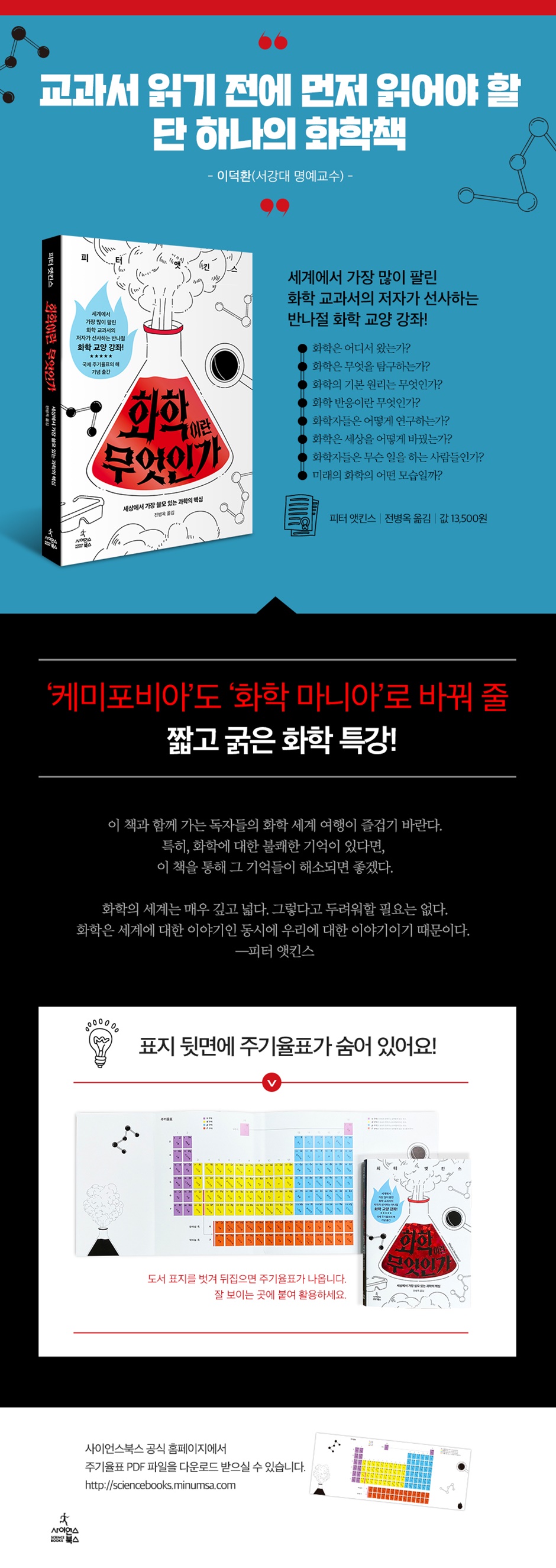
This book, consisting of seven chapters, covers the following topics:
- Where does chemistry come from?
- What does chemistry explore?
- What are the basic principles of chemistry?
- What is a chemical reaction?
- How do chemists do research?
- How has chemistry changed the world?
- What do chemists do?
- What will the future of chemistry look like?
It covers everything from the origins of chemistry to its principles and future.
The contents of each chapter are as follows.
Chapter 1: Where did chemistry come from and what does it explore?
In this chapter, we first look at medieval alchemy, the origin of chemistry.
Later, we will look in more detail at atoms, an important element of modern chemistry.
As scientific knowledge accumulated, chemistry was divided into several fields, including physical chemistry, inorganic chemistry, and organic chemistry.
It outlines the topics that each department studies.
Chemistry is also closely related to physics and biology, and the basic knowledge of chemistry was helped by physics, which later contributed greatly to the development of biology.
This relationship is also covered in detail.
Key concepts:
#Origins of Chemistry #Relationship between Alchemy and Chemistry #Relationship between Mathematics and Chemistry #Relationship between Physics and Mathematics and Chemistry #Atoms #Quantum Mechanics #Organic Chemistry #Physical Chemistry #Inorganic Chemistry #Analytical Chemistry #Biochemistry #Industrial Chemistry #Green Chemistry #Molecular Biology
Chapter 2: Principles of Chemistry, Part 1: Atoms and Molecules
In this chapter, we will look at atoms, one of the basic concepts of chemistry.
The way atoms combine to form molecules is a source of great curiosity for chemists.
This chapter explains the structure of the periodic table and explores how the fundamental knowledge contained in the table can be used to decipher the mechanisms and structures of chemical reactions and chemical bonds formed by the countless combinations of the 118 elements.
Key concepts:
#Periodic Table #Nucleus #Electron #Proton #Electron #Atomic Number #Electron Arrangement #Chemical Bond #Ionic Bond #Covalent Bond #Metallic Bond
Chapter 3: Principles of Chemistry, Part 2: Energy and Entropy
Without energy, nothing would happen in chemistry.
This chapter examines the role of energy and the concept of entropy as the engine of chemical change, providing a three-dimensional explanation of chemical reactions from both qualitative and quantitative perspectives.
You can also understand how thermodynamics, derived from physics, was utilized in chemistry and developed into thermochemistry.
Key concepts:
#Energy #Entropy #Thermodynamics #Law of Conservation of Energy #Law of Entropy #Thermochemistry #Enothermic Reaction #Exothermic Reaction #Reaction Rate #Reaction Mechanism #Activation Energy #Catalyst #Equilibrium
Chapter 4 Chemical Reactions
The essence of chemistry is the process by which combinations of atoms are converted into other combinations.
This chapter focuses on the process of this conversion, namely the chemical reaction.
Basic reactions can be divided into four types: acid-base reactions, oxidation-reduction reactions, radical reactions, and Lewis acid-base reactions.
There are several types, but each is not particularly complicated.
In this chapter, we will look at the basic knowledge and the efforts of chemists to uncover it.
The core of lithium-ion battery research, which won the 2019 Nobel Prize in Chemistry, is the oxidation-reduction reaction.
Key concepts:
#Acid-base reaction #Oxidation-reduction reaction #Radical reaction #Lewis acid-base reaction #Substitution reaction #Polymerization
Chapter 5 Experimental Techniques in Chemistry
Understanding reactions and synthesizing new molecules requires a variety of techniques and equipment.
In particular, we are making great efforts to advance existing analytical methods and develop new technologies in analytical chemistry laboratories.
This chapter examines several experimental and analytical techniques used by chemists.
Key concepts:
#Titration #Filtration #Chromatography #Spectroscopy #Atomic Spectroscopy #Nuclear Magnetic Resonance #NMR #MRI #Mass Spectrometry #X-ray Diffraction #Scanning Tunneling Microscopy #Atomic Force Microscopy #STM #AFM #Van der Waals Force #Computational Chemistry #Combinatory Chemistry
Chapter 6: What Chemistry Has Achieved
In this chapter, we will examine how the key concepts and principles of chemistry we have discussed so far contribute to our lives.
We will explore the contributions of chemistry to the development and utilization of useful substances such as pharmaceuticals, pesticides and fertilizers, transportation, and weapons.
Through this, readers will understand how chemistry enriches the world, cures human diseases, extends lifespan, and creates the materials that form the basis of life.
Key concepts:
#reverse osmosis #genetic engineering #nitrogen capture #commercial ammonia production #calcium phosphate #sustainability #fossil fuels #solar cells #electrochemistry #fuel cells #hydrogen cells #petrochemicals #nuclear power #plastics #materials revolution #fiber optics #quantum computers #molecular computers #genomics #proteomics #chemical weapons #green chemistry #responsible chemistry
Chapter 7 Where is Chemistry Going?
This chapter explores the future of chemistry.
It will showcase the roles chemists play in areas of active research in the 21st century and in emerging topics expected to emerge, such as the development of new materials, innovation in computer technology, and the development of nanoscience and technology.
This chapter will give you an idea of how chemistry will contribute to building future civilizations.
Key concepts:
#New Elements #Direct Observation of Atoms and Molecules #Nanoscience and Technology #Self-Assembly Molecules #Light Harvesting Technology #DNA Computers #Molecular Computer Synthesis #New Materials #Graphene #2D Chemistry #Surface Chemistry #Molecular Machines #Genomics #Proteomics #New Drug Development
An Elegant Guide to Chemistry for the Chemophobic
Chemistry has many dazzling achievements, but it also has a lot of homework to do.
It is a pure science that produces insights into nature rather than goods, although it is useful in many ways.
Thanks to chemists' extensive knowledge base, we now understand how matter works, from tiny pebbles to complex organisms.
This insight has led to the advancement of human civilization and allowed us to view nature with wonder in another sense.
This alone makes chemistry an amazing discipline.
This book, which condenses the world's most useful chemistry into a comprehensive guide for busy modern people, can literally transform even "chemophobes" into "chemistry enthusiasts."
By the time we reach Chapter 6, having examined all the various components of the discipline of chemistry, readers will hear the true voice of a veteran professor who has dedicated his life to the advancement and education of chemistry.
This chapter is the core of the book. Professor Atkins neither praises chemistry through fancy words nor tries to cover up its problems through fake science.
Instead, in a calm voice, he introduces the relationship between the discipline of chemistry and human civilization from primitive times to the present day, and the problems that arose in the process.
Moreover, it points out that chemists have the task of further developing civilization and solving problems.
I hope these parts are well conveyed to the readers.
-From the translator's note
In particular, if you have unpleasant memories about chemistry, I hope this book will help you overcome them.
The world of chemistry is very deep and wide.
There is no need to be afraid though.
Because chemistry is a story about the world, and it is also a story about us.
-Peter Atkins
The 2019 Nobel Prize in Chemistry went to John Goodenough (USA), Richard Whittingham (USA), and Akira Yoshino (Japan) for their contributions to the development of lithium-ion batteries.
Nowadays, it's hard to find someone who doesn't own a lithium-ion battery or at least one piece of equipment that contains one.
Lithium-ion batteries are an essential part of modern civilization and a fundamental technology for the future Fourth Industrial Revolution.
In fact, we live surrounded by the products of chemistry.
There is nothing that is not a product of chemistry, from food, clothing, and shelter to the infrastructure of urban civilization.
In fact, our country's economy also depends heavily on chemicals.
For example, the production and export volumes of our country's petrochemical industry alone amount to 90 trillion won and 58 trillion won, respectively.
(As of 2018) In the lithium-ion battery field, which won the Nobel Prize for this year to Japan and the United States, our chemical companies (Samsung SDI, LG Chem, etc.) are contributing to the export industry by controlling 30% of the global market.
If anyone asks what science is useful for, just look at what chemistry has accomplished.
However, chemistry does not receive much attention among educated people.
It is not easy to find general books on chemistry in the publishing market.
It's nothing compared to evolutionary biology or astrophysics, which have such prominent speakers as Richard Dawkins and Carl Sagan.
That doesn't mean there are no books or writers in the field of chemistry.
Peter William Atkins, author of What is Chemistry?, recently published by Science Books, is a representative chemistry writer.
Peter Atkins is best known as the author of Atkins' Physical Chemistry, one of the world's best-selling and most widely used physical chemistry textbooks for over 40 years since its first publication in 1978 (currently in its 11th edition).
He was a professor of chemistry at Lincoln College, Oxford University, a director of the Royal Society of Chemistry and the Royal Institution, and chairman of the Education Committee of the International Union of Pure and Applied Chemistry (IUPAC). He also published over 20 books, including textbooks on physical and inorganic chemistry, making significant contributions to chemistry education and popularization.
Among chemists around the world, there are few who graduated without reading even a single one of his textbooks.
(Physical chemistry and inorganic chemistry are required courses in most university chemistry departments.)
Peter Atkins, a veteran chemist, is famous not only for his textbooks but also for his popular books on chemistry.
His textbooks, which break free from the rigid and systematic framework of textbooks, neatly and elegantly explain the fundamental concepts and principles of chemistry, a vast and complex field, through surprising analogies and masterful explanations.
For example, in 『The Kingdom of the Elements』, which has been translated and published in Korea, the periodic table containing about 110 elements is explained without a single formula, comparing it to topography with mountain ranges, valleys, rivers, and plains.
This book, which provides a conceptual map of atomic, elemental, and quantum chemistry, is still recommended by numerous chemists and chemistry teachers as an introductory text for chemistry a quarter of a century after its publication.
In this book, which tackles the question, "What is chemistry?" head-on, Peter Atkins demonstrates his skills as a seasoned chemist and a master writer.
This book is fundamentally intended to provide readers with a concise and clear introduction to the fascinating, intellectually and economically significant world of chemistry.
At the same time, it aims to dispel vague aversions toward chemistry by showing adult readers who have only bad memories of chemistry, as well as young students who harbor a vague fear of chemistry, what it is like to see nature, the universe, materials, and the world through the eyes of a chemist.
Between reductionist physics, which pursues the smallest elementary particles and the simplest fundamental equations, and biology, which deals with life phenomena full of diversity and complexity that cannot be reduced to a single equation or particle, Peter Atkins explains the fascinating world of chemistry, which studies the transformation process in which atoms meet to create other atoms or molecules, and synthesizes molecules that have never existed in nature since the beginning of time, from its origins to its principles and future in a short book that can be read in half a day.
In the words of Peter Atkins, a master of chemistry, chemists can be 'couple managers' who pair one atom with another, or they can be convergents who connect physics and biology, and merge pure science with applied technology, or they can be modern-day alchemists who create technological civilization by modifying the four elements of water, earth, air, and fire.
At the same time, they are also accused of being environmental polluters and manufacturers of biochemical weapons, and are also responsible for developing technologies to restore the natural balance that humanity has disrupted.
As you read this book, which weaves together engaging explanations and vivid metaphors, you'll find yourself thinking very much like chemists.
For example, it will be possible to predict which combinations will be easy to form and which will be difficult to form, and it will be possible to guess how chemistry has transformed natural substances into useful products and how chemistry can be used to solve the numerous problems facing humanity.
Ultimately, as the author hopes, the unpleasant memories of chemistry that many adult readers have will be resolved.
It will also be a reference for science and engineering students who are considering their career paths.
A short and concise chemistry lecture that only a master can give.
Introducing chemistry concisely and clearly is never easy.
The method chosen by Professor Atkins, a master of writing textbooks that systematically and logically introduce the basic principles and laws of chemistry to college students majoring in chemistry, is unique.
It boldly abandons detailed explanations that are only necessary for scientists majoring in chemistry.
We focus on introducing only the essential key points necessary to understand the vast framework of chemistry.
It's not as easy as it sounds.
This is only possible if you have a firm belief in what's important and what's not. - Lee Deok-hwan (Professor Emeritus, Sogang University)
This book is designed to introduce readers to the fascinating, intellectually and economically significant world of chemistry.
My role is to guide you into the world of chemistry and help you see it clearly.
To this end, I will travel with readers through the world as seen through the eyes of chemists.
By understanding key concepts together, we will show how chemistry contributes to human culture and well-being.
We will also explain how chemists view and contemplate all the substances around us, from tiny pebbles to living organisms.
We will examine in detail how the knowledge chemists have accumulated through their sweat and toil is applied to transforming substances collected from the air or dug up from the ground into useful substances for our lives. - In the text
This book, consisting of seven chapters, covers the following topics:
- Where does chemistry come from?
- What does chemistry explore?
- What are the basic principles of chemistry?
- What is a chemical reaction?
- How do chemists do research?
- How has chemistry changed the world?
- What do chemists do?
- What will the future of chemistry look like?
It covers everything from the origins of chemistry to its principles and future.
The contents of each chapter are as follows.
Chapter 1: Where did chemistry come from and what does it explore?
In this chapter, we first look at medieval alchemy, the origin of chemistry.
Later, we will look in more detail at atoms, an important element of modern chemistry.
As scientific knowledge accumulated, chemistry was divided into several fields, including physical chemistry, inorganic chemistry, and organic chemistry.
It outlines the topics that each department studies.
Chemistry is also closely related to physics and biology, and the basic knowledge of chemistry was helped by physics, which later contributed greatly to the development of biology.
This relationship is also covered in detail.
Key concepts:
#Origins of Chemistry #Relationship between Alchemy and Chemistry #Relationship between Mathematics and Chemistry #Relationship between Physics and Mathematics and Chemistry #Atoms #Quantum Mechanics #Organic Chemistry #Physical Chemistry #Inorganic Chemistry #Analytical Chemistry #Biochemistry #Industrial Chemistry #Green Chemistry #Molecular Biology
Chapter 2: Principles of Chemistry, Part 1: Atoms and Molecules
In this chapter, we will look at atoms, one of the basic concepts of chemistry.
The way atoms combine to form molecules is a source of great curiosity for chemists.
This chapter explains the structure of the periodic table and explores how the fundamental knowledge contained in the table can be used to decipher the mechanisms and structures of chemical reactions and chemical bonds formed by the countless combinations of the 118 elements.
Key concepts:
#Periodic Table #Nucleus #Electron #Proton #Electron #Atomic Number #Electron Arrangement #Chemical Bond #Ionic Bond #Covalent Bond #Metallic Bond
Chapter 3: Principles of Chemistry, Part 2: Energy and Entropy
Without energy, nothing would happen in chemistry.
This chapter examines the role of energy and the concept of entropy as the engine of chemical change, providing a three-dimensional explanation of chemical reactions from both qualitative and quantitative perspectives.
You can also understand how thermodynamics, derived from physics, was utilized in chemistry and developed into thermochemistry.
Key concepts:
#Energy #Entropy #Thermodynamics #Law of Conservation of Energy #Law of Entropy #Thermochemistry #Enothermic Reaction #Exothermic Reaction #Reaction Rate #Reaction Mechanism #Activation Energy #Catalyst #Equilibrium
Chapter 4 Chemical Reactions
The essence of chemistry is the process by which combinations of atoms are converted into other combinations.
This chapter focuses on the process of this conversion, namely the chemical reaction.
Basic reactions can be divided into four types: acid-base reactions, oxidation-reduction reactions, radical reactions, and Lewis acid-base reactions.
There are several types, but each is not particularly complicated.
In this chapter, we will look at the basic knowledge and the efforts of chemists to uncover it.
The core of lithium-ion battery research, which won the 2019 Nobel Prize in Chemistry, is the oxidation-reduction reaction.
Key concepts:
#Acid-base reaction #Oxidation-reduction reaction #Radical reaction #Lewis acid-base reaction #Substitution reaction #Polymerization
Chapter 5 Experimental Techniques in Chemistry
Understanding reactions and synthesizing new molecules requires a variety of techniques and equipment.
In particular, we are making great efforts to advance existing analytical methods and develop new technologies in analytical chemistry laboratories.
This chapter examines several experimental and analytical techniques used by chemists.
Key concepts:
#Titration #Filtration #Chromatography #Spectroscopy #Atomic Spectroscopy #Nuclear Magnetic Resonance #NMR #MRI #Mass Spectrometry #X-ray Diffraction #Scanning Tunneling Microscopy #Atomic Force Microscopy #STM #AFM #Van der Waals Force #Computational Chemistry #Combinatory Chemistry
Chapter 6: What Chemistry Has Achieved
In this chapter, we will examine how the key concepts and principles of chemistry we have discussed so far contribute to our lives.
We will explore the contributions of chemistry to the development and utilization of useful substances such as pharmaceuticals, pesticides and fertilizers, transportation, and weapons.
Through this, readers will understand how chemistry enriches the world, cures human diseases, extends lifespan, and creates the materials that form the basis of life.
Key concepts:
#reverse osmosis #genetic engineering #nitrogen capture #commercial ammonia production #calcium phosphate #sustainability #fossil fuels #solar cells #electrochemistry #fuel cells #hydrogen cells #petrochemicals #nuclear power #plastics #materials revolution #fiber optics #quantum computers #molecular computers #genomics #proteomics #chemical weapons #green chemistry #responsible chemistry
Chapter 7 Where is Chemistry Going?
This chapter explores the future of chemistry.
It will showcase the roles chemists play in areas of active research in the 21st century and in emerging topics expected to emerge, such as the development of new materials, innovation in computer technology, and the development of nanoscience and technology.
This chapter will give you an idea of how chemistry will contribute to building future civilizations.
Key concepts:
#New Elements #Direct Observation of Atoms and Molecules #Nanoscience and Technology #Self-Assembly Molecules #Light Harvesting Technology #DNA Computers #Molecular Computer Synthesis #New Materials #Graphene #2D Chemistry #Surface Chemistry #Molecular Machines #Genomics #Proteomics #New Drug Development
An Elegant Guide to Chemistry for the Chemophobic
Chemistry has many dazzling achievements, but it also has a lot of homework to do.
It is a pure science that produces insights into nature rather than goods, although it is useful in many ways.
Thanks to chemists' extensive knowledge base, we now understand how matter works, from tiny pebbles to complex organisms.
This insight has led to the advancement of human civilization and allowed us to view nature with wonder in another sense.
This alone makes chemistry an amazing discipline.
This book, which condenses the world's most useful chemistry into a comprehensive guide for busy modern people, can literally transform even "chemophobes" into "chemistry enthusiasts."
By the time we reach Chapter 6, having examined all the various components of the discipline of chemistry, readers will hear the true voice of a veteran professor who has dedicated his life to the advancement and education of chemistry.
This chapter is the core of the book. Professor Atkins neither praises chemistry through fancy words nor tries to cover up its problems through fake science.
Instead, in a calm voice, he introduces the relationship between the discipline of chemistry and human civilization from primitive times to the present day, and the problems that arose in the process.
Moreover, it points out that chemists have the task of further developing civilization and solving problems.
I hope these parts are well conveyed to the readers.
-From the translator's note
GOODS SPECIFICS
- Publication date: October 30, 2019
- Format: Paperback book binding method guide
- Page count, weight, size: 192 pages | 276g | 128*188*15mm
- ISBN13: 9791189198848
- ISBN10: 1189198843
You may also like
카테고리
korean


korean

![GQ KOREA Mark (Monthly): December [2025]](http://librairie.coreenne.fr/cdn/shop/files/8ef265dbbfbf186523ed75ba7319009d.jpg?v=1765340328&width=3840)


