

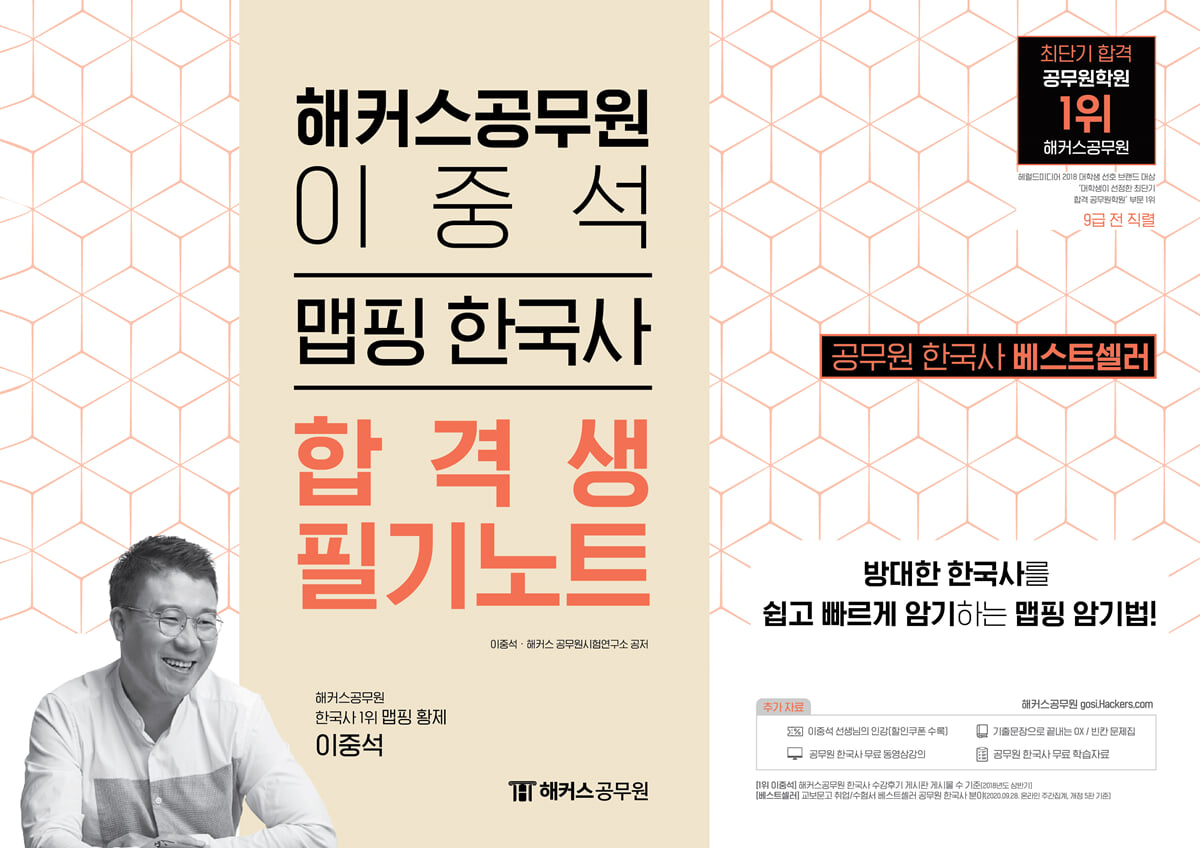
Hackers Civil Servant Lee Jung-seok Mapping Korean History Successful Candidate's Notes
 |
Description
Book Introduction
Mapping memorization technique for quickly and easily memorizing vast amounts of Korean history!
Hackers Civil Service Korean History Top Ranker, Lee Jung-seok's "Mapping Korean History Successful Student's Notes"
1.
Take your memorized content to the exam! Easily understand and memorize with Lee Jung-seok's [Mapping Memorization Technique]!
2.
Highly readable handwritten notes that make you want to study them the more you look at them!
3.
[Learning by Era] From understanding the flow to organizing key concepts, all in one book!
4.
200% chance of appearing on the exam! Achieve a high score in Korean history with [Integrated Topic-Based Learning]!
5.
Make sure to memorize it! [Final OX/Fill-in-the-Blank Workbook with Past Exam Sentences] is a final check on what you've learned!
Hackers Civil Service Korean History Top Ranker, Lee Jung-seok's "Mapping Korean History Successful Student's Notes"
1.
Take your memorized content to the exam! Easily understand and memorize with Lee Jung-seok's [Mapping Memorization Technique]!
2.
Highly readable handwritten notes that make you want to study them the more you look at them!
3.
[Learning by Era] From understanding the flow to organizing key concepts, all in one book!
4.
200% chance of appearing on the exam! Achieve a high score in Korean history with [Integrated Topic-Based Learning]!
5.
Make sure to memorize it! [Final OX/Fill-in-the-Blank Workbook with Past Exam Sentences] is a final check on what you've learned!
- You can preview some of the book's contents.
Preview
index
Catching the flow of prehistoric times
1. The meaning of history and the structural understanding of prehistoric times
2 Paleolithic and Neolithic Ages
3 Bronze Age and Iron Age
4 The Founding and Development of Gojoseon
5. Gojoseon's social appearance and related records
6 Early States
Check out the key prehistoric content
Catching the flow of ancient times
1 The Founding and Development of the Three Kingdoms
2 Gaya Federation
3 The ruling system of the Three Kingdoms
4 Ancient Steles (Epigraphy)
5 The Golden Age of the Three Kingdoms
6 Foreign Relations of the Three Kingdoms by Century
7 Goguryeo's external struggles and Silla's unification of the three kingdoms
8 Development of Unified Silla
9 The Development of Balhae
10 Unified Silla's ruling system
11 Balhae's ruling system
12 The Economy of the Three Kingdoms
13 The economies of North and South Korea
14 Ancient Society
15 Development of Ancient Learning
16 Ancient Buddhism and Other Thoughts
17 Ancient Tombs
18 Ancient Architecture and Towers
19 Ancient Science, Technology, and Art
20 Our culture that crossed over to Japan
Check out the ancient core content
Catching the flow of the Goryeo Dynasty
1. The process of founding Goryeo and the significance of its establishment
2 Achievements of the early Goryeo kings
3. Goryeo's central government organization
4. Local administrative and military organizations of Goryeo
5. Goryeo's system of selecting officials
6 The establishment and turmoil of the aristocratic society
7 The establishment and turmoil of the military regime
8. Goryeo's Foreign Relations
9. Yuan's interference in internal affairs and reformist politics in the late Goryeo Dynasty
10. Goryeo's land system
11. Economy of Goryeo
12 Goryeo's caste system
13 Society of Goryeo
14 Development of Confucianism and Educational Institutions
15 History of Goryeo
16 Buddhism in Goryeo
17 Development of various ideas and science and technology
18 The development of Goryeo aristocratic culture
Check out the key points of consideration
Catching the flow of the Joseon Dynasty
1. The process of Joseon's founding and the laying of the foundation for the nation
2 Achievements of the early kings of Joseon
3 Joseon's centralized government system
4. Local administrative organization of Joseon
5 Joseon's military system
6 Joseon Dynasty's official selection system
7. The emergence of Hun-gu and Sa-rim and the purges
8 Foreign relations in the early Joseon Dynasty
9 Japanese Invasion
10 Horan
11 Structural Understanding of Factional Politics
12 The development of factional politics
13. Politics of Tangpyeong
14th century political and social change movement
15 Joseon's Land System and Acquisition System
16 Changes in agriculture, handicrafts, and mining
17 Development of Commerce
18. The appearance of early Joseon society
19 Changes in social structure and rural order in the late Joseon Dynasty
20 Movements of social reform in the late Joseon Dynasty
21 The Creation of Hangul and Educational Institutions
22 Compilation Projects of the Early Joseon Dynasty
23 Development of Thought in the Early Joseon Dynasty
24 Changes in Neo-Confucianism and Yangmingism in the Late Joseon Dynasty
25 The development of Silhak in the late Joseon Dynasty
26 Expansion of national studies in the late Joseon Dynasty
27 Development of science and technology in the early Joseon Dynasty
28 Development of science and technology in the late Joseon Dynasty
29 Early Joseon Literature, Architecture, and Arts
30 New trends in late Joseon culture
Catching the flow of the Joseon Dynasty
Catching the flow of the modern era
1 Understanding Modernity
2. Heungseon Daewongun's policies
3. Conclusion of the unequal treaty
4. Structural Understanding of the Enlightenment and the Reform of the Righteous
5. Im-o Military Rebellion
6 Gapsin Coup
7 Donghak Peasant Movement
8. Gabo Reform and Eulmi Reform
9 Independence Association and the Korean Empire
10. The process of losing national sovereignty
11 Anti-Japanese Righteous Army Movement
12 Patriotic Enlightenment Movements
13. Economic Invasion by Great Powers and the Economic Salvation Movement
14. Acceptance of modern civilization and development of media organizations
15 Modern Education and National Studies
16 Modern literary and religious activities
Check out the key modern content
Catching the Flow of the Japanese Colonial Era
1 Changes in Japanese colonial rule
2. Japanese economic exploitation and industrial invasion
3 The national independence movement of the 1910s
4 March 1st Movement and the Establishment of the Provisional Government
5 Provisional Government of the Republic of Korea
6 Righteous Army and Korean Patriotic Corps
7. Anti-Japanese armed struggle in Manchuria
8 Anti-Japanese armed struggle in China
9. Domestic national independence movement
10 Skills Development Exercises
11 Student Anti-Japanese Manse Movement
12 National One-Party Movement
13 Lifestyles of Koreans at home and abroad
14 Colonial Education Policy, Press Suppression, and Korean Language Research
15. Research on Korean history during the Japanese colonial period
16 Literary, artistic, and religious activities during the Japanese colonial period
Check out the key details of the Japanese colonial period
Catching the flow of the modern era
1. History before and after liberation
2. The process of establishing the government of the Republic of Korea
3 Activities of the Constituent Assembly (1948-1950)
4. The Establishment of the North Korean Regime and the Korean War
5. Syngman Rhee's government (First Republic) and the April 19 Revolution
The 6th Jang Myun Cabinet (Second Republic) and the May 16 Military Coup
7 Park Chung-hee government (Third and Fourth Republics)
8. The Chun Doo-hwan government (Fifth Republic) and the June Democracy Movement
9. Roh Tae-woo government (6th Republic) ~ Lee Myung-bak government
10 Unification policies by period
11. Economic policies and changes in modern society over time
12 Developments in Educational Policy and Media by Period
Check out the key modern content
Korean history organized by topic
1. Governing system
2 Management recruitment system and educational institutions
3 Land system
4. Receipt system
5 History Books
6 Major Books
7 Rebellions and popular uprisings
8 UNESCO World Heritage Sites
9 local history
10 Frequently Appearing Figures in Modern and Contemporary History
1. The meaning of history and the structural understanding of prehistoric times
2 Paleolithic and Neolithic Ages
3 Bronze Age and Iron Age
4 The Founding and Development of Gojoseon
5. Gojoseon's social appearance and related records
6 Early States
Check out the key prehistoric content
Catching the flow of ancient times
1 The Founding and Development of the Three Kingdoms
2 Gaya Federation
3 The ruling system of the Three Kingdoms
4 Ancient Steles (Epigraphy)
5 The Golden Age of the Three Kingdoms
6 Foreign Relations of the Three Kingdoms by Century
7 Goguryeo's external struggles and Silla's unification of the three kingdoms
8 Development of Unified Silla
9 The Development of Balhae
10 Unified Silla's ruling system
11 Balhae's ruling system
12 The Economy of the Three Kingdoms
13 The economies of North and South Korea
14 Ancient Society
15 Development of Ancient Learning
16 Ancient Buddhism and Other Thoughts
17 Ancient Tombs
18 Ancient Architecture and Towers
19 Ancient Science, Technology, and Art
20 Our culture that crossed over to Japan
Check out the ancient core content
Catching the flow of the Goryeo Dynasty
1. The process of founding Goryeo and the significance of its establishment
2 Achievements of the early Goryeo kings
3. Goryeo's central government organization
4. Local administrative and military organizations of Goryeo
5. Goryeo's system of selecting officials
6 The establishment and turmoil of the aristocratic society
7 The establishment and turmoil of the military regime
8. Goryeo's Foreign Relations
9. Yuan's interference in internal affairs and reformist politics in the late Goryeo Dynasty
10. Goryeo's land system
11. Economy of Goryeo
12 Goryeo's caste system
13 Society of Goryeo
14 Development of Confucianism and Educational Institutions
15 History of Goryeo
16 Buddhism in Goryeo
17 Development of various ideas and science and technology
18 The development of Goryeo aristocratic culture
Check out the key points of consideration
Catching the flow of the Joseon Dynasty
1. The process of Joseon's founding and the laying of the foundation for the nation
2 Achievements of the early kings of Joseon
3 Joseon's centralized government system
4. Local administrative organization of Joseon
5 Joseon's military system
6 Joseon Dynasty's official selection system
7. The emergence of Hun-gu and Sa-rim and the purges
8 Foreign relations in the early Joseon Dynasty
9 Japanese Invasion
10 Horan
11 Structural Understanding of Factional Politics
12 The development of factional politics
13. Politics of Tangpyeong
14th century political and social change movement
15 Joseon's Land System and Acquisition System
16 Changes in agriculture, handicrafts, and mining
17 Development of Commerce
18. The appearance of early Joseon society
19 Changes in social structure and rural order in the late Joseon Dynasty
20 Movements of social reform in the late Joseon Dynasty
21 The Creation of Hangul and Educational Institutions
22 Compilation Projects of the Early Joseon Dynasty
23 Development of Thought in the Early Joseon Dynasty
24 Changes in Neo-Confucianism and Yangmingism in the Late Joseon Dynasty
25 The development of Silhak in the late Joseon Dynasty
26 Expansion of national studies in the late Joseon Dynasty
27 Development of science and technology in the early Joseon Dynasty
28 Development of science and technology in the late Joseon Dynasty
29 Early Joseon Literature, Architecture, and Arts
30 New trends in late Joseon culture
Catching the flow of the Joseon Dynasty
Catching the flow of the modern era
1 Understanding Modernity
2. Heungseon Daewongun's policies
3. Conclusion of the unequal treaty
4. Structural Understanding of the Enlightenment and the Reform of the Righteous
5. Im-o Military Rebellion
6 Gapsin Coup
7 Donghak Peasant Movement
8. Gabo Reform and Eulmi Reform
9 Independence Association and the Korean Empire
10. The process of losing national sovereignty
11 Anti-Japanese Righteous Army Movement
12 Patriotic Enlightenment Movements
13. Economic Invasion by Great Powers and the Economic Salvation Movement
14. Acceptance of modern civilization and development of media organizations
15 Modern Education and National Studies
16 Modern literary and religious activities
Check out the key modern content
Catching the Flow of the Japanese Colonial Era
1 Changes in Japanese colonial rule
2. Japanese economic exploitation and industrial invasion
3 The national independence movement of the 1910s
4 March 1st Movement and the Establishment of the Provisional Government
5 Provisional Government of the Republic of Korea
6 Righteous Army and Korean Patriotic Corps
7. Anti-Japanese armed struggle in Manchuria
8 Anti-Japanese armed struggle in China
9. Domestic national independence movement
10 Skills Development Exercises
11 Student Anti-Japanese Manse Movement
12 National One-Party Movement
13 Lifestyles of Koreans at home and abroad
14 Colonial Education Policy, Press Suppression, and Korean Language Research
15. Research on Korean history during the Japanese colonial period
16 Literary, artistic, and religious activities during the Japanese colonial period
Check out the key details of the Japanese colonial period
Catching the flow of the modern era
1. History before and after liberation
2. The process of establishing the government of the Republic of Korea
3 Activities of the Constituent Assembly (1948-1950)
4. The Establishment of the North Korean Regime and the Korean War
5. Syngman Rhee's government (First Republic) and the April 19 Revolution
The 6th Jang Myun Cabinet (Second Republic) and the May 16 Military Coup
7 Park Chung-hee government (Third and Fourth Republics)
8. The Chun Doo-hwan government (Fifth Republic) and the June Democracy Movement
9. Roh Tae-woo government (6th Republic) ~ Lee Myung-bak government
10 Unification policies by period
11. Economic policies and changes in modern society over time
12 Developments in Educational Policy and Media by Period
Check out the key modern content
Korean history organized by topic
1. Governing system
2 Management recruitment system and educational institutions
3 Land system
4. Receipt system
5 History Books
6 Major Books
7 Rebellions and popular uprisings
8 UNESCO World Heritage Sites
9 local history
10 Frequently Appearing Figures in Modern and Contemporary History
Detailed image
.jpg)
Publisher's Review
Mapping memorization technique for quickly and easily memorizing vast amounts of Korean history!
Hackers Civil Service Korean History Top Ranker, Lee Jung-seok's "Mapping Korean History Successful Student's Notes"
[Recommended for]
1.
Those preparing for the 9th grade civil service exam
2.
Those who want to quickly and easily organize the vast amount of Korean history covered in the exam.
3.
Those who want to understand the key points of the civil service Korean history exam and achieve a high score.
[Hacker's Textbook's Unique Features]
1.
Take your memorized content to the exam! Easily understand and memorize with Lee Jung-seok's [Mapping Memorization Technique]!
1) By using the 'mapping memorization technique' that 'structurizes/schematics' according to the flow of time, you can draw a complete picture of Korean history in your head and remember it clearly until the test day.
2) Rather than simple repetitive memorization, you can learn the flow of complex times/events easily and quickly through ‘mapping.’
2.
Highly readable handwritten notes that make you want to study them the more you look at them!
1) We improved readability by using Gothic fonts and colors that do not tire the eyes even when viewed for a long time.
2) By arranging the theories flexibly, learners can utilize the blank space to organize the content they need to know on their own.
3.
[Learning by Era] From understanding the flow to organizing key concepts, all in one book!
1) Catching the pulse of the times
By understanding the overall flow of Korean history through the 'Grab the Flow of Time' section organized by unit, you can effectively memorize it.
2) Summary of key concepts
By organizing the core concepts of Korean history along with the teacher's notes, you can learn effectively as if you were listening to a class.
3) Teacher Jungseok's solution to past exam questions
After analyzing the incorrect answer patterns of actual exams, you can acquire the skill of selecting the correct answer by presenting the incorrect answer patterns of approximately 200 previous exam questions.
4) Check the key contents by era
You can summarize/organize the main contents and memorization points of each unit, and review the essential memorization points through fill-in-the-blank questions.
4.
200% chance of appearing on the exam! Achieve a high score in Korean history with [Integrated Topic-Based Learning]!
After studying according to the flow of time, you can conclude by reviewing the key concepts of each topic that frequently appears on the exam through 'Korean History Organized by Topic.'
5.
Make sure to memorize it! [Final OX/Fill-in-the-Blank Workbook with Past Exam Sentences] is a final check on what you've learned!
By checking the 'O/X' of the previous exam questions and filling in the blanks with the appropriate content, you can check your memorization status and clearly understand the exam points to achieve a high score.
Hackers' Additional Benefits for Passing the Exam in the Shortest Time - Hackers Civil Service gosi.Hackers.com
1.
Professor Lee Jung-seok's online lecture (discount coupon included in the textbook)
2.
True/Full-Blank Practice Test Book (PDF)
3.
Free video lectures on Korean history for civil servants
4.
Free Korean History Study Materials for Civil Servants
[Hackers Civil Servant Korean History #1 Lee Jung-seok] Based on the number of posts on the Hackers Civil Servant Korean History course review board (first half of 2018)
Hackers Civil Service Korean History Top Ranker, Lee Jung-seok's "Mapping Korean History Successful Student's Notes"
[Recommended for]
1.
Those preparing for the 9th grade civil service exam
2.
Those who want to quickly and easily organize the vast amount of Korean history covered in the exam.
3.
Those who want to understand the key points of the civil service Korean history exam and achieve a high score.
[Hacker's Textbook's Unique Features]
1.
Take your memorized content to the exam! Easily understand and memorize with Lee Jung-seok's [Mapping Memorization Technique]!
1) By using the 'mapping memorization technique' that 'structurizes/schematics' according to the flow of time, you can draw a complete picture of Korean history in your head and remember it clearly until the test day.
2) Rather than simple repetitive memorization, you can learn the flow of complex times/events easily and quickly through ‘mapping.’
2.
Highly readable handwritten notes that make you want to study them the more you look at them!
1) We improved readability by using Gothic fonts and colors that do not tire the eyes even when viewed for a long time.
2) By arranging the theories flexibly, learners can utilize the blank space to organize the content they need to know on their own.
3.
[Learning by Era] From understanding the flow to organizing key concepts, all in one book!
1) Catching the pulse of the times
By understanding the overall flow of Korean history through the 'Grab the Flow of Time' section organized by unit, you can effectively memorize it.
2) Summary of key concepts
By organizing the core concepts of Korean history along with the teacher's notes, you can learn effectively as if you were listening to a class.
3) Teacher Jungseok's solution to past exam questions
After analyzing the incorrect answer patterns of actual exams, you can acquire the skill of selecting the correct answer by presenting the incorrect answer patterns of approximately 200 previous exam questions.
4) Check the key contents by era
You can summarize/organize the main contents and memorization points of each unit, and review the essential memorization points through fill-in-the-blank questions.
4.
200% chance of appearing on the exam! Achieve a high score in Korean history with [Integrated Topic-Based Learning]!
After studying according to the flow of time, you can conclude by reviewing the key concepts of each topic that frequently appears on the exam through 'Korean History Organized by Topic.'
5.
Make sure to memorize it! [Final OX/Fill-in-the-Blank Workbook with Past Exam Sentences] is a final check on what you've learned!
By checking the 'O/X' of the previous exam questions and filling in the blanks with the appropriate content, you can check your memorization status and clearly understand the exam points to achieve a high score.
Hackers' Additional Benefits for Passing the Exam in the Shortest Time - Hackers Civil Service gosi.Hackers.com
1.
Professor Lee Jung-seok's online lecture (discount coupon included in the textbook)
2.
True/Full-Blank Practice Test Book (PDF)
3.
Free video lectures on Korean history for civil servants
4.
Free Korean History Study Materials for Civil Servants
[Hackers Civil Servant Korean History #1 Lee Jung-seok] Based on the number of posts on the Hackers Civil Servant Korean History course review board (first half of 2018)
GOODS SPECIFICS
- Date of issue: July 2, 2021
- Page count, weight, size: 168 pages | 297*210*20mm
- ISBN13: 9791166624230
- ISBN10: 1166624234
You may also like
카테고리
korean


korean

![GQ KOREA Mark (Monthly): December [2025]](http://librairie.coreenne.fr/cdn/shop/files/8ef265dbbfbf186523ed75ba7319009d.jpg?v=1765340328&width=3840)


