

I live with microbes
 |
Description
Book Introduction
Avian flu, foot-and-mouth disease, SARS, MERS… The world isn’t all bad bacteria!
But why do humans always try to fight all microorganisms?
They say that both good and bad bacteria depend on the person...
The first microbiology class for the sweet coexistence of humans and microbes
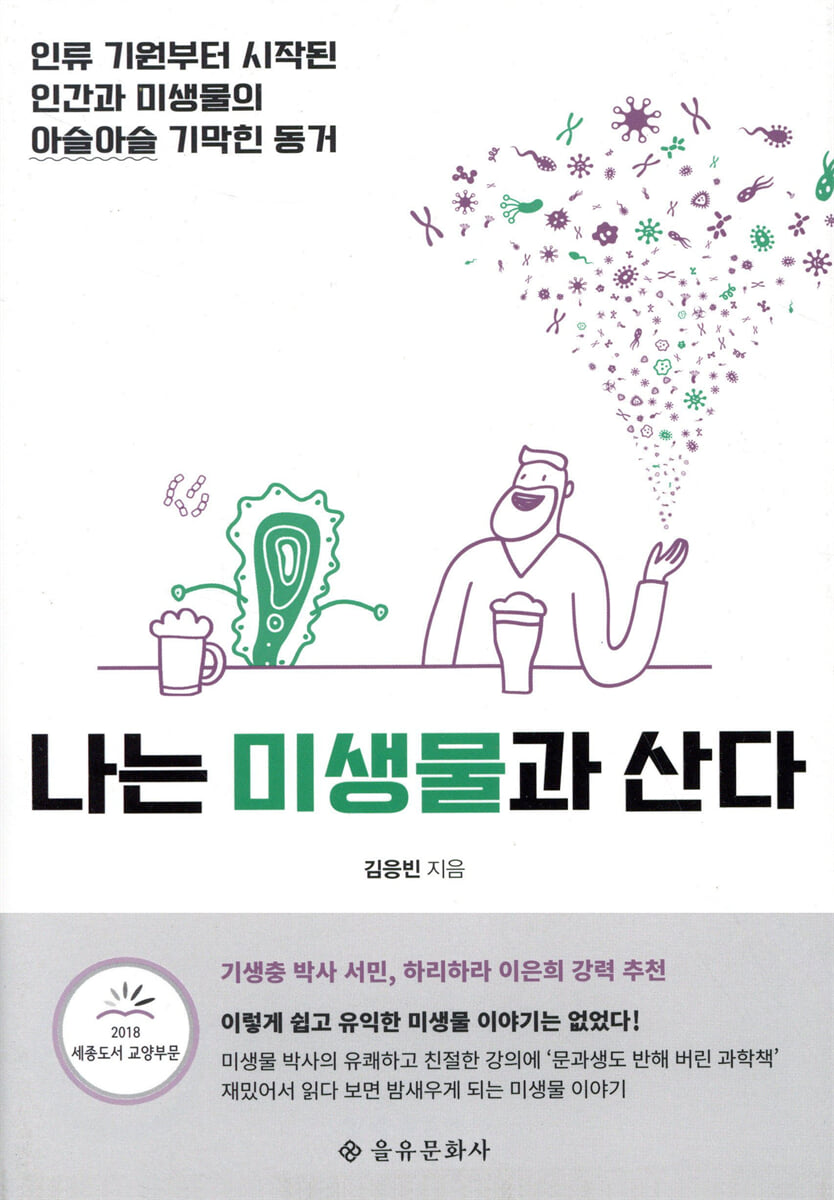
Professor Kim Eung-bin, a microbiologist, has published a science textbook titled “I Live with Microbes,” which explains microbes in an easy and fun way, published by Eulyoo Publishing.
In a situation where there are no domestic popular books on microbiology that are particularly enjoyable to read, Professor Kim Eung-bin of Yonsei University has written a more accessible and interesting account of the microbiology stories he has been lecturing to students and the public for 20 years.
It is also rich in visual materials, including related photos, drawings, diagrams, and graphs, so that even readers who are not familiar with science can understand it at a glance.
It also covers timely topics related to microorganisms, such as hospital-acquired infections and avian influenza, which have recently become issues, as well as stories about microorganisms that stimulate curiosity, such as cyanobacteria, which first gave oxygen to the Earth, bifidobacteria in breast milk that form the baby's immune system, Deinococcus radiodurans that eats radiation, and Thermus aquaticus that analyzes the DNA of criminals, and so on, providing both informativeness and entertainment.
This is a friendly introduction to microbiology that can be read easily even without extensive scientific knowledge.
But why do humans always try to fight all microorganisms?
They say that both good and bad bacteria depend on the person...
The first microbiology class for the sweet coexistence of humans and microbes
Professor Kim Eung-bin, a microbiologist, has published a science textbook titled “I Live with Microbes,” which explains microbes in an easy and fun way, published by Eulyoo Publishing.
In a situation where there are no domestic popular books on microbiology that are particularly enjoyable to read, Professor Kim Eung-bin of Yonsei University has written a more accessible and interesting account of the microbiology stories he has been lecturing to students and the public for 20 years.
It is also rich in visual materials, including related photos, drawings, diagrams, and graphs, so that even readers who are not familiar with science can understand it at a glance.
It also covers timely topics related to microorganisms, such as hospital-acquired infections and avian influenza, which have recently become issues, as well as stories about microorganisms that stimulate curiosity, such as cyanobacteria, which first gave oxygen to the Earth, bifidobacteria in breast milk that form the baby's immune system, Deinococcus radiodurans that eats radiation, and Thermus aquaticus that analyzes the DNA of criminals, and so on, providing both informativeness and entertainment.
This is a friendly introduction to microbiology that can be read easily even without extensive scientific knowledge.
- You can preview some of the book's contents.
Preview
index
prolog
Part 1: Microbes are Angry
1.
Microbial Honor Restoration Measures Meeting_1st
2.
Microbial Honor Restoration Measures Meeting_2nd
Part 2: Listening to the Story of Microorganisms
3.
Useful little facts about microorganisms
4.
Space Pioneer
5.
The Murderous Coexistence of Humans and Microorganisms
6.
The sweet coexistence of humans and microbes
7.
Microorganisms that make even poop worth its weight in gold
8.
The more you know about microorganisms, the more interesting they become.
Part 3: The Human Microbiome Exploration Never Ends
9.
What is truly essential is invisible to the eye.
10.
A Tale of Three Men in Microbiology
11.
A Microbiologist's Showdown Through the Century
12.
A scientist who caught the syphilis bacteria after 606 experiments
13.
Good microbes block bad microbes
14.
How to see the invisible
15.
The story of an infectious disease that shook the 21st century
Part 4: We Can't Live Without Microorganisms
16.
Microorganisms are as good as people!
17.
Shield microbes that protect humans from infection
18.
The three delicious microorganisms that come together?
19.
We live only in a microbial world
20.
A world where diverse microorganisms coexist
21.
I can't live without you
22.
I want to live in harmony with microbes.
Acknowledgements
References
Image source
Search
Detailed image

Into the book
From the moment a baby is born, he or she absorbs various microorganisms from the people who care for him or her and from the surrounding environment, including food.
In particular, breast milk provides not only good food but also good microorganisms to the baby.
Bifidobacteria, which are found in large quantities in breast milk, have been found to help form the baby's immune system.
In conclusion, the 'good microbiome' created through natural childbirth and breastfeeding is important for forming the baby's 'constitution', the body foundation for healthy growth. --- p.8
Our E. coli produces vitamins K and B7, among others.
Some of the enzymes that help blood clot require vitamin K, so without it, humans would be in trouble even with minor cuts.
What about vitamin B7, also known as biotin? It boosts metabolism, improves blood circulation, and helps prevent hair loss in humans.
Let's just touch on this.
As long as we are healthy, humans do not have to worry about these vitamin deficiencies.
And that's not all.
If we hold on tight to our large intestine, the bacteria that come in with the food we eat have no room to get in.
Ultimately, if we just stay in place, bad microorganisms cannot invade the human body.
In this way, we are sincerely repaying the humans who gave us a place to live and food. --- p.24
Our microbes take note of the way humans raise chickens and ducks.
In short, if you look at Korean chicken farms, each chicken is provided with a space smaller than the size of an A4 sheet of paper (210×297 millimeters).
This is like a person living his entire life in a crowded bus.
Imagine the frustration and hardships faced by chickens forced to live their entire lives in such a small cage. Chickens raised in such an environment experience significant stress, weakening their immune systems.
It's a cage filled with weak hosts...
Factory farming is a breeding paradise for parasites.
I wonder why humans, who claim to be wise, cannot see this fact, which is clearly visible even to microorganisms we humans consider insignificant. Or perhaps they are deliberately ignoring it even when they do see it. --- p.42
As a certain singer says in his song, “When the wind blows, I think of you,” when we say ‘infection,’ we usually think of ‘microorganisms.’
Just as air announces its presence through wind, microorganisms demonstrate their influence through their life activities.
The problem is that among the many functions of microbes, we are only interested in infection.
Many people equate microbes with pathogens.
Perhaps because of the trauma(?) of infection, people do not know the positive functions of microorganisms, and usually do not even try to find out.
In fact, microorganisms support the life of all living things on Earth, including humans.
Few people realize that half of the oxygen we breathe is produced by microscopic algae, microorganisms living in the ocean.
Just as Nanjido, which was a landfill, was restored into a beautiful park, it is also a beautiful story and a tale that microorganisms are the main players in purifying the environment polluted by humans.
In particular, breast milk provides not only good food but also good microorganisms to the baby.
Bifidobacteria, which are found in large quantities in breast milk, have been found to help form the baby's immune system.
In conclusion, the 'good microbiome' created through natural childbirth and breastfeeding is important for forming the baby's 'constitution', the body foundation for healthy growth. --- p.8
Our E. coli produces vitamins K and B7, among others.
Some of the enzymes that help blood clot require vitamin K, so without it, humans would be in trouble even with minor cuts.
What about vitamin B7, also known as biotin? It boosts metabolism, improves blood circulation, and helps prevent hair loss in humans.
Let's just touch on this.
As long as we are healthy, humans do not have to worry about these vitamin deficiencies.
And that's not all.
If we hold on tight to our large intestine, the bacteria that come in with the food we eat have no room to get in.
Ultimately, if we just stay in place, bad microorganisms cannot invade the human body.
In this way, we are sincerely repaying the humans who gave us a place to live and food. --- p.24
Our microbes take note of the way humans raise chickens and ducks.
In short, if you look at Korean chicken farms, each chicken is provided with a space smaller than the size of an A4 sheet of paper (210×297 millimeters).
This is like a person living his entire life in a crowded bus.
Imagine the frustration and hardships faced by chickens forced to live their entire lives in such a small cage. Chickens raised in such an environment experience significant stress, weakening their immune systems.
It's a cage filled with weak hosts...
Factory farming is a breeding paradise for parasites.
I wonder why humans, who claim to be wise, cannot see this fact, which is clearly visible even to microorganisms we humans consider insignificant. Or perhaps they are deliberately ignoring it even when they do see it. --- p.42
As a certain singer says in his song, “When the wind blows, I think of you,” when we say ‘infection,’ we usually think of ‘microorganisms.’
Just as air announces its presence through wind, microorganisms demonstrate their influence through their life activities.
The problem is that among the many functions of microbes, we are only interested in infection.
Many people equate microbes with pathogens.
Perhaps because of the trauma(?) of infection, people do not know the positive functions of microorganisms, and usually do not even try to find out.
In fact, microorganisms support the life of all living things on Earth, including humans.
Few people realize that half of the oxygen we breathe is produced by microscopic algae, microorganisms living in the ocean.
Just as Nanjido, which was a landfill, was restored into a beautiful park, it is also a beautiful story and a tale that microorganisms are the main players in purifying the environment polluted by humans.
--- p.47~48
Publisher's Review
There has never been a story about microbes this easy and beneficial!
Humans are beings who cannot survive even for a single second without microorganisms.
This is because our bodies contain about 100 trillion cells along with about 1,000 trillion microbial cells.
So, whether we like it or not, we have to live in a microbial world.
There is no freedom of choice here.
Because without microbes, our human lives would end.
If I want to live with someone, I can't think only of myself.
To be together, we need to understand and accept each other, and the more we know each other, the easier it will be to understand and accept each other.
However, we have been ignoring or disregarding the existence of microorganisms that are directly related to our lives.
So, when a virus-related incident like avian influenza, foot-and-mouth disease, SARS, or MERS occurred, there was an uproar as if all microorganisms had to be eradicated without fail.
Maybe it's a bigger threat to humans!
For the sweet coexistence of humans and microorganisms
An easy and fun microbiology class from a microbiologist!
This book tells an easy and fun story about microorganisms, the smallest creatures in the world that are directly related to human survival.
In Part 1, microorganisms such as E. coli, Legionella, and Hantaan virus are personified, and they express their regret to humans who have misunderstood them and offer advice on how to coexist with microorganisms.
Thanks to a new perspective that looks at humans from the perspective of microbes, we can glimpse stories about microbes that humans have not yet considered.
Part 2 provides a friendly explanation of the definition of microorganisms, their types and history, and the relationship between humans and microorganisms, using various microorganisms as examples.
It tells the story of the brutal coexistence of humans and microorganisms through Plasmodium falciparum, the cause of malaria, the oldest zoonotic infectious disease, and conversely, the sweet coexistence of humans and microorganisms through the various beneficial bacteria and intestinal microorganisms passed from mother to baby.
You'll also encounter stories of "good poop" transplants for patients with intestinal diseases, the sexist Wolbachia, and giant bacteria that are so large they're visible to the eye, despite being microbes.
Part 3 covers the stories of scientists who discovered, researched, and developed microorganisms over the past 300 years.
It includes the story of Leeuwenhoek of the Netherlands, who first identified microorganisms with a homemade microscope; Virchow, who first proposed 'cellular pathology' to investigate the cause of disease at the cellular level; Koch, who discovered pathogenic microorganisms; the story of catching a microorganism (syphilis) that touches the most primal desires of humans after 606 experiments; smallpox, the oldest infectious disease to be eradicated; and new infectious diseases that shook the 21st century, such as hospital-acquired infections and avian influenza.
Part 4 reveals how humans have benefited greatly from the incredible diversity and capabilities of microorganisms.
In particular, it shows that microorganisms can be either bad or good depending on how humans use them.
For example, the toxin Clostridium botulinum, which can paralyze human muscles, is used in botulinum toxin, and Xanthomonas campestris, which causes black rot, a disease that causes spots on crop leaves, is used to thicken foodstuffs like salad dressings and cosmetics like shampoo.
Meanwhile, lichens, which are made up of fungi that grow long hyphae to obtain water and minerals and algae that can photosynthesize without having to root in the ground, make up for each other's shortcomings and live together, make us think about what a beautiful life is where humans and humans, and humans and microorganisms coexist.
Just as there are good people and bad people in the human world,
Even in the microbial world, there are good and bad bacteria!
But why do humans always try to fight against microorganisms?
In Korea, animal-related infectious diseases such as avian influenza and foot-and-mouth disease have occurred frequently since 2000.
In addition, accidents involving microorganisms, such as the humidifier disinfectant accident that resulted in large-scale casualties and the Ewha Womans University Mokdong Hospital incident in which four newborns died, are occurring one after another.
Meanwhile, fear of microbes seems to be growing.
Professor Kim Eung-bin, the author, said, “Microbiology is a discipline that has developed through the war against microorganisms.
And this war is still ongoing.
It will continue as long as humanity exists.
So it's perhaps no wonder that many people associate microbes with infectious diseases and think of them as killers intent on taking our lives.
However, it is not desirable that the harmful effects of a very small number of pathogenic microorganisms be so highlighted that the majority of microorganisms that are beneficial to humans are also condemned.
We should avoid mistaking all microorganisms with the word 'bacteria' in their name as pathogens because of the presence of a few types of pathogenic microorganisms.
“Just as there are not only good people in the human world, there are also bad pathogenic microorganisms in the microbial world,” he says.
Learn the wisdom of living together with microorganisms!
This book also focuses on how microorganisms live.
Typically, organisms have multiple genes with similar or identical functions.
However, the Pelagibacter ubiq bacterium, discovered in the Sargasso Sea in the North Atlantic, lives with only one gene necessary for survival.
Moreover, some genes required for amino acid synthesis are missing from their genomes.
But how does this happen, since they don't live off of other organisms? Pelagibacter ubiq live in groups, each producing a sufficient amount of their own genes and supplementing each other's genetic deficiencies.
So, we can live without difficulty by sharing with each other even if we don't have to make all the necessary materials.
The way insects and microorganisms coexist is also surprising.
Although termites are wood eaters, they are not capable of digesting wood.
Fiber, the main component of wood, is broken down by various microorganisms living in the guts of termites.
Among them, a representative microorganism is a protozoan called Mixotrica.
And on the surface of this Myxotrica, bacteria called spirochetes live, and these guys act as cilia to help Myxotrica move and obtain food.
The fact that so many creatures within a termite colony live together peacefully by following such simple principles has a profound impact on human society.
The author also says, “We learn the wisdom of living together in a society of limitless competition from these microorganisms.”
GOODS SPECIFICS
- Date of issue: April 30, 2018
- Page count, weight, size: 292 pages | 404g | 145*210*20mm
- ISBN13: 9788932473789
- ISBN10: 8932473781
You may also like
카테고리
korean


korean

![GQ KOREA Mark (Monthly): December [2025]](http://librairie.coreenne.fr/cdn/shop/files/8ef265dbbfbf186523ed75ba7319009d.jpg?v=1765340328&width=3840)


