

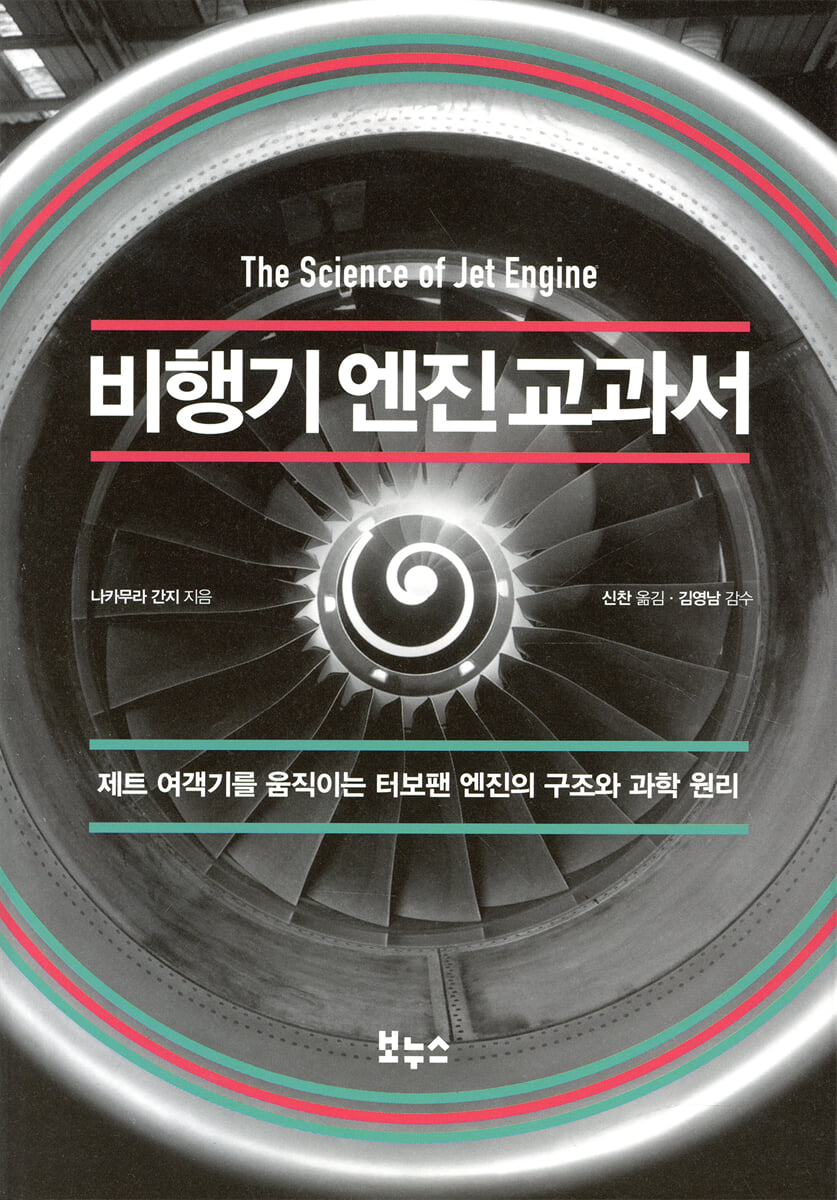
Aircraft Engine Textbook
 |
Description
Book Introduction
This book is an aviation textbook that covers the source of power generated by jet engines, their basic structure, operating system, and engine operation methods applied to takeoff and landing.
It covers both the structure and principles of aircraft engines and their operation.
It will be of great help to those interested in the structure of jet engines and the operation of passenger aircraft.
It covers both the structure and principles of aircraft engines and their operation.
It will be of great help to those interested in the structure of jet engines and the operation of passenger aircraft.
- You can preview some of the book's contents.
Preview
index
Preface _ 5
Chapter 1 The Role of Jet Engines
1-01 What is an Engine? _ 14
1-02 The Role of Jet Engines on the Ground _ 16
1-03 The Role of Jet Engines During Takeoff _ 18
1-04 Airplane weight _ 20
1-05 What is solar energy? _ 22
1-06 Top-bottom dynamics relationship _ 24
1-07 Post-war dynamics _ 26
1-08 Rise depends on engine power _ 28
Tidbits of Knowledge 1: Warm-up and Cool-down _ 30
Chapter 2 From Propellers to Jet Engines
2-01 Propeller _ 32
2-02 The Role of the Propeller _ 34
2-03 Recipro Engine _ 36
2-04 Recipro Engine and Propeller _ 38
2-05 Limitations of the Recipro Engine _ 40
2-06 Propeller Limitations _ 42
2-07 The Advent of Turboprops _ 44
2-08 Turbo Engine _ 46
2-09 Turbofan _ 48
2-10 medium-range jet airliners _ 50
2-11 Introduction of the Jumbo Jet _ 52
2-12 The emergence of wide-body machines _ 54
2-13 The Golden Age of Twin-Engine Fighters _ 56
2-14 The World's Largest Twin-Engine Aircraft _ 58
2-15 The World's Largest Passenger Airplanes _ 60
2-16 Supersonic Transporter (SST) _ 62
Fact #2: Realizing the Earth is Round _ 64
Chapter 3 What is a Jet Engine?
3-01 The Force That Makes Balloons Fly _ 66
3-02 The Power of Jet Engines _ 68
3-03 What is the thrust required for flight? _ 70
3-04 Jet Engine Structure _ 72
3-05 Structure of a Centrifugal Compressor _ 74
3-06 Operating Principle of Axial Compressor _ 76
3-07 Compressor Aerodynamics _ 78
3-08 Combustion Chamber _ 80
3-09 The Role of Turbines _ 82
3-10 Exhaust Section _ 84
3-11 What is a turbofan? _ 86
3-12 Fan Size _ 88
Fragmented Common Sense 3 Thrust Lever _ 90
Chapter 4 Jet Engine Driving System
4-01 Engine Cover _ 92
4-02 Air Intake _ 94
4-03 Engine Anti-Icing Device _ 96
4-04 Bleed Air _ 98
4-05 Accessory Gear Box _ 100
4-06 Generator _ 102
4-07 Lubricant Pump _ 104
4-08 Fuel Pump _ 106
4-09 Fuel Tank _ 108
4-10 Jet Engine Accessories _ 110
4-11 What is rated thrust? _ 112
4-12 Thrust lever operating range _ 114
4-13 Reverse Lever _ 116
4-14 Thrust change according to the operation of the thrust lever _ 118
4-15 Engine Control Unit _ 120
4-16 Starter _ 122
4-17 Engine Starting Device _ 124
4-18 Fire Prevention Measures _ 126
Facts 4: Anti-icing devices and outside temperature _ 128
Chapter 5 Jet Engine Instrumentation
5-01 The Role of Engine Instruments _ 130
5-02 Jet Engine Instruments _ 132
5-03 Display _ 134
5-04 N1 Tachometer _ 136
5-05 N2, N3 Rotational Meter _ 138
5-06 EGT series _ 140
5-07 Instrument for Measuring the Magnitude of Force _ 142
5-08 EPR series _ 144
5-09 Fuel Flow Meter _ 146
5-10 Lubricant Related Instruments _ 148
5-11 TAT system _ 150
5-12 ADIRS _ 152
5-13 FE (Aircraft Engineer) Panel _ 154
5-14 ECAM _ 156
5-15 EICAS _ 158
Pilots Check Each Other Out _ 160
Chapter 6 From Takeoff to Landing of a Jet Engine
6-01 The start of the flight is APU _ 162
6-02 APU Start (1) _ 164
6-03 APU Start (2) _ 166
6-04 Checking the fuel level _ 168
6-05 Engine Start Preparation _ 170
6-06 Engine Start _ 172
6-07 Engine Start Stop _ 174
6-08 Engine Anti-Icing Device _ 176
6-09 Takeoff Thrust and Outside Temperature _ 178
6-10 Takeoff Thrust and Pressure _ 180
6-11 Setting the Takeoff Thrust _ 182
6-12 Airbus Takeoff Thrust Setting _ 184
6-13 Boeing Takeoff Thrust Setting _ 186
6-14 Takeoff Thrust and Flight Speed _ 188
6-15 Takeoff Start _ 190
6-16 Engine failure during takeoff run _ 192
6-17 Takeoff Speed V1 (V One) _ 194
6-18 Takeoff Thrust Time Limit _ 196
6-19 Airbus Climb Thrust Setting _ 198
6-20 Boeing's climb thrust setting _ 200
6-21 Size of the upward thrust _ 202
6-22 Surplus Thrust and Surplus Horsepower _ 204
6-23 Operational Increase Limit _ 206
6-24 Cruise Thrust Setting _ 208
6-25 Size of cruise thrust _ 210
6-26 Drift Down _ 212
6-27 EDTO - 180 _ 214
6-28 Engine Stop _ 216
6-29 How to descend? _ 218
6-30 Children's Thrust Size _ 220
6-31 Engine power is needed when landing _ 222
6-32 Go Around _ 224
Search _ 227
References _ 231
Chapter 1 The Role of Jet Engines
1-01 What is an Engine? _ 14
1-02 The Role of Jet Engines on the Ground _ 16
1-03 The Role of Jet Engines During Takeoff _ 18
1-04 Airplane weight _ 20
1-05 What is solar energy? _ 22
1-06 Top-bottom dynamics relationship _ 24
1-07 Post-war dynamics _ 26
1-08 Rise depends on engine power _ 28
Tidbits of Knowledge 1: Warm-up and Cool-down _ 30
Chapter 2 From Propellers to Jet Engines
2-01 Propeller _ 32
2-02 The Role of the Propeller _ 34
2-03 Recipro Engine _ 36
2-04 Recipro Engine and Propeller _ 38
2-05 Limitations of the Recipro Engine _ 40
2-06 Propeller Limitations _ 42
2-07 The Advent of Turboprops _ 44
2-08 Turbo Engine _ 46
2-09 Turbofan _ 48
2-10 medium-range jet airliners _ 50
2-11 Introduction of the Jumbo Jet _ 52
2-12 The emergence of wide-body machines _ 54
2-13 The Golden Age of Twin-Engine Fighters _ 56
2-14 The World's Largest Twin-Engine Aircraft _ 58
2-15 The World's Largest Passenger Airplanes _ 60
2-16 Supersonic Transporter (SST) _ 62
Fact #2: Realizing the Earth is Round _ 64
Chapter 3 What is a Jet Engine?
3-01 The Force That Makes Balloons Fly _ 66
3-02 The Power of Jet Engines _ 68
3-03 What is the thrust required for flight? _ 70
3-04 Jet Engine Structure _ 72
3-05 Structure of a Centrifugal Compressor _ 74
3-06 Operating Principle of Axial Compressor _ 76
3-07 Compressor Aerodynamics _ 78
3-08 Combustion Chamber _ 80
3-09 The Role of Turbines _ 82
3-10 Exhaust Section _ 84
3-11 What is a turbofan? _ 86
3-12 Fan Size _ 88
Fragmented Common Sense 3 Thrust Lever _ 90
Chapter 4 Jet Engine Driving System
4-01 Engine Cover _ 92
4-02 Air Intake _ 94
4-03 Engine Anti-Icing Device _ 96
4-04 Bleed Air _ 98
4-05 Accessory Gear Box _ 100
4-06 Generator _ 102
4-07 Lubricant Pump _ 104
4-08 Fuel Pump _ 106
4-09 Fuel Tank _ 108
4-10 Jet Engine Accessories _ 110
4-11 What is rated thrust? _ 112
4-12 Thrust lever operating range _ 114
4-13 Reverse Lever _ 116
4-14 Thrust change according to the operation of the thrust lever _ 118
4-15 Engine Control Unit _ 120
4-16 Starter _ 122
4-17 Engine Starting Device _ 124
4-18 Fire Prevention Measures _ 126
Facts 4: Anti-icing devices and outside temperature _ 128
Chapter 5 Jet Engine Instrumentation
5-01 The Role of Engine Instruments _ 130
5-02 Jet Engine Instruments _ 132
5-03 Display _ 134
5-04 N1 Tachometer _ 136
5-05 N2, N3 Rotational Meter _ 138
5-06 EGT series _ 140
5-07 Instrument for Measuring the Magnitude of Force _ 142
5-08 EPR series _ 144
5-09 Fuel Flow Meter _ 146
5-10 Lubricant Related Instruments _ 148
5-11 TAT system _ 150
5-12 ADIRS _ 152
5-13 FE (Aircraft Engineer) Panel _ 154
5-14 ECAM _ 156
5-15 EICAS _ 158
Pilots Check Each Other Out _ 160
Chapter 6 From Takeoff to Landing of a Jet Engine
6-01 The start of the flight is APU _ 162
6-02 APU Start (1) _ 164
6-03 APU Start (2) _ 166
6-04 Checking the fuel level _ 168
6-05 Engine Start Preparation _ 170
6-06 Engine Start _ 172
6-07 Engine Start Stop _ 174
6-08 Engine Anti-Icing Device _ 176
6-09 Takeoff Thrust and Outside Temperature _ 178
6-10 Takeoff Thrust and Pressure _ 180
6-11 Setting the Takeoff Thrust _ 182
6-12 Airbus Takeoff Thrust Setting _ 184
6-13 Boeing Takeoff Thrust Setting _ 186
6-14 Takeoff Thrust and Flight Speed _ 188
6-15 Takeoff Start _ 190
6-16 Engine failure during takeoff run _ 192
6-17 Takeoff Speed V1 (V One) _ 194
6-18 Takeoff Thrust Time Limit _ 196
6-19 Airbus Climb Thrust Setting _ 198
6-20 Boeing's climb thrust setting _ 200
6-21 Size of the upward thrust _ 202
6-22 Surplus Thrust and Surplus Horsepower _ 204
6-23 Operational Increase Limit _ 206
6-24 Cruise Thrust Setting _ 208
6-25 Size of cruise thrust _ 210
6-26 Drift Down _ 212
6-27 EDTO - 180 _ 214
6-28 Engine Stop _ 216
6-29 How to descend? _ 218
6-30 Children's Thrust Size _ 220
6-31 Engine power is needed when landing _ 222
6-32 Go Around _ 224
Search _ 227
References _ 231
Detailed image

Publisher's Review
Rolls-Royce, Pratt & Whitney, and General Electric
Explaining the structure and principles of the world's three major jet engines.
More than 200,000 components, 650 core technologies.
As the specifications, which are even a bit overwhelming, suggest, jet airliners are the pinnacle of modern science.
People consider the engine to be the most important part of an airplane, requiring all kinds of technology.
Because the engine is the source of power that allows airplanes weighing hundreds of tons to travel between continents.
If you want to understand the essence of an airplane, you must first understand the structure and principles of the engine.
"Aircraft Engine Textbook" is the best aviation textbook for understanding jet engines.
First, let's look at the history of the aviation industry and see how the human desire to fly further, faster, and higher led to the development of the jet engine (turbofan engine).
After understanding the history of aviation, we will learn the basic principles of flight based on basic physics and compare the structure of a jet engine to a piston engine.
From the Douglas DC series, which led the early aviation industry, to the Boeing and Airbus aircraft that currently dominate the aviation industry, we will examine representative passenger aircraft and engines as examples and explain the structure and principles of the respective engines.
It provides a clear overview of how engine manufacturers such as Rolls-Royce, Pratt & Whitney, and General Electric have developed aircraft engines.
Jet engine structure, operating principles, operating system, and operation method
Understanding the Science of Aircraft Engines with Over 200 Illustrations and Graphs
The author wrote this book based on his experience operating jet engines for over 30 years.
Its strengths are its accurate information and well-structured structure, making it incomparable from the outset to the unsourced materials and fragmentary blog posts scattered across the Internet.
What makes this book stand out is not just the reliability of its information.
Unlike aviation textbooks used in vocational schools or educational institutions, it is notable that the overall difficulty level and structure of the text have been appropriately adjusted so that the general public can read and fully understand it.
In other words, anyone interested in jet engines can immediately understand the structure and operating principles of airplanes by reading this book.
This book again embodies the writing standards already stated in the author's previous works, 『Airplane Pilot Textbook』 and 『Airplane Structure Textbook』.
First, we used a lot of pictures to make it intuitively understandable.
This book contains over 200 illustrations and various graphs. The illustrations help readers immediately understand the content of each chapter and sometimes summarize previously explained information.
Graphs that appear frequently also play a role in increasing the reader's understanding.
Because there is no better tool for understanding multiple numbers and complex relationships than graphs.
The precise and meticulously drawn illustrations and graphs solidify this book's identity as an aviation textbook for the general public.
Second, we used appropriate analogies and easy terminology so that readers without specialized knowledge could immediately understand the principles of flight.
This feature is particularly evident in Chapters 1 and 2 of the book, where thrust is explained as the force of the air expelled by the balloon, and lift is explained as the reaction of the air caused by the pressure difference between the top and bottom of the airplane wing.
Although this explanation may not be accurate from an expert's perspective, it achieves the author's goal of helping the general public understand the principles of flight.
Third, we provided many easy-to-understand examples using figures close to reality.
Explanations using actual numbers add a sense of realism, which helps understand the content and makes the writing more interesting.
For example, calculations are made using directly observed flight data to determine how much engine power is required during flight.
In addition, whenever explaining the relationship between outside temperature, pressure, and thrust, or the setting of climb thrust or cruise thrust, the explanation is always continued with examples of values calculated using specific numbers.
From the principles of jet engines to their operation
Everything About Aircraft Engines in One Volume
"Airplane Engine Textbook" is a book written by the author on the subject of aircraft engines, which he did not cover in detail in his previous work, and it is also a book written by combining the strengths of his two previous works.
In other words, while the previously published books approached airplanes from two perspectives: aviation and aeronautical engineering, this book covers both aspects.
Chapters 1 through 5 of a total of 6 chapters view aircraft engines as a collection of cutting-edge technologies, and explain in detail the structure and principles of engines.
Chapter 6 explores how to actually handle the engine in specific situations.
If we remember that most of the work of flying an airplane involves operating the engine, we realize that Chapter 6 provides an outline of the art of piloting an airplane.
This book ultimately covers everything about aircraft engines, from the principles of jet engines to how to operate them.
It will provide proper aviation education to those interested in the structure of jet engines and the operation of passenger aircraft, and can even serve as a guide for more in-depth study.
Explaining the structure and principles of the world's three major jet engines.
More than 200,000 components, 650 core technologies.
As the specifications, which are even a bit overwhelming, suggest, jet airliners are the pinnacle of modern science.
People consider the engine to be the most important part of an airplane, requiring all kinds of technology.
Because the engine is the source of power that allows airplanes weighing hundreds of tons to travel between continents.
If you want to understand the essence of an airplane, you must first understand the structure and principles of the engine.
"Aircraft Engine Textbook" is the best aviation textbook for understanding jet engines.
First, let's look at the history of the aviation industry and see how the human desire to fly further, faster, and higher led to the development of the jet engine (turbofan engine).
After understanding the history of aviation, we will learn the basic principles of flight based on basic physics and compare the structure of a jet engine to a piston engine.
From the Douglas DC series, which led the early aviation industry, to the Boeing and Airbus aircraft that currently dominate the aviation industry, we will examine representative passenger aircraft and engines as examples and explain the structure and principles of the respective engines.
It provides a clear overview of how engine manufacturers such as Rolls-Royce, Pratt & Whitney, and General Electric have developed aircraft engines.
Jet engine structure, operating principles, operating system, and operation method
Understanding the Science of Aircraft Engines with Over 200 Illustrations and Graphs
The author wrote this book based on his experience operating jet engines for over 30 years.
Its strengths are its accurate information and well-structured structure, making it incomparable from the outset to the unsourced materials and fragmentary blog posts scattered across the Internet.
What makes this book stand out is not just the reliability of its information.
Unlike aviation textbooks used in vocational schools or educational institutions, it is notable that the overall difficulty level and structure of the text have been appropriately adjusted so that the general public can read and fully understand it.
In other words, anyone interested in jet engines can immediately understand the structure and operating principles of airplanes by reading this book.
This book again embodies the writing standards already stated in the author's previous works, 『Airplane Pilot Textbook』 and 『Airplane Structure Textbook』.
First, we used a lot of pictures to make it intuitively understandable.
This book contains over 200 illustrations and various graphs. The illustrations help readers immediately understand the content of each chapter and sometimes summarize previously explained information.
Graphs that appear frequently also play a role in increasing the reader's understanding.
Because there is no better tool for understanding multiple numbers and complex relationships than graphs.
The precise and meticulously drawn illustrations and graphs solidify this book's identity as an aviation textbook for the general public.
Second, we used appropriate analogies and easy terminology so that readers without specialized knowledge could immediately understand the principles of flight.
This feature is particularly evident in Chapters 1 and 2 of the book, where thrust is explained as the force of the air expelled by the balloon, and lift is explained as the reaction of the air caused by the pressure difference between the top and bottom of the airplane wing.
Although this explanation may not be accurate from an expert's perspective, it achieves the author's goal of helping the general public understand the principles of flight.
Third, we provided many easy-to-understand examples using figures close to reality.
Explanations using actual numbers add a sense of realism, which helps understand the content and makes the writing more interesting.
For example, calculations are made using directly observed flight data to determine how much engine power is required during flight.
In addition, whenever explaining the relationship between outside temperature, pressure, and thrust, or the setting of climb thrust or cruise thrust, the explanation is always continued with examples of values calculated using specific numbers.
From the principles of jet engines to their operation
Everything About Aircraft Engines in One Volume
"Airplane Engine Textbook" is a book written by the author on the subject of aircraft engines, which he did not cover in detail in his previous work, and it is also a book written by combining the strengths of his two previous works.
In other words, while the previously published books approached airplanes from two perspectives: aviation and aeronautical engineering, this book covers both aspects.
Chapters 1 through 5 of a total of 6 chapters view aircraft engines as a collection of cutting-edge technologies, and explain in detail the structure and principles of engines.
Chapter 6 explores how to actually handle the engine in specific situations.
If we remember that most of the work of flying an airplane involves operating the engine, we realize that Chapter 6 provides an outline of the art of piloting an airplane.
This book ultimately covers everything about aircraft engines, from the principles of jet engines to how to operate them.
It will provide proper aviation education to those interested in the structure of jet engines and the operation of passenger aircraft, and can even serve as a guide for more in-depth study.
GOODS SPECIFICS
- Date of issue: June 15, 2017
- Page count, weight, size: 232 pages | 394g | 148*210*14mm
- ISBN13: 9788964942925
- ISBN10: 8964942922
You may also like
카테고리
korean


korean

![GQ KOREA Mark (Monthly): December [2025]](http://librairie.coreenne.fr/cdn/shop/files/8ef265dbbfbf186523ed75ba7319009d.jpg?v=1765340328&width=3840)


