

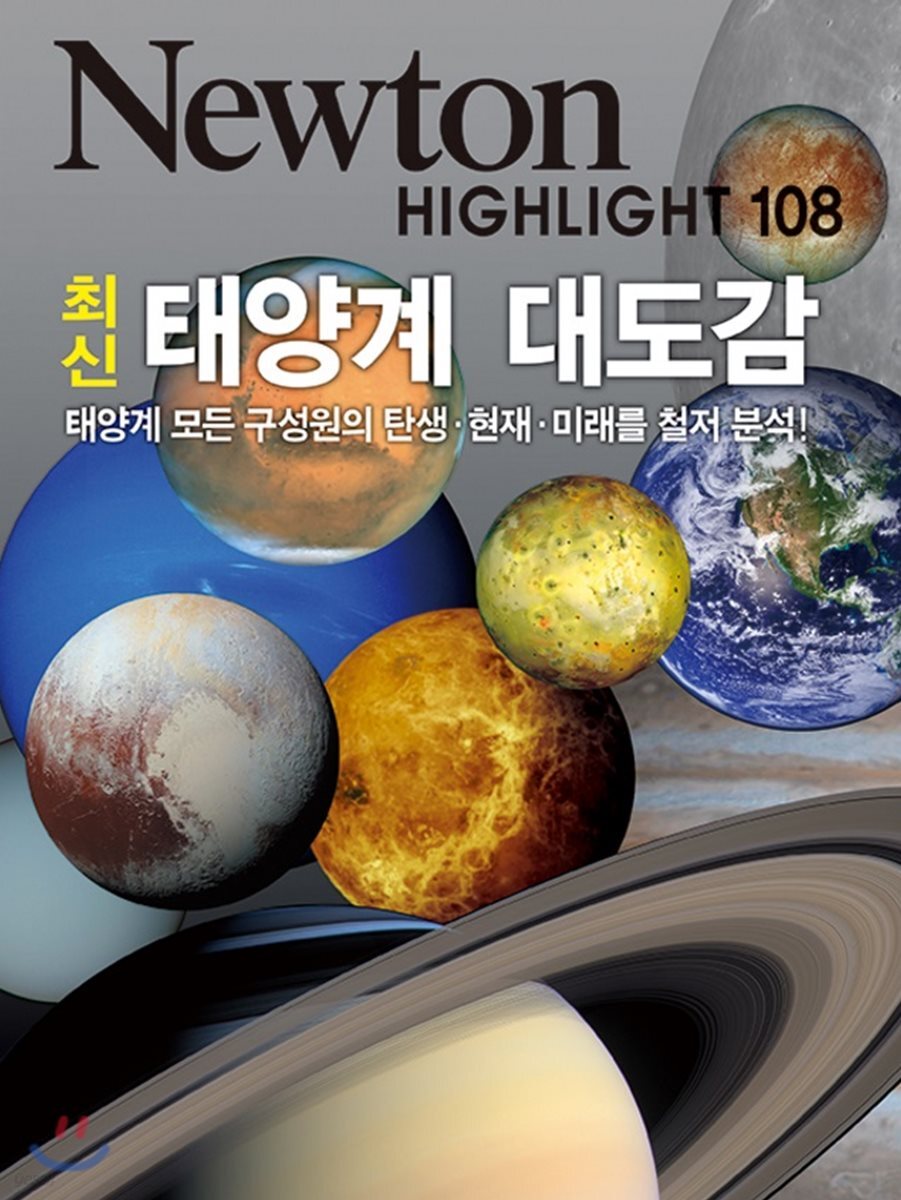
NEWTON HIGHLIGHT Newton Highlights: The Latest Solar System Atlas
 |
Description
Book Introduction
The solar system isn't just made up of planets!
The core of the solar system is the sun and the planets.
Although the Sun's influence in the solar system is overwhelming, its 'family' is extremely diverse beyond the planets.
These include satellites, dwarf planets, asteroids, trans-Neptunian objects, comets, and other minor celestial bodies.
The solar system maintains its current state as a result of countless interactions.
The solar system refers to 'the sun and all celestial bodies revolving around it.'
Rocks a few meters in diameter and comets that orbit the sun for hundreds of years are also included in the solar system.
And it is said that there are celestial bodies that revolve around the sun even though they are 1.5 to 15 trillion kilometers away from the sun.
Furthermore, these celestial bodies in the solar system were created at approximately the same time, about 4.6 billion years ago, and have been continuously orbiting the sun ever since.
The solar system boasts a vastness that defies imagination and a history that is mind-bogglingly long. This book is the definitive introduction to the solar system, explaining not only the current composition of the solar system but also its formation and future fate through meticulous illustrations and stunning photographs.
Chapter 1 outlines the overall framework, including the orbits of the planets, the components of the solar system, the size, density, and types of planets, and the size of the solar system.
Chapter 2 covers key aspects of the Sun, Earth, and Moon, including the Sun's structure, magnetic activity, Earth's energy, Earth's atmosphere, ocean circulation, the mechanism of the four seasons, the movements of the Earth and Moon, lunar and solar eclipses, and high and low tides.
Chapters 3 and 4 introduce the characteristics of the eight planets in the solar system, focusing on vivid photos captured by probes.
Chapter 5 describes all celestial bodies other than planets, including asteroids, dwarf planets, trans-Neptunian objects, and comets.
And in chapters 6 and 7, we learn about how the solar system came to be and how it will end in the future.
Finally, the 'Data' section provides a list of planets, dwarf planets, and satellites in the solar system, space probes that directly investigate the sun and each planet, and a schedule of major astronomical phenomena in the solar system.
Introducing the latest research with up-to-date images, "The Latest Solar System Atlas" will be a faithful guide to the solar system in which we live.
The core of the solar system is the sun and the planets.
Although the Sun's influence in the solar system is overwhelming, its 'family' is extremely diverse beyond the planets.
These include satellites, dwarf planets, asteroids, trans-Neptunian objects, comets, and other minor celestial bodies.
The solar system maintains its current state as a result of countless interactions.
The solar system refers to 'the sun and all celestial bodies revolving around it.'
Rocks a few meters in diameter and comets that orbit the sun for hundreds of years are also included in the solar system.
And it is said that there are celestial bodies that revolve around the sun even though they are 1.5 to 15 trillion kilometers away from the sun.
Furthermore, these celestial bodies in the solar system were created at approximately the same time, about 4.6 billion years ago, and have been continuously orbiting the sun ever since.
The solar system boasts a vastness that defies imagination and a history that is mind-bogglingly long. This book is the definitive introduction to the solar system, explaining not only the current composition of the solar system but also its formation and future fate through meticulous illustrations and stunning photographs.
Chapter 1 outlines the overall framework, including the orbits of the planets, the components of the solar system, the size, density, and types of planets, and the size of the solar system.
Chapter 2 covers key aspects of the Sun, Earth, and Moon, including the Sun's structure, magnetic activity, Earth's energy, Earth's atmosphere, ocean circulation, the mechanism of the four seasons, the movements of the Earth and Moon, lunar and solar eclipses, and high and low tides.
Chapters 3 and 4 introduce the characteristics of the eight planets in the solar system, focusing on vivid photos captured by probes.
Chapter 5 describes all celestial bodies other than planets, including asteroids, dwarf planets, trans-Neptunian objects, and comets.
And in chapters 6 and 7, we learn about how the solar system came to be and how it will end in the future.
Finally, the 'Data' section provides a list of planets, dwarf planets, and satellites in the solar system, space probes that directly investigate the sun and each planet, and a schedule of major astronomical phenomena in the solar system.
Introducing the latest research with up-to-date images, "The Latest Solar System Atlas" will be a faithful guide to the solar system in which we live.
index
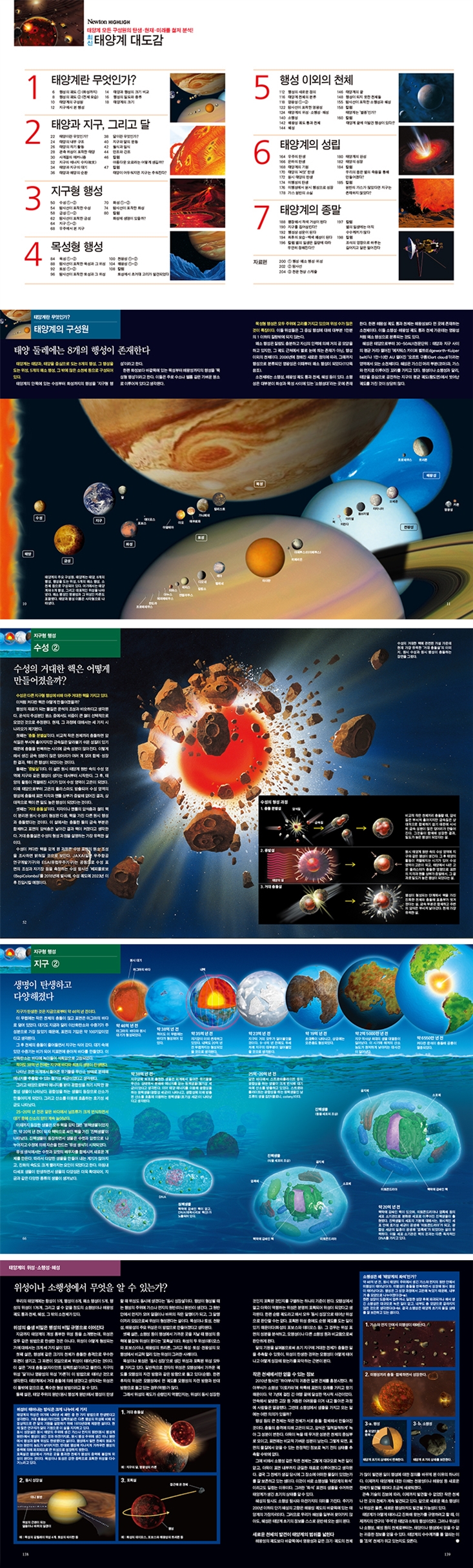
Chapter 1 What is the Solar System?
Orbits of the planets ① (up to Mars) _ Orbits of the planets ② (overall view) _ Members of the solar system _ Planets seen from Earth _ Comparison of the sizes of the sun and planets _ Density and types of planets _ Size of the solar system
Chapter 2 The Sun, the Earth, and the Moon
What is the Sun? _ The internal structure of the Sun _ The magnetic activity of the Sun _ The Sun captured by an observation satellite _ The mechanism of the four seasons _ The Earth's energy balance _ The Sun and the Earth's atmosphere _ The cycle of the Sun and the ocean _ What is the Moon? _ The movements of the Earth and the Moon _ Lunar and solar eclipses _ High and low tides
Column How do beautiful aurora appear?
Column When the sun gets dark, does the Earth get colder?
Chapter 3: Terrestrial Planets
Mercury ①~② _ Mercury captured by the probe _ Venus ①~② _ Venus captured by the probe _ Earth ①~② _ Earth seen from space _ Mars ①~② _ Mars captured by the probe
Column: Is there life on Mars?
Chapter 4 Jovian Planets
Jupiter ①~② _ Jupiter and its satellites captured by the probe _ Saturn ①~② _ Saturn and its satellites captured by the probe _ Uranus ①~② _ Neptune ①~②
Supergiant rings discovered on Saturn
Chapter 5 Celestial bodies other than planets
A new definition of a planet _ Classification of celestial bodies in the solar system _ Pluto ①~② _ Pluto captured by a probe _ Satellites, asteroids, and comets in the solar system _ Asteroids _ Celestial bodies passing through Neptune's orbit _ Comets _ The end of the solar system _ Celestial bodies that failed to become planets _ Asteroids and comets captured by a probe
Column: Is the Solar System a 'Special Species'?
Column: Is there an undiscovered planet at the edge of the solar system?
Chapter 6: The Formation of the Solar System
The birth of the universe _ The birth of the galaxy _ The origin of the solar system _ The birth of the 'seed' of the sun _ The birth of the primitive sun _ The birth of a planetoid _ Growth from a planetoid to a primitive planet _ The disappearance of the gas disk _ The completion of the solar system _ The growth of the sun
Column: Were our bodies created through the death of stars?
If the disk had more gas, Earth wouldn't exist?
Chapter 7: The End of the Solar System
It expands to become a red giant _ Swallows Earth? _ Becomes a planetary nebula _ Its final form - Becomes a white dwarf
The life of a star is randomly determined by its mass!?
There are still many mysteries in the life of a columnist.
The days become longer and the moon moves farther away due to the influence of the tides.
Data section
① Planets, dwarf planets, and satellites
② Probe
③ Astronomical phenomenon schedule
Orbits of the planets ① (up to Mars) _ Orbits of the planets ② (overall view) _ Members of the solar system _ Planets seen from Earth _ Comparison of the sizes of the sun and planets _ Density and types of planets _ Size of the solar system
Chapter 2 The Sun, the Earth, and the Moon
What is the Sun? _ The internal structure of the Sun _ The magnetic activity of the Sun _ The Sun captured by an observation satellite _ The mechanism of the four seasons _ The Earth's energy balance _ The Sun and the Earth's atmosphere _ The cycle of the Sun and the ocean _ What is the Moon? _ The movements of the Earth and the Moon _ Lunar and solar eclipses _ High and low tides
Column How do beautiful aurora appear?
Column When the sun gets dark, does the Earth get colder?
Chapter 3: Terrestrial Planets
Mercury ①~② _ Mercury captured by the probe _ Venus ①~② _ Venus captured by the probe _ Earth ①~② _ Earth seen from space _ Mars ①~② _ Mars captured by the probe
Column: Is there life on Mars?
Chapter 4 Jovian Planets
Jupiter ①~② _ Jupiter and its satellites captured by the probe _ Saturn ①~② _ Saturn and its satellites captured by the probe _ Uranus ①~② _ Neptune ①~②
Supergiant rings discovered on Saturn
Chapter 5 Celestial bodies other than planets
A new definition of a planet _ Classification of celestial bodies in the solar system _ Pluto ①~② _ Pluto captured by a probe _ Satellites, asteroids, and comets in the solar system _ Asteroids _ Celestial bodies passing through Neptune's orbit _ Comets _ The end of the solar system _ Celestial bodies that failed to become planets _ Asteroids and comets captured by a probe
Column: Is the Solar System a 'Special Species'?
Column: Is there an undiscovered planet at the edge of the solar system?
Chapter 6: The Formation of the Solar System
The birth of the universe _ The birth of the galaxy _ The origin of the solar system _ The birth of the 'seed' of the sun _ The birth of the primitive sun _ The birth of a planetoid _ Growth from a planetoid to a primitive planet _ The disappearance of the gas disk _ The completion of the solar system _ The growth of the sun
Column: Were our bodies created through the death of stars?
If the disk had more gas, Earth wouldn't exist?
Chapter 7: The End of the Solar System
It expands to become a red giant _ Swallows Earth? _ Becomes a planetary nebula _ Its final form - Becomes a white dwarf
The life of a star is randomly determined by its mass!?
There are still many mysteries in the life of a columnist.
The days become longer and the moon moves farther away due to the influence of the tides.
Data section
① Planets, dwarf planets, and satellites
② Probe
③ Astronomical phenomenon schedule
Detailed image
Publisher's Review
· What is the solar system? (Constituents of the solar system, planetary orbits, planets as seen from Earth, size, density, types of planets, etc.)
The solar system is a collection of planets and satellites centered around the sun.
Our solar system belongs to the Milky Way galaxy, which is home to countless stars like the sun.
Our galaxy is just one of countless galaxies in the universe.
Although the solar system is a very small entity in the universe, it is a world of enormous scale when viewed from the human senses.
First, we learn about the overall shape of the solar system, and compare the sizes of the planets and their distances from the sun in various ways.
· The Sun, the Earth, and the Moon (the structure and magnetic activity of the Sun, the mechanism of the four seasons, the atmospheric and oceanic circulation of the Sun and the Earth, the movement of the Earth and the Moon, solar and lunar eclipses, high and low tides, etc.)
The celestial bodies that have the greatest influence on our Earth are the sun and the moon.
The sun is an exceptionally large celestial body within the solar system and emits enormous amounts of energy.
We cannot survive without this energy.
Solar energy is also deeply involved in the changes of the four seasons and the circulation of the ocean.
Meanwhile, the moon is the only satellite that orbits the Earth.
Because they are close to each other, the Earth and the Moon have a close relationship, such as the Moon's gravitational pull causing tides on Earth.
We take a close look at the Earth, where we humans live, and the Sun and Moon.
· Terrestrial and Jovian planets (summary of the main contents of the eight planets, planets and their moons captured by probes, etc.)
There are eight planets in the solar system.
Among them, Mercury, Venus, Earth, and Mars, which have solid surfaces, are called 'terrestrial planets'.
These are four planets that orbit close to the Sun.
Meanwhile, the four planets that are further away than Mars, Jupiter, Saturn, Uranus, and Neptune, are called the 'Jovian planets'.
They have very large radii and masses compared to terrestrial planets.
It introduces various information, including the characteristics of each planet, its formation process, and interesting satellites.
· Celestial bodies other than planets (definition of planets, classification of solar system bodies, Pluto, asteroids, comets, home planets of the solar system, bodies transiting Neptune's orbit, bodies that are not planets, etc.)
In 2006, the definition of a planet was first established.
As a result, Pluto, which had long been the ninth planet in the solar system, was demoted from its planetary status and reclassified into a new category called "dwarf planet."
The definition of a planet, that is, what a planet is, is explained in detail.
We also look at the various types of celestial bodies that revolve around the Sun, including planetary satellites, asteroids, comets, and trans-Neptunian objects.
· The birth and end of the solar system (the origin of the solar system, from planetesimals to protoplanets, the completion and growth of the solar system, the expanding red giant, the end of the sun and the Earth, etc.)
When, where, and how did the solar system come into being and become what it is today? While it's incredibly difficult to know the exact truth, observations and theories continue to develop some scenarios.
Based on the latest information, we trace the scenario of the formation of the solar system from the origin of the universe.
But will the solar system last forever? Unfortunately, even stars like the Sun have a lifespan, and the solar system itself will eventually come to an end.
Based on observations of numerous stars, it is thought that the Sun will eventually turn into a giant red star.
What fate awaits our Earth then? We explore how the Sun will spend the remaining half of its life, and the latest research suggests a tragic end for the Sun and the solar system.
The solar system is a collection of planets and satellites centered around the sun.
Our solar system belongs to the Milky Way galaxy, which is home to countless stars like the sun.
Our galaxy is just one of countless galaxies in the universe.
Although the solar system is a very small entity in the universe, it is a world of enormous scale when viewed from the human senses.
First, we learn about the overall shape of the solar system, and compare the sizes of the planets and their distances from the sun in various ways.
· The Sun, the Earth, and the Moon (the structure and magnetic activity of the Sun, the mechanism of the four seasons, the atmospheric and oceanic circulation of the Sun and the Earth, the movement of the Earth and the Moon, solar and lunar eclipses, high and low tides, etc.)
The celestial bodies that have the greatest influence on our Earth are the sun and the moon.
The sun is an exceptionally large celestial body within the solar system and emits enormous amounts of energy.
We cannot survive without this energy.
Solar energy is also deeply involved in the changes of the four seasons and the circulation of the ocean.
Meanwhile, the moon is the only satellite that orbits the Earth.
Because they are close to each other, the Earth and the Moon have a close relationship, such as the Moon's gravitational pull causing tides on Earth.
We take a close look at the Earth, where we humans live, and the Sun and Moon.
· Terrestrial and Jovian planets (summary of the main contents of the eight planets, planets and their moons captured by probes, etc.)
There are eight planets in the solar system.
Among them, Mercury, Venus, Earth, and Mars, which have solid surfaces, are called 'terrestrial planets'.
These are four planets that orbit close to the Sun.
Meanwhile, the four planets that are further away than Mars, Jupiter, Saturn, Uranus, and Neptune, are called the 'Jovian planets'.
They have very large radii and masses compared to terrestrial planets.
It introduces various information, including the characteristics of each planet, its formation process, and interesting satellites.
· Celestial bodies other than planets (definition of planets, classification of solar system bodies, Pluto, asteroids, comets, home planets of the solar system, bodies transiting Neptune's orbit, bodies that are not planets, etc.)
In 2006, the definition of a planet was first established.
As a result, Pluto, which had long been the ninth planet in the solar system, was demoted from its planetary status and reclassified into a new category called "dwarf planet."
The definition of a planet, that is, what a planet is, is explained in detail.
We also look at the various types of celestial bodies that revolve around the Sun, including planetary satellites, asteroids, comets, and trans-Neptunian objects.
· The birth and end of the solar system (the origin of the solar system, from planetesimals to protoplanets, the completion and growth of the solar system, the expanding red giant, the end of the sun and the Earth, etc.)
When, where, and how did the solar system come into being and become what it is today? While it's incredibly difficult to know the exact truth, observations and theories continue to develop some scenarios.
Based on the latest information, we trace the scenario of the formation of the solar system from the origin of the universe.
But will the solar system last forever? Unfortunately, even stars like the Sun have a lifespan, and the solar system itself will eventually come to an end.
Based on observations of numerous stars, it is thought that the Sun will eventually turn into a giant red star.
What fate awaits our Earth then? We explore how the Sun will spend the remaining half of its life, and the latest research suggests a tragic end for the Sun and the solar system.
GOODS SPECIFICS
- Date of issue: May 15, 2017
- Page count, weight, size: 208 pages | 689g | 210*275*9mm
- ISBN13: 9791187879046
- ISBN10: 1187879045
You may also like
카테고리
korean


korean

![GQ KOREA Mark (Monthly): December [2025]](http://librairie.coreenne.fr/cdn/shop/files/8ef265dbbfbf186523ed75ba7319009d.jpg?v=1765340328&width=3840)


