

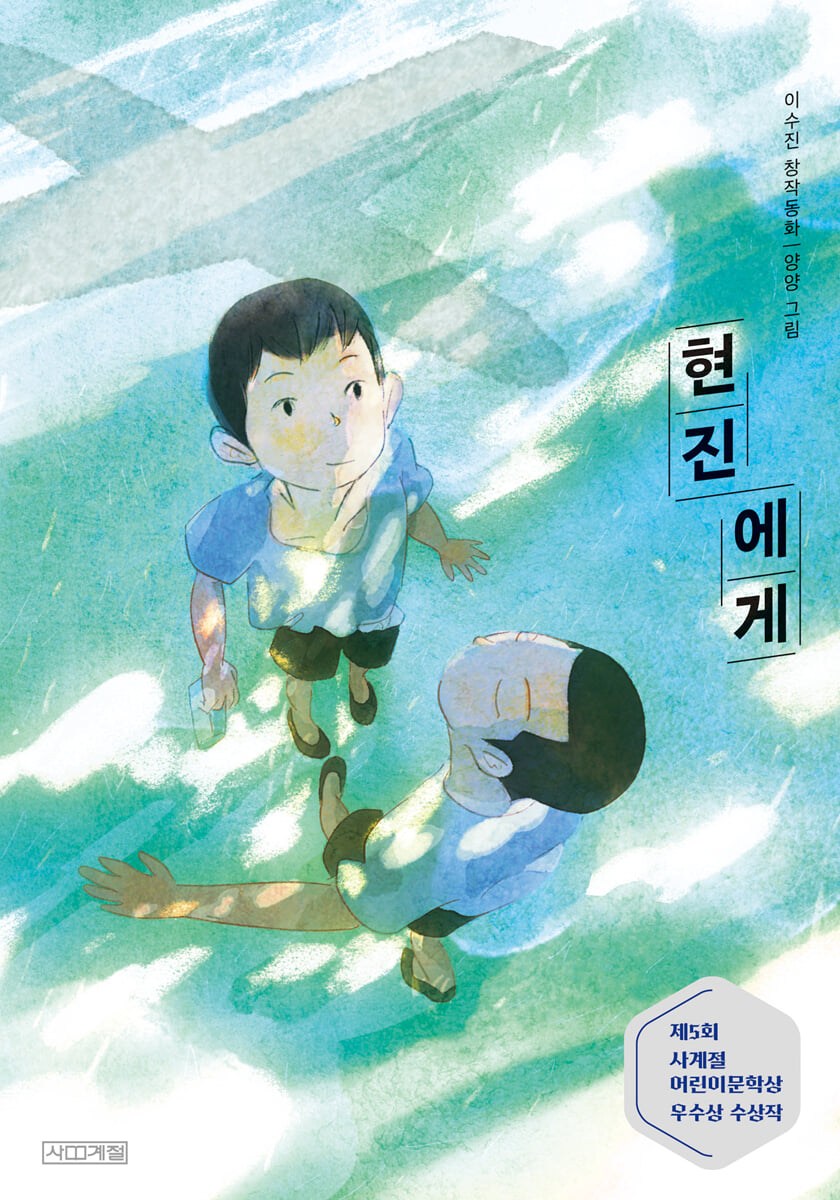
To Hyunjin
 |
Description
Book Introduction
Overcoming the pain of war, discrimination, and separation
The courage and friendship of children as they move on to the next season
Following 『Monster Child』 and 『The Speed of Luck』
Selections from the Four Seasons Children's Literature Awards that will move the hearts of young readers
The 5th Four Seasons Children's Literature Award winner, "To Hyunjin," is set in Tokyo in the summer of 1959.
A time of chaos when Japan, suffering from defeat and poverty, sought a way to survive due to another war that broke out in Korea.
The moment the protagonist's name is revealed, that unfamiliar space-time begins to come alive with the story of 'here and now.'
The twelve-year-old boy's name is Haruto Watanabe, and his name is Hyunjin Lee.
"To Hyunjin" delicately shows the impact of the great violence of "war" on children through the eyes of the protagonist, Hyunjin (Haruto), who was born to a Korean father and a Japanese mother.
The war not only tore apart Hyunjin's family and killed his friends' families, but also made the surviving children discriminate and hate each other.
Moreover, the conflicts that Hyunjin, a mixed-race person, has with his friends are something that could easily happen in today's Korean classrooms where children from diverse cultural backgrounds mingle.
That is why the precious hope and warm friendship that Hyun-jin regained through hardship in the midst of that pain leave a deep impression on the reader's heart.
The Four Seasons Children's Literature Award has discovered and introduced "children's literature that thinks about today's children," including the fantasy "Monster Child," which contains the power to overcome discrimination, and "Kisoyoung's Friends," which focuses on children's right to mourn.
The fifth award-winning work, "To Hyunjin," received praise from the judges for its depth in dealing with the heart that does not turn away from those who are discriminated against, the courage to reach out, and friendship that is not swayed by social conflict, and for its value as "not only a historical piece but also a story of friendship."
The practice of pointing fingers and hating each other because of our innate appearance, the language we speak, and our different religions is still ongoing.
1950s Japan may seem distant in both time and space, but what Hyun-jin experiences is anything but special.
Even at this very moment, somewhere, exclusion and oppression of foreigners may be occurring.
This is also why we must read this work today.
-Kim Min-ryeong (children's and youth literature critic)
The courage and friendship of children as they move on to the next season
Following 『Monster Child』 and 『The Speed of Luck』
Selections from the Four Seasons Children's Literature Awards that will move the hearts of young readers
The 5th Four Seasons Children's Literature Award winner, "To Hyunjin," is set in Tokyo in the summer of 1959.
A time of chaos when Japan, suffering from defeat and poverty, sought a way to survive due to another war that broke out in Korea.
The moment the protagonist's name is revealed, that unfamiliar space-time begins to come alive with the story of 'here and now.'
The twelve-year-old boy's name is Haruto Watanabe, and his name is Hyunjin Lee.
"To Hyunjin" delicately shows the impact of the great violence of "war" on children through the eyes of the protagonist, Hyunjin (Haruto), who was born to a Korean father and a Japanese mother.
The war not only tore apart Hyunjin's family and killed his friends' families, but also made the surviving children discriminate and hate each other.
Moreover, the conflicts that Hyunjin, a mixed-race person, has with his friends are something that could easily happen in today's Korean classrooms where children from diverse cultural backgrounds mingle.
That is why the precious hope and warm friendship that Hyun-jin regained through hardship in the midst of that pain leave a deep impression on the reader's heart.
The Four Seasons Children's Literature Award has discovered and introduced "children's literature that thinks about today's children," including the fantasy "Monster Child," which contains the power to overcome discrimination, and "Kisoyoung's Friends," which focuses on children's right to mourn.
The fifth award-winning work, "To Hyunjin," received praise from the judges for its depth in dealing with the heart that does not turn away from those who are discriminated against, the courage to reach out, and friendship that is not swayed by social conflict, and for its value as "not only a historical piece but also a story of friendship."
The practice of pointing fingers and hating each other because of our innate appearance, the language we speak, and our different religions is still ongoing.
1950s Japan may seem distant in both time and space, but what Hyun-jin experiences is anything but special.
Even at this very moment, somewhere, exclusion and oppression of foreigners may be occurring.
This is also why we must read this work today.
-Kim Min-ryeong (children's and youth literature critic)
- You can preview some of the book's contents.
Preview
index
1.
Family Separation_5
2.
Small Stone from Jeju Island_18
3.
Name in the picture_24
4.
The Story of You and Me_36
5.
Can We Be Friends_46
6.
Nobody Knows_57
7.
Hated People_67
8.
As lonely as a flower withers_79
9.
The Weight of Lies_86
10.
Summer Night Out_98
11.
Selection_106
12.
We Are Not Alone_117
13.
Dad and Me_132
14.
Friend_150
Author's Note_164
Commentary on the work_166
Family Separation_5
2.
Small Stone from Jeju Island_18
3.
Name in the picture_24
4.
The Story of You and Me_36
5.
Can We Be Friends_46
6.
Nobody Knows_57
7.
Hated People_67
8.
As lonely as a flower withers_79
9.
The Weight of Lies_86
10.
Summer Night Out_98
11.
Selection_106
12.
We Are Not Alone_117
13.
Dad and Me_132
14.
Friend_150
Author's Note_164
Commentary on the work_166
Detailed image

Publisher's Review
Haruto Watanabe and Hyunjin Lee
Twelve-year-old Haruto reluctantly sets off to school carrying the letter his mother gave him.
The envelope of the letter my mother wrote to my father was written in both Korean and Japanese.
However, in front of the post office, Haruto pretends to have accidentally thrown the letter on the ground and urges his best friend Ryo to go to school.
In the classroom, Jeong-woo, the only Korean in the class, silently endures bullying from other students as usual.
There are many children in Harutone's class who lost their families in the war.
Those children believe that both the war and losing the war are Korea's fault.
However, Haruto is well aware that it was Japan that started the war and of the violence Japan committed against Korea.
Haruto watches with unease as Japanese children bully Korean children, but cannot stand up and take their side.
The reason for this is because of another name Haruto has.
I have two names.
His Korean name is Lee Hyun-jin, and his Japanese name is Watanabe Haruto.
(Omitted) But my school friends call me Haruto, and no one knows my Korean name.
The fact that my mother is Japanese and my father is Korean.
(Pages 12-13)
The setting of 'Japan in the late 1950s' is a rather unfamiliar setting for young readers.
Many fairy tales featuring children caught in the midst of the Japanese colonial period or the Korean War have focused on the physical impact of massive violence on the lives of ordinary people.
However, 『To Hyunjin』 features Hyunjin, who lives in Japan after the Pacific War and the Korean War, as the main character, and informs young readers of the existence of children of mixed Korean and Japanese descent and Koreans in Japan.
What war leaves behind for children
A Korean father and a Japanese mother who married in Korea during the Japanese colonial period.
Soon, Joseon was liberated, and Hyunjin and his younger brother Sejin were born, and they dreamed of happy days ahead, but the Korean War broke out and the difficult evacuation began.
In the end, my father stayed in Korea and my mother and brother came to Japan.
Although they decided to meet again after a short separation, the family's separation has continued for years.
My mother works day and night to earn a living by sewing, and she worries about and misses my father who lives far away.
Every time he sees his mother struggling, and every time he recalls the memories they had together in Korea, Hyun-jin's vague resentment towards his father grows.
School life isn't easy either.
Hyunjin knows full well that it is unfair for the kids in his class to bully Jeongwoo.
Although he is afraid that his friends will turn away if they find out that he is half Korean, he cannot turn his back on Jeong-woo.
I'm curious about Jeong-woo, who proudly reveals his Korean name even while being bullied, and I want to call out the Korean name he wrote in a corner of his drawing.
Because Hyunjin would be the only one who could pronounce that name correctly in the classroom.
The war between the nations may have ended for a while, but for Hyunjin, this war is not over yet.
Those who died in the bombings could not return, and families separated by the war could not be reunited.
The conflict left by the war remains deeply rooted between Japanese and Korean children.
"To Hyunjin" delicately depicts the children still living in the places swept by war.
Beyond death and poverty, the scars that war leaves on society have a profound impact not only on adults but also on children.
And the conflict is even more significant because it is not limited to the 1950s.
Even in 2025, when we live, there is such a war.
State violence, including the ongoing Ukrainian war that has lasted for three years and seven months, is occurring everywhere, and many people hate and discriminate against each other based on skin color, gender, nationality, and religion.
Looking at it that way, Hyunjin's situation becomes even more vivid.
How will Hyun-jin overcome the 'war' that seems to never end, both in the past and in the present?
About the courage to reach out to each other
Hyunjin goes to find Jeongwoo, who is left alone in the classroom after everyone else has left, and reaches out to him.
They take Jeong-woo, who misses his family he left behind in Korea, and go around the neighborhood to have fun.
Jeong-woo, who was always alone, and Hyun-jin, who was afraid of being caught with Jeong-woo, leave school and walk along the wall with him, and even catch a spider's web.
That clumsy consolation becomes a beautiful memory that will remain long in the hearts of the two children as well as in the memories of the readers.
When Jeong-woo confesses his story of losing his family in Jeju and fleeing to Japan, Hyun-jin reveals a piece of her secret that she has never told anyone else.
He said that he himself has lived in Jeju Island, and that his father lives far away and does not live with him.
As she grows closer to Jung-woo, she begins to hide more things from Ryo, and Hyun-jin begins to feel guilty about not being honest with either of her friends.
And the desire to reveal one's own name out loud grows stronger.
Eventually, it is revealed that Hyun-jin's father is Korean, and she gets into trouble at school.
Hyun-jin, who was ignored by Ryo, wanders around feeling wronged and disappointed.
But even though they are so far apart, Hyun-jin rescues Ryo who is trapped in the warehouse, and Ryo helps Hyun-jin search for his younger brother.
The commotion lets both children know they are not alone.
And Hyunjin confesses directly to Ryo.
“My name is… my name is Lee Hyeon-jin.
“I’ve been wanting to tell you this for a while now.”
I meant it.
If I ever get to tell anyone my name, I want to tell Ryo first.
But it was strange.
Now that I've said it, I feel like it doesn't matter anymore whether my name is Hyunjin or Haruto or anything else.
(Page 141)
"The power to stand up to a cold and unjust world."
Ryo's father, who had been wandering around the neighborhood after fighting with Ryo after finding out that his father was Korean, calls Hyun-jin into the store and treats him no differently than before.
And it tells an unexpected story.
He said that the Koreans he met during the war were really good people.
When Hyunjin asks, “Were you a good person to that person too, sir?” Ryo’s father, who was flustered, begins to confess with difficulty.
I wasn't a good person to him.
And Ryo's father's subsequent confession contains an apology and consolation that all the older generations who started the war must pass on to the next generation.
“I thought I would know everything and be good at everything when I grew up, but that wasn’t the case.
If that were the case, the war would never have happened in the first place.
(Omitted) But now the war is over.
So now you have to stop making mistakes.
Haruto, straighten your shoulders.
You don't have to worry about it.”
Just like in this work, Hyunjin will wait for letters from her father and from her friend who has gone far away even after the seasons change.
And I will write them a letter.
I'm doing well and I miss them, so come back healthy.
And his best friend Ryo will always be by Hyunjin's side.
"To Hyunjin" brilliantly projects the present into a past that feels distant to children.
And while it cautions against violence and discrimination that exist between people, both past and present, it also clearly conveys the fact that the power to overcome them also exists among people.
This gentle voice will remain in the hearts of young readers and will be passed on to others as courage to reach out to the weak.
Twelve-year-old Haruto reluctantly sets off to school carrying the letter his mother gave him.
The envelope of the letter my mother wrote to my father was written in both Korean and Japanese.
However, in front of the post office, Haruto pretends to have accidentally thrown the letter on the ground and urges his best friend Ryo to go to school.
In the classroom, Jeong-woo, the only Korean in the class, silently endures bullying from other students as usual.
There are many children in Harutone's class who lost their families in the war.
Those children believe that both the war and losing the war are Korea's fault.
However, Haruto is well aware that it was Japan that started the war and of the violence Japan committed against Korea.
Haruto watches with unease as Japanese children bully Korean children, but cannot stand up and take their side.
The reason for this is because of another name Haruto has.
I have two names.
His Korean name is Lee Hyun-jin, and his Japanese name is Watanabe Haruto.
(Omitted) But my school friends call me Haruto, and no one knows my Korean name.
The fact that my mother is Japanese and my father is Korean.
(Pages 12-13)
The setting of 'Japan in the late 1950s' is a rather unfamiliar setting for young readers.
Many fairy tales featuring children caught in the midst of the Japanese colonial period or the Korean War have focused on the physical impact of massive violence on the lives of ordinary people.
However, 『To Hyunjin』 features Hyunjin, who lives in Japan after the Pacific War and the Korean War, as the main character, and informs young readers of the existence of children of mixed Korean and Japanese descent and Koreans in Japan.
What war leaves behind for children
A Korean father and a Japanese mother who married in Korea during the Japanese colonial period.
Soon, Joseon was liberated, and Hyunjin and his younger brother Sejin were born, and they dreamed of happy days ahead, but the Korean War broke out and the difficult evacuation began.
In the end, my father stayed in Korea and my mother and brother came to Japan.
Although they decided to meet again after a short separation, the family's separation has continued for years.
My mother works day and night to earn a living by sewing, and she worries about and misses my father who lives far away.
Every time he sees his mother struggling, and every time he recalls the memories they had together in Korea, Hyun-jin's vague resentment towards his father grows.
School life isn't easy either.
Hyunjin knows full well that it is unfair for the kids in his class to bully Jeongwoo.
Although he is afraid that his friends will turn away if they find out that he is half Korean, he cannot turn his back on Jeong-woo.
I'm curious about Jeong-woo, who proudly reveals his Korean name even while being bullied, and I want to call out the Korean name he wrote in a corner of his drawing.
Because Hyunjin would be the only one who could pronounce that name correctly in the classroom.
The war between the nations may have ended for a while, but for Hyunjin, this war is not over yet.
Those who died in the bombings could not return, and families separated by the war could not be reunited.
The conflict left by the war remains deeply rooted between Japanese and Korean children.
"To Hyunjin" delicately depicts the children still living in the places swept by war.
Beyond death and poverty, the scars that war leaves on society have a profound impact not only on adults but also on children.
And the conflict is even more significant because it is not limited to the 1950s.
Even in 2025, when we live, there is such a war.
State violence, including the ongoing Ukrainian war that has lasted for three years and seven months, is occurring everywhere, and many people hate and discriminate against each other based on skin color, gender, nationality, and religion.
Looking at it that way, Hyunjin's situation becomes even more vivid.
How will Hyun-jin overcome the 'war' that seems to never end, both in the past and in the present?
About the courage to reach out to each other
Hyunjin goes to find Jeongwoo, who is left alone in the classroom after everyone else has left, and reaches out to him.
They take Jeong-woo, who misses his family he left behind in Korea, and go around the neighborhood to have fun.
Jeong-woo, who was always alone, and Hyun-jin, who was afraid of being caught with Jeong-woo, leave school and walk along the wall with him, and even catch a spider's web.
That clumsy consolation becomes a beautiful memory that will remain long in the hearts of the two children as well as in the memories of the readers.
When Jeong-woo confesses his story of losing his family in Jeju and fleeing to Japan, Hyun-jin reveals a piece of her secret that she has never told anyone else.
He said that he himself has lived in Jeju Island, and that his father lives far away and does not live with him.
As she grows closer to Jung-woo, she begins to hide more things from Ryo, and Hyun-jin begins to feel guilty about not being honest with either of her friends.
And the desire to reveal one's own name out loud grows stronger.
Eventually, it is revealed that Hyun-jin's father is Korean, and she gets into trouble at school.
Hyun-jin, who was ignored by Ryo, wanders around feeling wronged and disappointed.
But even though they are so far apart, Hyun-jin rescues Ryo who is trapped in the warehouse, and Ryo helps Hyun-jin search for his younger brother.
The commotion lets both children know they are not alone.
And Hyunjin confesses directly to Ryo.
“My name is… my name is Lee Hyeon-jin.
“I’ve been wanting to tell you this for a while now.”
I meant it.
If I ever get to tell anyone my name, I want to tell Ryo first.
But it was strange.
Now that I've said it, I feel like it doesn't matter anymore whether my name is Hyunjin or Haruto or anything else.
(Page 141)
"The power to stand up to a cold and unjust world."
Ryo's father, who had been wandering around the neighborhood after fighting with Ryo after finding out that his father was Korean, calls Hyun-jin into the store and treats him no differently than before.
And it tells an unexpected story.
He said that the Koreans he met during the war were really good people.
When Hyunjin asks, “Were you a good person to that person too, sir?” Ryo’s father, who was flustered, begins to confess with difficulty.
I wasn't a good person to him.
And Ryo's father's subsequent confession contains an apology and consolation that all the older generations who started the war must pass on to the next generation.
“I thought I would know everything and be good at everything when I grew up, but that wasn’t the case.
If that were the case, the war would never have happened in the first place.
(Omitted) But now the war is over.
So now you have to stop making mistakes.
Haruto, straighten your shoulders.
You don't have to worry about it.”
Just like in this work, Hyunjin will wait for letters from her father and from her friend who has gone far away even after the seasons change.
And I will write them a letter.
I'm doing well and I miss them, so come back healthy.
And his best friend Ryo will always be by Hyunjin's side.
"To Hyunjin" brilliantly projects the present into a past that feels distant to children.
And while it cautions against violence and discrimination that exist between people, both past and present, it also clearly conveys the fact that the power to overcome them also exists among people.
This gentle voice will remain in the hearts of young readers and will be passed on to others as courage to reach out to the weak.
GOODS SPECIFICS
- Date of issue: October 3, 2025
- Page count, weight, size: 176 pages | 306g | 147*210*10mm
- ISBN13: 9791169813938
- ISBN10: 1169813933
- KC Certification: Certification Type: Conformity Confirmation
You may also like
카테고리
korean


korean

![GQ KOREA Mark (Monthly): December [2025]](http://librairie.coreenne.fr/cdn/shop/files/8ef265dbbfbf186523ed75ba7319009d.jpg?v=1765340328&width=3840)


