

Healing through medicine and humanities
 |
Description
Book Introduction
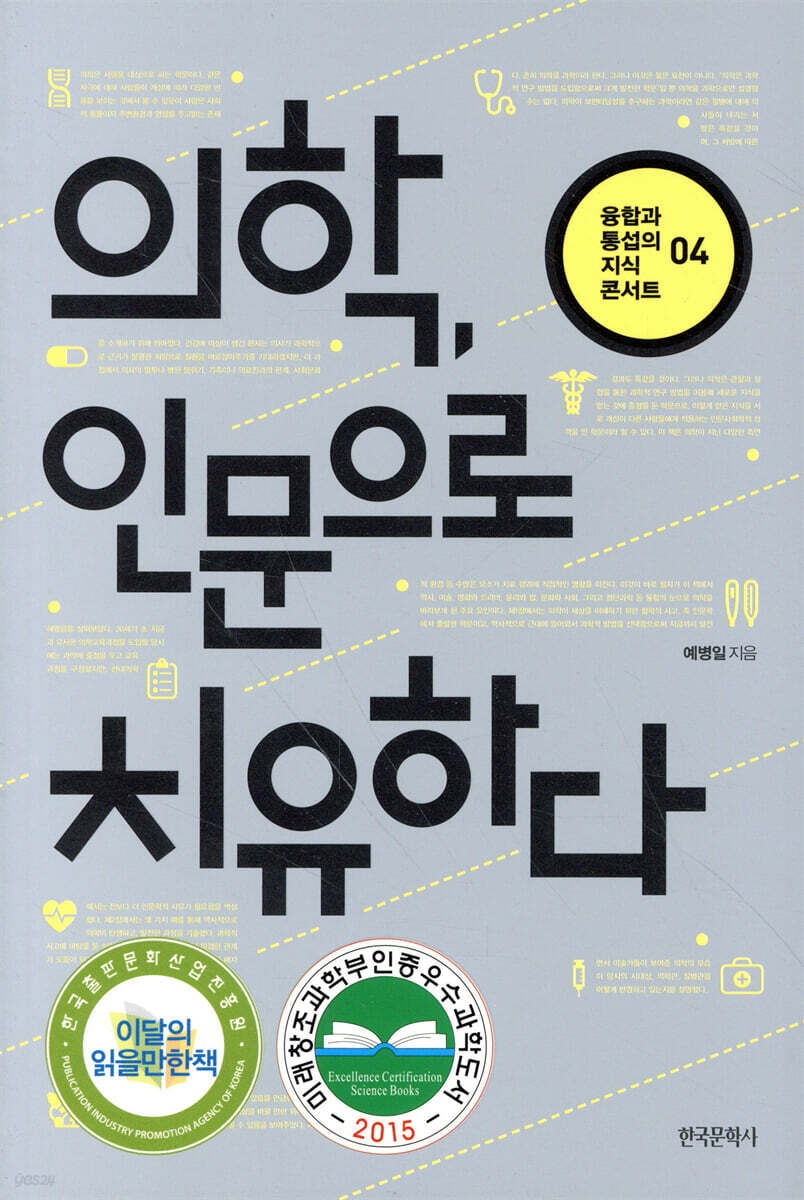
A world of medical humanities imagination encompassing science and humanities Medicine is often considered a difficult discipline that can only be handled by experts. However, as a discipline that deals with human life, medicine encompasses a vast field, to the point where almost all disciplines contribute to the advancement of medicine. Patients expect doctors to treat their illnesses with scientifically sound prescriptions, but in the process, numerous factors, such as the doctor's tone of voice, the hospital atmosphere, relationships with others, and the sociocultural environment, directly impact the treatment. This is why we must view medicine through a lens of convergence, linking it to history, art, culture and society, ethics and law, and cutting-edge science. In line with this, medical schools around the world today are strengthening education in humanistic medicine in addition to scientific medicine. The author, who is currently educating medical students at Yonsei University Wonju College of Medicine, introduces various aspects of medicine as part of this purpose, suggesting ways to understand the discipline of medicine and the direction it should take. As Professor Jeong Jae-seung says in his recommendation, the author says that the role of medicine is to “see humans not simply as living lumps of flesh, but as subjects who interact with the world and look at themselves through introspection, that is, as conscious living beings, and to seek healing.” The fourth book of the "Knowledge Concert of Convergence and Integration," "Medicine, Healing with Humanities," introduces medicine in various fields, allowing us to feel closer to medicine as an academic discipline closely related to human life, rather than medicine confined to a laboratory. |
- You can preview some of the book's contents.
Preview
index
Entering
Chapter 1: Medicine: Embracing Academics and the World through Convergence
Medicine originated from the humanities: The Birth of Medicine | Growing Through Scientific Methods and Natural Philosophy: The Growth of Medicine | Why Are Humanities Necessary in Medical Education?: The Necessity of Humanities Education | Viewing Medicine and Healthcare from a Humanities Perspective: The Importance of Medical Humanities | Medicine Develops Through Interdisciplinary Thinking: The Convergence of Medicine | Medicine Transcending East and West: The Field of Medicine
Chapter 2: Medicine: Saving Humanity at a Crucial Point in History
The Coexistence of the God of Medicine and the Medical Hero: The Dawn of Medicine | An Accidental Gun Accident Reveals the Truth About the Digestive System: Trust Between Doctors and Patients | Pasteur and Bernard, Rivals in 19th-Century Medicine: Microbiology and Experimental Medicine | Why Did Nightingale Go to War?: The Development of Nursing | New Medical Discoveries Always Face Challenges: The New Technology Debate
Chapter 3: Medical Insights Living and Breathing in Art
Berengar, leaving behind the first anatomical diagram: Anatomy and the Anatomical Diagram | The physicians and painters who brought an end to the Middle Ages: Vesalius and Calcar | The reality of medicine as depicted in paintings: Doctors and medicine | The real reason for Alexander's untimely death?: Estimates of medical causes of death | Is bloodletting the cure?: Bloodletting | The cholera pandemic that terrified the world, depicted in paintings: Cholera
Chapter 4: Finding Your Way Through Medicine in Film and Drama
Why do surgeons often appear in medical dramas?: Surgery and Internal Medicine | [CSI] Seeking the Rights of the Dead: Forensic Medicine and Forensic Science | Finding Traces of DNA: Polymerase Chain Reaction | [Hello Hazel] Showing Beautiful Vitality: Cancer and Treatment | [Cold], the Worst Virus Attack Ever: Avian Flu | Is the Artificial Organ Surgery in [Grey's Anatomy] Actually Possible?: 3D Printing
Chapter 5: Medicine: Struggling Between Ethics and Law
Advancing medical technology, deepening ethical issues: Medical ethics | Moving from medical ethics to bioethics law: Medicine and law | Theoretical approaches are needed for issues of life and ethics: The four principles of medical ethics | Even in an era of limitless competition, customer-satisfying medical care is important: Patients' Bill of Rights and Physicians' Declaration of Ethics | Abortion, considering life amidst ethics and law: Controversy over the ethics of abortion | The patient's right to treatment is paramount above all else: Patient's rights | What if a patient refuses treatment?: The right not to receive treatment and euthanasia
Chapter 6: Reading Medicine and Culture to See Society
Medicine is a culture: Medicine and culture | The cultural and sociological implications of tobacco and alcohol: The addictive nature of smoking and alcohol | Which is more dangerous, tuberculosis or AIDS?: The problem of tuberculosis and AIDS | Environmental destruction causes new diseases: Environmental problems and infectious diseases | What is more important is extending healthy life expectancy: Health in a super-aged society | Is Korea's health insurance system a source of pride for the world?: The medical insurance system
Chapter 7: Modern Medicine: Overcoming Limitations with Scientific Advancements
Waging a Breathless War Against Superbugs: The Problem of Antibiotic-Resistant Strains | Can Vaccines Prevent Cancer?: Cancer and Vaccines | The Age of Gene Doping is Coming: Drug Doping and Gene Doping | Dreaming of Treating Incurable Diseases Using Genes: Gene Therapy | Brightening the Future of Medicine with Personalized Treatments: Personalized Medicine | The Medicine of the Future, Empowered by Information Technology: Medicine and IT
Notes | Search
Chapter 1: Medicine: Embracing Academics and the World through Convergence
Medicine originated from the humanities: The Birth of Medicine | Growing Through Scientific Methods and Natural Philosophy: The Growth of Medicine | Why Are Humanities Necessary in Medical Education?: The Necessity of Humanities Education | Viewing Medicine and Healthcare from a Humanities Perspective: The Importance of Medical Humanities | Medicine Develops Through Interdisciplinary Thinking: The Convergence of Medicine | Medicine Transcending East and West: The Field of Medicine
Chapter 2: Medicine: Saving Humanity at a Crucial Point in History
The Coexistence of the God of Medicine and the Medical Hero: The Dawn of Medicine | An Accidental Gun Accident Reveals the Truth About the Digestive System: Trust Between Doctors and Patients | Pasteur and Bernard, Rivals in 19th-Century Medicine: Microbiology and Experimental Medicine | Why Did Nightingale Go to War?: The Development of Nursing | New Medical Discoveries Always Face Challenges: The New Technology Debate
Chapter 3: Medical Insights Living and Breathing in Art
Berengar, leaving behind the first anatomical diagram: Anatomy and the Anatomical Diagram | The physicians and painters who brought an end to the Middle Ages: Vesalius and Calcar | The reality of medicine as depicted in paintings: Doctors and medicine | The real reason for Alexander's untimely death?: Estimates of medical causes of death | Is bloodletting the cure?: Bloodletting | The cholera pandemic that terrified the world, depicted in paintings: Cholera
Chapter 4: Finding Your Way Through Medicine in Film and Drama
Why do surgeons often appear in medical dramas?: Surgery and Internal Medicine | [CSI] Seeking the Rights of the Dead: Forensic Medicine and Forensic Science | Finding Traces of DNA: Polymerase Chain Reaction | [Hello Hazel] Showing Beautiful Vitality: Cancer and Treatment | [Cold], the Worst Virus Attack Ever: Avian Flu | Is the Artificial Organ Surgery in [Grey's Anatomy] Actually Possible?: 3D Printing
Chapter 5: Medicine: Struggling Between Ethics and Law
Advancing medical technology, deepening ethical issues: Medical ethics | Moving from medical ethics to bioethics law: Medicine and law | Theoretical approaches are needed for issues of life and ethics: The four principles of medical ethics | Even in an era of limitless competition, customer-satisfying medical care is important: Patients' Bill of Rights and Physicians' Declaration of Ethics | Abortion, considering life amidst ethics and law: Controversy over the ethics of abortion | The patient's right to treatment is paramount above all else: Patient's rights | What if a patient refuses treatment?: The right not to receive treatment and euthanasia
Chapter 6: Reading Medicine and Culture to See Society
Medicine is a culture: Medicine and culture | The cultural and sociological implications of tobacco and alcohol: The addictive nature of smoking and alcohol | Which is more dangerous, tuberculosis or AIDS?: The problem of tuberculosis and AIDS | Environmental destruction causes new diseases: Environmental problems and infectious diseases | What is more important is extending healthy life expectancy: Health in a super-aged society | Is Korea's health insurance system a source of pride for the world?: The medical insurance system
Chapter 7: Modern Medicine: Overcoming Limitations with Scientific Advancements
Waging a Breathless War Against Superbugs: The Problem of Antibiotic-Resistant Strains | Can Vaccines Prevent Cancer?: Cancer and Vaccines | The Age of Gene Doping is Coming: Drug Doping and Gene Doping | Dreaming of Treating Incurable Diseases Using Genes: Gene Therapy | Brightening the Future of Medicine with Personalized Treatments: Personalized Medicine | The Medicine of the Future, Empowered by Information Technology: Medicine and IT
Notes | Search
Into the book
“As the 20th century drew to a close, fundamental questions arose about the philosophy of medicine.
It is clear that the driving force behind the great advancement of medicine has been the forward-looking, forward-moving use of scientific research methods. However, as medicine reached a certain level, questions such as, “Is what modern medicine is doing right?” and “Is the direction in which medicine is moving desirable?” began to pour in. (From “Chapter 1 Medicine, Embracing Academics and the World through Convergence”)
“Before Hippocrates, the Greeks thought that ‘disease was a punishment from the gods,’ so they rarely thought about curing it.
A common method was to pray to the god who had inflicted punishment for healing.
Since they thought that if they were going to borrow the power of a god, it would be better to pray to Asclepius, the god of medicine, they built temples for him in various places.
Temples were built in places with clean air and beautiful scenery, and when praying, the body and mind were purified to look good to the gods.
“It is only natural that maintaining good hygiene in a place with clean air and beautiful scenery would help to cure diseases, so it would have been effective to some extent.” (From “Chapter 2 Medicine, Saving Humanity at a Critical Point in History”)
“However, this controversy almost disappeared in the 17th century when Harvey’s theory of blood circulation became established as truth.
It has been discovered that the location of the blood draw does not matter because blood is constantly circulating throughout the body, and it is the same blood no matter where it is drawn.
Even after drawing an 'appropriate' amount of blood, if the disease did not improve, more blood was drawn, judging that the amount was insufficient. In some cases, the patient died from blood deficiency after continuing to draw blood, but this was merely "an unfortunate and inevitable consequence of the best treatment." (Chapter 3 Medical Insights Living and Breathing in Art)
“Hippocrates’ greatest achievement was bringing medicine from the realm of the gods to the realm of mankind.
Until recently, illness was thought to be a punishment from God, so it was most common to ask for help from God when suffering from an illness.
However, Hippocrates believed that disease was not a punishment from the gods, but rather a result of an abnormality within the human body or a disharmony between the human body and its surroundings. Therefore, he believed that treatment would be possible if the abnormality and disharmony were corrected.” (From “Chapter 5: Medicine, Suffering Between Ethics and Law”)
“Even now, most people think that AIDS is a scary, incurable disease.
However, AIDS and HIV infection must be distinguished.
The problem is that AIDS and HIV infection are not generally distinguished, and when the media refers to AIDS, it is often not actually referring to acquired immunodeficiency syndrome, but rather to a state in which the body is infected with a virus but no particular abnormalities appear.
“This condition, which should be called ‘viral infection’ rather than ‘AIDS,’ can be treated from this point on.” (From “Chapter 6: Reading Medicine and Culture to See Society”)
“Advances in microbiology and immunology have driven the development of infectious disease and surgical procedures in medicine. Advances in genetics and life sciences have led to the introduction of personalized medicine. Furthermore, the integration of information technology using electrical and electronic technologies into medicine is accelerating the advancement of medicine.
“Just as many modern disciplines are developing through convergence with other disciplines, medicine is also developing not as a single field of science, but as a field that combines various disciplines.” (From “Chapter 7 Modern Medicine, Overcoming Limitations with Scientific Advancement”)
It is clear that the driving force behind the great advancement of medicine has been the forward-looking, forward-moving use of scientific research methods. However, as medicine reached a certain level, questions such as, “Is what modern medicine is doing right?” and “Is the direction in which medicine is moving desirable?” began to pour in. (From “Chapter 1 Medicine, Embracing Academics and the World through Convergence”)
“Before Hippocrates, the Greeks thought that ‘disease was a punishment from the gods,’ so they rarely thought about curing it.
A common method was to pray to the god who had inflicted punishment for healing.
Since they thought that if they were going to borrow the power of a god, it would be better to pray to Asclepius, the god of medicine, they built temples for him in various places.
Temples were built in places with clean air and beautiful scenery, and when praying, the body and mind were purified to look good to the gods.
“It is only natural that maintaining good hygiene in a place with clean air and beautiful scenery would help to cure diseases, so it would have been effective to some extent.” (From “Chapter 2 Medicine, Saving Humanity at a Critical Point in History”)
“However, this controversy almost disappeared in the 17th century when Harvey’s theory of blood circulation became established as truth.
It has been discovered that the location of the blood draw does not matter because blood is constantly circulating throughout the body, and it is the same blood no matter where it is drawn.
Even after drawing an 'appropriate' amount of blood, if the disease did not improve, more blood was drawn, judging that the amount was insufficient. In some cases, the patient died from blood deficiency after continuing to draw blood, but this was merely "an unfortunate and inevitable consequence of the best treatment." (Chapter 3 Medical Insights Living and Breathing in Art)
“Hippocrates’ greatest achievement was bringing medicine from the realm of the gods to the realm of mankind.
Until recently, illness was thought to be a punishment from God, so it was most common to ask for help from God when suffering from an illness.
However, Hippocrates believed that disease was not a punishment from the gods, but rather a result of an abnormality within the human body or a disharmony between the human body and its surroundings. Therefore, he believed that treatment would be possible if the abnormality and disharmony were corrected.” (From “Chapter 5: Medicine, Suffering Between Ethics and Law”)
“Even now, most people think that AIDS is a scary, incurable disease.
However, AIDS and HIV infection must be distinguished.
The problem is that AIDS and HIV infection are not generally distinguished, and when the media refers to AIDS, it is often not actually referring to acquired immunodeficiency syndrome, but rather to a state in which the body is infected with a virus but no particular abnormalities appear.
“This condition, which should be called ‘viral infection’ rather than ‘AIDS,’ can be treated from this point on.” (From “Chapter 6: Reading Medicine and Culture to See Society”)
“Advances in microbiology and immunology have driven the development of infectious disease and surgical procedures in medicine. Advances in genetics and life sciences have led to the introduction of personalized medicine. Furthermore, the integration of information technology using electrical and electronic technologies into medicine is accelerating the advancement of medicine.
“Just as many modern disciplines are developing through convergence with other disciplines, medicine is also developing not as a single field of science, but as a field that combines various disciplines.” (From “Chapter 7 Modern Medicine, Overcoming Limitations with Scientific Advancement”)
--- From the text
Publisher's Review
A world of medical humanities imagination encompassing science and humanities
Medicine is often considered a difficult discipline that can only be handled by experts.
However, as a discipline that deals with human life, medicine encompasses a vast field, to the point where almost all disciplines contribute to the advancement of medicine.
Patients expect doctors to treat their illnesses with scientifically sound prescriptions, but in the process, numerous factors, such as the doctor's tone of voice, the hospital atmosphere, relationships with others, and the sociocultural environment, directly impact the treatment.
This is why we must view medicine through a lens of convergence, linking it to history, art, culture and society, ethics and law, and cutting-edge science.
In line with this, medical schools around the world today are strengthening education in humanistic medicine in addition to scientific medicine.
The author, who is currently educating medical students at Yonsei University Wonju College of Medicine, introduces various aspects of medicine as part of this purpose, suggesting ways to understand the discipline of medicine and the direction it should take.
As Professor Jeong Jae-seung's recommendation states, the role of medicine is to "see humans not simply as living lumps of flesh, but as subjects who interact with the world and look at themselves through introspection, that is, as conscious living beings, and to seek healing."
The fourth book of the "Knowledge Concert of Convergence and Integration," "Medicine, Healing with Humanities," introduces medicine in various fields, allowing us to feel closer to medicine as an academic discipline closely related to human life, rather than medicine confined to a laboratory.
Chapter 1: Medicine: Embracing Academics and the World through Convergence
Medicine is often considered a branch of science, but this is not a correct classification.
Medicine has made great strides by introducing scientific research methods, but it is still a discipline that deals with people, and must be accompanied by an understanding of people.
Born in the humanities, it has grown into a scientific discipline, and has crossed over into various fields of study and the world, encountering medicine as it contemplates the present and future of humanity, thereby drawing a larger picture of medicine.
Chapter 2: Medicine: Saving Humanity at a Crucial Point in History
The reason we study history is to use past events to help us make decisions in the present.
Today, medicine is a rational discipline with universally valid grounds, but in the past, medical procedures were sometimes performed that were perceived as absurd.
Looking back at the times when medicine saved humanity at critical junctures in history, we can see the direction we should take to further advance medicine.
Chapter 3: Medical Insights Living and Breathing in Art
From da Vinci to Picasso, artists have expressed the people and the circumstances of their time through their works of art, and this has also included aspects of medicine.
It is truly fascinating to look into the medical aspects of human art and understand how people of the time understood medicine and disease.
Chapter 4: Finding Your Way Through Medicine in Film and Drama
Medical dramas, with their frequent emergencies and life-or-death scenes, are always on the edge of your seat.
In this way, medicine depicted in movies and dramas allows people to feel closer to the medical field and medical staff.
Furthermore, medical knowledge and cutting-edge technologies used in scientific investigations, as well as movies and dramas depicting how virus mutations can put a country at risk, serve as important elements that deepen our understanding of medicine.
Chapter 5: Medicine: Wrestling Between Ethics and Law
As medicine has advanced, we have encountered many problems that were previously unforeseen, namely, situations that are difficult to judge ethically.
Advances in medicine are leading to a strengthening of ethics and laws governing all aspects of medical practice, which in turn demands changes in medical research and education.
In particular, we will look back on our 'attitude toward medicine' through consideration of various medical ethics issues such as euthanasia, abortion, and genetic manipulation, as well as bioethics laws.
Chapter 6: Reading Medicine and Culture to See Society
Humans, as social animals, are inevitably influenced by the culture inherent in that society.
If a person with a medical problem does not understand the culture of the society in which he or she is affected, solving the problem will be difficult.
This is because the effects that can be obtained from utilizing medicine and healthcare vary depending on how we deal with the cultural influences that we encounter in our daily lives, whether knowingly or unknowingly.
Chapter 7: Modern Medicine: Overcoming Limitations with Scientific Advancements
Today, it has become common for a particular discipline to receive assistance from other disciplines in order to develop.
Just as many modern disciplines develop through convergence with other disciplines, medicine is also developing into a field that combines various disciplines rather than being a single field of science.
In particular, cutting-edge medicine, which combines with information technology (IT), which is making remarkable progress today, offers new hope to humanity, which dreams of 'freedom from disease.'
Medicine, the discipline that heals all things human
Since it was established as an academic discipline by Hippocrates in the 5th to 4th century BC, medicine has continued to develop.
In the process, medicine was implemented in relation to religion and faith, or was called 'natural philosophy' before the word 'science' was used, and was also exploited for political purposes, such as the Nazis' vivisection of Jews or the Maruta experiments of Japanese imperialism.
The fact that medicine has changed in various ways according to the circumstances of the times is evidence that medicine as a discipline is deeply related to human life and culture.
For example, in France, where beauty is valued, the breast cancer surgery rate is relatively low, and Gajdusek of the United States also discovered that the cannibalistic culture of the Fore people of Papua New Guinea causes a fatal disease (kuru).
Medical treatment methods and medical systems also differ from country to country.
This book provides an easy-to-understand explanation, drawing on historical, cultural, and social evidence, of why countries approach the same disease differently and why their health insurance systems are implemented differently.
As we can see from the way bacteria constantly change their properties to survive, humans still do not fully understand the mechanisms of the human body.
It is not only the theories established through academics and the medical techniques actually practiced that have changed.
The nature of the disease has also changed.
In the past, when medical technology was not developed, many people lost their lives to infectious diseases caused by viruses, but now in the 21st century, chronic diseases such as diabetes, high blood pressure, cancer, and dementia have become the norm.
However, as medicine has changed in this way, countless researchers have contributed to the protection of human life by making new discoveries, and they are still devoting their utmost efforts to this.
However, the problem with modern medicine based on science is that as the focus of medicine shifts from the patient to the disease, doctors become indifferent to the patient's suffering and focus only on objectively apparent abnormal symptoms, which worsens the phenomenon of treating the patient like a machine.
However, the 'personalized medicine' that is emerging today places importance on individual characteristics, unlike conventional medicine that has been conducted based on statistical data on the entire human race.
This is precisely why the humanities aspect is emphasized in medicine today.
Medicine is often considered a difficult discipline that can only be handled by experts.
However, as a discipline that deals with human life, medicine encompasses a vast field, to the point where almost all disciplines contribute to the advancement of medicine.
Patients expect doctors to treat their illnesses with scientifically sound prescriptions, but in the process, numerous factors, such as the doctor's tone of voice, the hospital atmosphere, relationships with others, and the sociocultural environment, directly impact the treatment.
This is why we must view medicine through a lens of convergence, linking it to history, art, culture and society, ethics and law, and cutting-edge science.
In line with this, medical schools around the world today are strengthening education in humanistic medicine in addition to scientific medicine.
The author, who is currently educating medical students at Yonsei University Wonju College of Medicine, introduces various aspects of medicine as part of this purpose, suggesting ways to understand the discipline of medicine and the direction it should take.
As Professor Jeong Jae-seung's recommendation states, the role of medicine is to "see humans not simply as living lumps of flesh, but as subjects who interact with the world and look at themselves through introspection, that is, as conscious living beings, and to seek healing."
The fourth book of the "Knowledge Concert of Convergence and Integration," "Medicine, Healing with Humanities," introduces medicine in various fields, allowing us to feel closer to medicine as an academic discipline closely related to human life, rather than medicine confined to a laboratory.
Chapter 1: Medicine: Embracing Academics and the World through Convergence
Medicine is often considered a branch of science, but this is not a correct classification.
Medicine has made great strides by introducing scientific research methods, but it is still a discipline that deals with people, and must be accompanied by an understanding of people.
Born in the humanities, it has grown into a scientific discipline, and has crossed over into various fields of study and the world, encountering medicine as it contemplates the present and future of humanity, thereby drawing a larger picture of medicine.
Chapter 2: Medicine: Saving Humanity at a Crucial Point in History
The reason we study history is to use past events to help us make decisions in the present.
Today, medicine is a rational discipline with universally valid grounds, but in the past, medical procedures were sometimes performed that were perceived as absurd.
Looking back at the times when medicine saved humanity at critical junctures in history, we can see the direction we should take to further advance medicine.
Chapter 3: Medical Insights Living and Breathing in Art
From da Vinci to Picasso, artists have expressed the people and the circumstances of their time through their works of art, and this has also included aspects of medicine.
It is truly fascinating to look into the medical aspects of human art and understand how people of the time understood medicine and disease.
Chapter 4: Finding Your Way Through Medicine in Film and Drama
Medical dramas, with their frequent emergencies and life-or-death scenes, are always on the edge of your seat.
In this way, medicine depicted in movies and dramas allows people to feel closer to the medical field and medical staff.
Furthermore, medical knowledge and cutting-edge technologies used in scientific investigations, as well as movies and dramas depicting how virus mutations can put a country at risk, serve as important elements that deepen our understanding of medicine.
Chapter 5: Medicine: Wrestling Between Ethics and Law
As medicine has advanced, we have encountered many problems that were previously unforeseen, namely, situations that are difficult to judge ethically.
Advances in medicine are leading to a strengthening of ethics and laws governing all aspects of medical practice, which in turn demands changes in medical research and education.
In particular, we will look back on our 'attitude toward medicine' through consideration of various medical ethics issues such as euthanasia, abortion, and genetic manipulation, as well as bioethics laws.
Chapter 6: Reading Medicine and Culture to See Society
Humans, as social animals, are inevitably influenced by the culture inherent in that society.
If a person with a medical problem does not understand the culture of the society in which he or she is affected, solving the problem will be difficult.
This is because the effects that can be obtained from utilizing medicine and healthcare vary depending on how we deal with the cultural influences that we encounter in our daily lives, whether knowingly or unknowingly.
Chapter 7: Modern Medicine: Overcoming Limitations with Scientific Advancements
Today, it has become common for a particular discipline to receive assistance from other disciplines in order to develop.
Just as many modern disciplines develop through convergence with other disciplines, medicine is also developing into a field that combines various disciplines rather than being a single field of science.
In particular, cutting-edge medicine, which combines with information technology (IT), which is making remarkable progress today, offers new hope to humanity, which dreams of 'freedom from disease.'
Medicine, the discipline that heals all things human
Since it was established as an academic discipline by Hippocrates in the 5th to 4th century BC, medicine has continued to develop.
In the process, medicine was implemented in relation to religion and faith, or was called 'natural philosophy' before the word 'science' was used, and was also exploited for political purposes, such as the Nazis' vivisection of Jews or the Maruta experiments of Japanese imperialism.
The fact that medicine has changed in various ways according to the circumstances of the times is evidence that medicine as a discipline is deeply related to human life and culture.
For example, in France, where beauty is valued, the breast cancer surgery rate is relatively low, and Gajdusek of the United States also discovered that the cannibalistic culture of the Fore people of Papua New Guinea causes a fatal disease (kuru).
Medical treatment methods and medical systems also differ from country to country.
This book provides an easy-to-understand explanation, drawing on historical, cultural, and social evidence, of why countries approach the same disease differently and why their health insurance systems are implemented differently.
As we can see from the way bacteria constantly change their properties to survive, humans still do not fully understand the mechanisms of the human body.
It is not only the theories established through academics and the medical techniques actually practiced that have changed.
The nature of the disease has also changed.
In the past, when medical technology was not developed, many people lost their lives to infectious diseases caused by viruses, but now in the 21st century, chronic diseases such as diabetes, high blood pressure, cancer, and dementia have become the norm.
However, as medicine has changed in this way, countless researchers have contributed to the protection of human life by making new discoveries, and they are still devoting their utmost efforts to this.
However, the problem with modern medicine based on science is that as the focus of medicine shifts from the patient to the disease, doctors become indifferent to the patient's suffering and focus only on objectively apparent abnormal symptoms, which worsens the phenomenon of treating the patient like a machine.
However, the 'personalized medicine' that is emerging today places importance on individual characteristics, unlike conventional medicine that has been conducted based on statistical data on the entire human race.
This is precisely why the humanities aspect is emphasized in medicine today.
GOODS SPECIFICS
- Date of issue: March 5, 2015
- Page count, weight, size: 424 pages | 630g | 152*225*30mm
- ISBN13: 9788987527390
- ISBN10: 8987527395
You may also like
카테고리
korean


korean

![GQ KOREA Mark (Monthly): December [2025]](http://librairie.coreenne.fr/cdn/shop/files/8ef265dbbfbf186523ed75ba7319009d.jpg?v=1765340328&width=3840)


