

Alan Turing's Imitation Game
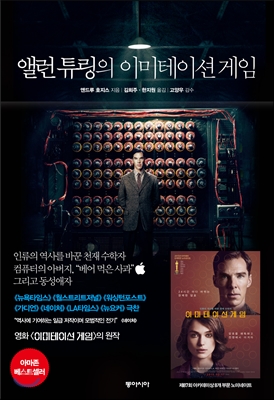 |
Description
Book Introduction
Based on the movie The Imitation Game!
A fresh look at Alan Turing, "the father of computing" and "one of the most important figures of the 20th century."
The theory that Apple's logo was created based on Turing's "bitten apple" motif.
Ranked 45th overall on Amazon, #1 in the science category, "A bestseller popular with both British and American readers."
Since 1966, the Association for Computing Machinery (ACM) has awarded the Turing Award annually to individuals who have made contributions to the field of computer science.
This award is called the Nobel Prize of computer science.
In 1999, Time magazine named Turing one of the “100 most important people of the 20th century,” adding that “the keyboards, spreadsheets, and word processing programs we use are all a legacy of Turing machines.”
He was also named one of the "100 Greatest Britons" in a 2002 BBC national poll.
Alan Turing's influence on the development of computers is so great that there is even a theory that Apple's logo was created based on Turing's 'bitten apple'.
On May 25, 2011, US President Barack Obama named Alan Turing as Britain's leading scientist during a speech to the British Parliament.
Additionally, in 2012, the 100th anniversary of his birth, events were held around the world to commemorate his achievements.
'Father of the Computer', an atheist, gay, eccentric, marathon-running genius mathematician.
Alan Turing's contributions to the creation of the concept of computers and the birth of modern computers are not widely known in Korea, but his achievements are highly regarded in the English-speaking world.
As of 2015, the original book of this book, "Alan Turing: The Enigma," which is considered the best biography about Alan Turing in the UK and the US, gained explosive popularity among readers as soon as it was published.
As of January 26, 2015, it ranked 45th overall on Amazon and 1st in the science and electricity category, quickly becoming a bestseller that garnered the attention and support of both English and American readers.
Also, the movie The Imitation Game, which was released in the UK and the US on November 14, 2014, became a big issue due to the influence of this book.
The Imitation Game, starring Benedict Cumberbatch and Keira Knightley, which is scheduled to be released in Korea on February 17, 2015, has been nominated for eight Academy Awards as of February 2015, and has swept numerous awards, including the Best Picture Award (Audience Award) at the 39th Toronto International Film Festival and the Audience Award at the 22nd Hamptons International Film Festival, clearly demonstrating the great achievements of Alan Turing that are still alive and well.
A fresh look at Alan Turing, "the father of computing" and "one of the most important figures of the 20th century."
The theory that Apple's logo was created based on Turing's "bitten apple" motif.
Ranked 45th overall on Amazon, #1 in the science category, "A bestseller popular with both British and American readers."
Since 1966, the Association for Computing Machinery (ACM) has awarded the Turing Award annually to individuals who have made contributions to the field of computer science.
This award is called the Nobel Prize of computer science.
In 1999, Time magazine named Turing one of the “100 most important people of the 20th century,” adding that “the keyboards, spreadsheets, and word processing programs we use are all a legacy of Turing machines.”
He was also named one of the "100 Greatest Britons" in a 2002 BBC national poll.
Alan Turing's influence on the development of computers is so great that there is even a theory that Apple's logo was created based on Turing's 'bitten apple'.
On May 25, 2011, US President Barack Obama named Alan Turing as Britain's leading scientist during a speech to the British Parliament.
Additionally, in 2012, the 100th anniversary of his birth, events were held around the world to commemorate his achievements.
'Father of the Computer', an atheist, gay, eccentric, marathon-running genius mathematician.
Alan Turing's contributions to the creation of the concept of computers and the birth of modern computers are not widely known in Korea, but his achievements are highly regarded in the English-speaking world.
As of 2015, the original book of this book, "Alan Turing: The Enigma," which is considered the best biography about Alan Turing in the UK and the US, gained explosive popularity among readers as soon as it was published.
As of January 26, 2015, it ranked 45th overall on Amazon and 1st in the science and electricity category, quickly becoming a bestseller that garnered the attention and support of both English and American readers.
Also, the movie The Imitation Game, which was released in the UK and the US on November 14, 2014, became a big issue due to the influence of this book.
The Imitation Game, starring Benedict Cumberbatch and Keira Knightley, which is scheduled to be released in Korea on February 17, 2015, has been nominated for eight Academy Awards as of February 2015, and has swept numerous awards, including the Best Picture Award (Audience Award) at the 39th Toronto International Film Festival and the Audience Award at the 22nd Hamptons International Film Festival, clearly demonstrating the great achievements of Alan Turing that are still alive and well.
- You can preview some of the book's contents.
Preview
index
Part 1: Logic
Chapter 1: Unity
Chapter 2: The Spirit of Pursuing Truth
Chapter 3: Newcomers
Chapter 4 Relay Competition
bridge
Part 2 Physics
Chapter 5 Preparation
Chapter 6: ACE Turned into a Bubble
Chapter 7: The Blue Forest Trees
Chapter 8 On the Beach
Chapter 1: Unity
Chapter 2: The Spirit of Pursuing Truth
Chapter 3: Newcomers
Chapter 4 Relay Competition
bridge
Part 2 Physics
Chapter 5 Preparation
Chapter 6: ACE Turned into a Bubble
Chapter 7: The Blue Forest Trees
Chapter 8 On the Beach
Detailed image
.jpg)
Publisher's Review
A fresh look at Alan Turing, "the father of computing" and "one of the most important figures of the 20th century."
The theory that Apple's logo was created based on Turing's "bitten apple" motif.
Ranked 45th overall on Amazon, #1 in the science category, "A bestseller popular with both British and American readers."
Since 1966, the Association for Computing Machinery (ACM) has awarded the Turing Award annually to individuals who have made contributions to the field of computer science.
This award is called the Nobel Prize of computer science.
In 1999, Time magazine named Turing one of the “100 most important people of the 20th century,” adding that “the keyboards, spreadsheets, and word processing programs we use are all a legacy of Turing machines.”
He was also named one of the "100 Greatest Britons" in a 2002 BBC national poll.
Alan Turing's influence on the development of computers is so great that there is even a theory that Apple's logo was created based on Turing's 'bitten apple'.
On May 25, 2011, US President Barack Obama named Alan Turing as Britain's leading scientist during a speech to the British Parliament.
Additionally, in 2012, the 100th anniversary of his birth, events were held around the world to commemorate his achievements.
'Father of the Computer', an atheist, gay, eccentric, marathon-running genius mathematician.
Alan Turing's contributions to the creation of the concept of computers and the birth of modern computers are not widely known in Korea, but his achievements are highly regarded in the English-speaking world.
As of 2015, the original book of this book, "Alan Turing: The Enigma," which is considered the best biography about Alan Turing in the UK and the US, gained explosive popularity among readers as soon as it was published.
As of January 26, 2015, it ranked 45th overall on Amazon and 1st in the science and electricity category, quickly becoming a bestseller that garnered the attention and support of both English and American readers.
Also, the movie The Imitation Game, which was released in the UK and the US on November 14, 2014, became a big issue due to the influence of this book.
The Imitation Game, starring Benedict Cumberbatch and Keira Knightley, which is scheduled to be released in Korea on February 17, 2015, has been nominated for eight Academy Awards as of February 2015, and has swept numerous awards, including the Best Picture Award (Audience Award) at the 39th Toronto International Film Festival and the Audience Award at the 22nd Hamptons International Film Festival, clearly demonstrating the great achievements of Alan Turing that are still alive and well.
Over 30 years of extensive research, meticulous writing, and incredibly vivid and detailed descriptions.
The most excellent compilation of Turing's life in over 900 pages.
"All About Alan Turing": "A first-rate work that contributes to history and an exemplary biography."
The new book, "Alan Turing's Imitation Game," is a massive 872-page book and is considered the most excellent biography of Alan Turing's life.
It details his birth, childhood, school and university days, his engagement to Joan Clarke, whom he met at Bletchley Park, his story of winning the war through codebreaking, his withdrawal from academia after being revealed to be homosexual, and his eventual suicide.
In particular, through a detailed explanation of the most intriguing Enigma codebreaking, you can understand in detail how Turing actually broke the supposedly impenetrable Enigma.
It also includes an introduction to the various theories he studied, including pure mathematics and morphogenesis, along with illustrations and formulas related to these, numerous letters exchanged with Turing, and citations to Turing's papers and articles.
And it helps to understand Turing's theory by introducing not only Turing's theory but also the theories of David Hilbert, Kurt Gödel, Wittgenstein, and Bertrand Russell.
It also includes actual pictorial photos of Alan Turing himself, his family, and related people, allowing you to see what Turing looked like at the time.
Therefore, this book not only provides information about Alan Turing's life, but also provides intellectual satisfaction about his theories.
Author Andrew Hodges is a leading Turing expert who continues to work on Turing-related topics to this day.
Since 1977, the author has felt a sense of mission to study Turing, interviewed numerous people who knew Turing, and painstakingly compiled related materials into a book.
This book, which portrays a man with remarkable vividness and detail, is a 'everything about Alan Turing' that encompasses both the scientific accuracy and clarity that are most important in a scientific biography.
The book's title, 'Imitation Game', is also called 'Imitation Game' or 'Turing Test'.
Turing uses whether a machine can perfectly imitate a human as a basis for judging whether a machine has intelligence, and the Turing Test he created uses a gender-guessing game.
In one room there is a man, in the other a woman, both claiming to be women, and those outside must guess their gender based solely on their written responses.
Likewise, if a computer is in one room and it is impossible to distinguish between a human and a computer's answer, then the computer can be judged to be capable of thinking.
This Turing test is the cornerstone of artificial intelligence, and Turing's research on 'thinking machines' and 'intelligent machines' continues to this day.
The author also says that while the meaning of the 'Imitation Game' may also be the meaning of the 'Turing Test', Turing's life as a homosexual was also an 'imitation game'.
“His social life was like a game of explaining words with gestures.
…but it was a game of imitation, not in the sense of consciously trying to deceive, but in the sense of being perceived as someone different from who you really are.” The ambiguous expression of the book’s title allows us to think about Alan Turing in many ways.
The fact that we can now work on documents using word processors or obtain information through Internet search engines is all thanks to Alan Turing, the 'father of computers' and a genius mathematician.
And he is also the person who made history by winning World War II.
No one can guarantee that our current life would have been possible without him.
In this respect, the importance of Alan Turing and the significance of this book become even more evident.
In the movie The Imitation Game, there is a line that goes like this:
“Sometimes someone you never imagined does something no one else would do.” The genius mathematician Alan Turing could literally be that “someone you never imagined.”
And as Nature puts it, The Imitation Game is “a first-rate historical contribution and an exemplary biography,” and it could be the unexpected book that inspires some to do the unexpected.
Alan Turing, the genius mathematician who changed human history
Why should we know the life and spirit of this great giant?
Germany, which was driving Europe into a corner and destroying it in World War II with the impenetrable Enigma code and the U-boat submarine.
But no one could stop Germany like that.
At this time, there was a person who saved Europe and the whole world.
This is Alan Turing, the British genius mathematician who deciphered the Enigma code and neutralized Germany.
Based on such extensive information about Alan Turing, The Imitation Game is the best scientific biography that focuses on his life and achievements from birth to death, as well as the unknown aspects of his life and achievements.
Alan Mathison Turing was born on June 23, 1912 in London, England.
As a child, Turing had a slovenly appearance, a stutter, and showed no talent for language.
However, he showed great talent in mathematics, and was able to solve difficult mathematical problems and study Einstein's theory of relativity on his own without any basic knowledge of calculus.
He entered Sherborne School, a British private school, in 1927.
At Sherborne School, Turing meets his first love, Christopher Mockham, and they develop a friendship and love, while also realizing his sexual identity.
However, in 1930, Mockham died of tuberculosis, leaving Turing devastated.
In fact, apart from Mockham's death, Mockham himself had a great influence on Turing.
They talked about math and science together and even promised to build intelligent machines in the future.
Turing entered King's College, Cambridge University in 1931 and majored in mathematics, showing great interest in group theory, numerical analysis, probability, and statistics.
In 1935, he published a paper titled "On Computable Numbers and Their Application to Decision Problems."
This paper contains the first mention of a "universal machine", an intelligent machine that we now call a "Turing machine" (the Turing machine described in the paper became the predecessor of the computer we know today).
Afterwards, he continued his research at Princeton University with a scholarship.
On September 4, 1939, in response to the war situation that threatened Britain's very existence, Alan Turing was appointed head of the cryptography department at the Government Signal and Cipher School in Bletchley Park, north of London, and was put in charge of deciphering the German Enigma cipher system.
Enigma (Greek for "riddle"), considered one of the world's most sophisticated and difficult codes, was useless if the code could not be deciphered within 24 hours because the rotor's position changed every day.
Before Turing came along, there was virtually no progress in deciphering the code.
However, in November 1938, Turing created the first machine to break Enigma, and this machine, 'Bombe', deciphered German weather forecast codes in 1940, leading to victory in the Battle of the Atlantic.
Turing played a decisive role in destroying Germany's fearsome U-boats.
He also conducted secret negotiations in the United States from late 1942 to early 1943.
After the war, he worked on a computer development project at the National Physical Laboratory (NPL) and then in 1948, he became deputy director of the Computing Laboratory of the Royal Society at the University of Manchester.
We are currently working to create what we call 'artificial intelligence', that is, an electronic brain that functions similarly to the human brain.
On March 15, 1951, he was elected a Fellow of the Royal Society in recognition of his research achievements in the paper "Computable Numbers", which had been published 15 years earlier.
He also received the Order of the British Empire (OBE) for his contribution to the exhibition.
However, even after the end of World War II, the British government did not disclose the activities of the Bletchley Park team, which was a secret operation.
Turing's achievements remained unknown until 30 years after the war, when the details of his cryptographic work began to come to light.
What is the reason?
'Chemical castration' given to the hero who led the war to victory
Why did I have to die after eating the 'poisoned apple'?
In 1952, Turing met a man named Arnold Murray and had a relationship with him. One day, a thief broke into his house and he reported it to the police.
It turns out that Arnold Murray told Turing's story to another man (Harry), and that man burglarized Turing's house.
During this process, Turing, who had simply intended to report the theft, ended up talking openly about his relationship with Arnold Murray, which became a huge problem.
Turing, who had come out as homosexual, was subject to criminal punishment solely for being homosexual, separate from reporting the theft.
The charge was “a serious obscene act contrary to Article 11 of the Criminal Law Amendment Act of 1885.”
Although sentenced to two years in prison, Turing chose 'chemical treatment' as an alternative.
However, it was only a 'treatment' in name, and in reality it was hormone administration, which was the same as 'chemical castration'.
Estrogen, a female hormone, was injected.
Afterwards, Allen was fired from the Manchester Computer Laboratory and withdrew from computer development.
Finally, on June 7, 1954, at the age of 41, Turing committed suicide at his home by eating an apple laced with cyanide.
It was a suicide plan that reminded me of the 'poisoned apple' from the cartoon Snow White and the Seven Dwarfs, which I had been interested in and enjoyed watching since I was young.
However, the fact that there were no signs of suicide beforehand, and no mention of depression or a desire to die, remains a mystery.
Alan Turing, a genius mathematician who led the world to victory in World War II and laid the foundation for modern computer science, was stigmatized simply for being homosexual and ended his life in vain and misfortune.
However, his death was kept secret until 1974, 20 years later, and the British government and Prime Minister Churchill, who knew Turing's historical contribution better than anyone else, kept it a secret and did not mention it.
It was precisely because of national security and homosexuality.
After Alan Turing's death, scientists around the world, including physicist Stephen Hawking, petitioned to restore his reputation.
Finally, in 2009, British Prime Minister Gordon Brown issued an apology for Turing's trial and punishment from 1952 to 1954.
It was a formal apology for the conviction of homosexuality that led to Turing's death.
Turing, who was convicted of "gross indecency" on March 31, 1952, was pardoned by Queen Elizabeth II on December 24, 2013, 61 years later, and declared innocent.
Turing's reputation was restored from the hostility and stigmatization of his time towards homosexuality, but not until after his death.
The theory that Apple's logo was created based on Turing's "bitten apple" motif.
Ranked 45th overall on Amazon, #1 in the science category, "A bestseller popular with both British and American readers."
Since 1966, the Association for Computing Machinery (ACM) has awarded the Turing Award annually to individuals who have made contributions to the field of computer science.
This award is called the Nobel Prize of computer science.
In 1999, Time magazine named Turing one of the “100 most important people of the 20th century,” adding that “the keyboards, spreadsheets, and word processing programs we use are all a legacy of Turing machines.”
He was also named one of the "100 Greatest Britons" in a 2002 BBC national poll.
Alan Turing's influence on the development of computers is so great that there is even a theory that Apple's logo was created based on Turing's 'bitten apple'.
On May 25, 2011, US President Barack Obama named Alan Turing as Britain's leading scientist during a speech to the British Parliament.
Additionally, in 2012, the 100th anniversary of his birth, events were held around the world to commemorate his achievements.
'Father of the Computer', an atheist, gay, eccentric, marathon-running genius mathematician.
Alan Turing's contributions to the creation of the concept of computers and the birth of modern computers are not widely known in Korea, but his achievements are highly regarded in the English-speaking world.
As of 2015, the original book of this book, "Alan Turing: The Enigma," which is considered the best biography about Alan Turing in the UK and the US, gained explosive popularity among readers as soon as it was published.
As of January 26, 2015, it ranked 45th overall on Amazon and 1st in the science and electricity category, quickly becoming a bestseller that garnered the attention and support of both English and American readers.
Also, the movie The Imitation Game, which was released in the UK and the US on November 14, 2014, became a big issue due to the influence of this book.
The Imitation Game, starring Benedict Cumberbatch and Keira Knightley, which is scheduled to be released in Korea on February 17, 2015, has been nominated for eight Academy Awards as of February 2015, and has swept numerous awards, including the Best Picture Award (Audience Award) at the 39th Toronto International Film Festival and the Audience Award at the 22nd Hamptons International Film Festival, clearly demonstrating the great achievements of Alan Turing that are still alive and well.
Over 30 years of extensive research, meticulous writing, and incredibly vivid and detailed descriptions.
The most excellent compilation of Turing's life in over 900 pages.
"All About Alan Turing": "A first-rate work that contributes to history and an exemplary biography."
The new book, "Alan Turing's Imitation Game," is a massive 872-page book and is considered the most excellent biography of Alan Turing's life.
It details his birth, childhood, school and university days, his engagement to Joan Clarke, whom he met at Bletchley Park, his story of winning the war through codebreaking, his withdrawal from academia after being revealed to be homosexual, and his eventual suicide.
In particular, through a detailed explanation of the most intriguing Enigma codebreaking, you can understand in detail how Turing actually broke the supposedly impenetrable Enigma.
It also includes an introduction to the various theories he studied, including pure mathematics and morphogenesis, along with illustrations and formulas related to these, numerous letters exchanged with Turing, and citations to Turing's papers and articles.
And it helps to understand Turing's theory by introducing not only Turing's theory but also the theories of David Hilbert, Kurt Gödel, Wittgenstein, and Bertrand Russell.
It also includes actual pictorial photos of Alan Turing himself, his family, and related people, allowing you to see what Turing looked like at the time.
Therefore, this book not only provides information about Alan Turing's life, but also provides intellectual satisfaction about his theories.
Author Andrew Hodges is a leading Turing expert who continues to work on Turing-related topics to this day.
Since 1977, the author has felt a sense of mission to study Turing, interviewed numerous people who knew Turing, and painstakingly compiled related materials into a book.
This book, which portrays a man with remarkable vividness and detail, is a 'everything about Alan Turing' that encompasses both the scientific accuracy and clarity that are most important in a scientific biography.
The book's title, 'Imitation Game', is also called 'Imitation Game' or 'Turing Test'.
Turing uses whether a machine can perfectly imitate a human as a basis for judging whether a machine has intelligence, and the Turing Test he created uses a gender-guessing game.
In one room there is a man, in the other a woman, both claiming to be women, and those outside must guess their gender based solely on their written responses.
Likewise, if a computer is in one room and it is impossible to distinguish between a human and a computer's answer, then the computer can be judged to be capable of thinking.
This Turing test is the cornerstone of artificial intelligence, and Turing's research on 'thinking machines' and 'intelligent machines' continues to this day.
The author also says that while the meaning of the 'Imitation Game' may also be the meaning of the 'Turing Test', Turing's life as a homosexual was also an 'imitation game'.
“His social life was like a game of explaining words with gestures.
…but it was a game of imitation, not in the sense of consciously trying to deceive, but in the sense of being perceived as someone different from who you really are.” The ambiguous expression of the book’s title allows us to think about Alan Turing in many ways.
The fact that we can now work on documents using word processors or obtain information through Internet search engines is all thanks to Alan Turing, the 'father of computers' and a genius mathematician.
And he is also the person who made history by winning World War II.
No one can guarantee that our current life would have been possible without him.
In this respect, the importance of Alan Turing and the significance of this book become even more evident.
In the movie The Imitation Game, there is a line that goes like this:
“Sometimes someone you never imagined does something no one else would do.” The genius mathematician Alan Turing could literally be that “someone you never imagined.”
And as Nature puts it, The Imitation Game is “a first-rate historical contribution and an exemplary biography,” and it could be the unexpected book that inspires some to do the unexpected.
Alan Turing, the genius mathematician who changed human history
Why should we know the life and spirit of this great giant?
Germany, which was driving Europe into a corner and destroying it in World War II with the impenetrable Enigma code and the U-boat submarine.
But no one could stop Germany like that.
At this time, there was a person who saved Europe and the whole world.
This is Alan Turing, the British genius mathematician who deciphered the Enigma code and neutralized Germany.
Based on such extensive information about Alan Turing, The Imitation Game is the best scientific biography that focuses on his life and achievements from birth to death, as well as the unknown aspects of his life and achievements.
Alan Mathison Turing was born on June 23, 1912 in London, England.
As a child, Turing had a slovenly appearance, a stutter, and showed no talent for language.
However, he showed great talent in mathematics, and was able to solve difficult mathematical problems and study Einstein's theory of relativity on his own without any basic knowledge of calculus.
He entered Sherborne School, a British private school, in 1927.
At Sherborne School, Turing meets his first love, Christopher Mockham, and they develop a friendship and love, while also realizing his sexual identity.
However, in 1930, Mockham died of tuberculosis, leaving Turing devastated.
In fact, apart from Mockham's death, Mockham himself had a great influence on Turing.
They talked about math and science together and even promised to build intelligent machines in the future.
Turing entered King's College, Cambridge University in 1931 and majored in mathematics, showing great interest in group theory, numerical analysis, probability, and statistics.
In 1935, he published a paper titled "On Computable Numbers and Their Application to Decision Problems."
This paper contains the first mention of a "universal machine", an intelligent machine that we now call a "Turing machine" (the Turing machine described in the paper became the predecessor of the computer we know today).
Afterwards, he continued his research at Princeton University with a scholarship.
On September 4, 1939, in response to the war situation that threatened Britain's very existence, Alan Turing was appointed head of the cryptography department at the Government Signal and Cipher School in Bletchley Park, north of London, and was put in charge of deciphering the German Enigma cipher system.
Enigma (Greek for "riddle"), considered one of the world's most sophisticated and difficult codes, was useless if the code could not be deciphered within 24 hours because the rotor's position changed every day.
Before Turing came along, there was virtually no progress in deciphering the code.
However, in November 1938, Turing created the first machine to break Enigma, and this machine, 'Bombe', deciphered German weather forecast codes in 1940, leading to victory in the Battle of the Atlantic.
Turing played a decisive role in destroying Germany's fearsome U-boats.
He also conducted secret negotiations in the United States from late 1942 to early 1943.
After the war, he worked on a computer development project at the National Physical Laboratory (NPL) and then in 1948, he became deputy director of the Computing Laboratory of the Royal Society at the University of Manchester.
We are currently working to create what we call 'artificial intelligence', that is, an electronic brain that functions similarly to the human brain.
On March 15, 1951, he was elected a Fellow of the Royal Society in recognition of his research achievements in the paper "Computable Numbers", which had been published 15 years earlier.
He also received the Order of the British Empire (OBE) for his contribution to the exhibition.
However, even after the end of World War II, the British government did not disclose the activities of the Bletchley Park team, which was a secret operation.
Turing's achievements remained unknown until 30 years after the war, when the details of his cryptographic work began to come to light.
What is the reason?
'Chemical castration' given to the hero who led the war to victory
Why did I have to die after eating the 'poisoned apple'?
In 1952, Turing met a man named Arnold Murray and had a relationship with him. One day, a thief broke into his house and he reported it to the police.
It turns out that Arnold Murray told Turing's story to another man (Harry), and that man burglarized Turing's house.
During this process, Turing, who had simply intended to report the theft, ended up talking openly about his relationship with Arnold Murray, which became a huge problem.
Turing, who had come out as homosexual, was subject to criminal punishment solely for being homosexual, separate from reporting the theft.
The charge was “a serious obscene act contrary to Article 11 of the Criminal Law Amendment Act of 1885.”
Although sentenced to two years in prison, Turing chose 'chemical treatment' as an alternative.
However, it was only a 'treatment' in name, and in reality it was hormone administration, which was the same as 'chemical castration'.
Estrogen, a female hormone, was injected.
Afterwards, Allen was fired from the Manchester Computer Laboratory and withdrew from computer development.
Finally, on June 7, 1954, at the age of 41, Turing committed suicide at his home by eating an apple laced with cyanide.
It was a suicide plan that reminded me of the 'poisoned apple' from the cartoon Snow White and the Seven Dwarfs, which I had been interested in and enjoyed watching since I was young.
However, the fact that there were no signs of suicide beforehand, and no mention of depression or a desire to die, remains a mystery.
Alan Turing, a genius mathematician who led the world to victory in World War II and laid the foundation for modern computer science, was stigmatized simply for being homosexual and ended his life in vain and misfortune.
However, his death was kept secret until 1974, 20 years later, and the British government and Prime Minister Churchill, who knew Turing's historical contribution better than anyone else, kept it a secret and did not mention it.
It was precisely because of national security and homosexuality.
After Alan Turing's death, scientists around the world, including physicist Stephen Hawking, petitioned to restore his reputation.
Finally, in 2009, British Prime Minister Gordon Brown issued an apology for Turing's trial and punishment from 1952 to 1954.
It was a formal apology for the conviction of homosexuality that led to Turing's death.
Turing, who was convicted of "gross indecency" on March 31, 1952, was pardoned by Queen Elizabeth II on December 24, 2013, 61 years later, and declared innocent.
Turing's reputation was restored from the hostility and stigmatization of his time towards homosexuality, but not until after his death.
GOODS SPECIFICS
- Date of issue: February 4, 2015
- Page count, weight, size: 872 pages | 1,379g | 153*224*40mm
- ISBN13: 9788962620979
- ISBN10: 8962620979
You may also like
카테고리
korean


korean

![GQ KOREA Mark (Monthly): December [2025]](http://librairie.coreenne.fr/cdn/shop/files/8ef265dbbfbf186523ed75ba7319009d.jpg?v=1765340328&width=3840)


