

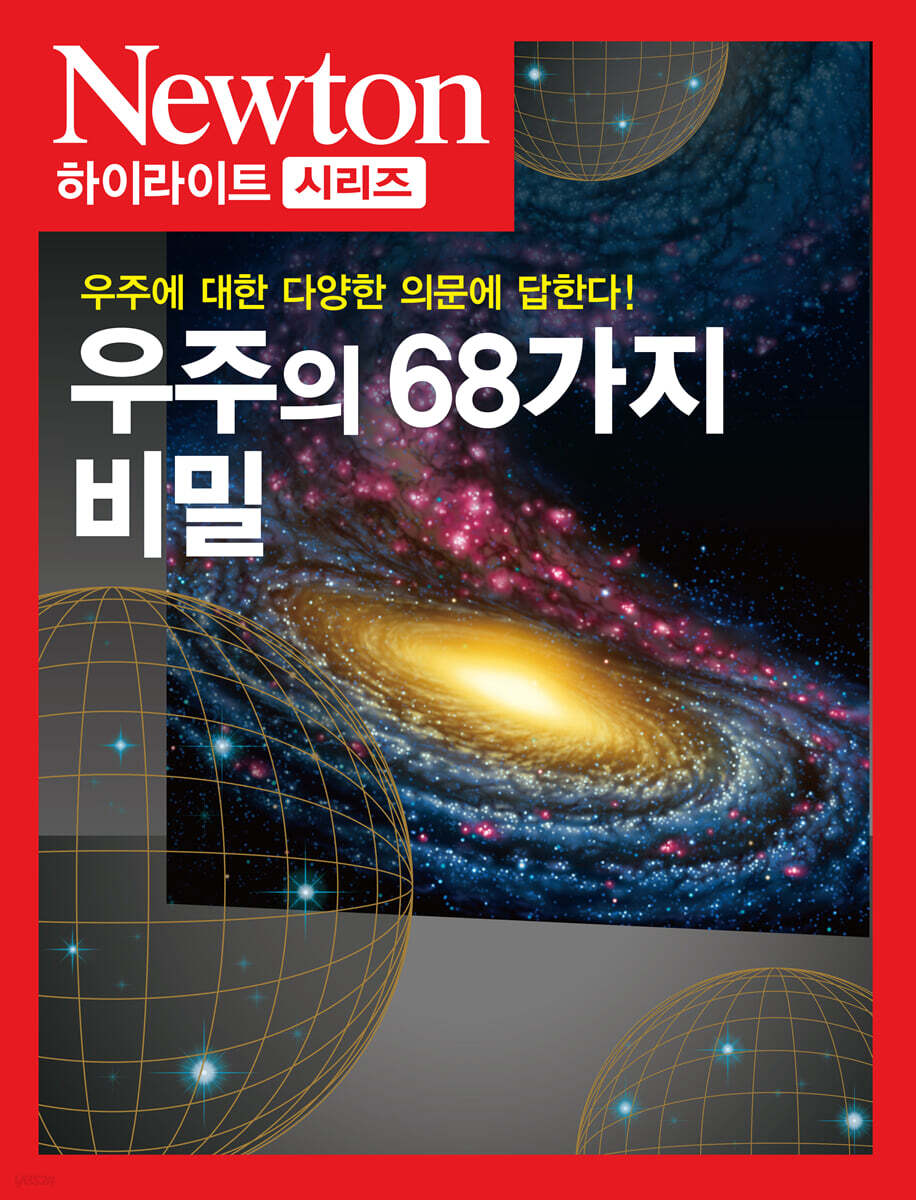
NEWTON HIGHLIGHT: 68 Secrets of the Universe
 |
Description
Book Introduction
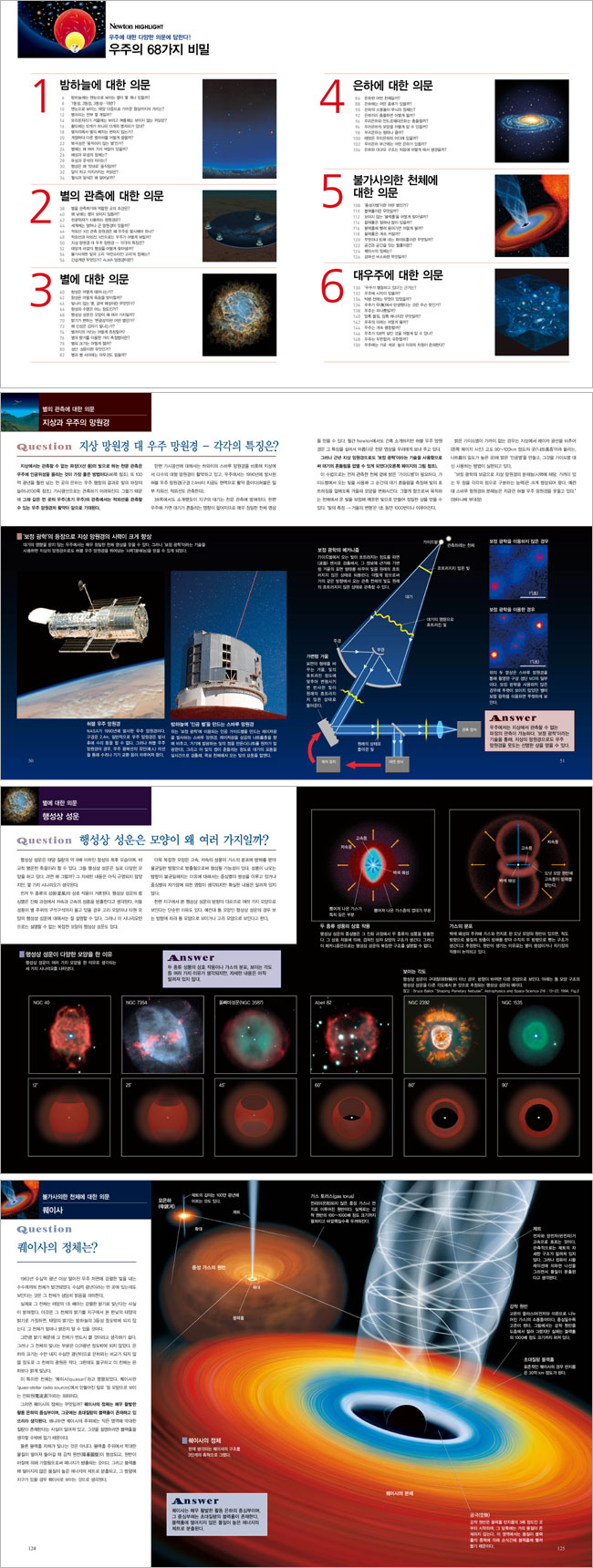
This book answers 68 key questions about the universe, including the night sky, stars, galaxies, mysterious celestial bodies, and astronomical phenomena, using detailed photographs and illustrations.
First, in Parts 1 and 2, we will look at questions and answers about the night sky and astronomical observations, including stars, planets, constellations, comets, lunar eclipses, and telescopes.
It covers a wide range of topics, from basics like star magnitudes (1st magnitude, 2nd magnitude, etc.) to infrared, ultraviolet, and X-ray telescopes, interferometers, and the ALMA telescope.
Part 3 answers questions about stars.
It also explains the birth and death of stars, brown dwarfs, planetary nebulae, variable stars, novas, star clusters and nebulae, as well as measuring distances to stars, and their brightness and size.
The theme of Part 4 is ‘Galaxy’.
It addresses questions about galaxies, including the shape and types of galaxies, the nature of galactic vortices, galaxy collisions, the relationship between the solar system and our galaxy, and galaxies and their large-scale structure.
Part 5 covers the strange celestial bodies and phenomena of the universe.
The main characters are neutron stars, black holes, white holes, wormholes, quasars, and gamma-ray bursts.
In the quiet atmosphere of the night sky, it explains in an easy-to-understand way the celestial bodies with powerful and mysterious properties that are difficult to imagine.
Part 6 answers questions about the universe.
It focuses on core topics related to cosmology, such as the expansion of the universe, the beginning and end of the universe, the Big Bang, the multiverse, dark matter and dark energy, the future of the universe, and the universe and dimensions.
First, in Parts 1 and 2, we will look at questions and answers about the night sky and astronomical observations, including stars, planets, constellations, comets, lunar eclipses, and telescopes.
It covers a wide range of topics, from basics like star magnitudes (1st magnitude, 2nd magnitude, etc.) to infrared, ultraviolet, and X-ray telescopes, interferometers, and the ALMA telescope.
Part 3 answers questions about stars.
It also explains the birth and death of stars, brown dwarfs, planetary nebulae, variable stars, novas, star clusters and nebulae, as well as measuring distances to stars, and their brightness and size.
The theme of Part 4 is ‘Galaxy’.
It addresses questions about galaxies, including the shape and types of galaxies, the nature of galactic vortices, galaxy collisions, the relationship between the solar system and our galaxy, and galaxies and their large-scale structure.
Part 5 covers the strange celestial bodies and phenomena of the universe.
The main characters are neutron stars, black holes, white holes, wormholes, quasars, and gamma-ray bursts.
In the quiet atmosphere of the night sky, it explains in an easy-to-understand way the celestial bodies with powerful and mysterious properties that are difficult to imagine.
Part 6 answers questions about the universe.
It focuses on core topics related to cosmology, such as the expansion of the universe, the beginning and end of the universe, the Big Bang, the multiverse, dark matter and dark energy, the future of the universe, and the universe and dimensions.
index
Part 1 Questions about the night sky
* How many stars are visible to the naked eye in the night sky?
* What are ‘1st class star, 2nd class star, 3rd class star…’?
* What is the distance to the nearest star after the Sun that can be seen with the naked eye?
* How many constellations are there in total?
* Why is Orion visible in winter but not in summer?
* There are 13 constellations in the zodiac, not 12?
* Does the arrangement of stars in a constellation not change?
* How to find different constellations for each season?
* Is Polaris a 'stationary star'?
* Why do stars have different colors?
* What are comets and meteors?
* What is the difference between a meteor and a meteorite?
* Why do planets move 'randomly'?
* Why does the moon wax and wane?
* Why do lunar and solar eclipses occur?
Part 2 Questions about star observations
* What are the conditions for a suitable place for stargazing?
* Why can't we see stars during the day?
* What telescopes do astronomers use?
* How big are the telescopes in the world?
* Why should infrared and X-ray observation telescopes be launched into space?
* What does the universe look like in infrared, ultraviolet, and X-ray?
* Ground-based telescopes vs. space-based telescopes – what are their characteristics?
* How do we find planets outside our solar system?
* What is the identity of the mysterious light ring, the 'Einstein Ring'?
* What is an interferometer? What is the ALMA telescope?
Part 3 Questions about the Stars
* How are stars born?
* How do stars die?
* What is a brown dwarf, a star that doesn't shine?
* How long does a star last?
* Why do planetary nebulae have different shapes?
* What kind of star is a 'variable star' whose brightness changes?
* Why does the divine suddenly shine?
* How do we measure the distance to a star?
* What is a method of measuring distance using the brightness of stars?
* How do you measure the size of a star?
* What is a cluster or nebula?
* Is there nothing between the stars?
Part 4 Questions about the Galaxy
* What kind of celestial body is a galaxy?
* What types of galaxies are there?
* What is the identity of the vortex pattern in the galaxy?
* What happens when galaxies collide?
* Will our Milky Way and the Andromeda Galaxy collide?
* How can we know the shape of our galaxy?
* How big is our galaxy?
* Where is the sun in our galaxy?
* What galaxies are there near our galaxy?
* How did galaxies and large-scale structures first form?
Part 5 Questions about mysterious celestial bodies
* What kind of star is a 'neutron star'?
* What is a black hole?
* How to find an invisible 'black hole'?
* How many black holes are there?
* What happens if you get sucked into a black hole?
* Will black holes continue to grow?
* What is a white hole that spits out anything?
* What is a wormhole that connects space and space?
* What is the identity of the quasar?
* What is a gamma-ray burst?
Part 6 Questions about the Universe
* What is the evidence that 'the universe is expanding'?
* Did the universe have a beginning?
* What was there before the Big Bang?
* What does it mean that the universe was created from nothing?
* Is there only one universe?
* What are dark matter and dark energy?
* What will the future of the universe be like?
* Will the universe continue to expand?
* How do we know that the universe is 13.8 billion years old?
* Is the universe infinite or finite?
* Are there dimensions in the universe other than length, width, and height?
* How many stars are visible to the naked eye in the night sky?
* What are ‘1st class star, 2nd class star, 3rd class star…’?
* What is the distance to the nearest star after the Sun that can be seen with the naked eye?
* How many constellations are there in total?
* Why is Orion visible in winter but not in summer?
* There are 13 constellations in the zodiac, not 12?
* Does the arrangement of stars in a constellation not change?
* How to find different constellations for each season?
* Is Polaris a 'stationary star'?
* Why do stars have different colors?
* What are comets and meteors?
* What is the difference between a meteor and a meteorite?
* Why do planets move 'randomly'?
* Why does the moon wax and wane?
* Why do lunar and solar eclipses occur?
Part 2 Questions about star observations
* What are the conditions for a suitable place for stargazing?
* Why can't we see stars during the day?
* What telescopes do astronomers use?
* How big are the telescopes in the world?
* Why should infrared and X-ray observation telescopes be launched into space?
* What does the universe look like in infrared, ultraviolet, and X-ray?
* Ground-based telescopes vs. space-based telescopes – what are their characteristics?
* How do we find planets outside our solar system?
* What is the identity of the mysterious light ring, the 'Einstein Ring'?
* What is an interferometer? What is the ALMA telescope?
Part 3 Questions about the Stars
* How are stars born?
* How do stars die?
* What is a brown dwarf, a star that doesn't shine?
* How long does a star last?
* Why do planetary nebulae have different shapes?
* What kind of star is a 'variable star' whose brightness changes?
* Why does the divine suddenly shine?
* How do we measure the distance to a star?
* What is a method of measuring distance using the brightness of stars?
* How do you measure the size of a star?
* What is a cluster or nebula?
* Is there nothing between the stars?
Part 4 Questions about the Galaxy
* What kind of celestial body is a galaxy?
* What types of galaxies are there?
* What is the identity of the vortex pattern in the galaxy?
* What happens when galaxies collide?
* Will our Milky Way and the Andromeda Galaxy collide?
* How can we know the shape of our galaxy?
* How big is our galaxy?
* Where is the sun in our galaxy?
* What galaxies are there near our galaxy?
* How did galaxies and large-scale structures first form?
Part 5 Questions about mysterious celestial bodies
* What kind of star is a 'neutron star'?
* What is a black hole?
* How to find an invisible 'black hole'?
* How many black holes are there?
* What happens if you get sucked into a black hole?
* Will black holes continue to grow?
* What is a white hole that spits out anything?
* What is a wormhole that connects space and space?
* What is the identity of the quasar?
* What is a gamma-ray burst?
Part 6 Questions about the Universe
* What is the evidence that 'the universe is expanding'?
* Did the universe have a beginning?
* What was there before the Big Bang?
* What does it mean that the universe was created from nothing?
* Is there only one universe?
* What are dark matter and dark energy?
* What will the future of the universe be like?
* Will the universe continue to expand?
* How do we know that the universe is 13.8 billion years old?
* Is the universe infinite or finite?
* Are there dimensions in the universe other than length, width, and height?
Detailed image
Publisher's Review
Special feature
Answering questions about the night sky and observations, including stars, planets, constellations, comets, lunar eclipses, and telescopes.
The night sky and its observation are fundamental to understanding the universe.
Starting with the stars (constellations) that are the main characters of the night sky and the constellations they form, it goes on to the basics such as planets, comets, meteors, meteorites, lunar and solar eclipses, and answers various questions about observing the night sky and stars, including infrared, ultraviolet, and X-ray telescopes, ground-based telescopes, and space telescopes used by astronomers.
In addition, it provides key explanations based on the latest data on more advanced questions such as exoplanets, Einstein rings, and interferometers.
In addition, we cover the birth and death of stars, brown dwarfs, planetary nebulae, variable stars, novae, and the brightness, size, and distance of stars, and we also learn in detail about star clusters and nebulae.
Solving questions about galaxies, including types of galaxies, galaxy collisions, and large-scale structure.
What exactly is a galaxy? What types of galaxies are there, and what is the nature of galactic vortices? Stars gather to form galaxies, and countless galaxies, in turn, form large-scale structures.
Do such galaxies collide? What happens when they do? What galaxies are near our own Milky Way? How did galaxies and large-scale structures form in the first place? This book completely answers many questions about the stars of the universe: galaxies.
Solving mysteries about mysterious celestial objects such as neutron stars, black holes, white holes, and quasars.
There are many mysterious celestial bodies in space.
These are celestial bodies with characteristics completely different from ordinary stars, such as neutron stars made up of only neutrons, black holes that swallow all matter including light, white holes that spit everything out, and quasars.
Among these celestial bodies, there are many whose mechanisms are not well known.
It provides a clear explanation of what happens to objects that enter the "event horizon," the boundary of a black hole; what a wormhole is, which connects space and time; and celestial bodies with mysterious characteristics, such as gamma-ray bursts.
Solving questions about the universe, including the birth and end of the universe, dark matter, and dark energy.
When thinking about the universe, the first question that comes to mind is probably, "How did it begin?" Questions like the universe's birth and end, and whether it has an end or not, pique people's curiosity.
It easily explains exciting topics such as, 'If the universe had a beginning, what came before it and what will happen at the end? Is this the universe we know of the only one? Is space-time (time and space viewed as one) four-dimensional?'
We will also learn about the core of dark matter and dark energy, the identity of which is unknown.
● A new format of scientific monographs, the 'Newton Highlights Series'
Newton, a science magazine, is a monthly magazine that delivers high-quality commentary and precise, high-quality graphics on all fields of science.
The 'Newton Highlights Series' is a collection of books that have been compiled by topic, selecting only the content that received great reviews from readers among the articles in 'Newton'.
Sister volumes on various topics, including physics, chemistry, life science, earth science, space science, science and technology, and mathematics, are selling like hotcakes.
Answering questions about the night sky and observations, including stars, planets, constellations, comets, lunar eclipses, and telescopes.
The night sky and its observation are fundamental to understanding the universe.
Starting with the stars (constellations) that are the main characters of the night sky and the constellations they form, it goes on to the basics such as planets, comets, meteors, meteorites, lunar and solar eclipses, and answers various questions about observing the night sky and stars, including infrared, ultraviolet, and X-ray telescopes, ground-based telescopes, and space telescopes used by astronomers.
In addition, it provides key explanations based on the latest data on more advanced questions such as exoplanets, Einstein rings, and interferometers.
In addition, we cover the birth and death of stars, brown dwarfs, planetary nebulae, variable stars, novae, and the brightness, size, and distance of stars, and we also learn in detail about star clusters and nebulae.
Solving questions about galaxies, including types of galaxies, galaxy collisions, and large-scale structure.
What exactly is a galaxy? What types of galaxies are there, and what is the nature of galactic vortices? Stars gather to form galaxies, and countless galaxies, in turn, form large-scale structures.
Do such galaxies collide? What happens when they do? What galaxies are near our own Milky Way? How did galaxies and large-scale structures form in the first place? This book completely answers many questions about the stars of the universe: galaxies.
Solving mysteries about mysterious celestial objects such as neutron stars, black holes, white holes, and quasars.
There are many mysterious celestial bodies in space.
These are celestial bodies with characteristics completely different from ordinary stars, such as neutron stars made up of only neutrons, black holes that swallow all matter including light, white holes that spit everything out, and quasars.
Among these celestial bodies, there are many whose mechanisms are not well known.
It provides a clear explanation of what happens to objects that enter the "event horizon," the boundary of a black hole; what a wormhole is, which connects space and time; and celestial bodies with mysterious characteristics, such as gamma-ray bursts.
Solving questions about the universe, including the birth and end of the universe, dark matter, and dark energy.
When thinking about the universe, the first question that comes to mind is probably, "How did it begin?" Questions like the universe's birth and end, and whether it has an end or not, pique people's curiosity.
It easily explains exciting topics such as, 'If the universe had a beginning, what came before it and what will happen at the end? Is this the universe we know of the only one? Is space-time (time and space viewed as one) four-dimensional?'
We will also learn about the core of dark matter and dark energy, the identity of which is unknown.
● A new format of scientific monographs, the 'Newton Highlights Series'
Newton, a science magazine, is a monthly magazine that delivers high-quality commentary and precise, high-quality graphics on all fields of science.
The 'Newton Highlights Series' is a collection of books that have been compiled by topic, selecting only the content that received great reviews from readers among the articles in 'Newton'.
Sister volumes on various topics, including physics, chemistry, life science, earth science, space science, science and technology, and mathematics, are selling like hotcakes.
GOODS SPECIFICS
- Date of issue: September 10, 2014
- Page count, weight, size: 152 pages | 494g | 210*275*8mm
- ISBN13: 9788955378900
- ISBN10: 8955378904
You may also like
카테고리
korean


korean

![GQ KOREA Mark (Monthly): December [2025]](http://librairie.coreenne.fr/cdn/shop/files/8ef265dbbfbf186523ed75ba7319009d.jpg?v=1765340328&width=3840)


