

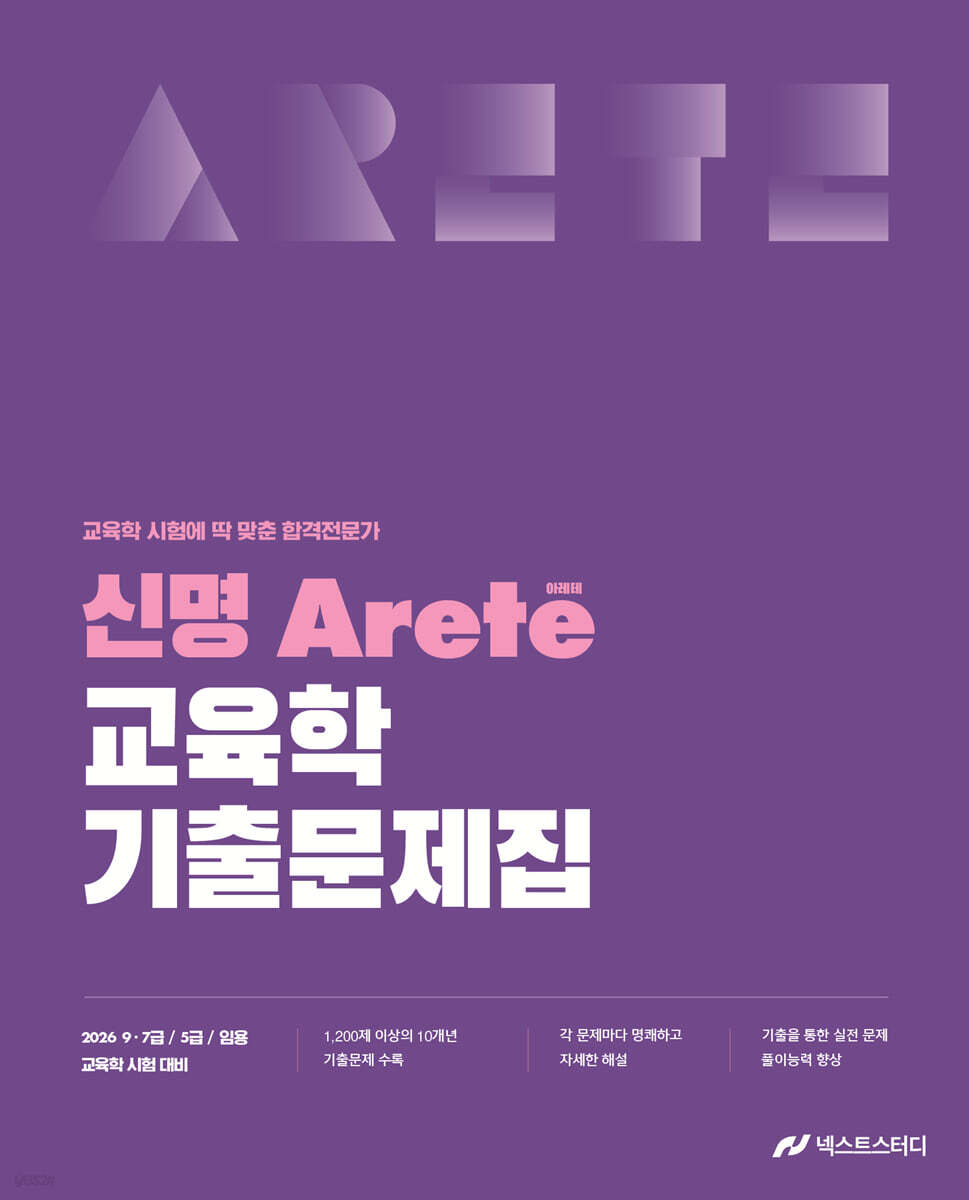
2026 Arete Education Exam Questions
 |
Description
Book Introduction
The "2026 Arete Education Past Exam Questions" is a collection of past exam questions on the introduction to education for the 7th and 9th grade civil service exams, the 5th grade civil service exam, and the employment exam.
More than 1,200 problems from past exams over the past 10 years ('11-'25) have been carefully selected and systematically included.
By including problems for each unit, the book is structured so that major topics can be learned naturally through repeated study.
Detailed explanations for each problem help students learn the key points and develop a sense of the actual exam. Answers and explanations are placed at the bottom of the problem to increase learning efficiency.
More than 1,200 problems from past exams over the past 10 years ('11-'25) have been carefully selected and systematically included.
By including problems for each unit, the book is structured so that major topics can be learned naturally through repeated study.
Detailed explanations for each problem help students learn the key points and develop a sense of the actual exam. Answers and explanations are placed at the bottom of the problem to increase learning efficiency.
- You can preview some of the book's contents.
Preview
index
PART I CURRICULUM
CHAPTER 01 Concept and Types of Curriculum
CHAPTER 02 Curriculum Theory and Curriculum Development and Design
CHAPTER 03 Curriculum Development and Structure Process
CHAPTER 04 Evolution of Korea's Curriculum
PART II: EDUCATIONAL METHODS AND EDUCATIONAL TECHNOLOGY
CHAPTER 01 Concepts of Teaching Methods and Instructional Design
CHAPTER 02 Teaching (Professoring) Theory and Teaching (Professoring) Model
CHAPTER 03 Teaching and Learning Methods
CHAPTER 04 Concepts of Educational Technology and Instructional Media, Distance Education
PART III EDUCATIONAL EVALUATION
CHAPTER 01 Meaning and Types of Educational Evaluation
CHAPTER 02 Requirements for a Good Evaluation Tool
CHAPTER 03 Classification of Educational Objectives and Evaluation Items
CHAPTER 04 Educational Statistics
CHAPTER 05 Types and Practice of Educational Research Methods
PART IV EDUCATIONAL ADMINISTRATION AND MANAGEMENT
CHAPTER 01 Concepts and Basic Principles of Educational Administration
CHAPTER 02 Development of Educational Policy and Educational Administration Theory
CHAPTER 03 Organizational Theory (Leadership and Motivation)
CHAPTER 04 Scholarship and Educational Finance
PART V EDUCATIONAL PHILOSOPHY
CHAPTER 01 Understanding Education
CHAPTER 02 The Meaning of Educational Philosophy and Educational Content Theory
CHAPTER 03 Traditional Educational Philosophy
CHAPTER 04 Modern Educational Philosophy
PART VI EDUCATOR
CHAPTER 01 (West) Primitive Society and Ancient Education
CHAPTER 02 (Western) Medieval Education
CHAPTER 03 (Western) Modern Education
CHAPTER 04 (West) Modern Education
CHAPTER 05 (Korea) Education in the Three Kingdoms Period
CHAPTER 06 (Korea) Education in the Goryeo Dynasty
CHAPTER 07 (Korea) Education in the Joseon Dynasty
CHAPTER 08 (Korea) Education in the Enlightenment Period
CHAPTER 09 (Korea) The Residency-General and Education during the Japanese Colonial Period
CHAPTER 10 (Korea) Education after Liberation
PART VII EDUCATIONAL PSYCHOLOGY
CHAPTER 01 Developmental Theory
CHAPTER 02 Development and Education of Cognitive Characteristics
CHAPTER 03 Development and Education of Definitive Characteristics
CHAPTER 04 Learning Theory and Transfer, Application Mechanisms
CHAPTER 05 The Basics of Life Guidance and Counseling
CHAPTER 06 Types of Counseling and Flight Theory
PART VIII Sociology of Education
CHAPTER 01 Major Theories of Educational Sociology
CHAPTER 02 Culture, Socialization, Social Class, and Education
CHAPTER 03 Equal Opportunity in Education (Educational Equality)
CHAPTER 04 Causality of the Educational Gap (Academic Achievement Gap) and Effective Schools
CHAPTER 05 School and Society, School Expansion and Academic Achievement Theory
CHAPTER 06 Lifelong Education Theory
CHAPTER 01 Concept and Types of Curriculum
CHAPTER 02 Curriculum Theory and Curriculum Development and Design
CHAPTER 03 Curriculum Development and Structure Process
CHAPTER 04 Evolution of Korea's Curriculum
PART II: EDUCATIONAL METHODS AND EDUCATIONAL TECHNOLOGY
CHAPTER 01 Concepts of Teaching Methods and Instructional Design
CHAPTER 02 Teaching (Professoring) Theory and Teaching (Professoring) Model
CHAPTER 03 Teaching and Learning Methods
CHAPTER 04 Concepts of Educational Technology and Instructional Media, Distance Education
PART III EDUCATIONAL EVALUATION
CHAPTER 01 Meaning and Types of Educational Evaluation
CHAPTER 02 Requirements for a Good Evaluation Tool
CHAPTER 03 Classification of Educational Objectives and Evaluation Items
CHAPTER 04 Educational Statistics
CHAPTER 05 Types and Practice of Educational Research Methods
PART IV EDUCATIONAL ADMINISTRATION AND MANAGEMENT
CHAPTER 01 Concepts and Basic Principles of Educational Administration
CHAPTER 02 Development of Educational Policy and Educational Administration Theory
CHAPTER 03 Organizational Theory (Leadership and Motivation)
CHAPTER 04 Scholarship and Educational Finance
PART V EDUCATIONAL PHILOSOPHY
CHAPTER 01 Understanding Education
CHAPTER 02 The Meaning of Educational Philosophy and Educational Content Theory
CHAPTER 03 Traditional Educational Philosophy
CHAPTER 04 Modern Educational Philosophy
PART VI EDUCATOR
CHAPTER 01 (West) Primitive Society and Ancient Education
CHAPTER 02 (Western) Medieval Education
CHAPTER 03 (Western) Modern Education
CHAPTER 04 (West) Modern Education
CHAPTER 05 (Korea) Education in the Three Kingdoms Period
CHAPTER 06 (Korea) Education in the Goryeo Dynasty
CHAPTER 07 (Korea) Education in the Joseon Dynasty
CHAPTER 08 (Korea) Education in the Enlightenment Period
CHAPTER 09 (Korea) The Residency-General and Education during the Japanese Colonial Period
CHAPTER 10 (Korea) Education after Liberation
PART VII EDUCATIONAL PSYCHOLOGY
CHAPTER 01 Developmental Theory
CHAPTER 02 Development and Education of Cognitive Characteristics
CHAPTER 03 Development and Education of Definitive Characteristics
CHAPTER 04 Learning Theory and Transfer, Application Mechanisms
CHAPTER 05 The Basics of Life Guidance and Counseling
CHAPTER 06 Types of Counseling and Flight Theory
PART VIII Sociology of Education
CHAPTER 01 Major Theories of Educational Sociology
CHAPTER 02 Culture, Socialization, Social Class, and Education
CHAPTER 03 Equal Opportunity in Education (Educational Equality)
CHAPTER 04 Causality of the Educational Gap (Academic Achievement Gap) and Effective Schools
CHAPTER 05 School and Society, School Expansion and Academic Achievement Theory
CHAPTER 06 Lifelong Education Theory
Publisher's Review
The features of the 『2026 Arete Educational Science Exam Questions』 are as follows.
(1) Selected and included key questions from the past 10 years.
More than 1,200 problems from past exams over the past 10 years ('11-'25) have been carefully selected and systematically included.
(2) Unit structure optimized for studying past exam questions
It is structured to enable linked learning by applying the same parts as the basic textbook, but the learning effect is maximized by organizing the chapters around the topics of past exam questions.
By including problems for each unit, you can learn the main topics naturally through repeated study.
(3) Detailed explanation and efficient composition
Detailed explanations for each problem help students learn the key points and develop a sense of the actual exam. Answers and explanations are placed at the bottom of the problem to increase learning efficiency.
(1) Selected and included key questions from the past 10 years.
More than 1,200 problems from past exams over the past 10 years ('11-'25) have been carefully selected and systematically included.
(2) Unit structure optimized for studying past exam questions
It is structured to enable linked learning by applying the same parts as the basic textbook, but the learning effect is maximized by organizing the chapters around the topics of past exam questions.
By including problems for each unit, you can learn the main topics naturally through repeated study.
(3) Detailed explanation and efficient composition
Detailed explanations for each problem help students learn the key points and develop a sense of the actual exam. Answers and explanations are placed at the bottom of the problem to increase learning efficiency.
GOODS SPECIFICS
- Date of issue: November 3, 2025
- Page count, weight, size: 424 pages | 210*260*30mm
- ISBN13: 9791173602535
- ISBN10: 1173602534
You may also like
카테고리
korean


korean

![GQ KOREA Mark (Monthly): December [2025]](http://librairie.coreenne.fr/cdn/shop/files/8ef265dbbfbf186523ed75ba7319009d.jpg?v=1765340328&width=3840)


