

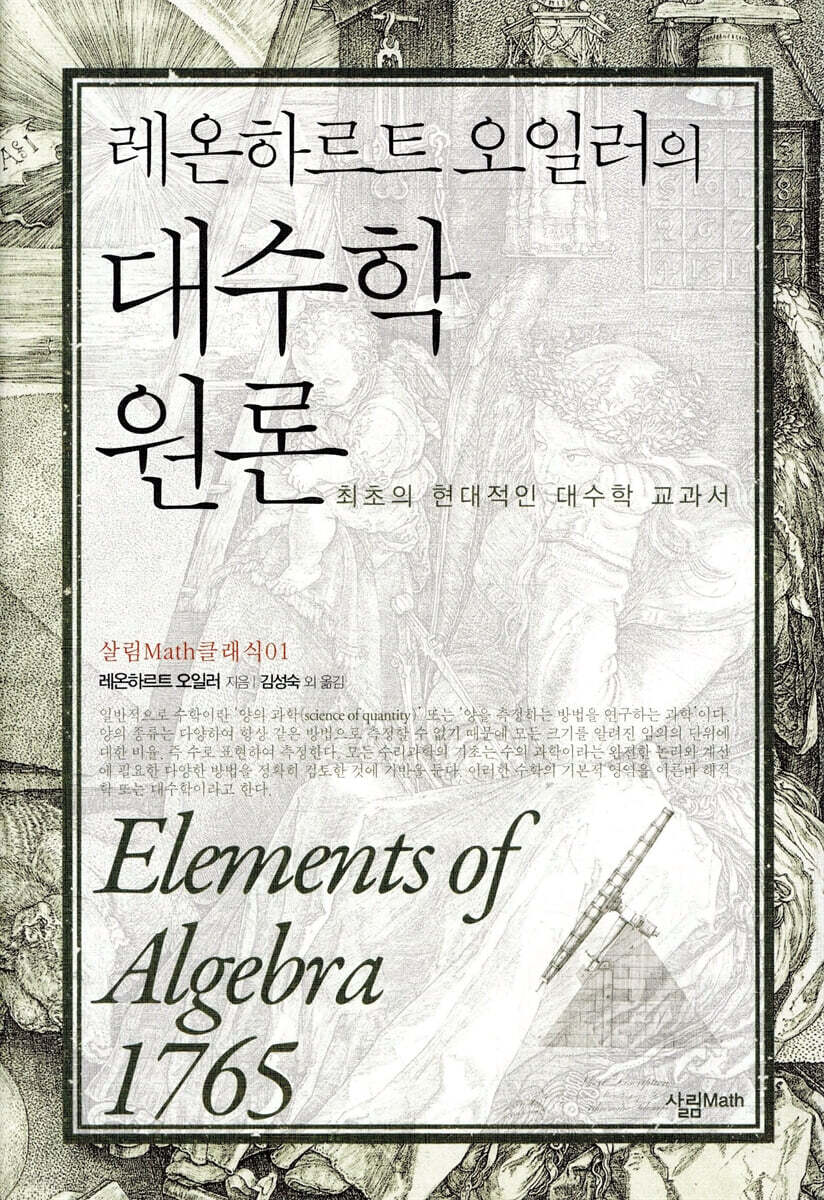
Elements of Algebra
 |
Description
Book Introduction
Euler.
He was a great mathematician who boasted an enormous amount of research, to the point that he wrote one-third of the mathematical papers published in Europe in the mid-18th century by himself, and he continued to research and write even after losing the sight in both eyes due to cataracts.
One of Euler's later achievements was writing the textbook Elements of Algebra, which was both basic and comprehensive.
This book, written under the direction of his students, is the first full-fledged work to organize the confusing notations of the time into a modern format, and is also the first algebra textbook to introduce complex numbers from the beginning.
Mathematician Euler's "Elements of Algebra," a compilation of his life's work written for students, has been published as the first volume of the Sallim Math Classic series.
This book is Euler's only work accessible to the general public without a mathematical background, and is therefore presented in an intuitively accessible and accessible language.
Of course, this book, written 250 years ago, may be too easy and basic for today's mathematicians.
However, this classic book in the history of mathematics provides a foundation for understanding the history of culture and thought through the history of mathematics, and helps us understand the fundamentals of how the mathematics we know has been formed.
This book, which covers the first half of the entire course, covers mathematics taught in middle and high school, and will be of great help to the general public in understanding the history and principles of mathematics.
He was a great mathematician who boasted an enormous amount of research, to the point that he wrote one-third of the mathematical papers published in Europe in the mid-18th century by himself, and he continued to research and write even after losing the sight in both eyes due to cataracts.
One of Euler's later achievements was writing the textbook Elements of Algebra, which was both basic and comprehensive.
This book, written under the direction of his students, is the first full-fledged work to organize the confusing notations of the time into a modern format, and is also the first algebra textbook to introduce complex numbers from the beginning.
Mathematician Euler's "Elements of Algebra," a compilation of his life's work written for students, has been published as the first volume of the Sallim Math Classic series.
This book is Euler's only work accessible to the general public without a mathematical background, and is therefore presented in an intuitively accessible and accessible language.
Of course, this book, written 250 years ago, may be too easy and basic for today's mathematicians.
However, this classic book in the history of mathematics provides a foundation for understanding the history of culture and thought through the history of mathematics, and helps us understand the fundamentals of how the mathematics we know has been formed.
This book, which covers the first half of the entire course, covers mathematics taught in middle and high school, and will be of great help to the general public in understanding the history and principles of mathematics.
index
introduction
Chapter 1: Various Methods for Calculating Monomials
1.1 About mathematics in general
1.2 Explanation of plus and minus signs
1.3 On the multiplication of monomials
1.4 The nature of whole numbers or integers in relation to arguments
1.5 Division of monomials
1.6 Properties of integers in relation to divisors
1.7 General concepts of fractions
1.8 Properties of fractions
1.9 Addition and Subtraction of Fractions
1.10 Multiplication and Division of Fractions
1.11 square
1.12 Square root and irrational numbers derived from it
Impossible number, or imaginary number, derived from the square root of 1.13
1.14 Cubic Numbers
1.15 Cube roots and irrational numbers derived from them
1.16 General powers
1.17 Calculating exponents
1.18 Roots related to general exponentiation
1.19 How to express irrational numbers with fractional exponents
1.20 Various operations and their relationships
1.21 log
1.22 Current log table in use
1.23 How to express logs
Chapter 2: Various Methods for Calculating Polynomials
2.1 Sum of polynomials
2.2 Subtraction of polynomials
2.3 Multiplication of polynomials
2.4 Division of polynomials
2.5 Expanding a fraction into an infinite series
2.6 Squares of polynomials
2.7 Finding the root of a polynomial
2.8 Operations on Irrational Numbers
2.9 Expansion of cubes and cube roots
2.10 Powers of polynomials
2.11 The arrangement of characters that forms the basis of the preceding rules
2.12 Representation of powers of irrational numbers in an infinite series
2.13 Expansion of powers of negative exponents
Chapter 3: Ratio and Proportion
3.1 Arithmetic ratio and difference of two numbers
3.2 Arithmetic Proportion
3.3 Arithmetic sequence
3.4 Sum of an arithmetic sequence
3.5 each
3.6 Geometrical ratio
3.7 Greatest common divisor of two numbers
3.8 Geometric proportions
3.9 Rules and Usefulness of Proportions
3.10 Composition Relationships
3.11 Geometric sequence
3.12 Infinite decimals
3.13 Interest Calculation
Chapter 4: Solving Algebraic Equations
4.1 About the general solution
4.2 On solving linear equations
4.3 Questions and Answers Related to 4.2
4.4 Solving simultaneous linear equations of two or more
4.5 On the solution of quadratic equations
4.6 On the solution of complete quadratic equations
4.7 Finding the roots of polygonal functions
4.8 Solving the square root of a binomial
4.9 Properties of quadratic equations
4.10 Pure cubic equations
4.11 Solving complete cubic equations
4.12 Cardano's formula or Scipio Perleo's formula
4.13 Solving quartic equations
4.14 Bombelli's formula for reducing the solution of a quartic equation to that of a cubic equation
4.15 A new method for solving quartic equations
4.16 Solving equations using approximations
Chapter 1: Various Methods for Calculating Monomials
1.1 About mathematics in general
1.2 Explanation of plus and minus signs
1.3 On the multiplication of monomials
1.4 The nature of whole numbers or integers in relation to arguments
1.5 Division of monomials
1.6 Properties of integers in relation to divisors
1.7 General concepts of fractions
1.8 Properties of fractions
1.9 Addition and Subtraction of Fractions
1.10 Multiplication and Division of Fractions
1.11 square
1.12 Square root and irrational numbers derived from it
Impossible number, or imaginary number, derived from the square root of 1.13
1.14 Cubic Numbers
1.15 Cube roots and irrational numbers derived from them
1.16 General powers
1.17 Calculating exponents
1.18 Roots related to general exponentiation
1.19 How to express irrational numbers with fractional exponents
1.20 Various operations and their relationships
1.21 log
1.22 Current log table in use
1.23 How to express logs
Chapter 2: Various Methods for Calculating Polynomials
2.1 Sum of polynomials
2.2 Subtraction of polynomials
2.3 Multiplication of polynomials
2.4 Division of polynomials
2.5 Expanding a fraction into an infinite series
2.6 Squares of polynomials
2.7 Finding the root of a polynomial
2.8 Operations on Irrational Numbers
2.9 Expansion of cubes and cube roots
2.10 Powers of polynomials
2.11 The arrangement of characters that forms the basis of the preceding rules
2.12 Representation of powers of irrational numbers in an infinite series
2.13 Expansion of powers of negative exponents
Chapter 3: Ratio and Proportion
3.1 Arithmetic ratio and difference of two numbers
3.2 Arithmetic Proportion
3.3 Arithmetic sequence
3.4 Sum of an arithmetic sequence
3.5 each
3.6 Geometrical ratio
3.7 Greatest common divisor of two numbers
3.8 Geometric proportions
3.9 Rules and Usefulness of Proportions
3.10 Composition Relationships
3.11 Geometric sequence
3.12 Infinite decimals
3.13 Interest Calculation
Chapter 4: Solving Algebraic Equations
4.1 About the general solution
4.2 On solving linear equations
4.3 Questions and Answers Related to 4.2
4.4 Solving simultaneous linear equations of two or more
4.5 On the solution of quadratic equations
4.6 On the solution of complete quadratic equations
4.7 Finding the roots of polygonal functions
4.8 Solving the square root of a binomial
4.9 Properties of quadratic equations
4.10 Pure cubic equations
4.11 Solving complete cubic equations
4.12 Cardano's formula or Scipio Perleo's formula
4.13 Solving quartic equations
4.14 Bombelli's formula for reducing the solution of a quartic equation to that of a cubic equation
4.15 A new method for solving quartic equations
4.16 Solving equations using approximations
Into the book
1.
Something that can increase or decrease is called size or quantity.
Therefore, the sum of money is quantity.
Because money can increase or decrease.
The same goes for weight and other things of similar nature.
2.
According to this definition, there are so many different kinds of quantities or sizes that they cannot be calculated according to any one rule.
It is for this very reason that mathematics is divided into several branches, each dealing with a special kind of magnitude.
Generally speaking, mathematics is the 'science of quantity' or 'the science that studies methods for measuring quantity'.
6.
Therefore, algebra only deals with numbers that represent quantities, and does not deal with the various types of quantities.
The diversity of quantities is a topic covered in other branches of mathematics.
7.
Arithmetic deals specifically with numbers, so it can be called the 'science of numbers.'
However, this science only refers to some of the calculation methods commonly used in everyday life.
Algebra, on the other hand, comprehensively deals with all possibilities that can exist when calculating and using numbers.
27 Here we can see that the order of the letters does not make a difference.
Therefore, ab is like ba, and the product of a and b is equal to the product of a and b.
To understand this, simply substitute the letters a and b with the numbers 3 and 4.
3 times 4 is the same as 4 times 3.
When there is another number, such as 68 7, that is not divisible by 3, the quotient cannot be expressed as an integer.
However, we should not think that we cannot form a concept of that share.
Imagine a line that is 7 feet long.
No one would doubt that this line can be divided into three equal parts, and that we can conceive of the length of any one of these three parts.
143 And since all conceivable numbers are either greater than 0, less than 0, or 0, the square root of a negative number is not among the conceivable numbers, so it must be said to be an unthinkable number.
In this way, we come to think of numbers that are essentially unthinkable, and because they exist only in our imagination, we call these numbers imaginary.
563 The main purpose of algebra, like that of other branches of mathematics, is to determine the values of unknown quantities.
And this can be obtained by carefully considering the given conditions—these are always expressed in terms of already known numbers.
For this reason, algebra is defined as 'the science that teaches us how to determine unknown quantities by writing known quantities.'
Something that can increase or decrease is called size or quantity.
Therefore, the sum of money is quantity.
Because money can increase or decrease.
The same goes for weight and other things of similar nature.
2.
According to this definition, there are so many different kinds of quantities or sizes that they cannot be calculated according to any one rule.
It is for this very reason that mathematics is divided into several branches, each dealing with a special kind of magnitude.
Generally speaking, mathematics is the 'science of quantity' or 'the science that studies methods for measuring quantity'.
6.
Therefore, algebra only deals with numbers that represent quantities, and does not deal with the various types of quantities.
The diversity of quantities is a topic covered in other branches of mathematics.
7.
Arithmetic deals specifically with numbers, so it can be called the 'science of numbers.'
However, this science only refers to some of the calculation methods commonly used in everyday life.
Algebra, on the other hand, comprehensively deals with all possibilities that can exist when calculating and using numbers.
27 Here we can see that the order of the letters does not make a difference.
Therefore, ab is like ba, and the product of a and b is equal to the product of a and b.
To understand this, simply substitute the letters a and b with the numbers 3 and 4.
3 times 4 is the same as 4 times 3.
When there is another number, such as 68 7, that is not divisible by 3, the quotient cannot be expressed as an integer.
However, we should not think that we cannot form a concept of that share.
Imagine a line that is 7 feet long.
No one would doubt that this line can be divided into three equal parts, and that we can conceive of the length of any one of these three parts.
143 And since all conceivable numbers are either greater than 0, less than 0, or 0, the square root of a negative number is not among the conceivable numbers, so it must be said to be an unthinkable number.
In this way, we come to think of numbers that are essentially unthinkable, and because they exist only in our imagination, we call these numbers imaginary.
563 The main purpose of algebra, like that of other branches of mathematics, is to determine the values of unknown quantities.
And this can be obtained by carefully considering the given conditions—these are always expressed in terms of already known numbers.
For this reason, algebra is defined as 'the science that teaches us how to determine unknown quantities by writing known quantities.'
--- From the text
Publisher's Review
A monumental work that gave birth to modern algebra
Euler, the great genius of 18th-century mathematics
Philosopher Whitehead called the 17th century, the century of genius, the era of Descartes, Newton, and Leibniz, but Leonhard Euler (1707-1783) of the 18th century would be almost the only person who could dispute this.
He was a great mathematician who left behind such great achievements that it is said that he wrote one-third of the mathematical papers published in Europe in the mid-18th century by himself, and who made contributions to the overall field of mathematics comparable to Gauss.
Euler discovered this formula while developing and improving the theory of trigonometric functions. This profound formula, which shows the relationship between the most important constants in mathematics and basic operations (squaring and addition), is called one of the most beautiful formulas in the history of mathematics.
A kind and wonderful lecture given by a master
The portrait of Euler we see shows one of his distorted eyes.
Having nearly lost the sight in one eye due to illness, he later lost the sight in both eyes due to cataracts.
But he did not stop studying and writing about mathematics, doing mental calculations and writing papers by stating them.
When he died, his friend announced Euler's death thus:
“Euler finally stopped calculating.”
One of Euler's later achievements was writing the textbook Elements of Algebra, which was both basic and comprehensive.
This book, written under the direction of his students, is the first full-fledged work to organize the confusing notations of the time into a modern format, and is also the first algebra textbook to introduce complex numbers from the beginning.
And above all, it is Euler's only work that can be read by the general public without a mathematical background, and it is also a wonderful introductory book written (or dictated) by the master for students, summarizing his life's work.
Anyone can overcome their fear of math and easily become immersed in it by following the lectures, which are presented in an intuitive and understandable language.
This is because this book, which is the first half of the entire course, mainly contains the mathematics content learned in middle and high school.
The first modern algebra textbook
Of course, this book, written 250 years ago, may seem too easy and basic to today's mathematicians.
Since then, mathematics has developed greatly, and things that Euler could not have imagined have been added to mathematics.
At least in the field of algebra, Galois' theory, which appeared after Euler, became the foundation of modern abstract algebra.
However, from a historical perspective, Elements of Algebra contains material of interest even to professional mathematicians.
In particular, his approach to mathematics captures a naive (but compelling) perspective from before the modern reorganization of the mathematical system.
One of the Fields Medalists once said that one of the best ways to learn mathematics is to show the historical development of mathematics (Kunihiko Kodaira).
In that respect, this book will be an invaluable resource, allowing us to directly witness the dynamic formation of the mathematics we know, and how a genius from 250 years ago developed the mathematical system.
Although many types of works on the history of mathematics have been written or translated so far, with the exception of Euclid's Elements, there have been few opportunities to directly view the classics of the history of mathematics.
Classics of mathematical history being introduced to our reading world.
Euler's Elements of Algebra is the first volume in the upcoming Sallim Math Classic series.
While we say that the history of mathematics is the foundation and basis for understanding the history of culture and thought, in reality, there has been almost no translation of classic works of the history of mathematics in our intellectual community.
In that sense, the Sallim Math Classics series will be a valuable project that fills a void in our publishing culture.
We ask for your warm interest and support for this project, which introduces masterpieces in the history of mathematics accessible to the general public, including Hilbert's future writings.
Euler, the great genius of 18th-century mathematics
Philosopher Whitehead called the 17th century, the century of genius, the era of Descartes, Newton, and Leibniz, but Leonhard Euler (1707-1783) of the 18th century would be almost the only person who could dispute this.
He was a great mathematician who left behind such great achievements that it is said that he wrote one-third of the mathematical papers published in Europe in the mid-18th century by himself, and who made contributions to the overall field of mathematics comparable to Gauss.
Euler discovered this formula while developing and improving the theory of trigonometric functions. This profound formula, which shows the relationship between the most important constants in mathematics and basic operations (squaring and addition), is called one of the most beautiful formulas in the history of mathematics.
A kind and wonderful lecture given by a master
The portrait of Euler we see shows one of his distorted eyes.
Having nearly lost the sight in one eye due to illness, he later lost the sight in both eyes due to cataracts.
But he did not stop studying and writing about mathematics, doing mental calculations and writing papers by stating them.
When he died, his friend announced Euler's death thus:
“Euler finally stopped calculating.”
One of Euler's later achievements was writing the textbook Elements of Algebra, which was both basic and comprehensive.
This book, written under the direction of his students, is the first full-fledged work to organize the confusing notations of the time into a modern format, and is also the first algebra textbook to introduce complex numbers from the beginning.
And above all, it is Euler's only work that can be read by the general public without a mathematical background, and it is also a wonderful introductory book written (or dictated) by the master for students, summarizing his life's work.
Anyone can overcome their fear of math and easily become immersed in it by following the lectures, which are presented in an intuitive and understandable language.
This is because this book, which is the first half of the entire course, mainly contains the mathematics content learned in middle and high school.
The first modern algebra textbook
Of course, this book, written 250 years ago, may seem too easy and basic to today's mathematicians.
Since then, mathematics has developed greatly, and things that Euler could not have imagined have been added to mathematics.
At least in the field of algebra, Galois' theory, which appeared after Euler, became the foundation of modern abstract algebra.
However, from a historical perspective, Elements of Algebra contains material of interest even to professional mathematicians.
In particular, his approach to mathematics captures a naive (but compelling) perspective from before the modern reorganization of the mathematical system.
One of the Fields Medalists once said that one of the best ways to learn mathematics is to show the historical development of mathematics (Kunihiko Kodaira).
In that respect, this book will be an invaluable resource, allowing us to directly witness the dynamic formation of the mathematics we know, and how a genius from 250 years ago developed the mathematical system.
Although many types of works on the history of mathematics have been written or translated so far, with the exception of Euclid's Elements, there have been few opportunities to directly view the classics of the history of mathematics.
Classics of mathematical history being introduced to our reading world.
Euler's Elements of Algebra is the first volume in the upcoming Sallim Math Classic series.
While we say that the history of mathematics is the foundation and basis for understanding the history of culture and thought, in reality, there has been almost no translation of classic works of the history of mathematics in our intellectual community.
In that sense, the Sallim Math Classics series will be a valuable project that fills a void in our publishing culture.
We ask for your warm interest and support for this project, which introduces masterpieces in the history of mathematics accessible to the general public, including Hilbert's future writings.
GOODS SPECIFICS
- Date of publication: December 27, 2010
- Format: Hardcover book binding method guide
- Page count, weight, size: 408 pages | 153*224*30mm
- ISBN13: 9788952215406
- ISBN10: 8952215400
You may also like
카테고리
korean


korean

![GQ KOREA Mark (Monthly): December [2025]](http://librairie.coreenne.fr/cdn/shop/files/8ef265dbbfbf186523ed75ba7319009d.jpg?v=1765340328&width=3840)


