

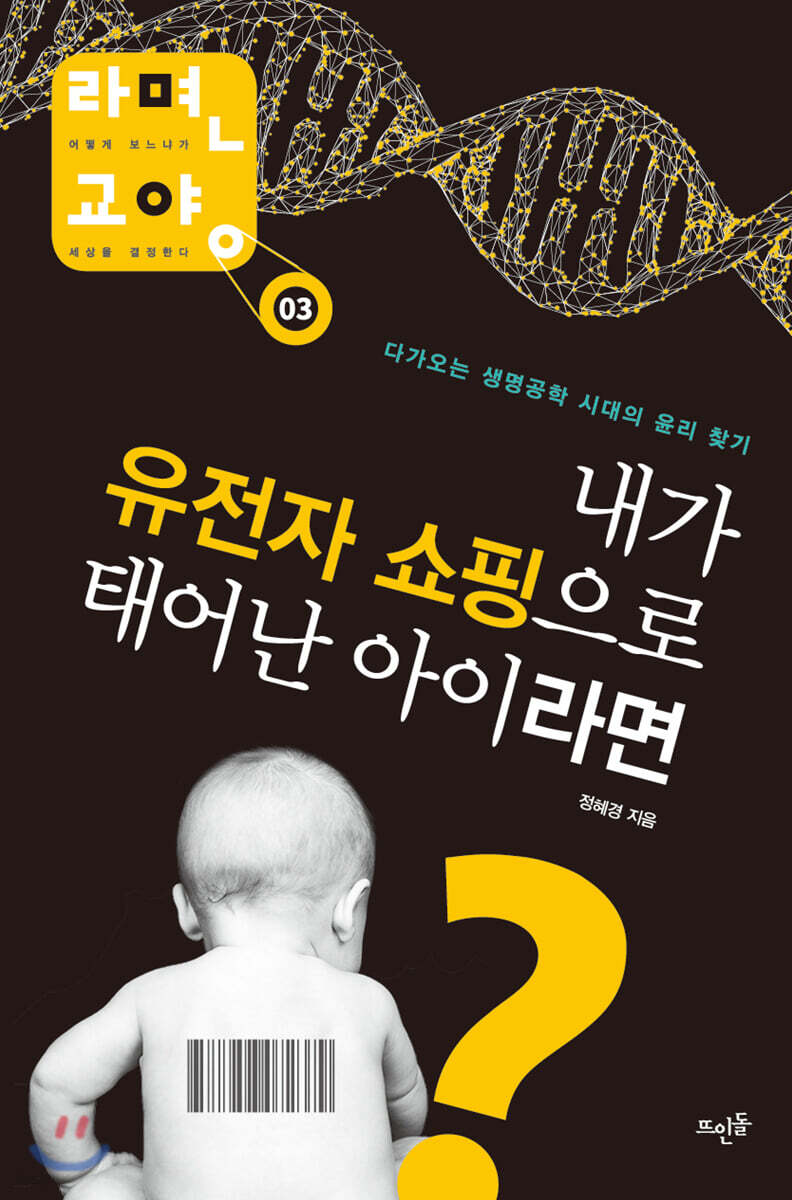
What if I was born through genetic shopping?
 |
Description
Book Introduction
The wheels of biotechnology have already begun to turn.
Should we stop it or should we speed it up?
Scientific ethics is no longer exclusive to the scientific community.
We must not allow a few people with power and knowledge to determine the future of humanity.
"What if I was born through genetic shopping?" was designed and structured to empower each reader to decide their own future.
Assuming that the pinnacle of biotechnology is genetic shopping, we first examined whether such an assumption is feasible.
And we tried to look at predictable situations from philosophical, religious, and social perspectives.
Part 1, "Will the Era of Gene Shopping Ever Arrive?" concludes that genetic shopping is technically feasible, and Part 2, "Will the Era of Gene Shopping Ever Arrive?" broadly examines its side effects and benefits.
This brings us to Part 3, "The Era of Gene Shopping: What Should We Prepare for?", where we finally examine the scientific ethics we, as ordinary citizens, should adhere to.
It is impossible to know exactly in which direction the biotechnology era will flow.
However, we can only predict the future of society based on how non-scientists, the citizens and readers, agree, implement, and monitor.
Should we stop it or should we speed it up?
Scientific ethics is no longer exclusive to the scientific community.
We must not allow a few people with power and knowledge to determine the future of humanity.
"What if I was born through genetic shopping?" was designed and structured to empower each reader to decide their own future.
Assuming that the pinnacle of biotechnology is genetic shopping, we first examined whether such an assumption is feasible.
And we tried to look at predictable situations from philosophical, religious, and social perspectives.
Part 1, "Will the Era of Gene Shopping Ever Arrive?" concludes that genetic shopping is technically feasible, and Part 2, "Will the Era of Gene Shopping Ever Arrive?" broadly examines its side effects and benefits.
This brings us to Part 3, "The Era of Gene Shopping: What Should We Prepare for?", where we finally examine the scientific ethics we, as ordinary citizens, should adhere to.
It is impossible to know exactly in which direction the biotechnology era will flow.
However, we can only predict the future of society based on how non-scientists, the citizens and readers, agree, implement, and monitor.
- You can preview some of the book's contents.
Preview
index
Introduction
Sketches of the Biotechnology Age 1: Vincent Goes Gene Shopping for His Mom, Dad, and Little Brother
Sketches of the Biotechnology Age 2: Blessed Younghee and Cheolsu
Sketches of the Biotechnology Age 3: Another Dark Daily Life of Younghee and Cheolsu
1 Will the era of shopping for genes ever come?
Why Genes? The Masters of Life's Replication and Genetics
What are the limits of biotechnology development?
Biotechnology by humans, for humans
Is the era of genetic shopping possible?
2 Can we enter an era of gene shopping?
The Light of Genetic Shopping: A Healthy and Abundant Life
The Shadow of the Genetic Shopping Era: Physical Side Effects and Social Impact
For vs. Against the Age of Genetic Shopping
the opposite
3 In the era of shopping for genes, what should we prepare for?
Minimum protective gear, scientific ethics
Various Ethical Perspectives on the Era of Genetic Shopping
Perspectives on the Age of Genetic Shopping: None of It's Perfect!
Preparing for the Right Choice: On the Borderline Between Control and Dependence, Excitement and Fear
Conclusion
The wheels of change have already begun to roll
Sketches of the Biotechnology Age 1: Vincent Goes Gene Shopping for His Mom, Dad, and Little Brother
Sketches of the Biotechnology Age 2: Blessed Younghee and Cheolsu
Sketches of the Biotechnology Age 3: Another Dark Daily Life of Younghee and Cheolsu
1 Will the era of shopping for genes ever come?
Why Genes? The Masters of Life's Replication and Genetics
What are the limits of biotechnology development?
Biotechnology by humans, for humans
Is the era of genetic shopping possible?
2 Can we enter an era of gene shopping?
The Light of Genetic Shopping: A Healthy and Abundant Life
The Shadow of the Genetic Shopping Era: Physical Side Effects and Social Impact
For vs. Against the Age of Genetic Shopping
the opposite
3 In the era of shopping for genes, what should we prepare for?
Minimum protective gear, scientific ethics
Various Ethical Perspectives on the Era of Genetic Shopping
Perspectives on the Age of Genetic Shopping: None of It's Perfect!
Preparing for the Right Choice: On the Borderline Between Control and Dependence, Excitement and Fear
Conclusion
The wheels of change have already begun to roll
Into the book
There is no need to fear that humans will change.
Because no one feels guilty about having apes as their ancestors or longs for those times.
--- p.113
Eugenics justified the domination and exploitation of the inferior Third World peoples by the self-proclaimed superior European race as if it were the natural order of things.
Furthermore, internally, the influence of genetics was exaggerated, leading the poor and lower classes to believe that their miserable lives were due to genetic defects.
--- p.139
The concept of a 'slippery slope' appears like licorice in predictions related to biotechnology.
The idea is that human intervention in life, although initially only partially permitted, will gradually expand in scope and eventually reach a point where it will be fully permitted.
--- p.181
Genetic testing is likely to be used as a tool for 'genetic discrimination'.
--- p.90
Genetic enhancement could create a whole new level of 'inequality'.
As a result of such inequality, the old saying, “A dragon rises from a ditch,” may become a thing of the past, and mobility between classes through fair competition may become a distant memory.
--- p.93
When human cloning became a hot topic, people's reaction was one of resistance to 'creating a copy of someone.'
However, the only thing that cloned humans and clones have in common is the genetic information contained in their DNA.
Although they start out with the same genetic information, the development and growth processes are different, so the clones are bound to be different people from the original humans.
--- p.104
Any argument against genetic shopping by citing the laws of nature is both anachronistic and self-defeating.
Did you know that many of the medical technologies we experience today faced the same criticism when they were first introduced? During the plague raging in late medieval Europe, religious dogmatists whipped themselves in an attempt to appease the wrath of the god who had caused the plague.
When Jenner developed the cowpox method of inoculating humans with cowpox extracted from cow pus to treat smallpox, people ridiculed him, asking, “Is Jenner trying to turn humans into cows?”
Because no one feels guilty about having apes as their ancestors or longs for those times.
--- p.113
Eugenics justified the domination and exploitation of the inferior Third World peoples by the self-proclaimed superior European race as if it were the natural order of things.
Furthermore, internally, the influence of genetics was exaggerated, leading the poor and lower classes to believe that their miserable lives were due to genetic defects.
--- p.139
The concept of a 'slippery slope' appears like licorice in predictions related to biotechnology.
The idea is that human intervention in life, although initially only partially permitted, will gradually expand in scope and eventually reach a point where it will be fully permitted.
--- p.181
Genetic testing is likely to be used as a tool for 'genetic discrimination'.
--- p.90
Genetic enhancement could create a whole new level of 'inequality'.
As a result of such inequality, the old saying, “A dragon rises from a ditch,” may become a thing of the past, and mobility between classes through fair competition may become a distant memory.
--- p.93
When human cloning became a hot topic, people's reaction was one of resistance to 'creating a copy of someone.'
However, the only thing that cloned humans and clones have in common is the genetic information contained in their DNA.
Although they start out with the same genetic information, the development and growth processes are different, so the clones are bound to be different people from the original humans.
--- p.104
Any argument against genetic shopping by citing the laws of nature is both anachronistic and self-defeating.
Did you know that many of the medical technologies we experience today faced the same criticism when they were first introduced? During the plague raging in late medieval Europe, religious dogmatists whipped themselves in an attempt to appease the wrath of the god who had caused the plague.
When Jenner developed the cowpox method of inoculating humans with cowpox extracted from cow pus to treat smallpox, people ridiculed him, asking, “Is Jenner trying to turn humans into cows?”
--- p.112
Publisher's Review
Light and Shadow in the Biotechnology Era
Asking non-scientists, citizens.
Are embryos human or not? Should biotechnology advance further, or should we stop challenging nature now? Why ask non-scientists? Because every time citizens leave everything to the scientific community and stop thinking for themselves, humanity has suffered terrible disasters.
The Holocaust perpetrated by the German Nazi Party, under the illusion of eugenics, was one such example, as was the dropping of atomic bombs on Japan by the United States during World War II.
As an animal that records and reflects, can we not repeat such mistakes again?
So don't be confused by the questions this book poses.
Instead, understand and judge.
If we are swayed by genetic determinism such as, “You are poor because of your inferior genetic makeup,” we may become bystanders in the biotechnology era.
If we cling to the fundamentalism that “humans should not interfere with nature,” we may lose opportunities to gain greater benefits.
"What if I were born through genetic shopping?" provides ample support so that each reader can develop their own perspective on biotechnology, which will drive future society.
1_Do biotechnology destroy human identity?
Imagine someone walking around the world who is genetically identical to you, with almost the same appearance and traits.
It is probably a natural instinct to feel that the uniqueness of my existence is being violated.
In that sense, human cloning would cause confusion about individual identity.
However, some argue that this is a misunderstanding caused by the word 'clone'.
Many people think that cloning in biotechnology means 'making a copy of someone.'
However, even identical twins with the same genetic makeup have distinct personalities and identities.
This means you don't have to worry about running into a copy of yourself on the street.
2_Is biotechnology a challenge to the harmony of nature?
When Jenner developed the cowpox method of inoculating humans with cowpox extracted from cow pus to treat smallpox, people ridiculed him, asking, “Is Jenner trying to turn humans into cows?”
As such, new treatments have always met with fierce resistance.
Genetic shopping, although currently met with strong religious and customary resistance, is likely to one day be accepted as naturally as Jenner's vaccination.
But on the other hand, the fear that humanity must bear is also great.
The possibility that genetic modification, if continued for hundreds of years or more, will affect the distribution of human genes, may one day be another Tower of Babel that will crumble miserably under the hammer of nature.
3_Biotechnology, what are the sacrifices made in the process?
Those who have hope for curing diseases through biotechnology support the development of biotechnology, saying that it is better to grasp at straws than to sit still and suffer misfortune.
They argue that early sacrifices are inevitable.
“If someone were to undergo an appendectomy tomorrow, it would be safer than any brain surgery in history.
First use is dangerous.
However, just as medical technology has advanced based on the sacrifices of our predecessors, a certain degree of sacrifice is sometimes something that must be accepted.” Of course, there are also strong opposing views on this.
Their question is: Is there a life worth sacrificing? Isn't the cold-blooded notion that "you have to be willing to take this level of risk to become able-bodied" behind the view that even a straw is worth grasping at?
4_Doesn’t biotechnology threaten social justice?
If biotechnology becomes safe, a small number of wealthy people will undoubtedly have access to quality treatment early on.
Then, we cannot ignore the possibility that it will bring about a new class society.
A society where inequality stemming from biotechnology advancements is entrenched might be a dystopia, devoid of the vitality or hope that comes from fair competition. However, some argue that controlling technology to prevent this is unrealistic.
They argue that biotechnology should be unveiled for the sake of social justice.
Rather than accepting inequality that benefits only a few during the transition period, the way to create equality in capitalism is to broaden the scope of benefits overall.
Asking non-scientists, citizens.
Are embryos human or not? Should biotechnology advance further, or should we stop challenging nature now? Why ask non-scientists? Because every time citizens leave everything to the scientific community and stop thinking for themselves, humanity has suffered terrible disasters.
The Holocaust perpetrated by the German Nazi Party, under the illusion of eugenics, was one such example, as was the dropping of atomic bombs on Japan by the United States during World War II.
As an animal that records and reflects, can we not repeat such mistakes again?
So don't be confused by the questions this book poses.
Instead, understand and judge.
If we are swayed by genetic determinism such as, “You are poor because of your inferior genetic makeup,” we may become bystanders in the biotechnology era.
If we cling to the fundamentalism that “humans should not interfere with nature,” we may lose opportunities to gain greater benefits.
"What if I were born through genetic shopping?" provides ample support so that each reader can develop their own perspective on biotechnology, which will drive future society.
1_Do biotechnology destroy human identity?
Imagine someone walking around the world who is genetically identical to you, with almost the same appearance and traits.
It is probably a natural instinct to feel that the uniqueness of my existence is being violated.
In that sense, human cloning would cause confusion about individual identity.
However, some argue that this is a misunderstanding caused by the word 'clone'.
Many people think that cloning in biotechnology means 'making a copy of someone.'
However, even identical twins with the same genetic makeup have distinct personalities and identities.
This means you don't have to worry about running into a copy of yourself on the street.
2_Is biotechnology a challenge to the harmony of nature?
When Jenner developed the cowpox method of inoculating humans with cowpox extracted from cow pus to treat smallpox, people ridiculed him, asking, “Is Jenner trying to turn humans into cows?”
As such, new treatments have always met with fierce resistance.
Genetic shopping, although currently met with strong religious and customary resistance, is likely to one day be accepted as naturally as Jenner's vaccination.
But on the other hand, the fear that humanity must bear is also great.
The possibility that genetic modification, if continued for hundreds of years or more, will affect the distribution of human genes, may one day be another Tower of Babel that will crumble miserably under the hammer of nature.
3_Biotechnology, what are the sacrifices made in the process?
Those who have hope for curing diseases through biotechnology support the development of biotechnology, saying that it is better to grasp at straws than to sit still and suffer misfortune.
They argue that early sacrifices are inevitable.
“If someone were to undergo an appendectomy tomorrow, it would be safer than any brain surgery in history.
First use is dangerous.
However, just as medical technology has advanced based on the sacrifices of our predecessors, a certain degree of sacrifice is sometimes something that must be accepted.” Of course, there are also strong opposing views on this.
Their question is: Is there a life worth sacrificing? Isn't the cold-blooded notion that "you have to be willing to take this level of risk to become able-bodied" behind the view that even a straw is worth grasping at?
4_Doesn’t biotechnology threaten social justice?
If biotechnology becomes safe, a small number of wealthy people will undoubtedly have access to quality treatment early on.
Then, we cannot ignore the possibility that it will bring about a new class society.
A society where inequality stemming from biotechnology advancements is entrenched might be a dystopia, devoid of the vitality or hope that comes from fair competition. However, some argue that controlling technology to prevent this is unrealistic.
They argue that biotechnology should be unveiled for the sake of social justice.
Rather than accepting inequality that benefits only a few during the transition period, the way to create equality in capitalism is to broaden the scope of benefits overall.
GOODS SPECIFICS
- Date of issue: October 20, 2008
- Page count, weight, size: 182 pages | 316g | 142*215*20mm
- ISBN13: 9788958072379
- ISBN10: 8958072377
You may also like
카테고리
korean


korean

![GQ KOREA Mark (Monthly): December [2025]](http://librairie.coreenne.fr/cdn/shop/files/8ef265dbbfbf186523ed75ba7319009d.jpg?v=1765340328&width=3840)


