

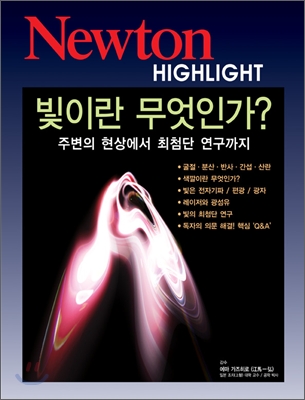
Newton Highlight What is light?
 |
Description
Book Introduction
It is easy to understand scientific phenomena, but it is not easy to understand the principles.
For example, there are few people who do not know about the refraction of light.
However, it is not easy to explain 'why' light refracts when it passes from air to water.
The greatest strength of this book, "What is Light?", is that it explains the fundamental principles behind scientific phenomena with precise, high-quality illustrations.
It covers everything about light at a glance, including basic phenomena such as refraction, dispersion, reflection, interference, and scattering; the principles of light and color, the generation of electromagnetic waves; the various properties of light such as transparency and opacity, polarization, and photons; and cutting-edge research on light such as lasers, optical fibers, and "a flash of 1/1000 trillionth of a second" and "light slower than a bicycle."
In addition to the content covered in the main text, we have compiled questions that readers commonly ask into a Q&A format, thereby reconfirming the content of the main text and providing even more advanced content.
For example, there are few people who do not know about the refraction of light.
However, it is not easy to explain 'why' light refracts when it passes from air to water.
The greatest strength of this book, "What is Light?", is that it explains the fundamental principles behind scientific phenomena with precise, high-quality illustrations.
It covers everything about light at a glance, including basic phenomena such as refraction, dispersion, reflection, interference, and scattering; the principles of light and color, the generation of electromagnetic waves; the various properties of light such as transparency and opacity, polarization, and photons; and cutting-edge research on light such as lasers, optical fibers, and "a flash of 1/1000 trillionth of a second" and "light slower than a bicycle."
In addition to the content covered in the main text, we have compiled questions that readers commonly ask into a Q&A format, thereby reconfirming the content of the main text and providing even more advanced content.
index
Chapter 1 Various Light Phenomena
Sunlight ①~② / Refraction ①~④ / Dispersion of light ①~③ / Refraction by the atmosphere ①~② / Reflection ①~④ / Interference ①~④ / Scattering ①~②
Chapter 2 What is Color?
The three primary colors of light ①~④ / The three primary colors of color ①~②
Chapter 3: The Identity of Light
Light is an electromagnetic wave ①~⑨ / Generation of electromagnetic waves ①~⑧ / Transparency and opacity / Polarization ①~② / Photons / Pressure of light
Chapter 4: The 21st Century of Light
Laser ①~③ / Fiber optic
Chapter 5
Amazing cutting-edge research
Flash of 1/1000 trillionth of a second ①~③
Special Interview: Eric Ipen (Professor, MIT)
Slower than a bicycle ①~②
Special Interview: Renee Howe (Professor, Harvard University)
Chapter 6
Epilogue: What is "Light"? 154
Want to know more? Q&A
Q1.
Why does it get dark immediately when I turn off the lights?
Q2.
I can't understand why light bends.
Q3.
How has the identity of light been elucidated?
Q4.
Can't you see the light passing in front of your eyes?
Q5.
If you wipe the surface of a white object, does it become a mirror?
Q6.
What does 'light is an electromagnetic wave' mean?
Q7.
Light is a wave, so why does it travel through a vacuum?
Q8.
What is a photon? Why does a massless photon exert pressure?
Q9.
Why are Blu-ray Discs and HD DVDs so large?
Q10.
Isn't the speed of light constant and the highest speed in nature?
Sunlight ①~② / Refraction ①~④ / Dispersion of light ①~③ / Refraction by the atmosphere ①~② / Reflection ①~④ / Interference ①~④ / Scattering ①~②
Chapter 2 What is Color?
The three primary colors of light ①~④ / The three primary colors of color ①~②
Chapter 3: The Identity of Light
Light is an electromagnetic wave ①~⑨ / Generation of electromagnetic waves ①~⑧ / Transparency and opacity / Polarization ①~② / Photons / Pressure of light
Chapter 4: The 21st Century of Light
Laser ①~③ / Fiber optic
Chapter 5
Amazing cutting-edge research
Flash of 1/1000 trillionth of a second ①~③
Special Interview: Eric Ipen (Professor, MIT)
Slower than a bicycle ①~②
Special Interview: Renee Howe (Professor, Harvard University)
Chapter 6
Epilogue: What is "Light"? 154
Want to know more? Q&A
Q1.
Why does it get dark immediately when I turn off the lights?
Q2.
I can't understand why light bends.
Q3.
How has the identity of light been elucidated?
Q4.
Can't you see the light passing in front of your eyes?
Q5.
If you wipe the surface of a white object, does it become a mirror?
Q6.
What does 'light is an electromagnetic wave' mean?
Q7.
Light is a wave, so why does it travel through a vacuum?
Q8.
What is a photon? Why does a massless photon exert pressure?
Q9.
Why are Blu-ray Discs and HD DVDs so large?
Q10.
Isn't the speed of light constant and the highest speed in nature?
Publisher's Review
From light phenomena to cutting-edge research
Can you imagine a world without light? Even setting aside the impact of light on living things, without it, we would have difficulty perceiving the external world.
Also, various light phenomena have various scientific meanings.
There are many examples of scientific phenomena of light, such as why the sky appears blue and red when the air is colorless and transparent, why does light passing through a prism split into rainbow colors, why does light refract when it passes from air to water, why are rainbows semicircular, why do mirages form, and why can humans only see visible light.
On the other hand, if the 20th century is said to be the era of ‘electronics,’ the 21st century is said to be the era of ‘optical science,’ and light is the main character of 21st century science.
Human science has already reached the level of freely manipulating light, such as 『pulse light that shines for only one quadrillionth of a second』 and 『light slower than the speed of a bicycle』, not to mention lasers and optical fibers.
Based on these various properties of light, this book provides a comprehensive overview of light, from the basics to cutting-edge research.
First, in the first half of the book, we will look at various phenomena and principles of light that we commonly see around us.
That is, it organizes the various properties of light, such as refraction, dispersion, reflection, interference, and scattering, as well as color and electromagnetic waves.
The strengths of the "Newton Highlights Series," which explains scientific phenomena and principles using precise illustrations and photographs, are fully demonstrated in this book.
The latter part of the book introduces the state of the art in optical science research that freely manipulates light.
Additionally, it includes valuable interviews with Professor Eric Ipen of the Massachusetts Institute of Technology and Professor Lene Howe of Harvard University, who are active at the forefront of cutting-edge research.
All content in this book is based on the opinions and reviews of a monitoring team of Newton readers.
By incorporating lively feedback from readers, we are proud to have created a science guidebook that is even more accessible to readers, and we confidently recommend it to you.
● Over 200 illustrations showing the principles and phenomena of light
It is easy to understand scientific phenomena, but it is not easy to understand the principles.
For example, there is hardly anyone who does not know 『The Refraction of Light』.
However, it is not easy to explain 'why' light refracts when it passes from air to water.
The greatest strength of this book, "What is Light?", is that it explains the fundamental principles behind scientific phenomena with precise, high-quality illustrations.
This is the world's best image data, condensed with all the know-how of the science magazine Newton.
● 100% customized composition and commentary that has been reviewed by readers before publication
The topic of ‘light’ is one that many people seem to know well, but in fact, they only know vaguely about.
Newton took note of these characteristics and, before creating the content, he operated a "special editorial monitor team" comprised of readers from various classes.
By incorporating readers' opinions on the overall structure, as well as the parts that readers find particularly difficult to understand, the detailed explanation method, and the creation of illustrations, we have structured it so that readers can understand as easily and comfortably as possible.
● From basics to applications and cutting-edge technologies… Everything about light at a glance
We see light everywhere and at all times.
And light exhibits many curious phenomena, and the examples are very diverse.
This book covers everything about light at a glance, including basic phenomena such as refraction, dispersion, reflection, interference, and scattering; the principles of light and color, the generation of electromagnetic waves, the various properties of light such as transparency and opacity, polarization, and photons; and cutting-edge research on light such as lasers, optical fibers, and "Flashes of 1/1000 trillionth of a second" and "Light slower than a bicycle."
● Includes top 10 core Q&As, commonly asked questions by readers
The lighting fixtures in the room emit light constantly.
But when you turn off the light, the room immediately becomes dark.
Where did all that "much light" disappear to? There are many aspects of the phenomenon and principles of light that are difficult to understand.
In addition to the content covered in the main text, we have compiled a Q&A of common questions readers have, thereby reconfirming the content of the main text and providing even more advanced content.
● The 22nd science book in the Newton Highlights Series
NEWTON publishes one volume each month in the Newton Highlights Series, a scientific monograph that summarizes the latest research findings in all scientific fields with high-quality commentary articles and sophisticated graphics.
Periodicals such as 『Theory of Relativity』, 『Quantum Theory』, 『Black Holes and White Holes』, 『Human Body - 21st Century Anatomy』, 『Periodic Table』, and 『Weather and Meteorology』 are also selling well.
Can you imagine a world without light? Even setting aside the impact of light on living things, without it, we would have difficulty perceiving the external world.
Also, various light phenomena have various scientific meanings.
There are many examples of scientific phenomena of light, such as why the sky appears blue and red when the air is colorless and transparent, why does light passing through a prism split into rainbow colors, why does light refract when it passes from air to water, why are rainbows semicircular, why do mirages form, and why can humans only see visible light.
On the other hand, if the 20th century is said to be the era of ‘electronics,’ the 21st century is said to be the era of ‘optical science,’ and light is the main character of 21st century science.
Human science has already reached the level of freely manipulating light, such as 『pulse light that shines for only one quadrillionth of a second』 and 『light slower than the speed of a bicycle』, not to mention lasers and optical fibers.
Based on these various properties of light, this book provides a comprehensive overview of light, from the basics to cutting-edge research.
First, in the first half of the book, we will look at various phenomena and principles of light that we commonly see around us.
That is, it organizes the various properties of light, such as refraction, dispersion, reflection, interference, and scattering, as well as color and electromagnetic waves.
The strengths of the "Newton Highlights Series," which explains scientific phenomena and principles using precise illustrations and photographs, are fully demonstrated in this book.
The latter part of the book introduces the state of the art in optical science research that freely manipulates light.
Additionally, it includes valuable interviews with Professor Eric Ipen of the Massachusetts Institute of Technology and Professor Lene Howe of Harvard University, who are active at the forefront of cutting-edge research.
All content in this book is based on the opinions and reviews of a monitoring team of Newton readers.
By incorporating lively feedback from readers, we are proud to have created a science guidebook that is even more accessible to readers, and we confidently recommend it to you.
● Over 200 illustrations showing the principles and phenomena of light
It is easy to understand scientific phenomena, but it is not easy to understand the principles.
For example, there is hardly anyone who does not know 『The Refraction of Light』.
However, it is not easy to explain 'why' light refracts when it passes from air to water.
The greatest strength of this book, "What is Light?", is that it explains the fundamental principles behind scientific phenomena with precise, high-quality illustrations.
This is the world's best image data, condensed with all the know-how of the science magazine Newton.
● 100% customized composition and commentary that has been reviewed by readers before publication
The topic of ‘light’ is one that many people seem to know well, but in fact, they only know vaguely about.
Newton took note of these characteristics and, before creating the content, he operated a "special editorial monitor team" comprised of readers from various classes.
By incorporating readers' opinions on the overall structure, as well as the parts that readers find particularly difficult to understand, the detailed explanation method, and the creation of illustrations, we have structured it so that readers can understand as easily and comfortably as possible.
● From basics to applications and cutting-edge technologies… Everything about light at a glance
We see light everywhere and at all times.
And light exhibits many curious phenomena, and the examples are very diverse.
This book covers everything about light at a glance, including basic phenomena such as refraction, dispersion, reflection, interference, and scattering; the principles of light and color, the generation of electromagnetic waves, the various properties of light such as transparency and opacity, polarization, and photons; and cutting-edge research on light such as lasers, optical fibers, and "Flashes of 1/1000 trillionth of a second" and "Light slower than a bicycle."
● Includes top 10 core Q&As, commonly asked questions by readers
The lighting fixtures in the room emit light constantly.
But when you turn off the light, the room immediately becomes dark.
Where did all that "much light" disappear to? There are many aspects of the phenomenon and principles of light that are difficult to understand.
In addition to the content covered in the main text, we have compiled a Q&A of common questions readers have, thereby reconfirming the content of the main text and providing even more advanced content.
● The 22nd science book in the Newton Highlights Series
NEWTON publishes one volume each month in the Newton Highlights Series, a scientific monograph that summarizes the latest research findings in all scientific fields with high-quality commentary articles and sophisticated graphics.
Periodicals such as 『Theory of Relativity』, 『Quantum Theory』, 『Black Holes and White Holes』, 『Human Body - 21st Century Anatomy』, 『Periodic Table』, and 『Weather and Meteorology』 are also selling well.
GOODS SPECIFICS
- Date of issue: October 15, 2008
- Page count, weight, size: 160 pages | 530g | 210*297*20mm
- ISBN13: 9788955377649
- ISBN10: 8955378068
You may also like
카테고리
korean


korean

![GQ KOREA Mark (Monthly): December [2025]](http://librairie.coreenne.fr/cdn/shop/files/8ef265dbbfbf186523ed75ba7319009d.jpg?v=1765340328&width=3840)


