

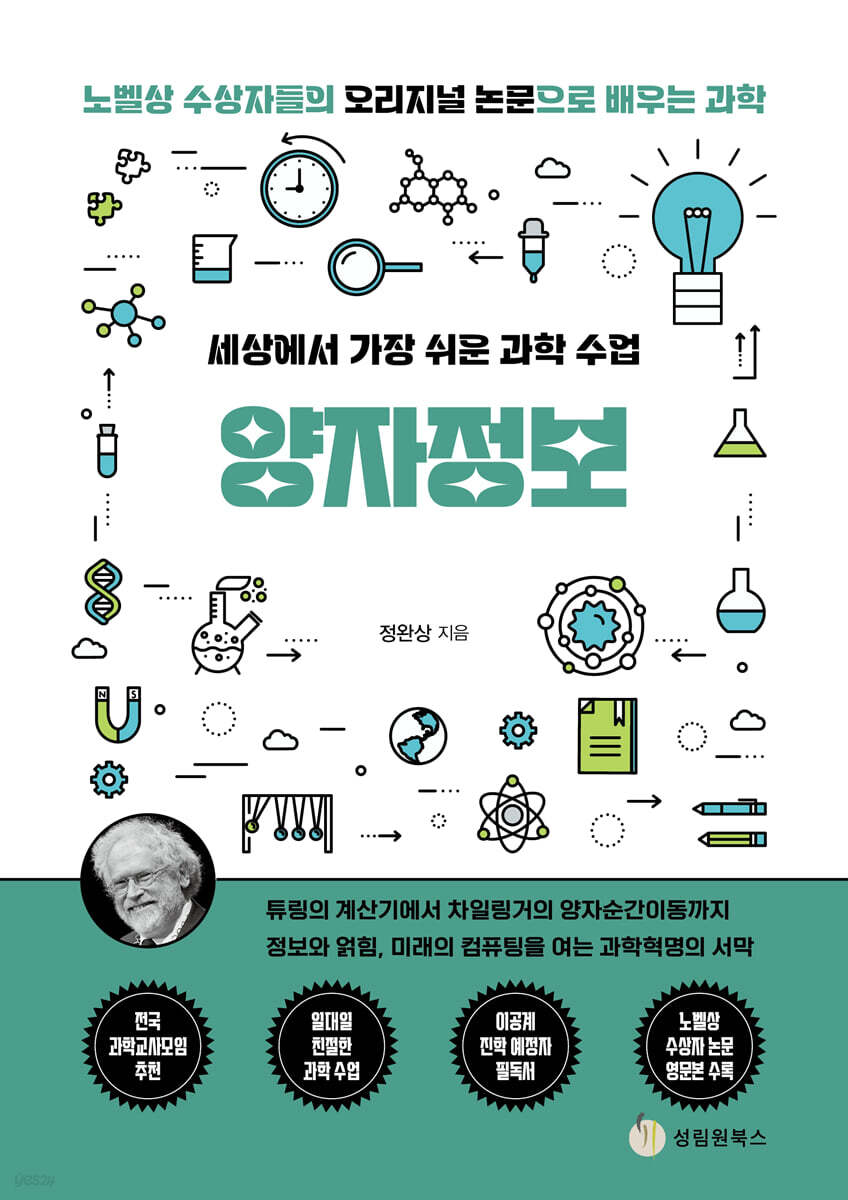
The World's Easiest Science Lesson: Quantum Information
 |
Description
Book Introduction
From Turing's calculator to Zeilinger's quantum teleportation
Information and Entanglement: The Prelude to a Scientific Revolution that Opens the Future of Computing
The Second Wave of the Information Revolution: Quantum Answers!
The 19th book in the series "Learning Science with Original Papers by Nobel Prize Winners," "Quantum Information," begins with Shannon's information theory and covers the Einstein-Podolsky-Rosen (EPR) problem, Bell's inequality, Aspe's entanglement experiment, and Zeilinger's team's quantum teleportation—a narrative that weaves together how the concept of "information" expanded from bits to qubits.
From binary numbers of 0 and 1, superposition and entanglement drawn with Bloch spheres, quantum gates and algorithms, quantum cryptography (QKD) and satellite communications, this book guides you through the core of today's quantum information science through interactive explanations and original text readings.
In particular, the original text of the decisive paper (verification of entanglement and teleportation) by John Clauser, Alain Aspe, and Anton Zeilinger, winners of the 2022 Nobel Prize in Physics, was included, allowing readers to directly follow the process of confirming 'quantum facts' through experiments beyond theory.
Information and Entanglement: The Prelude to a Scientific Revolution that Opens the Future of Computing
The Second Wave of the Information Revolution: Quantum Answers!
The 19th book in the series "Learning Science with Original Papers by Nobel Prize Winners," "Quantum Information," begins with Shannon's information theory and covers the Einstein-Podolsky-Rosen (EPR) problem, Bell's inequality, Aspe's entanglement experiment, and Zeilinger's team's quantum teleportation—a narrative that weaves together how the concept of "information" expanded from bits to qubits.
From binary numbers of 0 and 1, superposition and entanglement drawn with Bloch spheres, quantum gates and algorithms, quantum cryptography (QKD) and satellite communications, this book guides you through the core of today's quantum information science through interactive explanations and original text readings.
In particular, the original text of the decisive paper (verification of entanglement and teleportation) by John Clauser, Alain Aspe, and Anton Zeilinger, winners of the 2022 Nobel Prize in Physics, was included, allowing readers to directly follow the process of confirming 'quantum facts' through experiments beyond theory.
- You can preview some of the book's contents.
Preview
index
Recommendation
I hope you can understand the original papers of these genius scientists.
The Quantum World Opens: Dr. Deutsch on Zeilinger's Quantum Information Revolution (Surprise Interview)
First Encounter: Classical Information Theory and the Birth of Computers
How Information Began - From Letters to Codes, Humanity's Information Revolution
Al-Kindi, the philosopher who cracked the code: The beginning of frequency analysis and the birth of information science.
The World Seen in 0 and 1 _ The Roots of Digitality Taught to Leibniz by the Book of Changes
Calculating with Machines: From Schickard to Leibniz: The Birth and Evolution of the Calculator
The Father of the Computer, Charles Babbage _ The Birth of the Difference Engine and the Analytical Engine
The Logic of 0 and 1, the World of Boolean Algebra _ George Boole and the Foundations of Digital Logic
De Morgan, the man who transformed logic into symbols - De Morgan's laws and modern logic
Alan Turing: Changing the World with 0s and 1s _ The Mathematician Who Dreamed of Computers and the Digital Revolution
Turing's Imagination Becomes a Computer: A World of Complex Computation Created by Simple Devices
How Computers Evolved: War, Science, and the Human Imagination
Second Encounter _ In Search of the Roots of the Digital Revolution
Charles Peirce, who opened the door to 0 and 1, the founder of symbolic logic that ushered in the digital age.
Thinking with machines, designing the future through play - Shannon's digital universe
Entropy: Changing the Face of Information _ Shannon's Uncovered Meaning of Uncertainty
Third Encounter: The World of Quantum Algorithms with Qubits
Quantum Information Begins in Superposition: The Language of Wavefunctions and Eigenstates
The Cat in the Box: The Quantum World as Seen Through Schrödinger's Experiment
Qubits: The Possibility of Invisible Information _ Superposition and Collapse of 0 and 1
Qubit Manipulation Technology: Quantum Gates - Unitary Matrices and Linear Transformations
The Mathematics of the Hadamard Gate: The Foundation of Quantum Computation Created by a French Mathematician
What is a tensor product? Describing two qubits as a single state.
Uncloning Information - Qubits and the Quantum Cloning Prohibition Theory
Fourth Encounter _ Quantum Mechanics: From Debate to Experiment
Einstein and Bohr's Quantum Debate: Is Quantum Mechanics Complete?
The EPR Paradox: A Question That Shook Quantum Mechanics: Entanglement or the Action of Ghosts?
The Bell Inequality Challenge: Entanglement or Hidden Variables?
Quantum Entanglement Revealed by Experiments - The Era of Quantum Information Led by John Klauzer
Is faster-than-light information possible? _ The Aspe experiment and overcoming Bell's inequality.
Fifth Meeting: The Dawn of the Quantum Information Era
Asking the Truth in Quantum Language _ Anton Zeilinger, Designer of the Quantum World
Teleportation is possible - Quantum teleportation, entanglement swapping, and future communication
Quantum entanglement switch, CNOT gate - control bit, target bit and quantum logic
How Entanglement Arose: The Hadamard Gate and the Principle of Quantum Entanglement
How to Send the Unsendable _ Quantum Teleportation Created by CNOT and Entanglement
The Evolution of Cryptography: From Ancient Cryptography to Quantum Cryptography: A 2,500-Year Journey of Information Security
Breakable Passwords, Detectable Sensors - Quantum Security and Ultra-Precision Detection Systems
Sixth Meeting: Quantum Algorithms and Quantum Computers
The Birth of Quantum Algorithms: The Deutsch-Yoza Theory and Experiments That Changed the Structure of Reality
The Two Wings of Quantum _ The Operating Principles and Influence of Shor's Algorithm and Grover's Algorithm
Deutsch's Algorithm: A New World of Computation with Oracle Machines and Boolean Functions
Quantum Computers: Pushing the Limits of Computation - From Sycamore to IBM Eagle
In addition to the meeting
Can Quantum-Mechanical Description of Physical Reality Be Considered Complete?_English Version of the 1935 Einstein-Podolsky-Rosen Paper
On the Einstein-Podolsky-Rosen Paradox_1964 Bell Paper English Version
Experimental Realization of the Einstein-Podolsky-Rosen-Bohm Gedankenexperiment: A New Violation of Bell's Inequalities _1982 Aspect Group Paper, English Version
Experimental Quantum Teleportation_1997 Zeilinger Group Paper English Version
Concluding our meeting with a great paper
Books and papers referenced for this book
Greek letters used in formulas
Introducing the Nobel Prize winners in Physics
I hope you can understand the original papers of these genius scientists.
The Quantum World Opens: Dr. Deutsch on Zeilinger's Quantum Information Revolution (Surprise Interview)
First Encounter: Classical Information Theory and the Birth of Computers
How Information Began - From Letters to Codes, Humanity's Information Revolution
Al-Kindi, the philosopher who cracked the code: The beginning of frequency analysis and the birth of information science.
The World Seen in 0 and 1 _ The Roots of Digitality Taught to Leibniz by the Book of Changes
Calculating with Machines: From Schickard to Leibniz: The Birth and Evolution of the Calculator
The Father of the Computer, Charles Babbage _ The Birth of the Difference Engine and the Analytical Engine
The Logic of 0 and 1, the World of Boolean Algebra _ George Boole and the Foundations of Digital Logic
De Morgan, the man who transformed logic into symbols - De Morgan's laws and modern logic
Alan Turing: Changing the World with 0s and 1s _ The Mathematician Who Dreamed of Computers and the Digital Revolution
Turing's Imagination Becomes a Computer: A World of Complex Computation Created by Simple Devices
How Computers Evolved: War, Science, and the Human Imagination
Second Encounter _ In Search of the Roots of the Digital Revolution
Charles Peirce, who opened the door to 0 and 1, the founder of symbolic logic that ushered in the digital age.
Thinking with machines, designing the future through play - Shannon's digital universe
Entropy: Changing the Face of Information _ Shannon's Uncovered Meaning of Uncertainty
Third Encounter: The World of Quantum Algorithms with Qubits
Quantum Information Begins in Superposition: The Language of Wavefunctions and Eigenstates
The Cat in the Box: The Quantum World as Seen Through Schrödinger's Experiment
Qubits: The Possibility of Invisible Information _ Superposition and Collapse of 0 and 1
Qubit Manipulation Technology: Quantum Gates - Unitary Matrices and Linear Transformations
The Mathematics of the Hadamard Gate: The Foundation of Quantum Computation Created by a French Mathematician
What is a tensor product? Describing two qubits as a single state.
Uncloning Information - Qubits and the Quantum Cloning Prohibition Theory
Fourth Encounter _ Quantum Mechanics: From Debate to Experiment
Einstein and Bohr's Quantum Debate: Is Quantum Mechanics Complete?
The EPR Paradox: A Question That Shook Quantum Mechanics: Entanglement or the Action of Ghosts?
The Bell Inequality Challenge: Entanglement or Hidden Variables?
Quantum Entanglement Revealed by Experiments - The Era of Quantum Information Led by John Klauzer
Is faster-than-light information possible? _ The Aspe experiment and overcoming Bell's inequality.
Fifth Meeting: The Dawn of the Quantum Information Era
Asking the Truth in Quantum Language _ Anton Zeilinger, Designer of the Quantum World
Teleportation is possible - Quantum teleportation, entanglement swapping, and future communication
Quantum entanglement switch, CNOT gate - control bit, target bit and quantum logic
How Entanglement Arose: The Hadamard Gate and the Principle of Quantum Entanglement
How to Send the Unsendable _ Quantum Teleportation Created by CNOT and Entanglement
The Evolution of Cryptography: From Ancient Cryptography to Quantum Cryptography: A 2,500-Year Journey of Information Security
Breakable Passwords, Detectable Sensors - Quantum Security and Ultra-Precision Detection Systems
Sixth Meeting: Quantum Algorithms and Quantum Computers
The Birth of Quantum Algorithms: The Deutsch-Yoza Theory and Experiments That Changed the Structure of Reality
The Two Wings of Quantum _ The Operating Principles and Influence of Shor's Algorithm and Grover's Algorithm
Deutsch's Algorithm: A New World of Computation with Oracle Machines and Boolean Functions
Quantum Computers: Pushing the Limits of Computation - From Sycamore to IBM Eagle
In addition to the meeting
Can Quantum-Mechanical Description of Physical Reality Be Considered Complete?_English Version of the 1935 Einstein-Podolsky-Rosen Paper
On the Einstein-Podolsky-Rosen Paradox_1964 Bell Paper English Version
Experimental Realization of the Einstein-Podolsky-Rosen-Bohm Gedankenexperiment: A New Violation of Bell's Inequalities _1982 Aspect Group Paper, English Version
Experimental Quantum Teleportation_1997 Zeilinger Group Paper English Version
Concluding our meeting with a great paper
Books and papers referenced for this book
Greek letters used in formulas
Introducing the Nobel Prize winners in Physics
Detailed image

Into the book
The author introduces quantum algorithms and quantum computers in earnest.
We describe an experiment that reveals how quantum teleportation is related to quantum entanglement and its potential applications in practical communications and satellites.
--- p.13
Previous experiments, such as those by Clauser and Friedman, could not rule out both 'locality' and 'realism'.
It wasn't logically perfect because the measurement angles weren't predetermined and the distance between the devices wasn't sufficient.
But in his 1997 experiment, Zeilinger randomly changed the settings of his measuring equipment while the entangled photon pairs were flying by! And that was within nanoseconds.
--- p.20
Quantum cryptography, quantum communication, and quantum computers are no longer just theoretical possibilities; they are now beginning to expand into the realm of technological development.
I think Zeilinger's paper was like the moment when Newton's apple fell.
Since then, it has become not 'quantum entanglement may exist', but 'entanglement exists, and we can use it'.
--- p.22
Shannon redefined the concept in the context of 'information uncertainty'.
In thermodynamics, entropy is a measure of "how disordered a state is." In information theory, it's used as a measure of how unpredictable a message is.
--- p.97
Einstein pointed out the incompleteness of quantum mechanics, saying that this could not happen unless there was a ghost acting at a distance between the two.
Scientists call the ghosts that Einstein claimed hidden variables.
--- p.147
Classical computers calculate using bits that are either 0 or 1, but quantum computers calculate using qubits.
A qubit is a superposition state where 0 and 1 can exist simultaneously.
So, in problems that require considering multiple cases simultaneously, quantum algorithms can be much faster.
We describe an experiment that reveals how quantum teleportation is related to quantum entanglement and its potential applications in practical communications and satellites.
--- p.13
Previous experiments, such as those by Clauser and Friedman, could not rule out both 'locality' and 'realism'.
It wasn't logically perfect because the measurement angles weren't predetermined and the distance between the devices wasn't sufficient.
But in his 1997 experiment, Zeilinger randomly changed the settings of his measuring equipment while the entangled photon pairs were flying by! And that was within nanoseconds.
--- p.20
Quantum cryptography, quantum communication, and quantum computers are no longer just theoretical possibilities; they are now beginning to expand into the realm of technological development.
I think Zeilinger's paper was like the moment when Newton's apple fell.
Since then, it has become not 'quantum entanglement may exist', but 'entanglement exists, and we can use it'.
--- p.22
Shannon redefined the concept in the context of 'information uncertainty'.
In thermodynamics, entropy is a measure of "how disordered a state is." In information theory, it's used as a measure of how unpredictable a message is.
--- p.97
Einstein pointed out the incompleteness of quantum mechanics, saying that this could not happen unless there was a ghost acting at a distance between the two.
Scientists call the ghosts that Einstein claimed hidden variables.
--- p.147
Classical computers calculate using bits that are either 0 or 1, but quantum computers calculate using qubits.
A qubit is a superposition state where 0 and 1 can exist simultaneously.
So, in problems that require considering multiple cases simultaneously, quantum algorithms can be much faster.
--- p.197
Publisher's Review
★ Recommended by the National Science Teachers Association ★ A must-read for those planning to pursue science and engineering majors
★ A book that covers the original papers of Nobel Prize winners ★ Includes the original English version of the papers
From bits to qubits and into physics
Human intelligence, which handles information, has expanded from language to numbers, and from formulas to physics.
When Shannon established 'information theory' in the mid-20th century and reduced all signals in the world to bits of 0 and 1, he drew a new coordinate system for human knowledge.
But quantum mechanics shook the system again.
Quantum Information narratively explores this very turning point.
Qubits, which can exist in a state between 0 and 1, and entanglement, where changes in one immediately affect the other even when they are far apart, have fundamentally shaken the existing concept of information.
This book shows the process by which information is redefined in the language of physics, starting from Shannon's information theory, and continuing through Einstein, Podolsky, and Rosen's problems, Bell's inequality, Aspe's entanglement experiment, and Zeilinger's quantum teleportation.
The journey from 'bits to qubits' is a philosophical event that changes the very way humans perceive reality.
People who drew the quantum world with mathematics
All the physicists who laid the foundations of quantum information tried to express the uncertainty of the world in mathematical language.
After Heisenberg proposed the uncertainty principle and Bohr explained the duality of particles with the concept of complementarity, Bell quantified the contradictions in the theory and presented a clear framework for experimental verification called 'Bell's inequality'.
"Quantum Information" goes beyond simply explaining these historical moments, and includes the EPR paper, Bell's original text, Aspe's experimental report, and Zeilinger's quantum teleportation paper.
Readers will experience 'how scientific thinking leads to verification' by directly reading the formulas, data, and schematics of experimental devices.
Superposition and entanglement of qubits, gate operations, and the no-cloning theorem are concepts born at the intersection of mathematical logic and physical reality.
"Quantum Information" unravels these concepts in everyday conversation, shatters the prejudice that "quantum mechanics is difficult" and demonstrates how beautifully the logic of physics is structured.
Scientists who experimentally proved entanglement
Einstein doubted the reality of quantum entanglement, calling it "spooky action at a distance," but his doubts were eventually resolved experimentally.
In the 1970s and 1980s, Alain Aspe and John Clauser proved that quantum entanglement actually exists through elaborate experiments that verified Bell's inequality.
Afterwards, Zeilinger's research team used entanglement to implement quantum teleportation, which 'transfers' the state of one particle to another particle that is far away.
"Quantum Information" faithfully restores the formulas and procedures of this experiment, allowing readers to follow step-by-step how quantum teleportation is possible.
Entanglement and teleportation are no longer philosophical symbols, but the practical foundation of quantum computers, quantum cryptography, and quantum communication.
The 2022 Nobel Prize in Physics was awarded to these three scientists—Klausser, Aspe, and Zeilinger—for their work, which is considered a decisive experiment that opened the door to the quantum information era.
『Quantum Information』 reproduces the original text as is, allowing readers to witness firsthand the moment that became a turning point in the history of science.
A liberal arts book that connects reason and technology
Quantum Information is a book that bridges the gap between technology and philosophy, experiment and reason.
Professor Jeong Wan-sang's unique question-and-answer format piques readers' curiosity, and through the questions posed by the "physics group," difficult concepts such as entanglement, teleportation, and quantum gates are transformed into familiar language.
The book shows that quantum information is transforming the technology, ethics, and even human perception of modern society.
Quantum computers are changing the paradigm of computation, quantum cryptography is rewriting the concept of security, and entangled communication suggests that it can extend to the farthest reaches of the universe.
"Quantum Information" is a guide not only for young people and aspiring science and engineering students, but also for all readers seeking to understand the future of information and the philosophical foundations of science.
The series' identity as "Science through Direct Reading of Papers" shines through in this volume as well.
The author's passion for broadening our horizons through science, coupled with the friendly commentary that encourages fearless exploration of complex concepts, solidifies this book as a "universal textbook on thinking science."
Dr. Park Moon-ho, a brain science expert, appeared on the YouTube channel 'Education Reporter TV' and mentioned the 'Learn Science with Original Papers by Nobel Prize Winners' series by Seonglimwon Books as a recommended book that will help develop talent in science and engineering. He introduced it as a book that explains Nobel Prize-winning papers in physics in detail so that even high school students can understand them.
He praised the series, saying that it is truly worthy of applause, saying that he hopes that it will make scientific knowledge easily accessible to everyone and spread throughout Korea.
★ A book that covers the original papers of Nobel Prize winners ★ Includes the original English version of the papers
From bits to qubits and into physics
Human intelligence, which handles information, has expanded from language to numbers, and from formulas to physics.
When Shannon established 'information theory' in the mid-20th century and reduced all signals in the world to bits of 0 and 1, he drew a new coordinate system for human knowledge.
But quantum mechanics shook the system again.
Quantum Information narratively explores this very turning point.
Qubits, which can exist in a state between 0 and 1, and entanglement, where changes in one immediately affect the other even when they are far apart, have fundamentally shaken the existing concept of information.
This book shows the process by which information is redefined in the language of physics, starting from Shannon's information theory, and continuing through Einstein, Podolsky, and Rosen's problems, Bell's inequality, Aspe's entanglement experiment, and Zeilinger's quantum teleportation.
The journey from 'bits to qubits' is a philosophical event that changes the very way humans perceive reality.
People who drew the quantum world with mathematics
All the physicists who laid the foundations of quantum information tried to express the uncertainty of the world in mathematical language.
After Heisenberg proposed the uncertainty principle and Bohr explained the duality of particles with the concept of complementarity, Bell quantified the contradictions in the theory and presented a clear framework for experimental verification called 'Bell's inequality'.
"Quantum Information" goes beyond simply explaining these historical moments, and includes the EPR paper, Bell's original text, Aspe's experimental report, and Zeilinger's quantum teleportation paper.
Readers will experience 'how scientific thinking leads to verification' by directly reading the formulas, data, and schematics of experimental devices.
Superposition and entanglement of qubits, gate operations, and the no-cloning theorem are concepts born at the intersection of mathematical logic and physical reality.
"Quantum Information" unravels these concepts in everyday conversation, shatters the prejudice that "quantum mechanics is difficult" and demonstrates how beautifully the logic of physics is structured.
Scientists who experimentally proved entanglement
Einstein doubted the reality of quantum entanglement, calling it "spooky action at a distance," but his doubts were eventually resolved experimentally.
In the 1970s and 1980s, Alain Aspe and John Clauser proved that quantum entanglement actually exists through elaborate experiments that verified Bell's inequality.
Afterwards, Zeilinger's research team used entanglement to implement quantum teleportation, which 'transfers' the state of one particle to another particle that is far away.
"Quantum Information" faithfully restores the formulas and procedures of this experiment, allowing readers to follow step-by-step how quantum teleportation is possible.
Entanglement and teleportation are no longer philosophical symbols, but the practical foundation of quantum computers, quantum cryptography, and quantum communication.
The 2022 Nobel Prize in Physics was awarded to these three scientists—Klausser, Aspe, and Zeilinger—for their work, which is considered a decisive experiment that opened the door to the quantum information era.
『Quantum Information』 reproduces the original text as is, allowing readers to witness firsthand the moment that became a turning point in the history of science.
A liberal arts book that connects reason and technology
Quantum Information is a book that bridges the gap between technology and philosophy, experiment and reason.
Professor Jeong Wan-sang's unique question-and-answer format piques readers' curiosity, and through the questions posed by the "physics group," difficult concepts such as entanglement, teleportation, and quantum gates are transformed into familiar language.
The book shows that quantum information is transforming the technology, ethics, and even human perception of modern society.
Quantum computers are changing the paradigm of computation, quantum cryptography is rewriting the concept of security, and entangled communication suggests that it can extend to the farthest reaches of the universe.
"Quantum Information" is a guide not only for young people and aspiring science and engineering students, but also for all readers seeking to understand the future of information and the philosophical foundations of science.
The series' identity as "Science through Direct Reading of Papers" shines through in this volume as well.
The author's passion for broadening our horizons through science, coupled with the friendly commentary that encourages fearless exploration of complex concepts, solidifies this book as a "universal textbook on thinking science."
Dr. Park Moon-ho, a brain science expert, appeared on the YouTube channel 'Education Reporter TV' and mentioned the 'Learn Science with Original Papers by Nobel Prize Winners' series by Seonglimwon Books as a recommended book that will help develop talent in science and engineering. He introduced it as a book that explains Nobel Prize-winning papers in physics in detail so that even high school students can understand them.
He praised the series, saying that it is truly worthy of applause, saying that he hopes that it will make scientific knowledge easily accessible to everyone and spread throughout Korea.
GOODS SPECIFICS
- Date of issue: November 17, 2025
- Page count, weight, size: 264 pages | 384g | 152*210*15mm
- ISBN13: 9791124072028
- ISBN10: 1124072020
You may also like
카테고리
korean


korean

![GQ KOREA Mark (Monthly): December [2025]](http://librairie.coreenne.fr/cdn/shop/files/8ef265dbbfbf186523ed75ba7319009d.jpg?v=1765340328&width=3840)


