

Find us
 |
Description
Book Introduction
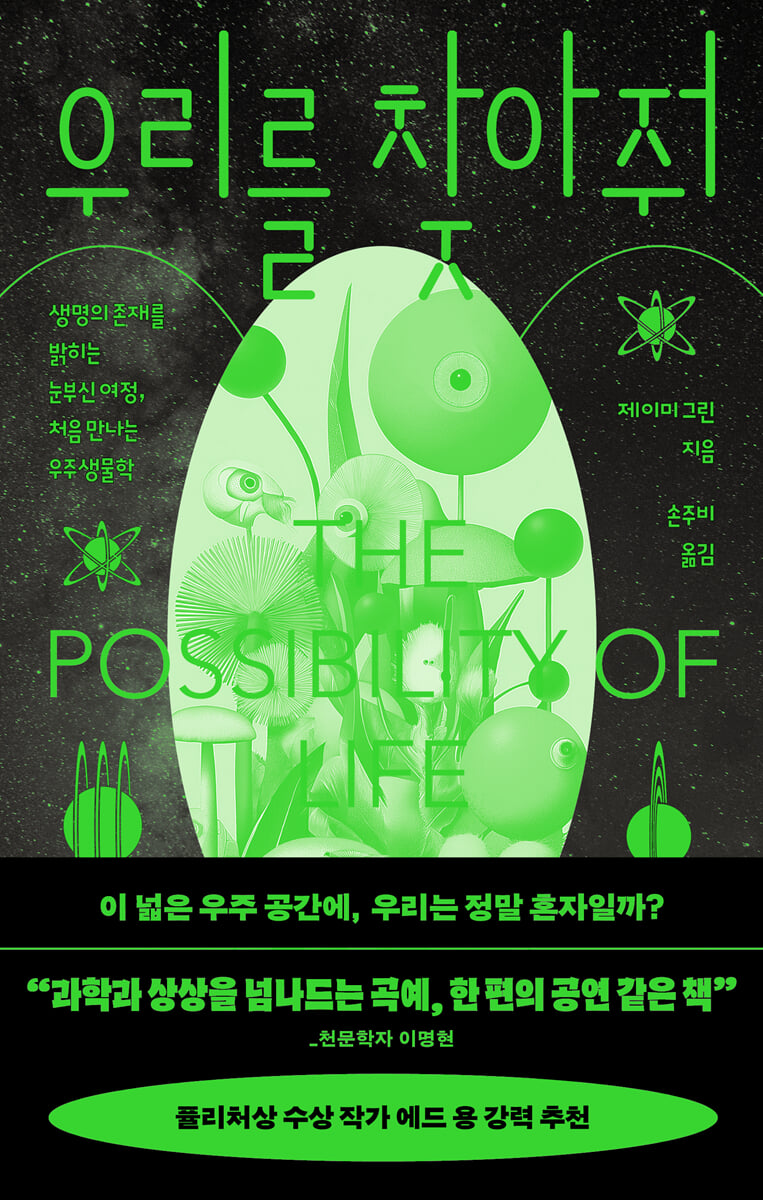
"Do alien life exist?" "Are they similar to humans?" "Will our civilization ever encounter other intelligent life?" Everyone has wondered at least once about alien life, and humanity's fundamental curiosity is answered through astrobiology.
Astrobiology, which seeks answers by crossing various fields of study, from astronomy, biology, geology, physics, and chemistry, is a unique fusion science that deals with the 'universe' and 'life.'
Jamie Green, America's most prominent science communicator, guides readers through a vibrant universe, blending cutting-edge science on exoplanets and extraterrestrial life with the imagination of science fiction, linguistics, psychology, and philosophy. With AI and cutting-edge space telescopes enabling us to observe the depths of space, a feast of all possible lifeforms unfolds before us.
Astrobiology, which seeks answers by crossing various fields of study, from astronomy, biology, geology, physics, and chemistry, is a unique fusion science that deals with the 'universe' and 'life.'
Jamie Green, America's most prominent science communicator, guides readers through a vibrant universe, blending cutting-edge science on exoplanets and extraterrestrial life with the imagination of science fiction, linguistics, psychology, and philosophy. With AI and cutting-edge space telescopes enabling us to observe the depths of space, a feast of all possible lifeforms unfolds before us.
- You can preview some of the book's contents.
Preview
index
At the beginning of the book_ The Watching Stars
Chapter 1: Origins: What on Earth is Life?
Chapter 2: The Planets: Disputing Earth's Specialness
Chapter 3 Animals: In Search of the Most Alien-Like Alien Life
Chapter 4: People: The Worlds Beyond We Will Encounter
Chapter 5 Technology: Now is the Space Age
Chapter 6: Contact: Can You Reject the Opportunity to Meet in Person?
Going Out_ Hopeful Monsters
Acknowledgments | Translator's Note | References | Index
Chapter 1: Origins: What on Earth is Life?
Chapter 2: The Planets: Disputing Earth's Specialness
Chapter 3 Animals: In Search of the Most Alien-Like Alien Life
Chapter 4: People: The Worlds Beyond We Will Encounter
Chapter 5 Technology: Now is the Space Age
Chapter 6: Contact: Can You Reject the Opportunity to Meet in Person?
Going Out_ Hopeful Monsters
Acknowledgments | Translator's Note | References | Index
Detailed image

Into the book
The universe is so vast that it defies description.
Planets orbit, stars burn, and the black hole at the center of our galaxy sucks in massive amounts, oblivious to our existence.
It is indescribably vast.
We are just dots, flickers of matter that organize themselves in amusing ways for a while.
We take this 'smallness' as evidence of human insignificance and importance.
Of all the possibilities imaginable, Earth is the only planet on which we know life exists.
The thought that Earth might be the only place in the universe that harbors life is a terrifying burden.
The responsibility this clumsy race must bear is enormous, and the universe is too lonely to live in.
--- p.18, 「Introduction_Watching Stars」
The question of whether we are the only living beings is meaningless.
We are not alone.
Because we are not separate entities from the spiral arms of the galaxy or the dust-gathering vortices of the wind.
We are no more anomalous than atoms.
How can we possibly think we're unique in this situation? When we seek knowledge about the origins of life, we ask ourselves what life is.
Is self-replicating information life? Is life a new way for the universe to organize energy? Or, as Carl Sagan and others have suggested, is life simply the universe's way of experiencing and understanding itself? Life, of course, is all of these things.
--- p.72, Chapter 1: Origins: What on Earth is Life?
The planets are another place where our specialness is challenged.
Are planets like Earth common or rare? Rocky, humid, with just enough gravity to hold an atmosphere but not so much that it crushes you, with seasons, and a moon… something like that.
How many conditions would be needed to create an Earth-like planet? And are those conditions similar to those required for life? Understanding the various types of planets that could exist in the universe will help us answer these questions.
How strange a world must be for life to thrive?
--- p.78, Chapter 2: The Planet: Disputing Earth's Specialness
The reason we hope for a universe where life exists is because the alternative feels so lonely.
We seek solidarity with people from other worlds.
But that assumes they will feel like we are their relatives.
We do not know whether Earth's evolution is convergent, divergent, repeatable, or random.
The possibilities for life elsewhere could be infinitely strange.
But if we can bond with alien animals, it might give Earth's animals, including humans, a better chance.
--- p.150, Chapter 3 Animals: In Search of the Most Extraterrestrial Alien Life
Perhaps the reason humans are lonely on Earth is because we have outcompeted (or subjugated) someone to truly be with us.
100,000 years ago, there was a different species of human on Earth.
But now all that's left are species that can't communicate with us.
Perhaps on every planet with life, there is a lonely species that longs to find kindred spirits on other worlds.
If there was convergent evolution toward a human-like form, similar convergence might have occurred in intellectual abilities, branching of thought, and types of language.
Although whispers of our heterogeneous origins remain.
--- p.177, Chapter 4: People: The Worlds Beyond Where We Will Meet
Humanity is a challenger just entering the ranks of technological civilization.
If we measure time from the time we first had the technology to detect things outside our solar system, we haven't even reached the first century yet.
So, if we have acquired the power to manipulate nuclear energy and have not blown ourselves up, or made our planet uninhabitable through reckless energy consumption, the civilization we encounter is likely older than our own.
--- p.204, Chapter 5 Technology: Now is the Space Age
The Golden Record is one of the most colorful messages ever sent into space by humanity, conceived over months of effort by a committee led by Carl Sagan.
It also includes a pulsar map showing where satellites came from, and a method of converting the humming engraved on their surface into images and sounds when played on a record.
The video includes scientific diagrams, photos of the Arecibo telescope, breastfeeding, and a woman standing in front of a supermarket produce list eating grapes that she appears to have not yet purchased.
The soundtrack includes recordings of dozens of pieces of music (including Bach, Javanese gamelan, and Chuck Berry), greetings in 55 languages, thunder, wind, trains, cars, heartbeats, and whale sounds.
Also included was an hour of brainwaves recorded by Ann Druyan as she meditated on topics such as human history, current struggles, and "the individual's feelings when falling in love."
--- p.306, Chapter 6: Contact: Can You Reject the Opportunity to Meet in Person?
It was early spring, and I was surrounded by the sounds of birds.
The winter crows had not yet departed, but starlings and swallows were flying in, and one of them flitted between the trees and passed me.
At that moment, I was struck by wonder.
These alien creatures had chosen to abandon the ground and fly, living their lives with a discordant chirping and crying that made no sense to me.
They had feathers, hollow bones, and delicate, scaly legs.
It was truly amazing! And difficult to understand.
And it was real, right in front of me.
Planets orbit, stars burn, and the black hole at the center of our galaxy sucks in massive amounts, oblivious to our existence.
It is indescribably vast.
We are just dots, flickers of matter that organize themselves in amusing ways for a while.
We take this 'smallness' as evidence of human insignificance and importance.
Of all the possibilities imaginable, Earth is the only planet on which we know life exists.
The thought that Earth might be the only place in the universe that harbors life is a terrifying burden.
The responsibility this clumsy race must bear is enormous, and the universe is too lonely to live in.
--- p.18, 「Introduction_Watching Stars」
The question of whether we are the only living beings is meaningless.
We are not alone.
Because we are not separate entities from the spiral arms of the galaxy or the dust-gathering vortices of the wind.
We are no more anomalous than atoms.
How can we possibly think we're unique in this situation? When we seek knowledge about the origins of life, we ask ourselves what life is.
Is self-replicating information life? Is life a new way for the universe to organize energy? Or, as Carl Sagan and others have suggested, is life simply the universe's way of experiencing and understanding itself? Life, of course, is all of these things.
--- p.72, Chapter 1: Origins: What on Earth is Life?
The planets are another place where our specialness is challenged.
Are planets like Earth common or rare? Rocky, humid, with just enough gravity to hold an atmosphere but not so much that it crushes you, with seasons, and a moon… something like that.
How many conditions would be needed to create an Earth-like planet? And are those conditions similar to those required for life? Understanding the various types of planets that could exist in the universe will help us answer these questions.
How strange a world must be for life to thrive?
--- p.78, Chapter 2: The Planet: Disputing Earth's Specialness
The reason we hope for a universe where life exists is because the alternative feels so lonely.
We seek solidarity with people from other worlds.
But that assumes they will feel like we are their relatives.
We do not know whether Earth's evolution is convergent, divergent, repeatable, or random.
The possibilities for life elsewhere could be infinitely strange.
But if we can bond with alien animals, it might give Earth's animals, including humans, a better chance.
--- p.150, Chapter 3 Animals: In Search of the Most Extraterrestrial Alien Life
Perhaps the reason humans are lonely on Earth is because we have outcompeted (or subjugated) someone to truly be with us.
100,000 years ago, there was a different species of human on Earth.
But now all that's left are species that can't communicate with us.
Perhaps on every planet with life, there is a lonely species that longs to find kindred spirits on other worlds.
If there was convergent evolution toward a human-like form, similar convergence might have occurred in intellectual abilities, branching of thought, and types of language.
Although whispers of our heterogeneous origins remain.
--- p.177, Chapter 4: People: The Worlds Beyond Where We Will Meet
Humanity is a challenger just entering the ranks of technological civilization.
If we measure time from the time we first had the technology to detect things outside our solar system, we haven't even reached the first century yet.
So, if we have acquired the power to manipulate nuclear energy and have not blown ourselves up, or made our planet uninhabitable through reckless energy consumption, the civilization we encounter is likely older than our own.
--- p.204, Chapter 5 Technology: Now is the Space Age
The Golden Record is one of the most colorful messages ever sent into space by humanity, conceived over months of effort by a committee led by Carl Sagan.
It also includes a pulsar map showing where satellites came from, and a method of converting the humming engraved on their surface into images and sounds when played on a record.
The video includes scientific diagrams, photos of the Arecibo telescope, breastfeeding, and a woman standing in front of a supermarket produce list eating grapes that she appears to have not yet purchased.
The soundtrack includes recordings of dozens of pieces of music (including Bach, Javanese gamelan, and Chuck Berry), greetings in 55 languages, thunder, wind, trains, cars, heartbeats, and whale sounds.
Also included was an hour of brainwaves recorded by Ann Druyan as she meditated on topics such as human history, current struggles, and "the individual's feelings when falling in love."
--- p.306, Chapter 6: Contact: Can You Reject the Opportunity to Meet in Person?
It was early spring, and I was surrounded by the sounds of birds.
The winter crows had not yet departed, but starlings and swallows were flying in, and one of them flitted between the trees and passed me.
At that moment, I was struck by wonder.
These alien creatures had chosen to abandon the ground and fly, living their lives with a discordant chirping and crying that made no sense to me.
They had feathers, hollow bones, and delicate, scaly legs.
It was truly amazing! And difficult to understand.
And it was real, right in front of me.
--- p.322, "Going Out: Hopeful Monsters"
Publisher's Review
“In this vast space, are we really alone?”
Astrobiology: A Sophisticated Map of Life Created by Scientists
* In October 2025, ESA's Cassini probe discovered that Saturn's moon Enceladus may harbor life.
* September 2025, NASA's Mars rover 'Perseverance' finds potential traces of life in rock samples.
* In March 2025, the James Webb Space Telescope confirmed carbon dioxide on an exoplanet.
The news that life may exist on distant, Earth-like planets in our solar system often becomes a special, inspiring message for those going about their daily lives.
Scientists continually send probes to Mars to search for signs of life, and launch space telescopes out of Earth to search for exoplanets and evidence of life hundreds of light-years away.
From ancient times, when Galileo began looking at the night sky, to today, when the James Webb Space Telescope observes the deep universe, the question that has captivated humanity for thousands of years is: "Are we really alone?"
The author vividly portrays the convergence research field of 'astrobiology' by interviewing leading experts in each field, including scientists conducting cutting-edge research on exoplanets and evolution, philosophers, psychologists, and linguists examining civilization and culture.
Also Ryu Cixin, Ursula K.
Le Guin, Ted Chiang, NK
Science fiction such as Jemisin's, TV series and movies such as "Avatar," "Star Trek," and "The Matrix," and even Carl Sagan's "Cosmos" and "Contact" have made diverse use of science fiction and non-fiction to broaden the spectrum of extraterrestrial life we can imagine.
The strength of "Find Us" lies in the brisk narrative and witty development of this versatile science communicator, who covers everything from literature to science in a balanced way.
Another noteworthy aspect of this book is that Son Ju-bi, an observational astronomer who actually draws a 'map of the universe', took charge of the translation, providing accurate information with a realistic feel to Korean readers.
Beyond simple knowledge, this is a story filled with the imagination and insight of 'scientists' and 'artists', a first-hand look at friendly astrobiology.
“Exploring beyond Earth is ultimately the best way to know myself.”
A celebration of life across the universe, crossing science fiction and science fiction.
The search for extraterrestrial life consists of defining life, speculating on the possible range of life, and conducting scientific observations to prove the hypothesis.
This process illustrates the novel and surprising research approach of astrobiology, in which humanity 'experiments' on the entire universe.
Furthermore, the path to finding answers based on the only planet known to have life, Earth, can be said to be the beginning and end of this study.
Chapter 1, 'Origin', and Chapter 2, 'Planet', consider the various definitions of life given by different eras and scholars, and show the history of imagining life on extraterrestrial planets.
Additionally, we speculate on the shape of planets such as 'super-Earths' and 'mini-Neptunes' where life could exist, and scientifically draw out the beings that would be born on them.
Many people talk about how special Earth is in the universe, but he persuasively explains that saying it is not like Earth does not mean that there is no life.
Chapter 3, 'Animals' and Chapter 4, 'People', lead us to think about extraterrestrial life beyond our everyday senses, expanding our awareness of intelligent life.
The science-based imagination that makes impossible life possible, such as non-humanoid plant and animal forms, silicon-based intelligent life, shellfish-crustacean humans, snake-humans, ape-humans, and dinosaur-humans, breaks the readers' prejudices and surprises them.
In particular, it provides rich food for thought by adding philosophical considerations on the language and civilization necessary for the development of intelligent life.
In Chapter 5, "Technology," and Chapter 6, "Contact," the author argues that with the rapid advancement of technology and the impending arrival of first contact with extraterrestrial life, we must anticipate and prepare for what will happen on Earth. Just as the development of AI has prompted us to consider the social repercussions and potential dark sides of AI, the author persuasively presents the considerations we must consider when contact with extraterrestrial life occurs, drawing on discussions from anthropologists and historians.
"Find Us" looks across thousands of light-years of space and tells the story of how life can exist anywhere in the universe.
After experiencing the infinite expansion of life's possibilities, it eventually returns to Earth to deliver an important message to our civilization, which is destroying itself.
The author suggests that humans are not alone in peering into the vast expanses of space in search of life.
And we end with Carl Sagan's story, saying that just as our civilization is going through a "technological adolescence" and a "civilizational adolescence" facing the threats of climate change, pandemics, and nuclear weapons, the mere fact that there is extraterrestrial life somewhere in the universe that has overcome these challenges gives hope to humanity.
This book will provide an engaging reading experience not only for those interested in the convergence science of astrobiology, which involves formulating and proving hypotheses, but also for readers who want to explore the adventures of human civilization, which has continuously explored life beyond Earth.
Astrobiology: A Sophisticated Map of Life Created by Scientists
* In October 2025, ESA's Cassini probe discovered that Saturn's moon Enceladus may harbor life.
* September 2025, NASA's Mars rover 'Perseverance' finds potential traces of life in rock samples.
* In March 2025, the James Webb Space Telescope confirmed carbon dioxide on an exoplanet.
The news that life may exist on distant, Earth-like planets in our solar system often becomes a special, inspiring message for those going about their daily lives.
Scientists continually send probes to Mars to search for signs of life, and launch space telescopes out of Earth to search for exoplanets and evidence of life hundreds of light-years away.
From ancient times, when Galileo began looking at the night sky, to today, when the James Webb Space Telescope observes the deep universe, the question that has captivated humanity for thousands of years is: "Are we really alone?"
The author vividly portrays the convergence research field of 'astrobiology' by interviewing leading experts in each field, including scientists conducting cutting-edge research on exoplanets and evolution, philosophers, psychologists, and linguists examining civilization and culture.
Also Ryu Cixin, Ursula K.
Le Guin, Ted Chiang, NK
Science fiction such as Jemisin's, TV series and movies such as "Avatar," "Star Trek," and "The Matrix," and even Carl Sagan's "Cosmos" and "Contact" have made diverse use of science fiction and non-fiction to broaden the spectrum of extraterrestrial life we can imagine.
The strength of "Find Us" lies in the brisk narrative and witty development of this versatile science communicator, who covers everything from literature to science in a balanced way.
Another noteworthy aspect of this book is that Son Ju-bi, an observational astronomer who actually draws a 'map of the universe', took charge of the translation, providing accurate information with a realistic feel to Korean readers.
Beyond simple knowledge, this is a story filled with the imagination and insight of 'scientists' and 'artists', a first-hand look at friendly astrobiology.
“Exploring beyond Earth is ultimately the best way to know myself.”
A celebration of life across the universe, crossing science fiction and science fiction.
The search for extraterrestrial life consists of defining life, speculating on the possible range of life, and conducting scientific observations to prove the hypothesis.
This process illustrates the novel and surprising research approach of astrobiology, in which humanity 'experiments' on the entire universe.
Furthermore, the path to finding answers based on the only planet known to have life, Earth, can be said to be the beginning and end of this study.
Chapter 1, 'Origin', and Chapter 2, 'Planet', consider the various definitions of life given by different eras and scholars, and show the history of imagining life on extraterrestrial planets.
Additionally, we speculate on the shape of planets such as 'super-Earths' and 'mini-Neptunes' where life could exist, and scientifically draw out the beings that would be born on them.
Many people talk about how special Earth is in the universe, but he persuasively explains that saying it is not like Earth does not mean that there is no life.
Chapter 3, 'Animals' and Chapter 4, 'People', lead us to think about extraterrestrial life beyond our everyday senses, expanding our awareness of intelligent life.
The science-based imagination that makes impossible life possible, such as non-humanoid plant and animal forms, silicon-based intelligent life, shellfish-crustacean humans, snake-humans, ape-humans, and dinosaur-humans, breaks the readers' prejudices and surprises them.
In particular, it provides rich food for thought by adding philosophical considerations on the language and civilization necessary for the development of intelligent life.
In Chapter 5, "Technology," and Chapter 6, "Contact," the author argues that with the rapid advancement of technology and the impending arrival of first contact with extraterrestrial life, we must anticipate and prepare for what will happen on Earth. Just as the development of AI has prompted us to consider the social repercussions and potential dark sides of AI, the author persuasively presents the considerations we must consider when contact with extraterrestrial life occurs, drawing on discussions from anthropologists and historians.
"Find Us" looks across thousands of light-years of space and tells the story of how life can exist anywhere in the universe.
After experiencing the infinite expansion of life's possibilities, it eventually returns to Earth to deliver an important message to our civilization, which is destroying itself.
The author suggests that humans are not alone in peering into the vast expanses of space in search of life.
And we end with Carl Sagan's story, saying that just as our civilization is going through a "technological adolescence" and a "civilizational adolescence" facing the threats of climate change, pandemics, and nuclear weapons, the mere fact that there is extraterrestrial life somewhere in the universe that has overcome these challenges gives hope to humanity.
This book will provide an engaging reading experience not only for those interested in the convergence science of astrobiology, which involves formulating and proving hypotheses, but also for readers who want to explore the adventures of human civilization, which has continuously explored life beyond Earth.
GOODS SPECIFICS
- Date of issue: October 29, 2025
- Page count, weight, size: 356 pages | 488g | 140*220*22mm
- ISBN13: 9791171715381
- ISBN10: 1171715382
You may also like
카테고리
korean


korean

![GQ KOREA Mark (Monthly): December [2025]](http://librairie.coreenne.fr/cdn/shop/files/8ef265dbbfbf186523ed75ba7319009d.jpg?v=1765340328&width=3840)


