

A History of the Universe Through 100 Objects
 |
Description
Book Introduction
“Space exploration with 100 objects!”
Spacesuits, calculators, telescopes, rovers, robots, spaceships…
A splendid legacy of human creativity and challenge
Humanity has long been curious about the sky.
And he discovered certain repetitions and regularities in the movements of the sun, moon, and planets, the connections between constellations and seasons, the mysteries of solar and lunar eclipses, and the positions of the horizon and sunrise and sunset.
This understanding soon led to the creation of calendars, religious practices, architectural design, the foundations of mathematics and science, and is the cornerstone of modern space exploration.
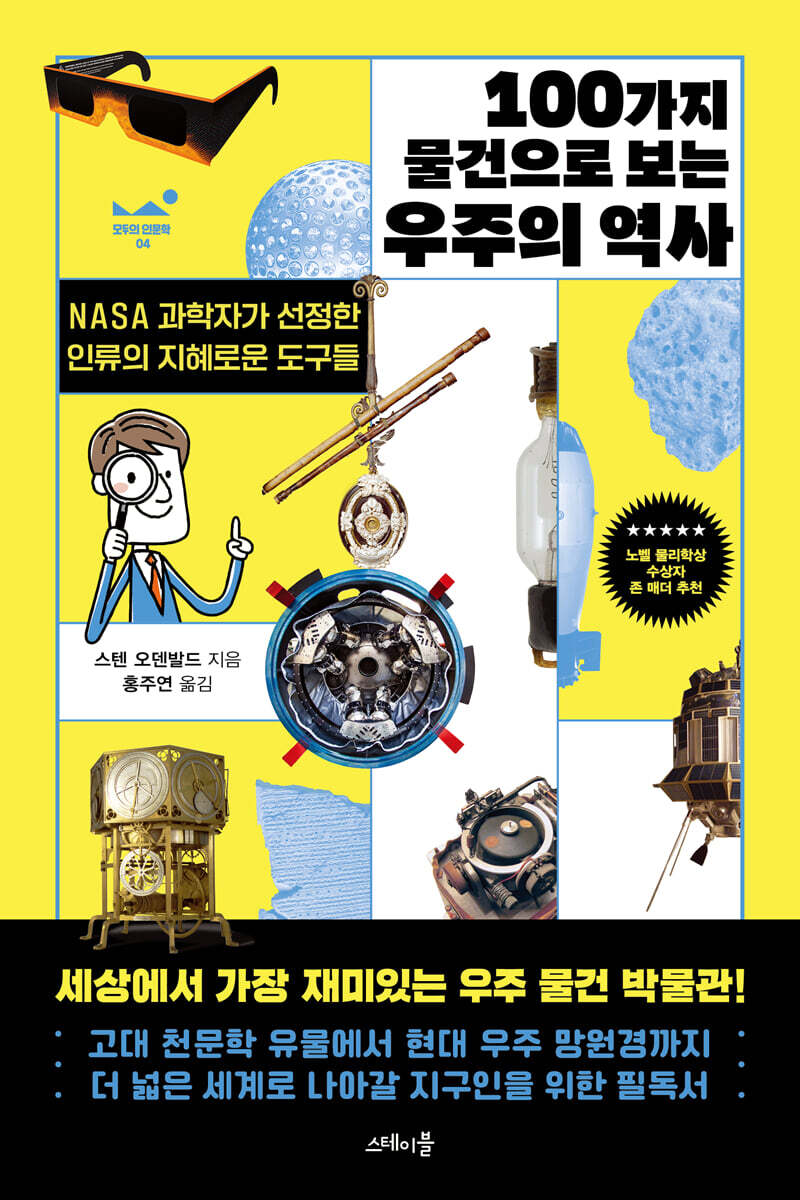
"A Brief History of the Universe in 100 Objects" is a book that contains "100 of humanity's greatest tools for understanding the universe" selected by NASA scientist Stan Odenwald.
From the 'Blombos Cave Ochre Paintings' of 71,000 BC, known as the first recorded human records, to the 'James Webb Space Telescope' of 2022, which took 24 years and cost 10.8 billion dollars to build, 100 space objects spanning ancient and modern times are introduced with abundant photos.
The author does not simply describe objects; he weaves together the knowledge system that has grown around those objects and the history of humanity.
What makes this book special is that while it covers the well-known tools of astronomy—calculators, maps, telescopes, satellites, and robots that explore the solar system—it also introduces objects more familiar from everyday life, not just space.
For example, rubber O-rings (circular rings used to prevent leaks) are commonly found in garden hoses and scuba gear, but they are also used as sealants to fill gaps between components in rocket fuel boosters.
The reason this item is included in the book is because it was the cause of the Challenger space shuttle accident, the worst tragedy in the history of space exploration.
At the other extreme of these small objects is the Large Hadron Collider, the most complex machine and largest scientific instrument ever built by humans.
After reading this book, you will realize how rapidly human creativity has accelerated.
The gap between the two artifacts listed at the very beginning is 30,000 years, but the gap between the objects listed later in the book is only a few years.
The message read here is clear.
Humans can achieve anything if they put their minds to it (and have the resources)! And countless challenges still await readers!
Spacesuits, calculators, telescopes, rovers, robots, spaceships…
A splendid legacy of human creativity and challenge
Humanity has long been curious about the sky.
And he discovered certain repetitions and regularities in the movements of the sun, moon, and planets, the connections between constellations and seasons, the mysteries of solar and lunar eclipses, and the positions of the horizon and sunrise and sunset.
This understanding soon led to the creation of calendars, religious practices, architectural design, the foundations of mathematics and science, and is the cornerstone of modern space exploration.
"A Brief History of the Universe in 100 Objects" is a book that contains "100 of humanity's greatest tools for understanding the universe" selected by NASA scientist Stan Odenwald.
From the 'Blombos Cave Ochre Paintings' of 71,000 BC, known as the first recorded human records, to the 'James Webb Space Telescope' of 2022, which took 24 years and cost 10.8 billion dollars to build, 100 space objects spanning ancient and modern times are introduced with abundant photos.
The author does not simply describe objects; he weaves together the knowledge system that has grown around those objects and the history of humanity.
What makes this book special is that while it covers the well-known tools of astronomy—calculators, maps, telescopes, satellites, and robots that explore the solar system—it also introduces objects more familiar from everyday life, not just space.
For example, rubber O-rings (circular rings used to prevent leaks) are commonly found in garden hoses and scuba gear, but they are also used as sealants to fill gaps between components in rocket fuel boosters.
The reason this item is included in the book is because it was the cause of the Challenger space shuttle accident, the worst tragedy in the history of space exploration.
At the other extreme of these small objects is the Large Hadron Collider, the most complex machine and largest scientific instrument ever built by humans.
After reading this book, you will realize how rapidly human creativity has accelerated.
The gap between the two artifacts listed at the very beginning is 30,000 years, but the gap between the objects listed later in the book is only a few years.
The message read here is clear.
Humans can achieve anything if they put their minds to it (and have the resources)! And countless challenges still await readers!
- You can preview some of the book's contents.
Preview
index
A Testimonial - Nobel Prize Winner in Physics John Mather
introduction
1 The Ocher Paintings of Blombos Cave: A First Step to Understanding the Universe
2 Avery Blanchard Bone Plates: An Ancient Lunar Calendar
3 Egyptian Star Clock: A First Attempt at Quantifying Celestial Objects
4 Nebra Sky Disk: A Portable Planetarium
5 The Venus Plate of Ammisaduqa: A Document That Formed the Foundation of Modern Astronomy
6 The Saints of Senenmut: A Detailed Depiction of the Sky
7 Merkhet: The Combination of Astronomy and Architecture
8 Nimrud Lenses: The Fundamental Elements of Telescope Operation
9 Greek Armillary Sphere: The First Celestial Calculator
10 dioptra: Record the exact position of a star
11 Antikythera Mechanism: A Portable Astronomical Calculator
12 Hipparchus' Star Chart: The Foundation of Celestial Maps
13 Astrolabe: Measuring Time Using the Stars
14 Dunhuang Saints: The First Perfect Saints
15 Al-Khwarizmi's Algebraic Textbook: Increased Ability to Calculate the Universe
16 Dresden Codex: A Glimpse into Mayan Astronomy
17 Chaco Canyon's Solar Dagger: A Homage to the Sky in Light and Spirals
18 Giovanni de Dondi's Astrarium: A Sophisticated Calculator from the Late Middle Ages
19 Bighorn Medicine Wheel: A Native American monument pointing to the stars
20 Ensisheim Meteorite: A stone that fell from the sky
21 On the Revolutions of the Heavenly Spheres: Copernicus's Book That Changed the Center of the Universe
22 Tycho's Wall Quadrant: Other Precision Astronomical Instruments
23 Galileo's Telescope: The Beginning of Modern Astronomy
24 Calculator: The Calculator That Led the Space Program in the 1960s
25 Eyepiece Micrometer: The Most Precise Astronomical Observation Equipment
26 Clockwork Rotating Device: A New Way to Observe with a Telescope
27 Zhaohuan: An ingenious tool to help you create your star chart
28 Skiddy Pony Saints: A Sacred Bundle of Celestial Records
29 Observing the Sun through Smoked Glass: The Original Eclipse Glasses That Popularized Astronomical Observation
30 Gyroscope: A tool that keeps the rocket flying straight
31 Battery: Powering the Spaceship
32 Pilatre and Darland's Balloon: The First Flight
33 William Herschel's 12-meter telescope: the largest scientific instrument of its time.
34 Spectrograph: Discovering the Composition of Stars
35 Daguerreotype Camera: The Beginning of Astronomical Photography
36 Solar panels: Powering the spacecraft
37 Leviathan of Parsonstown: The Last Telescope
38 Crookes Tube: Detection and Measurement of Nuclear Particles
39 Triode Vacuum Tube: The Birth of Electronics
40 Ion Rocket Engine: A Groundbreaking Propulsion Device
41 Hooker Telescope: The Most Famous Telescope
42 Robert Goddard's Rocket: The First Liquid-Fueled Rocket
43 Van de Graaff Generator: The Beginning of Particle Acceleration Technology
44 Coronagraph: An Eclipse Observable Anytime
45 Jansky's Carousel Radio Telescope: The Birth of Radio Astronomy
46 V-2 Rocket: The First Man-Made Object in Space
47 ENIAC: The First Modern Computer
48 Colossus Mark II: The first programmable computer
49 Radio Interferometry: A Groundbreaking Advance in Space Observation
50 Heat Shields: A Safe Return to Earth
51 Integrated Circuits: The Computing Foundation for Space Exploration
52 Atomic Clocks: Measuring the Universe Using Time
53 Space Station: Hidden Heroes
54 Hydrogen Line Radio Telescope: Exploring the Interstellar Medium
55 X-ray Telescope: A New Window on the Universe
56 Hydrogen Bomb: The Destructive Power Hidden Behind Starlight
57 Radioisotope Thermoelectric Generators: How to Get Electricity Where There Is No Sun
58 Nuclear Rocket Engines: Faster into Space
59 Sputnik: Soviet victory that lasted only a few months
60 Vanguard 1: The Oldest Space Debris
61 Luna 3: The first glimpse of the far side of the moon
62 Infinite Loop Magnetic Tape Recorder: Data Storage in Space
63 Laser: See in a New Light
64 Space Food: Cuisine of the Space Age
65 Spacesuit: A second skin that sustains life
66 Shincom 2 and 3: Commercialization of Space
67 Vidicon Camera: Electronic Photography of Celestial Objects
68 Space Blanket: A Simple Way to Regulate Your Body Temperature
69 Portable Mobility Device: Floating in Space
70 Apollo 1 Block I Hatch: A Warning About the Perils of Space Travel
71 Interface Message Processor: The Beginning of the World Wide Web
72 Hasselblad Camera: The First Selfie in Space
73 Apollo 11 Moon Rocks: The First Geological Samples from Another World
74 CCD Imager: Taking Pictures of the Universe Without Film
75 Lunar Laser Distance Measurement Retroreflector: The Earth-Moon Distance Measured by Laser
76 Apollo Lunar Television Camera: Filming the First Steps on the Moon
77 Neutrino Detector at Homestake Gold Mine: The First Neutrino Detector
78 Lunokhod 1: The first robot to visit another world
79 Skylab's Exercise Bike: How to Stay Fit in Space
80 Laser Geodynamic Satellites: Discovering the Real Face of Earth
81 Smoot's Microwave Radiometer: Confirmation of the Big Bang Cosmology
82 Viking's robotic arm for collecting samples: A robot exploring the surface of another planet
83 Rubber Mirrors: Telescopes Using Adaptive Optics
84 Multifiber Spectrograph: 100 Galaxies at Once
85 Venera Lander: Exploring the Surface of Venus
Challenger's Broken O-Ring: A Minor Part Caused a Historic Disaster
87 Costa: The device that revolutionized the Hubble Space Telescope
88 CMOS sensor: Ultra-precise astronomical images
89 Allen Hills Meteorite: The Search for Extraterrestrial Life Begins in Full Swing
90 Sojourner: The Beginning of Robotic Mars Exploration
91 Gravity Probe B: A Test of General Relativity
92 Lidar: Automatic docking without human touch
93 Large Hadron Collider: The most complex machine ever built by humans
94 Kepler Space Telescope: The World's Largest Digital Camera in Space
95 Curiosity Rover: The Amazing Robot Exploring Space
96 Mars Orbiter Mangalyaan: India Joins the Mars Club on a Budget
97 3D-Printed Ratchet Wrench: The Technology to Make Anything in Space
98 Gravitational-Wave Interferometer LIGO: Exploring Ripples in Spacetime
99 Double Asteroid Path-Changing Experiment: How to Prevent Asteroid Impact Destruction
The James Webb Space Telescope: A New Era of Discovery Begins
introduction
1 The Ocher Paintings of Blombos Cave: A First Step to Understanding the Universe
2 Avery Blanchard Bone Plates: An Ancient Lunar Calendar
3 Egyptian Star Clock: A First Attempt at Quantifying Celestial Objects
4 Nebra Sky Disk: A Portable Planetarium
5 The Venus Plate of Ammisaduqa: A Document That Formed the Foundation of Modern Astronomy
6 The Saints of Senenmut: A Detailed Depiction of the Sky
7 Merkhet: The Combination of Astronomy and Architecture
8 Nimrud Lenses: The Fundamental Elements of Telescope Operation
9 Greek Armillary Sphere: The First Celestial Calculator
10 dioptra: Record the exact position of a star
11 Antikythera Mechanism: A Portable Astronomical Calculator
12 Hipparchus' Star Chart: The Foundation of Celestial Maps
13 Astrolabe: Measuring Time Using the Stars
14 Dunhuang Saints: The First Perfect Saints
15 Al-Khwarizmi's Algebraic Textbook: Increased Ability to Calculate the Universe
16 Dresden Codex: A Glimpse into Mayan Astronomy
17 Chaco Canyon's Solar Dagger: A Homage to the Sky in Light and Spirals
18 Giovanni de Dondi's Astrarium: A Sophisticated Calculator from the Late Middle Ages
19 Bighorn Medicine Wheel: A Native American monument pointing to the stars
20 Ensisheim Meteorite: A stone that fell from the sky
21 On the Revolutions of the Heavenly Spheres: Copernicus's Book That Changed the Center of the Universe
22 Tycho's Wall Quadrant: Other Precision Astronomical Instruments
23 Galileo's Telescope: The Beginning of Modern Astronomy
24 Calculator: The Calculator That Led the Space Program in the 1960s
25 Eyepiece Micrometer: The Most Precise Astronomical Observation Equipment
26 Clockwork Rotating Device: A New Way to Observe with a Telescope
27 Zhaohuan: An ingenious tool to help you create your star chart
28 Skiddy Pony Saints: A Sacred Bundle of Celestial Records
29 Observing the Sun through Smoked Glass: The Original Eclipse Glasses That Popularized Astronomical Observation
30 Gyroscope: A tool that keeps the rocket flying straight
31 Battery: Powering the Spaceship
32 Pilatre and Darland's Balloon: The First Flight
33 William Herschel's 12-meter telescope: the largest scientific instrument of its time.
34 Spectrograph: Discovering the Composition of Stars
35 Daguerreotype Camera: The Beginning of Astronomical Photography
36 Solar panels: Powering the spacecraft
37 Leviathan of Parsonstown: The Last Telescope
38 Crookes Tube: Detection and Measurement of Nuclear Particles
39 Triode Vacuum Tube: The Birth of Electronics
40 Ion Rocket Engine: A Groundbreaking Propulsion Device
41 Hooker Telescope: The Most Famous Telescope
42 Robert Goddard's Rocket: The First Liquid-Fueled Rocket
43 Van de Graaff Generator: The Beginning of Particle Acceleration Technology
44 Coronagraph: An Eclipse Observable Anytime
45 Jansky's Carousel Radio Telescope: The Birth of Radio Astronomy
46 V-2 Rocket: The First Man-Made Object in Space
47 ENIAC: The First Modern Computer
48 Colossus Mark II: The first programmable computer
49 Radio Interferometry: A Groundbreaking Advance in Space Observation
50 Heat Shields: A Safe Return to Earth
51 Integrated Circuits: The Computing Foundation for Space Exploration
52 Atomic Clocks: Measuring the Universe Using Time
53 Space Station: Hidden Heroes
54 Hydrogen Line Radio Telescope: Exploring the Interstellar Medium
55 X-ray Telescope: A New Window on the Universe
56 Hydrogen Bomb: The Destructive Power Hidden Behind Starlight
57 Radioisotope Thermoelectric Generators: How to Get Electricity Where There Is No Sun
58 Nuclear Rocket Engines: Faster into Space
59 Sputnik: Soviet victory that lasted only a few months
60 Vanguard 1: The Oldest Space Debris
61 Luna 3: The first glimpse of the far side of the moon
62 Infinite Loop Magnetic Tape Recorder: Data Storage in Space
63 Laser: See in a New Light
64 Space Food: Cuisine of the Space Age
65 Spacesuit: A second skin that sustains life
66 Shincom 2 and 3: Commercialization of Space
67 Vidicon Camera: Electronic Photography of Celestial Objects
68 Space Blanket: A Simple Way to Regulate Your Body Temperature
69 Portable Mobility Device: Floating in Space
70 Apollo 1 Block I Hatch: A Warning About the Perils of Space Travel
71 Interface Message Processor: The Beginning of the World Wide Web
72 Hasselblad Camera: The First Selfie in Space
73 Apollo 11 Moon Rocks: The First Geological Samples from Another World
74 CCD Imager: Taking Pictures of the Universe Without Film
75 Lunar Laser Distance Measurement Retroreflector: The Earth-Moon Distance Measured by Laser
76 Apollo Lunar Television Camera: Filming the First Steps on the Moon
77 Neutrino Detector at Homestake Gold Mine: The First Neutrino Detector
78 Lunokhod 1: The first robot to visit another world
79 Skylab's Exercise Bike: How to Stay Fit in Space
80 Laser Geodynamic Satellites: Discovering the Real Face of Earth
81 Smoot's Microwave Radiometer: Confirmation of the Big Bang Cosmology
82 Viking's robotic arm for collecting samples: A robot exploring the surface of another planet
83 Rubber Mirrors: Telescopes Using Adaptive Optics
84 Multifiber Spectrograph: 100 Galaxies at Once
85 Venera Lander: Exploring the Surface of Venus
Challenger's Broken O-Ring: A Minor Part Caused a Historic Disaster
87 Costa: The device that revolutionized the Hubble Space Telescope
88 CMOS sensor: Ultra-precise astronomical images
89 Allen Hills Meteorite: The Search for Extraterrestrial Life Begins in Full Swing
90 Sojourner: The Beginning of Robotic Mars Exploration
91 Gravity Probe B: A Test of General Relativity
92 Lidar: Automatic docking without human touch
93 Large Hadron Collider: The most complex machine ever built by humans
94 Kepler Space Telescope: The World's Largest Digital Camera in Space
95 Curiosity Rover: The Amazing Robot Exploring Space
96 Mars Orbiter Mangalyaan: India Joins the Mars Club on a Budget
97 3D-Printed Ratchet Wrench: The Technology to Make Anything in Space
98 Gravitational-Wave Interferometer LIGO: Exploring Ripples in Spacetime
99 Double Asteroid Path-Changing Experiment: How to Prevent Asteroid Impact Destruction
The James Webb Space Telescope: A New Era of Discovery Begins
Detailed image
.jpg)
Into the book
Everyone knows that Neil Armstrong was the first human to set foot on the moon.
But without the spacesuit, he would have had to stay inside the lunar module.
The famous photo of Earth from space would not have existed without the Hasselblad camera.
There are many other examples like this.
The 100 objects featured in this book have made significant advances in human understanding of the universe, but many of them are likely things you've never even heard of.
However, this new discovery will stimulate readers' boundless imagination and provide them with time to gain more awareness and wisdom about the universe.
--- From the "Preface"
The universe is not fixed in one place.
For example, all stars, planets, meteors, satellites, etc. are in constant motion and in relationship with each other.
In a situation where there are so many variables that are constantly changing, it would be slow and inefficient to perform calculations on one data set and then repeat that calculation every time the data changes.
Algebra is the key that unlocks the potential of engineering and physics.
Algebra has enabled us to calculate the motion and forces of the constantly dynamically changing natural state, enabling today's technology to advance at an astonishingly rapid pace.
--- From "Al-Khwarizmi's Algebra Textbook"
There is some debate as to who first came up with the idea of a liquid-fueled rocket.
However, the first person to actually use this was Robert Goddard, who launched the first rocket in the United States using liquid oxygen and gasoline as propellant on March 16, 1926.
He wrote in his diary:
“It was almost magical how the rocket took off without making any particularly loud noise or sparking anything.
It was as if he was saying, 'I've been here long enough, so if you don't mind, I'll go somewhere else now.'"
--- From "Rockets by Robert Goddard"
Clocks are becoming more and more accurate.
In 2013, physicist Andrew Ludlow and his team at the National Institute of Standards and Technology unveiled an optical lattice atomic clock for ytterbium (element number 70) with an accuracy of 2 parts per trillion.
This means that the error that occurs over the 14 billion years since the birth of the universe is less than one second.
--- From "Atomic Clock"
The major design flaw appears to have been in the hatch.
If there had been an easy way to escape even if everything else had gone wrong, the astronauts' lives could have been saved.
However, Apollo 1's Block I hatch, called a plug hatch, maintained a higher pressure inside than outside to ensure a tight seal.
Moreover, it was supposed to open inward only after internal depressurization.
Although designed to prevent accidental opening during a mission, the Apollo 1 tragedy exposed a fatal flaw in that design.
The vent valves that were supposed to operate to depressurize the vessel were blocked by the flames, and there was no device to quickly depressurize the vessel in an emergency.
But without the spacesuit, he would have had to stay inside the lunar module.
The famous photo of Earth from space would not have existed without the Hasselblad camera.
There are many other examples like this.
The 100 objects featured in this book have made significant advances in human understanding of the universe, but many of them are likely things you've never even heard of.
However, this new discovery will stimulate readers' boundless imagination and provide them with time to gain more awareness and wisdom about the universe.
--- From the "Preface"
The universe is not fixed in one place.
For example, all stars, planets, meteors, satellites, etc. are in constant motion and in relationship with each other.
In a situation where there are so many variables that are constantly changing, it would be slow and inefficient to perform calculations on one data set and then repeat that calculation every time the data changes.
Algebra is the key that unlocks the potential of engineering and physics.
Algebra has enabled us to calculate the motion and forces of the constantly dynamically changing natural state, enabling today's technology to advance at an astonishingly rapid pace.
--- From "Al-Khwarizmi's Algebra Textbook"
There is some debate as to who first came up with the idea of a liquid-fueled rocket.
However, the first person to actually use this was Robert Goddard, who launched the first rocket in the United States using liquid oxygen and gasoline as propellant on March 16, 1926.
He wrote in his diary:
“It was almost magical how the rocket took off without making any particularly loud noise or sparking anything.
It was as if he was saying, 'I've been here long enough, so if you don't mind, I'll go somewhere else now.'"
--- From "Rockets by Robert Goddard"
Clocks are becoming more and more accurate.
In 2013, physicist Andrew Ludlow and his team at the National Institute of Standards and Technology unveiled an optical lattice atomic clock for ytterbium (element number 70) with an accuracy of 2 parts per trillion.
This means that the error that occurs over the 14 billion years since the birth of the universe is less than one second.
--- From "Atomic Clock"
The major design flaw appears to have been in the hatch.
If there had been an easy way to escape even if everything else had gone wrong, the astronauts' lives could have been saved.
However, Apollo 1's Block I hatch, called a plug hatch, maintained a higher pressure inside than outside to ensure a tight seal.
Moreover, it was supposed to open inward only after internal depressurization.
Although designed to prevent accidental opening during a mission, the Apollo 1 tragedy exposed a fatal flaw in that design.
The vent valves that were supposed to operate to depressurize the vessel were blocked by the flames, and there was no device to quickly depressurize the vessel in an emergency.
--- From "Apollo 1 Block I Hatch"
Publisher's Review
A whole new way to understand the universe!
The Joy of Science in 100 Objects
The current estimated age of the universe is approximately 14 billion years.
Compared to the scale of the universe, the short history of human exploration and understanding of it seems insignificant, even insignificant.
Because most of the space outside the Earth is still unknown.
But humans did not stop observing.
Archaeological evidence suggests that humans have been dreaming of realms beyond the physical world and recording their discoveries for tens of thousands of years, or even longer, driven by curiosity.
Without prehistoric artifacts like ancient lunar calendars, sidereal clocks, and crystal lenses, space travel as we know it today would not exist.
"A Brief History of the Universe in 100 Objects" introduces 100 objects that embody groundbreaking and useful technologies essential to our understanding of the universe. According to the author, a NASA scientist, in the foreword, "Choosing the 100 most important objects in the history of space exploration was not easy.
If I were to list everything worth knowing, it would easily take 1,000 pages, and any ranking of importance is bound to be subjective.
“So, I focused on showing, through the eyes of a scientist, the flow of how physics and engineering have contributed to the great leaps in human knowledge of how the universe works,” he says.
Here are some of the main items included in the book:
Curiosity Rover (2021)
The most recently launched Mars mission rover.
It is a mobile chemical laboratory that can take ultra-high-resolution images of its surroundings, drill into rocks, process samples obtained in a chemical laboratory to determine their exact species, and transmit this data to a Mars orbiter.
It traveled about 20 km and spent four years exploring the foothills of the central Martian mountain called Sharp Mountain.
Kepler Space Telescope (2009)
The world's largest digital camera ever launched into space.
With its 42 CCD imaging devices, it can track more than 150,000 stars over an area approximately 150 times the size of the full moon.
In particular, in 2014, Kepler-186F was discovered, the first Earth-sized planet discovered in the solar system to be confirmed to be within the habitable zone of its star.
As of 2018, Kepler has detected and confirmed the existence of more than 2,600 exoplanets.
Laser Geodynamic Satellite LAGEOS (1976)
Isaac Newton claimed that the Earth was not a perfect sphere, and this was soon proven to be true.
The Earth is distorted into an oblate spheroid by the gravity of the sun and the moon.
In short, it looks like the ball has been compressed up and down.
As satellite technology developed, LAGEOS, the first satellite for the purpose of surveying the Earth, was launched in 1976.
As a result, it was possible to determine the shape of the Earth within a few centimeters of error, and accordingly, it was possible to prove that the Earth's polar regions are flat and its equatorial region is bulging.
Space Blanket (1964)
The technologies used in space also bring advancements to the daily lives of modern people.
One of them is the space blanket, a plastic sheet coated with a heat-reflective metal film that is used to regulate the temperature of a spacecraft or the body temperatures of astronauts.
It also acts as a temporary barrier when the outer shell of the spacecraft is damaged, and when an astronaut wraps themselves around it with the heat-reflective membrane facing their body, it reflects up to 97% of the infrared energy escaping from their body, keeping them warm. Conversely, when turned over and wrapped around with the reflective membrane facing outward, it reflects infrared energy like a mirror, preventing their body temperature from rising.
In late 1979, the New York City Marathon began distributing space blankets to participants, and these blankets are still distributed at finish lines around the world today.
Luna 3 (1959)
The mission of this Soviet-launched spacecraft was to fly by the moon closely and take as many pictures of the far side as possible.
Luna 3 had a photo developing system and a simple scanner that could send photos to Earth like a fax.
Although it was a low-quality image, it was the first glimpse of the far side of the moon that humanity had ever glimpsed! And, curiously, we discovered that, unlike the near side, the far side of the moon has virtually no "marinas" what we call "lunar maria."
ENIAC (1943)
The first modern computer with memory, program storage, and execution modules, created at the University of Pennsylvania.
Electronic Numerical Integrator and Calculator, abbreviated as ENIAC.
The computer completed complex missile trajectory calculations in 30 seconds, a task that would take a human more than 20 hours.
By the end of its lifespan, it had over 20,000 vacuum tubes, 5 million soldered points, and weighed 30 tons.
The vacuum tubes in early computers were so hot that they sometimes attracted bugs, and this is where the term "bug" comes from.
solar panel (1839)
In 1839, 19-year-old French physicist Edmond Becquerel discovered that mixing silver chloride with an acidic solution and exposing it to sunlight produced an electric current.
This phenomenon later came to be called the ‘photoelectric effect.’
Vanguard 1, launched in 1958, became the first spacecraft to use solar panels.
Even today, solar power is used to generate electricity for satellite systems and to operate instruments and equipment onboard spacecraft, as well as for propulsion.
It is usually made to be able to rotate so that it always receives direct light.
The largest solar cell in space is on the International Space Station.
The total number of batteries here is 262,400, an area equivalent to half the size of a soccer field.
Up to 120 kilowatts of electricity are generated here.
William Herschel's 12-meter telescope (1785)
William Herschel, an Englishman who began to be interested in astronomy in the early 1770s, had previously been a musician who composed symphonies, concertos, and church organ music.
Then, he began making discoveries that would go down in history while building the largest telescope of its time.
Herschel compiled a systematic list of 25,000 non-stellar objects observed through his telescope, classifying more than 2,400 of them by morphology.
Herschel's catalog was first published as the General Catalogue of Nebulae, and later as the New General Catalogue, supplemented by his sister and son.
It is still used today, with almost every bright nebula and galaxy visible in the sky today being numbered NGC, short for New General Catalog.
For example, the Orion Nebula is called NGC 1973.
Observing the sun through soot-glass (1706)
The first recorded use of smoke-stained glass to observe the sun was in the 1706 issue of the Philosophical Proceedings of the Royal Society of London.
The observation method is simple.
Simply tilt a piece of glass slightly over the candle flame so that the soot it produces when it burns is thick enough to cover the flame and block out the sunlight.
Smoked glass was extremely popular during the eclipse period of the 19th and 20th centuries.
This method has made observing solar eclipses a popular event, increasing interest in astronomy.
Skiddy Pony Saint (1700)
Numbering over 60,000 in the early 18th century, the Pawnee were one of the largest and most powerful tribes on the Great Plains of North America.
Among them, 'Skiddy (Wolf) Pony' had a wealth of knowledge about the night sky and believed that it was the stars that formed his family and village, and taught him his way of life and rituals.
Even the layout of the village followed the positions of important stars in the sky.
They depict the positions of major stars and constellations on a soft piece of buckskin measuring 56cm wide and 38cm high.
It is both a relic that testifies to the amazing power of human observation and a beautiful work of art.
Calculator (1622)
Astronomer John Napier invented the logarithm, a function used in mathematics for multiplication and division.
Some time later, the English clergyman Edmund Gunter invented a ruler that could perform trigonometric calculations using logarithms and two compasses.
And in 1632, the form of the slide rule was completed when the English mathematician William Oughtred invented a tool that could multiply and divide by sliding two rulers.
In the 1800s, the slide rule was so commonly used by engineers that it appeared to the layperson as a tool similar to a surgeon's stethoscope.
The engineers and scientists who led America's space program used these hand-held calculators to solve problems and land humans on the moon.
Ensisheim meteorite (1492)
In 1492, a meteorite weighing about 130 kg fell to the ground in Ensisheim, northeastern France.
A hole about 1 meter across was created, and a dazzling fireball could be seen and a loud noise heard from more than 150 kilometers away from the city.
Residents cut off more than 45 kilograms of the meteorite and shared them as souvenirs.
And they tied it up with an iron chain inside the church.
Because I might go out and wander around at night.
This stone has witnesses who remember the exact date and time it fell from the sky, and it is the oldest meteorite whose fragments have been preserved to this day.
Astrolabe (375 AD)
The astrolabe, an ancient smartphone, is a device that tells both time and location at the same time.
This measuring instrument, consisting of a rotating circular star chart, indicated which stars were visible at a particular latitude, and indicated the brightest stars in the sky and solar and lunar eclipses with a moving disk and needle.
It also had an observation device attached so it could be used to measure the altitude of stars above the horizon.
Nebra Sky Disc (1600 BC)
The Nebra sky disk, made of bronze, is about 30 cm in diameter and weighs about 2 kg. Its shape is so unique that it was initially thought to be a fake.
However, a closer examination of the verdigris covering the disc revealed that it was a very old artifact.
Radiocarbon dating of a piece of birch bark found near the excavation site suggests a burial date of between 1600 and 1560 BC, but strictly speaking, the disc could have been made decades or even centuries before it was buried.
This elaborately crafted disk is the oldest known artifact that realistically depicts the shapes of the sun, moon, and stars.
The Joy of Science in 100 Objects
The current estimated age of the universe is approximately 14 billion years.
Compared to the scale of the universe, the short history of human exploration and understanding of it seems insignificant, even insignificant.
Because most of the space outside the Earth is still unknown.
But humans did not stop observing.
Archaeological evidence suggests that humans have been dreaming of realms beyond the physical world and recording their discoveries for tens of thousands of years, or even longer, driven by curiosity.
Without prehistoric artifacts like ancient lunar calendars, sidereal clocks, and crystal lenses, space travel as we know it today would not exist.
"A Brief History of the Universe in 100 Objects" introduces 100 objects that embody groundbreaking and useful technologies essential to our understanding of the universe. According to the author, a NASA scientist, in the foreword, "Choosing the 100 most important objects in the history of space exploration was not easy.
If I were to list everything worth knowing, it would easily take 1,000 pages, and any ranking of importance is bound to be subjective.
“So, I focused on showing, through the eyes of a scientist, the flow of how physics and engineering have contributed to the great leaps in human knowledge of how the universe works,” he says.
Here are some of the main items included in the book:
Curiosity Rover (2021)
The most recently launched Mars mission rover.
It is a mobile chemical laboratory that can take ultra-high-resolution images of its surroundings, drill into rocks, process samples obtained in a chemical laboratory to determine their exact species, and transmit this data to a Mars orbiter.
It traveled about 20 km and spent four years exploring the foothills of the central Martian mountain called Sharp Mountain.
Kepler Space Telescope (2009)
The world's largest digital camera ever launched into space.
With its 42 CCD imaging devices, it can track more than 150,000 stars over an area approximately 150 times the size of the full moon.
In particular, in 2014, Kepler-186F was discovered, the first Earth-sized planet discovered in the solar system to be confirmed to be within the habitable zone of its star.
As of 2018, Kepler has detected and confirmed the existence of more than 2,600 exoplanets.
Laser Geodynamic Satellite LAGEOS (1976)
Isaac Newton claimed that the Earth was not a perfect sphere, and this was soon proven to be true.
The Earth is distorted into an oblate spheroid by the gravity of the sun and the moon.
In short, it looks like the ball has been compressed up and down.
As satellite technology developed, LAGEOS, the first satellite for the purpose of surveying the Earth, was launched in 1976.
As a result, it was possible to determine the shape of the Earth within a few centimeters of error, and accordingly, it was possible to prove that the Earth's polar regions are flat and its equatorial region is bulging.
Space Blanket (1964)
The technologies used in space also bring advancements to the daily lives of modern people.
One of them is the space blanket, a plastic sheet coated with a heat-reflective metal film that is used to regulate the temperature of a spacecraft or the body temperatures of astronauts.
It also acts as a temporary barrier when the outer shell of the spacecraft is damaged, and when an astronaut wraps themselves around it with the heat-reflective membrane facing their body, it reflects up to 97% of the infrared energy escaping from their body, keeping them warm. Conversely, when turned over and wrapped around with the reflective membrane facing outward, it reflects infrared energy like a mirror, preventing their body temperature from rising.
In late 1979, the New York City Marathon began distributing space blankets to participants, and these blankets are still distributed at finish lines around the world today.
Luna 3 (1959)
The mission of this Soviet-launched spacecraft was to fly by the moon closely and take as many pictures of the far side as possible.
Luna 3 had a photo developing system and a simple scanner that could send photos to Earth like a fax.
Although it was a low-quality image, it was the first glimpse of the far side of the moon that humanity had ever glimpsed! And, curiously, we discovered that, unlike the near side, the far side of the moon has virtually no "marinas" what we call "lunar maria."
ENIAC (1943)
The first modern computer with memory, program storage, and execution modules, created at the University of Pennsylvania.
Electronic Numerical Integrator and Calculator, abbreviated as ENIAC.
The computer completed complex missile trajectory calculations in 30 seconds, a task that would take a human more than 20 hours.
By the end of its lifespan, it had over 20,000 vacuum tubes, 5 million soldered points, and weighed 30 tons.
The vacuum tubes in early computers were so hot that they sometimes attracted bugs, and this is where the term "bug" comes from.
solar panel (1839)
In 1839, 19-year-old French physicist Edmond Becquerel discovered that mixing silver chloride with an acidic solution and exposing it to sunlight produced an electric current.
This phenomenon later came to be called the ‘photoelectric effect.’
Vanguard 1, launched in 1958, became the first spacecraft to use solar panels.
Even today, solar power is used to generate electricity for satellite systems and to operate instruments and equipment onboard spacecraft, as well as for propulsion.
It is usually made to be able to rotate so that it always receives direct light.
The largest solar cell in space is on the International Space Station.
The total number of batteries here is 262,400, an area equivalent to half the size of a soccer field.
Up to 120 kilowatts of electricity are generated here.
William Herschel's 12-meter telescope (1785)
William Herschel, an Englishman who began to be interested in astronomy in the early 1770s, had previously been a musician who composed symphonies, concertos, and church organ music.
Then, he began making discoveries that would go down in history while building the largest telescope of its time.
Herschel compiled a systematic list of 25,000 non-stellar objects observed through his telescope, classifying more than 2,400 of them by morphology.
Herschel's catalog was first published as the General Catalogue of Nebulae, and later as the New General Catalogue, supplemented by his sister and son.
It is still used today, with almost every bright nebula and galaxy visible in the sky today being numbered NGC, short for New General Catalog.
For example, the Orion Nebula is called NGC 1973.
Observing the sun through soot-glass (1706)
The first recorded use of smoke-stained glass to observe the sun was in the 1706 issue of the Philosophical Proceedings of the Royal Society of London.
The observation method is simple.
Simply tilt a piece of glass slightly over the candle flame so that the soot it produces when it burns is thick enough to cover the flame and block out the sunlight.
Smoked glass was extremely popular during the eclipse period of the 19th and 20th centuries.
This method has made observing solar eclipses a popular event, increasing interest in astronomy.
Skiddy Pony Saint (1700)
Numbering over 60,000 in the early 18th century, the Pawnee were one of the largest and most powerful tribes on the Great Plains of North America.
Among them, 'Skiddy (Wolf) Pony' had a wealth of knowledge about the night sky and believed that it was the stars that formed his family and village, and taught him his way of life and rituals.
Even the layout of the village followed the positions of important stars in the sky.
They depict the positions of major stars and constellations on a soft piece of buckskin measuring 56cm wide and 38cm high.
It is both a relic that testifies to the amazing power of human observation and a beautiful work of art.
Calculator (1622)
Astronomer John Napier invented the logarithm, a function used in mathematics for multiplication and division.
Some time later, the English clergyman Edmund Gunter invented a ruler that could perform trigonometric calculations using logarithms and two compasses.
And in 1632, the form of the slide rule was completed when the English mathematician William Oughtred invented a tool that could multiply and divide by sliding two rulers.
In the 1800s, the slide rule was so commonly used by engineers that it appeared to the layperson as a tool similar to a surgeon's stethoscope.
The engineers and scientists who led America's space program used these hand-held calculators to solve problems and land humans on the moon.
Ensisheim meteorite (1492)
In 1492, a meteorite weighing about 130 kg fell to the ground in Ensisheim, northeastern France.
A hole about 1 meter across was created, and a dazzling fireball could be seen and a loud noise heard from more than 150 kilometers away from the city.
Residents cut off more than 45 kilograms of the meteorite and shared them as souvenirs.
And they tied it up with an iron chain inside the church.
Because I might go out and wander around at night.
This stone has witnesses who remember the exact date and time it fell from the sky, and it is the oldest meteorite whose fragments have been preserved to this day.
Astrolabe (375 AD)
The astrolabe, an ancient smartphone, is a device that tells both time and location at the same time.
This measuring instrument, consisting of a rotating circular star chart, indicated which stars were visible at a particular latitude, and indicated the brightest stars in the sky and solar and lunar eclipses with a moving disk and needle.
It also had an observation device attached so it could be used to measure the altitude of stars above the horizon.
Nebra Sky Disc (1600 BC)
The Nebra sky disk, made of bronze, is about 30 cm in diameter and weighs about 2 kg. Its shape is so unique that it was initially thought to be a fake.
However, a closer examination of the verdigris covering the disc revealed that it was a very old artifact.
Radiocarbon dating of a piece of birch bark found near the excavation site suggests a burial date of between 1600 and 1560 BC, but strictly speaking, the disc could have been made decades or even centuries before it was buried.
This elaborately crafted disk is the oldest known artifact that realistically depicts the shapes of the sun, moon, and stars.
GOODS SPECIFICS
- Date of issue: January 8, 2025
- Page count, weight, size: 304 pages | 494g | 140*210*20mm
- ISBN13: 9791193476116
- ISBN10: 1193476119
You may also like
카테고리
korean


korean

![GQ KOREA Mark (Monthly): December [2025]](http://librairie.coreenne.fr/cdn/shop/files/8ef265dbbfbf186523ed75ba7319009d.jpg?v=1765340328&width=3840)


