

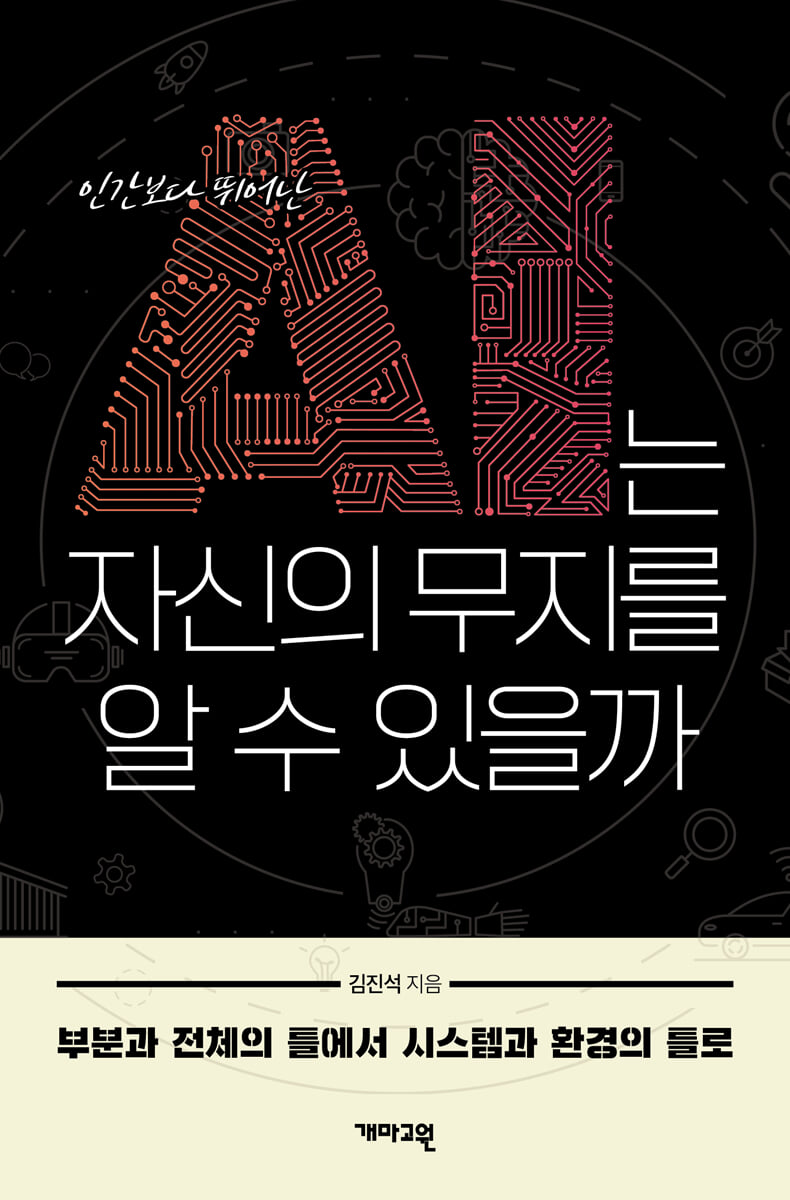
Can AI recognize its own ignorance?
 |
Description
Book Introduction
Intelligence is likely to be higher than that of humans,
Even AI can't avoid the wall of ignorance!
- The problem of AI systems and complexity -
This book is not just about AI.
AI, which started out as an imitation of the human brain and is expected to surpass human intelligence, poses the question, "Can AI recognize its own ignorance?" and embarks on a journey to reflect on where we humans stand today.
To this end, the author presents a new definition of the relationship between information and uncertainty through Claude Shannon's information theory and Niklas Luhmann's system theory, and delves into the shift from the paradigm of part/whole to the paradigm of system/environment.
Building on this foundation, the author explores the question raised in "From Transcendence to Perpetuation," exploring how both humans and AI can respond to and transcend an increasingly complex and uncertain world. Can AI solve complex problems, whether the climate crisis, the future of the welfare state, or even the future of humanity? If even AI, purportedly surpassing human intelligence, cannot, how should we address the world's complexity? To answer these questions, the author guides readers through a deep exploration and conceptual thought, moving from "transcendence" to "perpetuation," and then "perpetuation."
In fact, another theme that runs through this book is humanity.
At first glance, the two seem very different.
However, I believe that in the process of understanding and studying AI, we will also come to understand humans.
While it is often believed that humans developed artificial intelligence to use as tools, one of the driving forces behind AI research was actually the quest for intelligence beyond humans.
But what exactly does it mean to surpass humans? We live in an age where expectations and disappointments about humanity intersect harshly. It's difficult to predict the complex relationship AI will have with humans in the future, but in any case, humans still don't know much about themselves.
My conceptual work, 'Po-wol-gyeol', was intended to pose and answer this question.
- Main text p.8~9
Even AI can't avoid the wall of ignorance!
- The problem of AI systems and complexity -
This book is not just about AI.
AI, which started out as an imitation of the human brain and is expected to surpass human intelligence, poses the question, "Can AI recognize its own ignorance?" and embarks on a journey to reflect on where we humans stand today.
To this end, the author presents a new definition of the relationship between information and uncertainty through Claude Shannon's information theory and Niklas Luhmann's system theory, and delves into the shift from the paradigm of part/whole to the paradigm of system/environment.
Building on this foundation, the author explores the question raised in "From Transcendence to Perpetuation," exploring how both humans and AI can respond to and transcend an increasingly complex and uncertain world. Can AI solve complex problems, whether the climate crisis, the future of the welfare state, or even the future of humanity? If even AI, purportedly surpassing human intelligence, cannot, how should we address the world's complexity? To answer these questions, the author guides readers through a deep exploration and conceptual thought, moving from "transcendence" to "perpetuation," and then "perpetuation."
In fact, another theme that runs through this book is humanity.
At first glance, the two seem very different.
However, I believe that in the process of understanding and studying AI, we will also come to understand humans.
While it is often believed that humans developed artificial intelligence to use as tools, one of the driving forces behind AI research was actually the quest for intelligence beyond humans.
But what exactly does it mean to surpass humans? We live in an age where expectations and disappointments about humanity intersect harshly. It's difficult to predict the complex relationship AI will have with humans in the future, but in any case, humans still don't know much about themselves.
My conceptual work, 'Po-wol-gyeol', was intended to pose and answer this question.
- Main text p.8~9
- You can preview some of the book's contents.
Preview
index
Entering
Part 1: As information increases, uncertainty also increases.
Chapter 1.
The human mind has difficulty receiving information in a balanced manner.
Chapter 2.
The irony that 'information is an expression of uncertainty'
Chapter 3. The Autonomy of AI Learning Relates to the Closedness of Information Processing Systems
From the paradigm of part and whole to the paradigm of system and environment
Chapter 4.
Information is produced within the limits of the system.
Chapter 5.
The world can now only be observed in different ways
Chapter 6.
The relationship between humans and society, moving beyond the framework of part/whole to the distinction between system/environment
Chapter 7.
Can social conflict be addressed in a way befitting its complexity?
Part 3: Humans and their AI agents who cannot solve their own problems
Chapter 8. AI Enables Humans to Understand in More Complex and Unconstrained Ways
Chapter 9.
Ambiguous expectations and illusions about artificial general intelligence
Chapter 10. AI Weapons: Another Risk: Eliminating Human Sacrifice
Chapter 11.
Why AI Instead of Humans Form Organizations
Part 4: Po-wol, and Wol-po
Chapter 12.
How did Powell's project begin?
Chapter 13.
The one who jumps over the one who crawls, the one who flies over the one who runs, the one who crawls over the one who flies
Chapter 14.
It was called Powol, but it was Wolpo
Going out
Part 1: As information increases, uncertainty also increases.
Chapter 1.
The human mind has difficulty receiving information in a balanced manner.
Chapter 2.
The irony that 'information is an expression of uncertainty'
Chapter 3. The Autonomy of AI Learning Relates to the Closedness of Information Processing Systems
From the paradigm of part and whole to the paradigm of system and environment
Chapter 4.
Information is produced within the limits of the system.
Chapter 5.
The world can now only be observed in different ways
Chapter 6.
The relationship between humans and society, moving beyond the framework of part/whole to the distinction between system/environment
Chapter 7.
Can social conflict be addressed in a way befitting its complexity?
Part 3: Humans and their AI agents who cannot solve their own problems
Chapter 8. AI Enables Humans to Understand in More Complex and Unconstrained Ways
Chapter 9.
Ambiguous expectations and illusions about artificial general intelligence
Chapter 10. AI Weapons: Another Risk: Eliminating Human Sacrifice
Chapter 11.
Why AI Instead of Humans Form Organizations
Part 4: Po-wol, and Wol-po
Chapter 12.
How did Powell's project begin?
Chapter 13.
The one who jumps over the one who crawls, the one who flies over the one who runs, the one who crawls over the one who flies
Chapter 14.
It was called Powol, but it was Wolpo
Going out
Publisher's Review
The irony of AI,
The more information there is, the greater the uncertainty.
We often think of AI as a smart tool or a superintelligence that will surpass human capabilities, and information as something useful that increases certainty.
However, this book confirms that the advancement of information, while increasing certainty and practicality, has been discovered and developed along with the technology to deal with 'uncertainty' in essence.
According to Claude Shannon, known as the father of information theory, the amount of information actually increases as uncertainty increases.
Simply put, the size of uncertainty is the value/amount of information.
Why is that? Because facts that everyone knows have no value as information.
The message “The sun will rise in the east tomorrow” has little uncertainty, so the information amount is close to 0, but the message “Our company’s AI will guess the winning lottery numbers” has a lot of uncertainty, so the information amount is large.
Given this property that information neither simply expresses certainty nor aims to reduce uncertainty, it is likely that AI intelligence will continue to advance significantly in the future, but no matter how much it advances, uncertainty will not be reduced.
Why ‘system and environment’ rather than ‘part and whole’?
A New Framework for Reading the Age of Complexity
So how should we address this uncertainty and complexity? The author delves into this question through Luhmann's systems theory.
Traditional thinking divided the world into parts and wholes.
The part was considered to be part of the whole and to follow (or should follow) the goal and logic of the whole.
But that perception is no longer valid today.
Corporations and political parties do not function solely as parts of the state or society as a whole.
As social systems, these organizations perceive society or the nation as their environment.
Even individual humans are like that.
Luhmann even said, “Humans are no part of society.”
As is commonly understood, humans are not just a part of society, but they also face the environment of society and interact with that environment.
The relationship a system has to its environment is different from the relationship its parts have to the whole.
We must now honestly admit that there is no (or very little) shared wholeness among the various entities in society.
It is impossible to resolve conflicts by putting forward some ideal or moral rule or principle that is valuable to the whole, nor is it possible to judge the world by clear divisions such as progressive or conservative.
The best way to do this is to accept the complexity of today's society and manage conflicts so they don't erupt violently.
This is why we need a framework of systems and environments that replaces the framework of parts and wholes.
A perspective that starts from the distinction between system and environment predicts that social conflict will be tamed into a more refined form if physical violence is reduced, but it does not believe that the problem will be solved by targeting or appealing to political programs such as reducing violence or expanding consensus.
While systems theory argues that morality, law, and capital cannot resolve conflicts, it does not consider them entirely meaningless.
It is also true that this situation itself heightens complexity again.
Complexity is a problem that cannot be easily solved by any set of rules or norms or by any political program, but must be dealt with flexibly and adaptably.
-Main text, pp. 203-204
From Po-wol (匍越) to Wol-po (越匍)
The Path AI and Humans Should Take
In this reality, AI teaches us to think differently and more broadly about the uncertainty of the world and the environment.
AI also performs intellectually and mentally sophisticated tasks on behalf of humans, allowing us to view others and society as a social environment.
In the future, AI will become an essential collaborator, cooperative system, or even agent for human psychological and social existence.
However, AI will not be a superintelligence that can tell us the answers to all our conflicts and problems.
Even if they can surpass humans in information processing, they are ultimately still information processing systems, and must face the increasingly complex environment surrounding them. (Therefore, rather than vaguely anticipating AGI, it's more appropriate to understand AI as a system that processes uncertainty/information.)
AI, like humans, will have its own biases and personalities, and above all, it will face the same problems of uncertainty and complexity that humans face.
Such problems cannot be solved by absolute rationality and reason that transcends everything.
For example, even if there is a solution to the climate crisis, it is impossible to realize it in reality because there are too many stakeholders.
The way to overcome this problem is to stick close to reality and examine the conflict delicately.
You should not ‘jump over [超越]’ but ‘crawl over [匍越]’.
AI will surpass humans in some ways, but even after that, it will still have to crawl back down. This is because even if AI overcomes certain boundaries, new environments will continue to add complexity.
We must become aware of our own ignorance and limitations, and embrace (i.e., crawl back) their complexity.
The proverb, “The one who jumps over the one who crawls, the one who flies over the one who runs, and the one who crawls over the one who flies,” which is repeated several times in the book, refers to this cycle.
The limitation of not being able to overcome one's own ignorance is the same for both humans and AI with higher intelligence than humans.
You have to be able to reflect on yourself to be able to move forward.
"Can AI Know Its Own Ignorance?" traverses information theory, systems theory, psychology, and sociology, demonstrating the power of a persistent perspective on technology, society, and humanity in the AI era. Simultaneously confronting both the dazzling advancements of AI and the fundamental limitations behind them, it will provide us with the intellectual insight and reflection we need as we navigate this age of super-uncertainty.
Human life, on the one hand, will fly in technological civilization with the help of AI.
Countless medical and biochemical methods will be developed to strengthen psychological and physical systems.
But on the other hand, the value of a simple and slow life still seems to be precious to people.
And paradoxically, simplicity will continue to be important in human life.
A warm and loving heart will also be equally important.
Especially, the simple heart and loving mind that has been put in effort for a long time will be as precious as the success of the guy.
In civilization, I am of course needed.
But I have a guy crawling on top of me.
This seems especially true for people.
Whether in terms of intelligence or biological limitations, humans are both flying and crawling.
How innocently do children, ignorant of the world, smile.
But as we age, we tend to feel overwhelmed by complexity.
Also, as lifespan increases, complexity increases.
In this situation, simplicity and modesty become important again, as they always have.
- Main text p.386
The more information there is, the greater the uncertainty.
We often think of AI as a smart tool or a superintelligence that will surpass human capabilities, and information as something useful that increases certainty.
However, this book confirms that the advancement of information, while increasing certainty and practicality, has been discovered and developed along with the technology to deal with 'uncertainty' in essence.
According to Claude Shannon, known as the father of information theory, the amount of information actually increases as uncertainty increases.
Simply put, the size of uncertainty is the value/amount of information.
Why is that? Because facts that everyone knows have no value as information.
The message “The sun will rise in the east tomorrow” has little uncertainty, so the information amount is close to 0, but the message “Our company’s AI will guess the winning lottery numbers” has a lot of uncertainty, so the information amount is large.
Given this property that information neither simply expresses certainty nor aims to reduce uncertainty, it is likely that AI intelligence will continue to advance significantly in the future, but no matter how much it advances, uncertainty will not be reduced.
Why ‘system and environment’ rather than ‘part and whole’?
A New Framework for Reading the Age of Complexity
So how should we address this uncertainty and complexity? The author delves into this question through Luhmann's systems theory.
Traditional thinking divided the world into parts and wholes.
The part was considered to be part of the whole and to follow (or should follow) the goal and logic of the whole.
But that perception is no longer valid today.
Corporations and political parties do not function solely as parts of the state or society as a whole.
As social systems, these organizations perceive society or the nation as their environment.
Even individual humans are like that.
Luhmann even said, “Humans are no part of society.”
As is commonly understood, humans are not just a part of society, but they also face the environment of society and interact with that environment.
The relationship a system has to its environment is different from the relationship its parts have to the whole.
We must now honestly admit that there is no (or very little) shared wholeness among the various entities in society.
It is impossible to resolve conflicts by putting forward some ideal or moral rule or principle that is valuable to the whole, nor is it possible to judge the world by clear divisions such as progressive or conservative.
The best way to do this is to accept the complexity of today's society and manage conflicts so they don't erupt violently.
This is why we need a framework of systems and environments that replaces the framework of parts and wholes.
A perspective that starts from the distinction between system and environment predicts that social conflict will be tamed into a more refined form if physical violence is reduced, but it does not believe that the problem will be solved by targeting or appealing to political programs such as reducing violence or expanding consensus.
While systems theory argues that morality, law, and capital cannot resolve conflicts, it does not consider them entirely meaningless.
It is also true that this situation itself heightens complexity again.
Complexity is a problem that cannot be easily solved by any set of rules or norms or by any political program, but must be dealt with flexibly and adaptably.
-Main text, pp. 203-204
From Po-wol (匍越) to Wol-po (越匍)
The Path AI and Humans Should Take
In this reality, AI teaches us to think differently and more broadly about the uncertainty of the world and the environment.
AI also performs intellectually and mentally sophisticated tasks on behalf of humans, allowing us to view others and society as a social environment.
In the future, AI will become an essential collaborator, cooperative system, or even agent for human psychological and social existence.
However, AI will not be a superintelligence that can tell us the answers to all our conflicts and problems.
Even if they can surpass humans in information processing, they are ultimately still information processing systems, and must face the increasingly complex environment surrounding them. (Therefore, rather than vaguely anticipating AGI, it's more appropriate to understand AI as a system that processes uncertainty/information.)
AI, like humans, will have its own biases and personalities, and above all, it will face the same problems of uncertainty and complexity that humans face.
Such problems cannot be solved by absolute rationality and reason that transcends everything.
For example, even if there is a solution to the climate crisis, it is impossible to realize it in reality because there are too many stakeholders.
The way to overcome this problem is to stick close to reality and examine the conflict delicately.
You should not ‘jump over [超越]’ but ‘crawl over [匍越]’.
AI will surpass humans in some ways, but even after that, it will still have to crawl back down. This is because even if AI overcomes certain boundaries, new environments will continue to add complexity.
We must become aware of our own ignorance and limitations, and embrace (i.e., crawl back) their complexity.
The proverb, “The one who jumps over the one who crawls, the one who flies over the one who runs, and the one who crawls over the one who flies,” which is repeated several times in the book, refers to this cycle.
The limitation of not being able to overcome one's own ignorance is the same for both humans and AI with higher intelligence than humans.
You have to be able to reflect on yourself to be able to move forward.
"Can AI Know Its Own Ignorance?" traverses information theory, systems theory, psychology, and sociology, demonstrating the power of a persistent perspective on technology, society, and humanity in the AI era. Simultaneously confronting both the dazzling advancements of AI and the fundamental limitations behind them, it will provide us with the intellectual insight and reflection we need as we navigate this age of super-uncertainty.
Human life, on the one hand, will fly in technological civilization with the help of AI.
Countless medical and biochemical methods will be developed to strengthen psychological and physical systems.
But on the other hand, the value of a simple and slow life still seems to be precious to people.
And paradoxically, simplicity will continue to be important in human life.
A warm and loving heart will also be equally important.
Especially, the simple heart and loving mind that has been put in effort for a long time will be as precious as the success of the guy.
In civilization, I am of course needed.
But I have a guy crawling on top of me.
This seems especially true for people.
Whether in terms of intelligence or biological limitations, humans are both flying and crawling.
How innocently do children, ignorant of the world, smile.
But as we age, we tend to feel overwhelmed by complexity.
Also, as lifespan increases, complexity increases.
In this situation, simplicity and modesty become important again, as they always have.
- Main text p.386
GOODS SPECIFICS
- Date of issue: November 15, 2025
- Page count, weight, size: 400 pages | 482g | 135*205*24mm
- ISBN13: 9788957695067
- ISBN10: 8957695060
You may also like
카테고리
korean


korean

![ELLE 엘르 스페셜 에디션 A형 : 12월 [2025]](http://librairie.coreenne.fr/cdn/shop/files/b8e27a3de6c9538896439686c6b0e8fb.jpg?v=1766436872&width=3840)


