

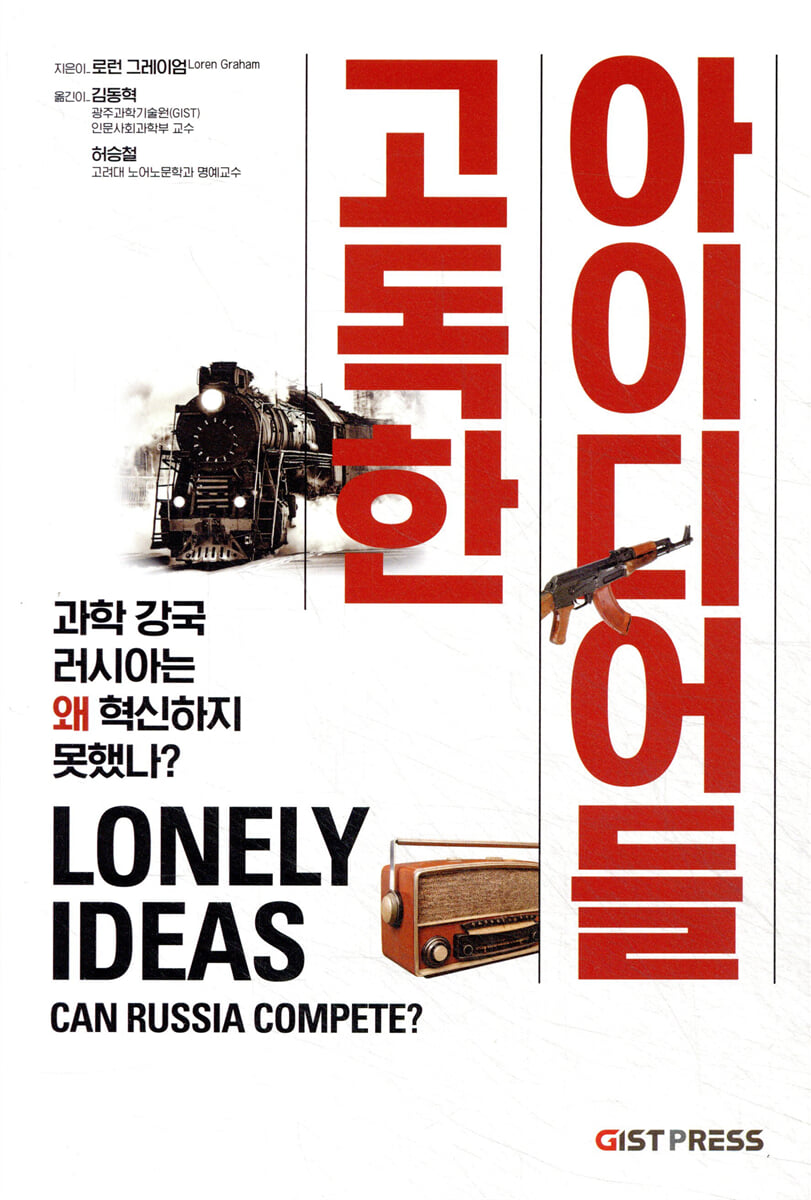
Lonely Ideas
 |
Description
Book Introduction
Where have the Russian inventors gone, the ones who were 'world firsts'?
There is no technological innovation without national and social innovation.
Who invented the first light bulb? The answer to this question will likely be Thomas Edison.
But even before Edison began his research on electric light, Russian electrical engineer Alexander Lodygin invented the first electric incandescent lamp using a filament.
And that's not all.
Russians invented Europe's first steam locomotive, the first multi-engine passenger aircraft, and created Europe's first electric computer.
But among the 'inventors' we know, there are very few who are Russian.
Like Tchaikovsky in music and Tolstoy in literature, Russia has gone down in history as a pioneer in music, literature, philosophy, mathematics, and basic science. However, despite achieving numerous firsts in the field of technology and inventions, it has failed to leave a mark on world history.
What is the reason?
The author of this book says:
“The success of technology is determined outside the laboratory, in the broader socio-economic environment.” Over the past 300 years, Russia has excelled at developing technological ideas, but has failed to translate them into commercial profits or global recognition.
As the title of the book suggests, it is ‘Lonely Ideas.’
The author traces the history and chronology of the technological fields led by Russia.
In the process, it shows that even the most outstanding ideas and inventions cannot bear fruit under the state's faulty judgment and excessive control.
The history of science and technology in Russia reflects the history of Russian politics and society.
Revolutions that overthrow the system occur in Russia, but gradual social reforms are rarely achieved.
Because there was no social innovation, scientific, technological, and industrial development were bound to be delayed.
Based on the author's extensive research and field investigations, this book covers the problems of Russian science and technology (Part 1), the root causes of those problems (Part 2), and the current situation, prospects, and recommendations (Part 3).
Until now, there have been few books published in Korea that comprehensively cover the history of Russian science and inventors.
In that respect, this book, “Solitary Ideas,” provides readers with valuable information.
Furthermore, it is also valuable as a humanities textbook, as it goes beyond the simple history of science and technology and covers the social and political history that underpins it.
There is no technological innovation without national and social innovation.
Who invented the first light bulb? The answer to this question will likely be Thomas Edison.
But even before Edison began his research on electric light, Russian electrical engineer Alexander Lodygin invented the first electric incandescent lamp using a filament.
And that's not all.
Russians invented Europe's first steam locomotive, the first multi-engine passenger aircraft, and created Europe's first electric computer.
But among the 'inventors' we know, there are very few who are Russian.
Like Tchaikovsky in music and Tolstoy in literature, Russia has gone down in history as a pioneer in music, literature, philosophy, mathematics, and basic science. However, despite achieving numerous firsts in the field of technology and inventions, it has failed to leave a mark on world history.
What is the reason?
The author of this book says:
“The success of technology is determined outside the laboratory, in the broader socio-economic environment.” Over the past 300 years, Russia has excelled at developing technological ideas, but has failed to translate them into commercial profits or global recognition.
As the title of the book suggests, it is ‘Lonely Ideas.’
The author traces the history and chronology of the technological fields led by Russia.
In the process, it shows that even the most outstanding ideas and inventions cannot bear fruit under the state's faulty judgment and excessive control.
The history of science and technology in Russia reflects the history of Russian politics and society.
Revolutions that overthrow the system occur in Russia, but gradual social reforms are rarely achieved.
Because there was no social innovation, scientific, technological, and industrial development were bound to be delayed.
Based on the author's extensive research and field investigations, this book covers the problems of Russian science and technology (Part 1), the root causes of those problems (Part 2), and the current situation, prospects, and recommendations (Part 3).
Until now, there have been few books published in Korea that comprehensively cover the history of Russian science and inventors.
In that respect, this book, “Solitary Ideas,” provides readers with valuable information.
Furthermore, it is also valuable as a humanities textbook, as it goes beyond the simple history of science and technology and covers the social and political history that underpins it.
- You can preview some of the book's contents.
Preview
index
introduction
Part 1 / The Problem: Why Can't Russia Modernize After Three Centuries of Effort?
01 Early Military Industry: Early Success, Late Decline
02 Railway: Hope and Distortion
03 The Electrical Industry: Failed Inventors of the 19th Century
04 Aviation: The Price of Frustration, a Deformed Industry
05 Soviet Industrialization: The Myth of Modernization
06 Semiconductor Industry: Russia's Unknown and Unrewarded Pioneers
07 Genetics and Biotechnology: The Missed Revolution
08 Computers: Success and Failure
09 Laser: Genius and a Lost Opportunity
10 Exceptions and What They Prove: Software, Space, and Nuclear Energy
Part 2 / What causes the problem?
11 Attitude Matters
12 Political Order
13 Social Barriers
14 Legal System
15 Economic factors
16 Corruption and Crime
17 Education and Research Organizations
Part 3 / Can Russia Overcome Its Problems Today? Russia's Special Opportunities 18 Creating New Foundations and Research Universities
19 Rusnano and Skolkovo
20 How can Russia escape the trap that has persisted for three centuries?
Acknowledgements
Translator's Note
annual report
Americas
biographical book
Search
Part 1 / The Problem: Why Can't Russia Modernize After Three Centuries of Effort?
01 Early Military Industry: Early Success, Late Decline
02 Railway: Hope and Distortion
03 The Electrical Industry: Failed Inventors of the 19th Century
04 Aviation: The Price of Frustration, a Deformed Industry
05 Soviet Industrialization: The Myth of Modernization
06 Semiconductor Industry: Russia's Unknown and Unrewarded Pioneers
07 Genetics and Biotechnology: The Missed Revolution
08 Computers: Success and Failure
09 Laser: Genius and a Lost Opportunity
10 Exceptions and What They Prove: Software, Space, and Nuclear Energy
Part 2 / What causes the problem?
11 Attitude Matters
12 Political Order
13 Social Barriers
14 Legal System
15 Economic factors
16 Corruption and Crime
17 Education and Research Organizations
Part 3 / Can Russia Overcome Its Problems Today? Russia's Special Opportunities 18 Creating New Foundations and Research Universities
19 Rusnano and Skolkovo
20 How can Russia escape the trap that has persisted for three centuries?
Acknowledgements
Translator's Note
annual report
Americas
biographical book
Search
GOODS SPECIFICS
- Date of issue: October 30, 2025
- Page count, weight, size: 300 pages | 566g | 152*224*19mm
- ISBN13: 9791190961332
- ISBN10: 1190961334
You may also like
카테고리
korean


korean

![ELLE 엘르 스페셜 에디션 A형 : 12월 [2025]](http://librairie.coreenne.fr/cdn/shop/files/b8e27a3de6c9538896439686c6b0e8fb.jpg?v=1766436872&width=3840)


