

The cat who taught a seagull to fly
 |
Description
Book Introduction
A masterpiece by world-renowned author Luis Sepulveda
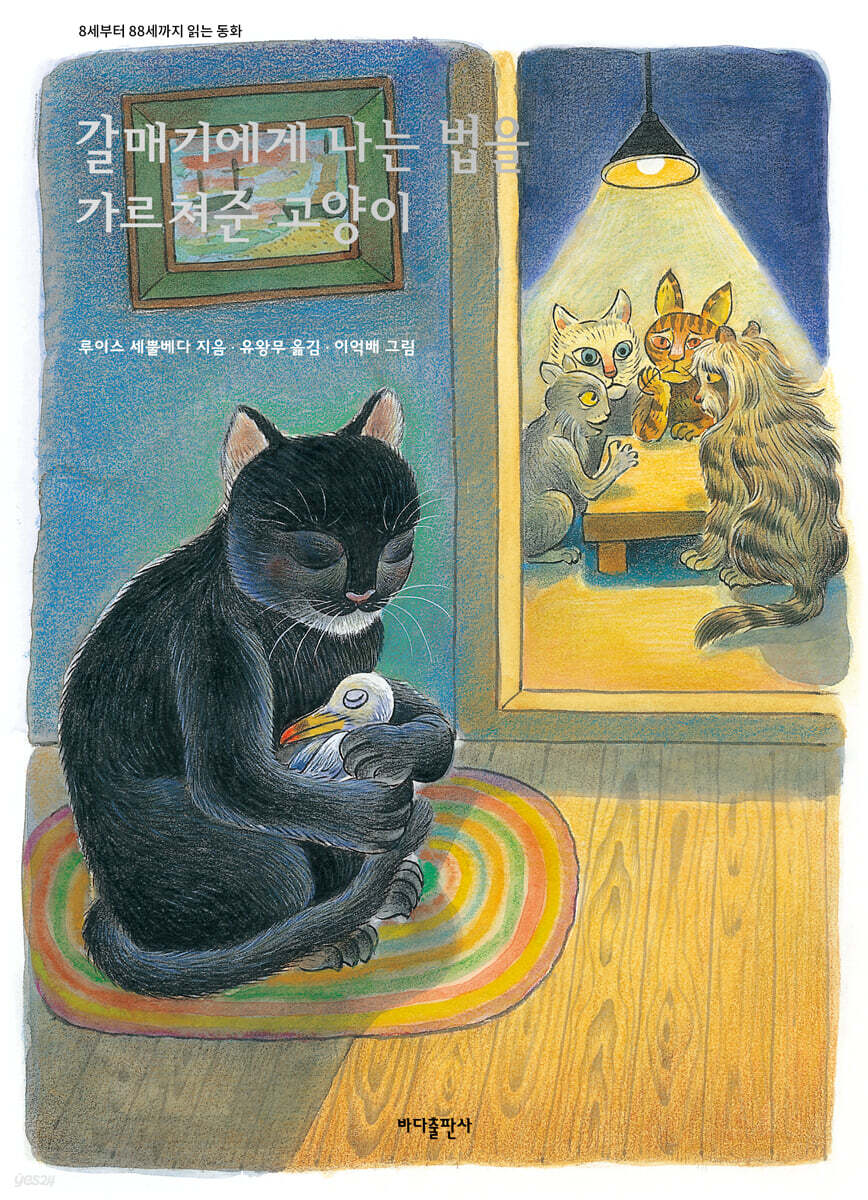
Sorbas, a large black cat
A heartbreaking story of friendship between a baby seagull who lost its mother and taught her how to fly.
★Included in 5th grade Korean language textbooks from 2015 to 2020
★Included in the 2021 Hanuri Open Education Reading Education Textbook
★2003 Children's Book Research Association Recommended Books
“You can’t fly in the sky with just wings!
“You can only fly if you try to fly.”
“Baby Seagull, we have only accepted and loved those who are like us.
We have not been able to love and acknowledge any being other than ourselves.
It wasn't an easy task.
But now, I can respect and cherish other beings.
You made me realize that.
You are a seagull.
It's not a cat.
So you must follow the fate of the seagull.
Only when you fly in the sky will you be able to feel true happiness.
And the feelings you have for us and the affection we have for you will become deeper and more beautiful.
“That is true affection between different beings.”
-Mother cat to her baby seagull
※ The third revised edition of “The Cat Who Taught a Seagull to Fly” was created based on the National Institute of the Korean Language’s Standard Korean Dictionary, correcting notations that needed to be corrected after the first edition was published in 2000.
The names appearing in the work are the same as in the first edition.
Sorbas, a large black cat
A heartbreaking story of friendship between a baby seagull who lost its mother and taught her how to fly.
★Included in 5th grade Korean language textbooks from 2015 to 2020
★Included in the 2021 Hanuri Open Education Reading Education Textbook
★2003 Children's Book Research Association Recommended Books
“You can’t fly in the sky with just wings!
“You can only fly if you try to fly.”
“Baby Seagull, we have only accepted and loved those who are like us.
We have not been able to love and acknowledge any being other than ourselves.
It wasn't an easy task.
But now, I can respect and cherish other beings.
You made me realize that.
You are a seagull.
It's not a cat.
So you must follow the fate of the seagull.
Only when you fly in the sky will you be able to feel true happiness.
And the feelings you have for us and the affection we have for you will become deeper and more beautiful.
“That is true affection between different beings.”
-Mother cat to her baby seagull
※ The third revised edition of “The Cat Who Taught a Seagull to Fly” was created based on the National Institute of the Korean Language’s Standard Korean Dictionary, correcting notations that needed to be corrected after the first edition was published in 2000.
The names appearing in the work are the same as in the first edition.
- You can preview some of the book's contents.
Preview
index
1
Seagull Kenga 11
Black Cat Sorbas 17
Black Wave 27
Kenga's Last Flight 35
It looks like a cat of unknown age 41
The Strange House at the Port, Hari Exhibition Hall 47
The all-knowing cat, Sabelottodo 53
Unchanging Promise 63
One Sad Night 69
2
Cat with Seagull Egg 75
Sorbas, 81, becomes a mother
Two Gangster Cats 89
Negotiation with the King Rat 95
Is it male or female? 105
Truly Lucky, Aportunada 113
I am a seagull learning to read 119
Cats' Final Decision 127
Chosen Human, Poet 133
Meet the Poet 139
Fly, Aportunada 149
Translator's Note 159
Seagull Kenga 11
Black Cat Sorbas 17
Black Wave 27
Kenga's Last Flight 35
It looks like a cat of unknown age 41
The Strange House at the Port, Hari Exhibition Hall 47
The all-knowing cat, Sabelottodo 53
Unchanging Promise 63
One Sad Night 69
2
Cat with Seagull Egg 75
Sorbas, 81, becomes a mother
Two Gangster Cats 89
Negotiation with the King Rat 95
Is it male or female? 105
Truly Lucky, Aportunada 113
I am a seagull learning to read 119
Cats' Final Decision 127
Chosen Human, Poet 133
Meet the Poet 139
Fly, Aportunada 149
Translator's Note 159
Publisher's Review
“I promised myself that one day I would tell my children about the harm caused by humans destroying nature.”
-Louis Sepulveda
A philosophical fairy tale by author Luis Sepulveda, who values reconciliation between humans and nature.
The problem of environmental destruction caused by human selfishness
A heartbreaking story of friendship between a cat and a seagull
This book is the work of Luis Sepulveda, a representative writer of Latin literature.
Sepulveda is a representative writer of the post-boom generation, following in the footsteps of the boom generation (Gabriel Marquez, Jorge Luis Borges, Pablo Neruda, etc.) who broke through the limitations of Western literature with the so-called 'magical realism' of the 1960s.
In this work, he presents a seagull and a cat as the main characters, and in a concise style, he depicts the journey of strangers becoming one through the process of keeping a promise.
A seagull, facing death due to polluted seawater, meets a cat by chance and asks it to protect its eggs and teach its chicks how to fly when they are born, but eventually dies.
From this situation, the cat's journey to keep his promise to the seagull unfolds, and through this journey, readers encounter a clear lyricism and the restoration of the relationship between humans and nature, and between humans, a topic of our time.
This work, which exquisitely combines the form of a fable, a concise style, a serious theme, and humor, became the best-selling book in Europe in 1996, and was praised by the German press as “an excellent story with an appropriate mix of emotion, tension, and lessons, and worth reading for both adults and children” (Süddeutsche Zeitung).
Sorbas, a large black cat,
Teaching an orphaned chick to fly
A seagull was swept away by oil-polluted waves in the North Sea near the port of Hamburg.
A seagull covered in sticky tar residue all over its body, blocking even its pores.
Using all his remaining strength, he flies towards land and eventually crashes onto the balcony of a house in the Hamburg harbor, where he meets Sorbas, a black cat who happens to be sunbathing on the balcony.
The cat Sorbas makes three promises to the dying seagull.
It was a very burdensome promise for Sorbas, who promised not to eat the eggs laid by the first gull, to take good care of the second egg so that it could hatch, and to teach the third baby gull how to fly when it was born.
However, Sorbas makes a promise on the honor of the cats living in the harbor, and does his best to keep his three promises.
Faced with an unfamiliar and difficult situation, Sorbas receives help from the harbor cats Secretario, Colonello, and Sabelloto.
With the help of his friends, Sorbas hatches an egg and overcomes all kinds of difficulties while living with the newly born baby seagull, Afortunada.
But the third promise, to teach the baby gull how to fly, was no easy task for Sorbas and his friends.
Sorbas and his friends search encyclopedias for information about flying and teach Afortunada, but all seventeen of their attempts at flying end in failure.
Eventually, Sorbas decides to seek help from someone outside the cat world.
That was exactly how to get help from humans.
However, “not communicating with humans” was a taboo in cat society.
Finally, the harbor cats decide that Sorbas can get help from humans, and he asks for help from the only human he can trust: a poet.
One rainy evening, the harbor cats and the poet head to the railing of the Cathedral of San Miguel for the first flight of a baby seagull.
As Aportunada is about to embark on his first flight, his mother cat, Sorbas, speaks to him.
“Wings alone don’t make you fly! You can only fly if you try.”
Finally, Aportunada kicks off the railing and soars through the rainy night sky.
As Sorbas looks at Aportunada, drops of liquid, either rain or tears, begin to flow endlessly from the corners of his eyes.
-Louis Sepulveda
A philosophical fairy tale by author Luis Sepulveda, who values reconciliation between humans and nature.
The problem of environmental destruction caused by human selfishness
A heartbreaking story of friendship between a cat and a seagull
This book is the work of Luis Sepulveda, a representative writer of Latin literature.
Sepulveda is a representative writer of the post-boom generation, following in the footsteps of the boom generation (Gabriel Marquez, Jorge Luis Borges, Pablo Neruda, etc.) who broke through the limitations of Western literature with the so-called 'magical realism' of the 1960s.
In this work, he presents a seagull and a cat as the main characters, and in a concise style, he depicts the journey of strangers becoming one through the process of keeping a promise.
A seagull, facing death due to polluted seawater, meets a cat by chance and asks it to protect its eggs and teach its chicks how to fly when they are born, but eventually dies.
From this situation, the cat's journey to keep his promise to the seagull unfolds, and through this journey, readers encounter a clear lyricism and the restoration of the relationship between humans and nature, and between humans, a topic of our time.
This work, which exquisitely combines the form of a fable, a concise style, a serious theme, and humor, became the best-selling book in Europe in 1996, and was praised by the German press as “an excellent story with an appropriate mix of emotion, tension, and lessons, and worth reading for both adults and children” (Süddeutsche Zeitung).
Sorbas, a large black cat,
Teaching an orphaned chick to fly
A seagull was swept away by oil-polluted waves in the North Sea near the port of Hamburg.
A seagull covered in sticky tar residue all over its body, blocking even its pores.
Using all his remaining strength, he flies towards land and eventually crashes onto the balcony of a house in the Hamburg harbor, where he meets Sorbas, a black cat who happens to be sunbathing on the balcony.
The cat Sorbas makes three promises to the dying seagull.
It was a very burdensome promise for Sorbas, who promised not to eat the eggs laid by the first gull, to take good care of the second egg so that it could hatch, and to teach the third baby gull how to fly when it was born.
However, Sorbas makes a promise on the honor of the cats living in the harbor, and does his best to keep his three promises.
Faced with an unfamiliar and difficult situation, Sorbas receives help from the harbor cats Secretario, Colonello, and Sabelloto.
With the help of his friends, Sorbas hatches an egg and overcomes all kinds of difficulties while living with the newly born baby seagull, Afortunada.
But the third promise, to teach the baby gull how to fly, was no easy task for Sorbas and his friends.
Sorbas and his friends search encyclopedias for information about flying and teach Afortunada, but all seventeen of their attempts at flying end in failure.
Eventually, Sorbas decides to seek help from someone outside the cat world.
That was exactly how to get help from humans.
However, “not communicating with humans” was a taboo in cat society.
Finally, the harbor cats decide that Sorbas can get help from humans, and he asks for help from the only human he can trust: a poet.
One rainy evening, the harbor cats and the poet head to the railing of the Cathedral of San Miguel for the first flight of a baby seagull.
As Aportunada is about to embark on his first flight, his mother cat, Sorbas, speaks to him.
“Wings alone don’t make you fly! You can only fly if you try.”
Finally, Aportunada kicks off the railing and soars through the rainy night sky.
As Sorbas looks at Aportunada, drops of liquid, either rain or tears, begin to flow endlessly from the corners of his eyes.
GOODS SPECIFICS
- Publication date: September 30, 2021
- Page count, weight, size: 164 pages | 302g | 153*210*10mm
- ISBN13: 9791166890475
- ISBN10: 1166890473
- KC Certification: Certification Type: Conformity Confirmation
You may also like
카테고리
korean


korean

![GQ KOREA Mark (Monthly): December [2025]](http://librairie.coreenne.fr/cdn/shop/files/8ef265dbbfbf186523ed75ba7319009d.jpg?v=1765340328&width=3840)


