

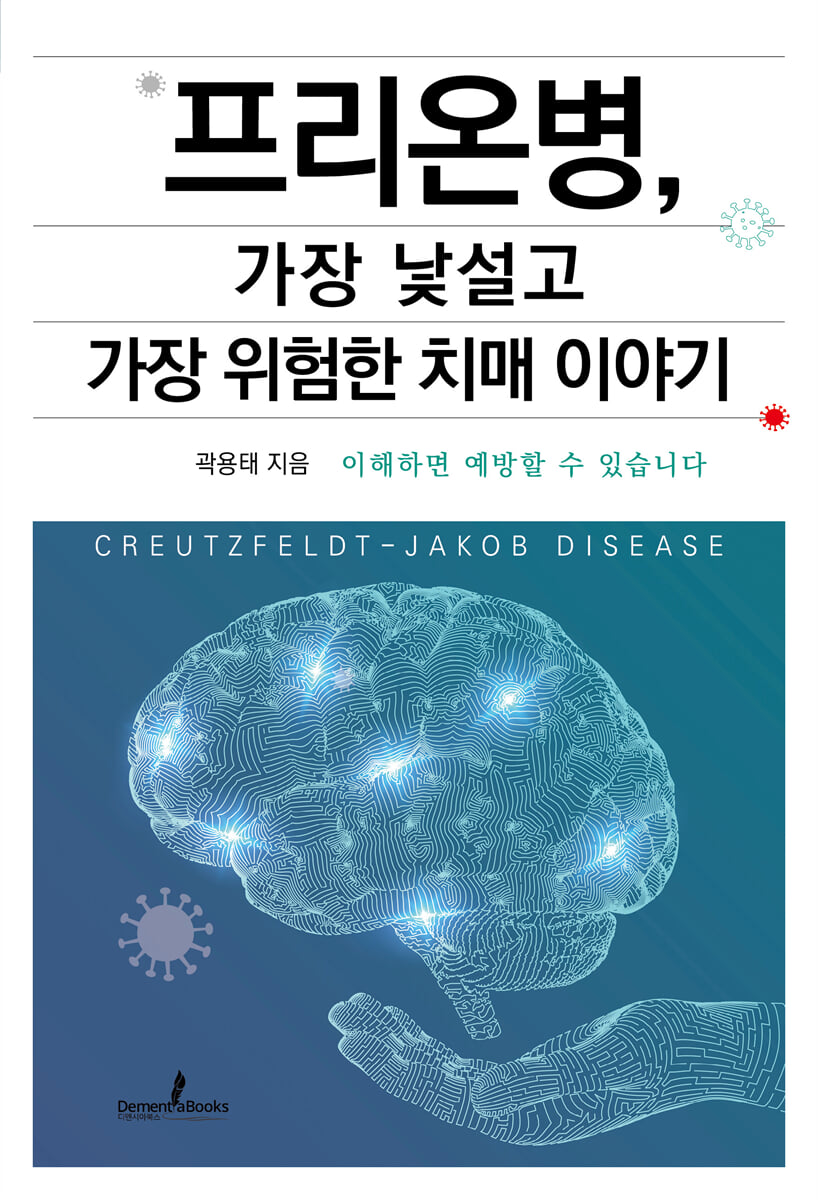
Prion Disease: The Strangest and Most Dangerous Type of Dementia
 |
Description
Book Introduction
- What if an ordinary protein suddenly turns into a 'monster' and destroys the brain?
- Everything about prion disease, the invisible disaster that has permeated our daily lives!
From scrapie, the bizarre disease that terrified sheep in 18th-century Europe, to the hidden truth behind the mad cow disease controversy that rocked South Korea in 2008, to the shocking link between Alzheimer's and Parkinson's, the last remaining challenge in modern medicine.
At the heart of it all is an unpredictable monster called a prion, which begins as an ordinary protein.
This book is a comprehensive guide to prion disease, which is called 'the strangest and most dangerous dementia.'
Prion diseases are completely different from common infectious diseases.
It is not something that has genetic material (DNA or RNA) like viruses or bacteria, nor is it something that is caused solely by genetic factors like cancer.
It starts with a simple misfolding of a normal protein in our bodies.
This mutated protein acts like a domino effect, abnormally changing surrounding normal proteins and creating holes in the brain like a sponge.
Once started, this disease is a fatal one that progresses rapidly without treatment or recovery.
This book begins with the author, a neurologist, personally encountering a rare disease that was once a textbook during his residency in the 1990s, and delves into the fascinating world of prion disease.
The author delves into the reality of prion diseases, including the unfamiliar name Creutzfeldt-Jakob Disease (CJD), and includes not only professional medical information but also deep reflections on social prejudices surrounding the disease, medical ethics, and the role of science.
In “Prion Disease, the Story of the Most Strange and Dangerous Dementia,” the author does not view prion disease simply as a medical illness.
From scrapie, which originated in sheep in the 18th century, to kuru, which was discovered through the cannibalistic practices of the For people of Papua New Guinea, to the recent spread of madroof disease in wild deer and camels, prions warn of the disaster caused by the indiscriminate contact between nature and humans.
However, it goes beyond simple warnings and illuminates the medical, social, and ethical issues surrounding this disease from various angles, raising questions such as “harmony with nature,” “attitude toward scientific truth,” and “ethical responsibility toward life,” delivering a profound message that readers can ponder together.
It also provides guidance on how we can prepare for unseen dangers and protect human dignity in the face of unpredictable disasters.
- Everything about prion disease, the invisible disaster that has permeated our daily lives!
From scrapie, the bizarre disease that terrified sheep in 18th-century Europe, to the hidden truth behind the mad cow disease controversy that rocked South Korea in 2008, to the shocking link between Alzheimer's and Parkinson's, the last remaining challenge in modern medicine.
At the heart of it all is an unpredictable monster called a prion, which begins as an ordinary protein.
This book is a comprehensive guide to prion disease, which is called 'the strangest and most dangerous dementia.'
Prion diseases are completely different from common infectious diseases.
It is not something that has genetic material (DNA or RNA) like viruses or bacteria, nor is it something that is caused solely by genetic factors like cancer.
It starts with a simple misfolding of a normal protein in our bodies.
This mutated protein acts like a domino effect, abnormally changing surrounding normal proteins and creating holes in the brain like a sponge.
Once started, this disease is a fatal one that progresses rapidly without treatment or recovery.
This book begins with the author, a neurologist, personally encountering a rare disease that was once a textbook during his residency in the 1990s, and delves into the fascinating world of prion disease.
The author delves into the reality of prion diseases, including the unfamiliar name Creutzfeldt-Jakob Disease (CJD), and includes not only professional medical information but also deep reflections on social prejudices surrounding the disease, medical ethics, and the role of science.
In “Prion Disease, the Story of the Most Strange and Dangerous Dementia,” the author does not view prion disease simply as a medical illness.
From scrapie, which originated in sheep in the 18th century, to kuru, which was discovered through the cannibalistic practices of the For people of Papua New Guinea, to the recent spread of madroof disease in wild deer and camels, prions warn of the disaster caused by the indiscriminate contact between nature and humans.
However, it goes beyond simple warnings and illuminates the medical, social, and ethical issues surrounding this disease from various angles, raising questions such as “harmony with nature,” “attitude toward scientific truth,” and “ethical responsibility toward life,” delivering a profound message that readers can ponder together.
It also provides guidance on how we can prepare for unseen dangers and protect human dignity in the face of unpredictable disasters.
- You can preview some of the book's contents.
Preview
index
Introduction 4
Chapter 1: Surgery of the Day: A Day in the Hospital with a Patient with Creutzfeldt-Jakob Disease 13
Chapter 2: What Are Prions, the Invisible Infectious Agents? 21
Chapter 3: The History of Prions: The Protein Rebellion That Began in New Guinea 29
Chapter 4: The Secret of Cannibalism and Genes: The Story Left Behind for the Fores After Kuru 39
Chapter 5 Types of Creutzfeldt-Jakob Disease: The Names Are Difficult, But the Stories Are Interesting 47
Chapter 6: How is Creutzfeldt-Jakob Disease Diagnosed? 59
Chapter 7 Iatrogenic Creutzfeldt-Jakob Disease: Cases of Medically Transmitted Infection 67
Chapter 8: Mad Cow Disease and My Memory: When Science and Emotion Collide 75
Chapter 9: Prions and Degenerative Brain Diseases: The Link to Alzheimer's and Parkinson's Diseases
Chapter 10: A Disease That Crosses Borders: Prions 87
Chapter 11: Prion Infection Management in Healthcare Settings 95
Chapter 12: Prevention and Response: How Are Policies and Guidelines Determined? 109
Chapter 13: How to Deal with Patients with Creutzfeldt-Jakob Disease and Their Families 119
Chapter 14: The Future of Prions: Are Treatments and Vaccines Possible? 127
Conclusion: The Age-Old Controversy Surrounding the Origin of Life 135
Chapter 1: Surgery of the Day: A Day in the Hospital with a Patient with Creutzfeldt-Jakob Disease 13
Chapter 2: What Are Prions, the Invisible Infectious Agents? 21
Chapter 3: The History of Prions: The Protein Rebellion That Began in New Guinea 29
Chapter 4: The Secret of Cannibalism and Genes: The Story Left Behind for the Fores After Kuru 39
Chapter 5 Types of Creutzfeldt-Jakob Disease: The Names Are Difficult, But the Stories Are Interesting 47
Chapter 6: How is Creutzfeldt-Jakob Disease Diagnosed? 59
Chapter 7 Iatrogenic Creutzfeldt-Jakob Disease: Cases of Medically Transmitted Infection 67
Chapter 8: Mad Cow Disease and My Memory: When Science and Emotion Collide 75
Chapter 9: Prions and Degenerative Brain Diseases: The Link to Alzheimer's and Parkinson's Diseases
Chapter 10: A Disease That Crosses Borders: Prions 87
Chapter 11: Prion Infection Management in Healthcare Settings 95
Chapter 12: Prevention and Response: How Are Policies and Guidelines Determined? 109
Chapter 13: How to Deal with Patients with Creutzfeldt-Jakob Disease and Their Families 119
Chapter 14: The Future of Prions: Are Treatments and Vaccines Possible? 127
Conclusion: The Age-Old Controversy Surrounding the Origin of Life 135
Detailed image

Into the book
This book covers not only basic medical information about Creutzfeldt-Jakob disease, but also how hospital systems should operate when a suspected case is identified, as well as communication with patients and their caregivers, medical ethics, and infection control practices.
--- p.19
Unfortunately, no effective drugs have yet been developed to fundamentally prevent or cure prion diseases.
Because reversing protein misfolding or blocking the process in the first place is much more difficult than you might think.
--- p.26
In the late 1970s, neurologist Stanley Prusiner … one day encountered a shocking discovery.
“Purified proteins alone can cause disease.” He names these infectious proteins “prions.”
This is a compound word of protein and infectious particle, and completely overturns the existing concept of pathogen.
--- p.34
Prions are pathogens that cause infection through changes in protein structure alone, without genetic material, and are an entity that has shaken up the existing concept of pathogens.
Prions are expanding research into 'prion-like diseases' because they share similar transmission mechanisms with degenerative brain diseases such as Alzheimer's, Parkinson's, and Lou Gehrig's disease.
--- p.37
Creutzfeldt-Jakob disease is a rare, rapidly progressive, fatal brain disorder whose early symptoms resemble dementia, making early recognition difficult.
Diagnosis involves brain MRI (DWI), electroencephalography (EEG), cerebrospinal fluid (CSF) examinations, and specific tests such as RT-QuIC.
--- p.65
Variant Creutzfeldt-Jakob disease may no longer be a threat to South Korea.
But the shadow that the disease left on our society has not yet disappeared.
It's a social lesson about how anxiety can grow, how expert groups can fail, and the consequences of not telling the truth.
--- p.80
Creutzfeldt-Jakob disease is not yet curable.
But this disease asks all of us: “How do we prepare for death?”, “What is care?”, and “How do we treat people with dignity?”
--- p.126
We haven't yet completely defeated prions, but we're already making significant efforts to track them, understand them, and try to stop them.
...
One day, all these efforts will come together to create a breakthrough.
--- p.19
Unfortunately, no effective drugs have yet been developed to fundamentally prevent or cure prion diseases.
Because reversing protein misfolding or blocking the process in the first place is much more difficult than you might think.
--- p.26
In the late 1970s, neurologist Stanley Prusiner … one day encountered a shocking discovery.
“Purified proteins alone can cause disease.” He names these infectious proteins “prions.”
This is a compound word of protein and infectious particle, and completely overturns the existing concept of pathogen.
--- p.34
Prions are pathogens that cause infection through changes in protein structure alone, without genetic material, and are an entity that has shaken up the existing concept of pathogens.
Prions are expanding research into 'prion-like diseases' because they share similar transmission mechanisms with degenerative brain diseases such as Alzheimer's, Parkinson's, and Lou Gehrig's disease.
--- p.37
Creutzfeldt-Jakob disease is a rare, rapidly progressive, fatal brain disorder whose early symptoms resemble dementia, making early recognition difficult.
Diagnosis involves brain MRI (DWI), electroencephalography (EEG), cerebrospinal fluid (CSF) examinations, and specific tests such as RT-QuIC.
--- p.65
Variant Creutzfeldt-Jakob disease may no longer be a threat to South Korea.
But the shadow that the disease left on our society has not yet disappeared.
It's a social lesson about how anxiety can grow, how expert groups can fail, and the consequences of not telling the truth.
--- p.80
Creutzfeldt-Jakob disease is not yet curable.
But this disease asks all of us: “How do we prepare for death?”, “What is care?”, and “How do we treat people with dignity?”
--- p.126
We haven't yet completely defeated prions, but we're already making significant efforts to track them, understand them, and try to stop them.
...
One day, all these efforts will come together to create a breakthrough.
--- p.133
Publisher's Review
- What is the reality of prions, the invisible monsters that are eating away at your brain?
The Hidden History and Truth of the Protein Disaster Caused by Human Desire
In 2008, as the mad cow disease crisis shook the nation between scientific facts and emotional fear, one doctor who studied the disease felt a profound sense of helplessness.
The author realized that the voice of science was being lost amidst silent experts, a public swept up in myths, and political interests.
The truth is only conveyed when someone has the courage to speak it.
This book is the result of that realization.
Through this book, the author provides insight into the root of the emotion called 'anxiety'.
The complex world of prion diseases is explained in a clear and easy-to-understand manner for the general reader.
The book's opening chapter, a fictional scenario, plunges readers into a tense medical setting, vividly illustrating just how complex and dangerous prions can be.
Surgical instruments that cannot be sterilized, infections with incubation periods of decades, and the ethical dilemmas they pose for medical professionals remind us that this disease is not simply a disease, but a "systemic crisis."
In particular, this book emphasizes that prion diseases are more than just “brain diseases,” but rather pose fundamental questions about life and evolution.
The bizarre nature of prions, which replicate and propagate themselves using only protein structures without the genetic material DNA, has given a fresh shock to the scientific community, suggesting another possibility for the emergence of life billions of years ago.
Even degenerative diseases such as Alzheimer's and Parkinson's are classified as "prion-like diseases," showing that the prion principle, a chain reaction of misfolded proteins, is becoming a new paradigm in modern medicine.
Through this book, the author offers readers more than just expert knowledge.
That is the importance and responsibility of scientific thinking.
The author's point that the indiscriminate livestock farming system gave rise to mad cow disease and that the culture of consuming wild animals can become the seed of new infectious diseases clearly demonstrates that prion disease is a disaster created by human desire.
Even if a cure or vaccine has not yet been developed, understanding the cause and transmission routes of the disease, sharing transparent information, and establishing systematic preparedness are the best preventative measures we can take.
"Prion Disease: The Strangest and Most Dangerous Story of Dementia" offers an opportunity to find answers to fears, broaden our understanding of unknown realms, and reflect on the relationship between science and society.
This book is a must-read guide to "the strange dementia" for all of us, not just medical professionals, scientists, and policymakers.
Faced with the enormous questions posed by a tiny piece of protein called a prion, this book quietly invites readers to face the truth with courage and gather wisdom together.
The Hidden History and Truth of the Protein Disaster Caused by Human Desire
In 2008, as the mad cow disease crisis shook the nation between scientific facts and emotional fear, one doctor who studied the disease felt a profound sense of helplessness.
The author realized that the voice of science was being lost amidst silent experts, a public swept up in myths, and political interests.
The truth is only conveyed when someone has the courage to speak it.
This book is the result of that realization.
Through this book, the author provides insight into the root of the emotion called 'anxiety'.
The complex world of prion diseases is explained in a clear and easy-to-understand manner for the general reader.
The book's opening chapter, a fictional scenario, plunges readers into a tense medical setting, vividly illustrating just how complex and dangerous prions can be.
Surgical instruments that cannot be sterilized, infections with incubation periods of decades, and the ethical dilemmas they pose for medical professionals remind us that this disease is not simply a disease, but a "systemic crisis."
In particular, this book emphasizes that prion diseases are more than just “brain diseases,” but rather pose fundamental questions about life and evolution.
The bizarre nature of prions, which replicate and propagate themselves using only protein structures without the genetic material DNA, has given a fresh shock to the scientific community, suggesting another possibility for the emergence of life billions of years ago.
Even degenerative diseases such as Alzheimer's and Parkinson's are classified as "prion-like diseases," showing that the prion principle, a chain reaction of misfolded proteins, is becoming a new paradigm in modern medicine.
Through this book, the author offers readers more than just expert knowledge.
That is the importance and responsibility of scientific thinking.
The author's point that the indiscriminate livestock farming system gave rise to mad cow disease and that the culture of consuming wild animals can become the seed of new infectious diseases clearly demonstrates that prion disease is a disaster created by human desire.
Even if a cure or vaccine has not yet been developed, understanding the cause and transmission routes of the disease, sharing transparent information, and establishing systematic preparedness are the best preventative measures we can take.
"Prion Disease: The Strangest and Most Dangerous Story of Dementia" offers an opportunity to find answers to fears, broaden our understanding of unknown realms, and reflect on the relationship between science and society.
This book is a must-read guide to "the strange dementia" for all of us, not just medical professionals, scientists, and policymakers.
Faced with the enormous questions posed by a tiny piece of protein called a prion, this book quietly invites readers to face the truth with courage and gather wisdom together.
GOODS SPECIFICS
- Date of issue: September 30, 2025
- Page count, weight, size: 140 pages | 150*220*12mm
- ISBN13: 9791199261112
You may also like
카테고리
korean


korean

![GQ KOREA Mark (Monthly): December [2025]](http://librairie.coreenne.fr/cdn/shop/files/8ef265dbbfbf186523ed75ba7319009d.jpg?v=1765340328&width=3840)


