

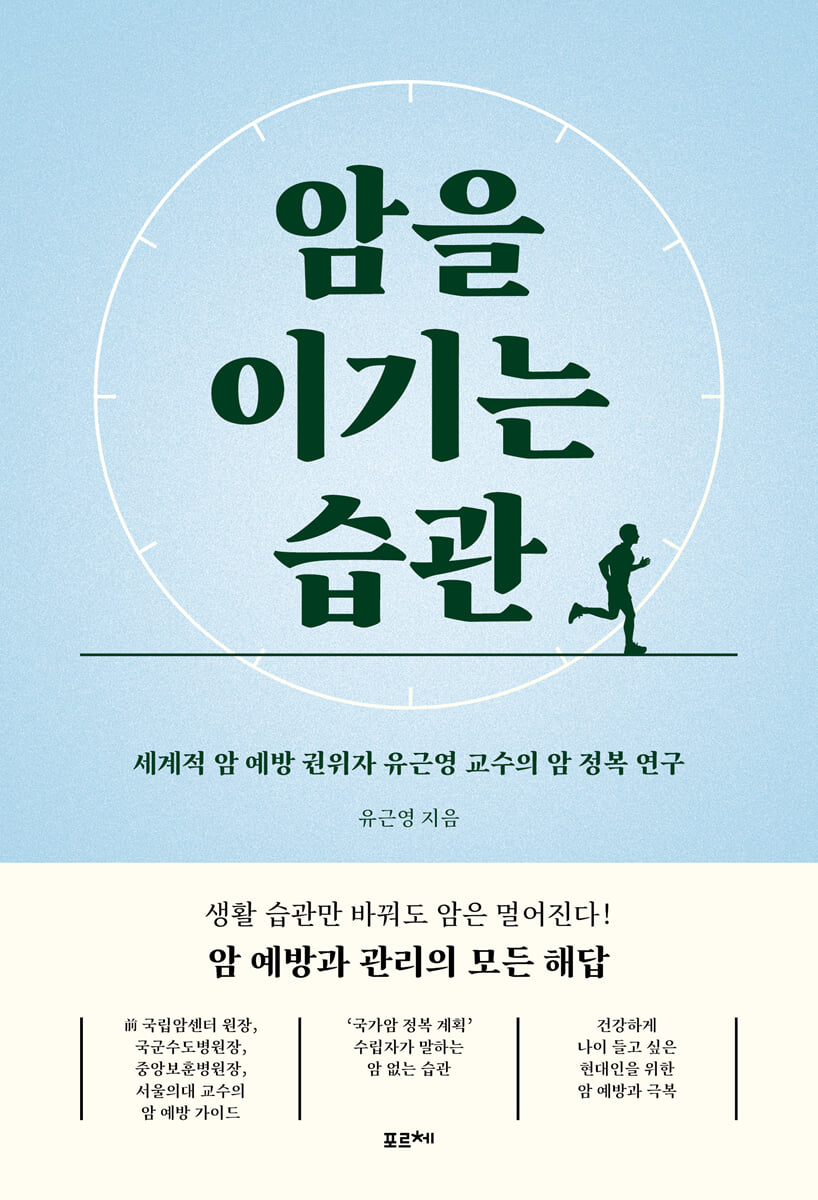
Habits that Beat Cancer
 |
Description
Book Introduction
A cancer prevention guide from Professor Yoo Geun-young, former director of the National Cancer Center and a key figure in establishing the "National Cancer Conquest Plan."
Change your lifestyle and cancer will go away!
A healthy daily life is the most powerful vaccine.
This book is a white paper on cancer prevention in daily life written by Professor Geun-Young Yoo of Seoul National University College of Medicine, a world-renowned authority on cancer prevention who is a living witness to Korean cancer epidemiology research and has paved the way for cancer prevention.
The author emphasizes that 'the most powerful treatment for cancer is prevention.'
Based on his epidemiological research and policy experience accumulated while serving as the Director of the National Cancer Center, the Director of the Central Veterans Hospital, the Director of the Armed Forces Capital Hospital, and the President of major academic societies such as the Asia-Pacific Cancer Prevention Organization, he clearly explains the risk factors for cancer development with scientific evidence and presents specific health guidelines that readers can put into practice in their daily lives.
Authoritative insights, particularly those based on large-scale epidemiological data, including Korean cohort studies and Asian joint studies, provide readers with scientifically grounded lifestyle choices for cancer prevention.
This book contains all the answers to cancer prevention and management that anyone can easily practice in their daily lives, and guides readers through the first steps toward cancer prevention.
"Habits that Beat Cancer" is the result of a lifetime of research on cancer prevention and conquest by Professor Yoo Geun-young, a leading authority in Korea and a world-renowned figure.
It will be the ultimate health guidebook, with medical expertise and practicality, on cancer prevention and overcoming for modern people who want to age healthily.
Change your lifestyle and cancer will go away!
A healthy daily life is the most powerful vaccine.
This book is a white paper on cancer prevention in daily life written by Professor Geun-Young Yoo of Seoul National University College of Medicine, a world-renowned authority on cancer prevention who is a living witness to Korean cancer epidemiology research and has paved the way for cancer prevention.
The author emphasizes that 'the most powerful treatment for cancer is prevention.'
Based on his epidemiological research and policy experience accumulated while serving as the Director of the National Cancer Center, the Director of the Central Veterans Hospital, the Director of the Armed Forces Capital Hospital, and the President of major academic societies such as the Asia-Pacific Cancer Prevention Organization, he clearly explains the risk factors for cancer development with scientific evidence and presents specific health guidelines that readers can put into practice in their daily lives.
Authoritative insights, particularly those based on large-scale epidemiological data, including Korean cohort studies and Asian joint studies, provide readers with scientifically grounded lifestyle choices for cancer prevention.
This book contains all the answers to cancer prevention and management that anyone can easily practice in their daily lives, and guides readers through the first steps toward cancer prevention.
"Habits that Beat Cancer" is the result of a lifetime of research on cancer prevention and conquest by Professor Yoo Geun-young, a leading authority in Korea and a world-renowned figure.
It will be the ultimate health guidebook, with medical expertise and practicality, on cancer prevention and overcoming for modern people who want to age healthily.
- You can preview some of the book's contents.
Preview
index
prolog
Before we begin - Read the Cancer Conqueror: The Beginning of Cancer Prevention
Part 1: We're All Fighting Cancer
Chapter 1: Cancer Can Affect Anyone
I might get cancer someday too 26
31 Reasons Why Some People Win Against Cancer, and Others Lose
Is it possible to prevent cancer? 35
Chapter 2 Cancer that can develop anywhere in the body
Stomach cancer caused by salty or burnt foods 46
Why We Tell You to Eat Vegetables, Not Just Meat: Colon Cancer 52
57 Reasons Why Women Have Different Breast Cancer Incidence Rates
63 Deadly Traces Cigarette Smoke Leaves on Your Lungs
Liver cancer, a silent, deepening disease, 72
Cervical cancer is completely preventable 77
A quiet cancer, thyroid cancer 84
88 Threats to Blood, the Body's Lifeguard
Chapter 3: Hidden Accomplices in Causing Cancer
Obesity is the breeding ground for cancer 94
The Effects of the Chernobyl Nuclear Accident on Cancer 97
Cancer 101: Ethnic Differences
Mysterious Pneumonia, Immune System Depression, and the Possibility of Cancer 105
Southeast Asia's tropical fruits unexpectedly cause cancer 108
The Dangers of Drinking Alcohol Down Your Neck 110
Part 2: Everyday Choices That Prevent Cancer
Chapter 1: Changes in the Table Lead to Changes in the Body
What Happens When You Resist the Temptation of Meat 116
The power of a handful of small but mighty beans: 120
Salt: A Double-Edged Sword for Your Health 124
Greasy Food Causes Breast Cancer 129
*133 Foods That Are Good for Cancer Prevention
*137 Foods Good for Cancer Patients
Chapter 2: 100-Point Lifestyle Habits to Prevent Cancer
Cancer doesn't come overnight 140
There is no such thing as too much alcohol without harm 149
152 Reasons to Avoid the Sun
Regular exercise is a powerful cancer vaccine 156
Chapter 3: Cancer: Knowing It First Can Prevent It
The earlier it is detected, the less scary cancer becomes. 168
The only cancer that can be prevented by vaccination alone 176
*Let's Create Cancer Prevention Habits - 4-Week Plan 180
*The Ins and Outs of Cancer Treatment 186
*A Word to Cancer Researchers, Cancer Patients, and Those of You Who Don't Have Cancer 189
Before we begin - Read the Cancer Conqueror: The Beginning of Cancer Prevention
Part 1: We're All Fighting Cancer
Chapter 1: Cancer Can Affect Anyone
I might get cancer someday too 26
31 Reasons Why Some People Win Against Cancer, and Others Lose
Is it possible to prevent cancer? 35
Chapter 2 Cancer that can develop anywhere in the body
Stomach cancer caused by salty or burnt foods 46
Why We Tell You to Eat Vegetables, Not Just Meat: Colon Cancer 52
57 Reasons Why Women Have Different Breast Cancer Incidence Rates
63 Deadly Traces Cigarette Smoke Leaves on Your Lungs
Liver cancer, a silent, deepening disease, 72
Cervical cancer is completely preventable 77
A quiet cancer, thyroid cancer 84
88 Threats to Blood, the Body's Lifeguard
Chapter 3: Hidden Accomplices in Causing Cancer
Obesity is the breeding ground for cancer 94
The Effects of the Chernobyl Nuclear Accident on Cancer 97
Cancer 101: Ethnic Differences
Mysterious Pneumonia, Immune System Depression, and the Possibility of Cancer 105
Southeast Asia's tropical fruits unexpectedly cause cancer 108
The Dangers of Drinking Alcohol Down Your Neck 110
Part 2: Everyday Choices That Prevent Cancer
Chapter 1: Changes in the Table Lead to Changes in the Body
What Happens When You Resist the Temptation of Meat 116
The power of a handful of small but mighty beans: 120
Salt: A Double-Edged Sword for Your Health 124
Greasy Food Causes Breast Cancer 129
*133 Foods That Are Good for Cancer Prevention
*137 Foods Good for Cancer Patients
Chapter 2: 100-Point Lifestyle Habits to Prevent Cancer
Cancer doesn't come overnight 140
There is no such thing as too much alcohol without harm 149
152 Reasons to Avoid the Sun
Regular exercise is a powerful cancer vaccine 156
Chapter 3: Cancer: Knowing It First Can Prevent It
The earlier it is detected, the less scary cancer becomes. 168
The only cancer that can be prevented by vaccination alone 176
*Let's Create Cancer Prevention Habits - 4-Week Plan 180
*The Ins and Outs of Cancer Treatment 186
*A Word to Cancer Researchers, Cancer Patients, and Those of You Who Don't Have Cancer 189
Detailed image

Into the book
When you're young and healthy, it's easy to feel like cancer is something vague and far away, but it's never far away.
It can happen to anyone, including ourselves, our family, and friends, and no one is exempt from cancer.
Cancer may still be growing inside your body.
--- From "1 in 3 people will get cancer at some point"
Cancer doesn't develop overnight.
It is correct to say that preparations for cancer development are already underway in our bodies.
However, if you maintain your health and develop lifestyle habits that help prevent cancer, cancer will bow its head on its own.
--- From "Helicobacter pylori that survives even in strong acidity"
The natural alternative to a meat-based diet is a vegetarian diet.
A plant-based diet is high in dietary fiber, which promotes bowel movement and helps prevent carcinogens from remaining in the colonic mucosa for a long time.
all.
Additionally, vitamins and antioxidants in vegetables and fruits play a role in suppressing cancer development by lowering oxidative stress in the body.
--- From "What Happens When You Resist the Temptation of Meat"
Some people raise concerns that “eating a lot of soy can cause breast cancer.”
This is because the isoflavones in soybeans have a structure similar to the female hormone estrogen, but research shows that this is not true.
It is claimed that the isoflavones in soybeans act as pro-estrogen or anti-estrogen depending on the situation, supplementing estrogen in postmenopausal women and, conversely, suppressing excessive estrogen action in premenopausal women, thereby reducing the incidence of breast cancer.
--- From "There is no connection between soy consumption and breast cancer"
Consuming good fats ultimately increases our HDL cholesterol levels. HDL, also known as "good cholesterol," transports unnecessary cholesterol from the body to the liver for excretion.
Studies have shown that higher HDL levels are associated with a reduced risk of several diseases, including breast cancer.
--- From "Eat Fat, But Choose Healthy Fat"
Studies have shown that the risk of lung cancer is reduced by more than half after 10 years of quitting smoking, and regular exercise is also known to be effective in preventing colon and breast cancer.
Additionally, early detection of cancer through regular health checkups can significantly improve treatment outcomes.
--- From "Cancer doesn't come overnight"
Until the early 20th century, lung cancer was a relatively rare cancer.
However, starting in the mid-1900s, the incidence of lung cancer began to rise rapidly in the United States and some European countries, and later increased in women as well.
Medical experts have pointed to two reasons for this change.
One is the serious air pollution in large cities, and the other is the rapid increase in the smoking population.
--- From "You must prevent danger just by breathing"
Although cancer has no obvious symptoms in its early stages, it still sends out small signals from our bodies.
If you continue to feel mildly tired or lose weight without any reason, you may experience unusual discomfort or small lumps on your body.
Most people dismiss this as a mild symptom that will get better over time, but being complacent and thinking, "Surely not," can make the illness worse.
When you feel that something is different from usual in your body, the most important thing is not to just ignore it.
It can happen to anyone, including ourselves, our family, and friends, and no one is exempt from cancer.
Cancer may still be growing inside your body.
--- From "1 in 3 people will get cancer at some point"
Cancer doesn't develop overnight.
It is correct to say that preparations for cancer development are already underway in our bodies.
However, if you maintain your health and develop lifestyle habits that help prevent cancer, cancer will bow its head on its own.
--- From "Helicobacter pylori that survives even in strong acidity"
The natural alternative to a meat-based diet is a vegetarian diet.
A plant-based diet is high in dietary fiber, which promotes bowel movement and helps prevent carcinogens from remaining in the colonic mucosa for a long time.
all.
Additionally, vitamins and antioxidants in vegetables and fruits play a role in suppressing cancer development by lowering oxidative stress in the body.
--- From "What Happens When You Resist the Temptation of Meat"
Some people raise concerns that “eating a lot of soy can cause breast cancer.”
This is because the isoflavones in soybeans have a structure similar to the female hormone estrogen, but research shows that this is not true.
It is claimed that the isoflavones in soybeans act as pro-estrogen or anti-estrogen depending on the situation, supplementing estrogen in postmenopausal women and, conversely, suppressing excessive estrogen action in premenopausal women, thereby reducing the incidence of breast cancer.
--- From "There is no connection between soy consumption and breast cancer"
Consuming good fats ultimately increases our HDL cholesterol levels. HDL, also known as "good cholesterol," transports unnecessary cholesterol from the body to the liver for excretion.
Studies have shown that higher HDL levels are associated with a reduced risk of several diseases, including breast cancer.
--- From "Eat Fat, But Choose Healthy Fat"
Studies have shown that the risk of lung cancer is reduced by more than half after 10 years of quitting smoking, and regular exercise is also known to be effective in preventing colon and breast cancer.
Additionally, early detection of cancer through regular health checkups can significantly improve treatment outcomes.
--- From "Cancer doesn't come overnight"
Until the early 20th century, lung cancer was a relatively rare cancer.
However, starting in the mid-1900s, the incidence of lung cancer began to rise rapidly in the United States and some European countries, and later increased in women as well.
Medical experts have pointed to two reasons for this change.
One is the serious air pollution in large cities, and the other is the rapid increase in the smoking population.
--- From "You must prevent danger just by breathing"
Although cancer has no obvious symptoms in its early stages, it still sends out small signals from our bodies.
If you continue to feel mildly tired or lose weight without any reason, you may experience unusual discomfort or small lumps on your body.
Most people dismiss this as a mild symptom that will get better over time, but being complacent and thinking, "Surely not," can make the illness worse.
When you feel that something is different from usual in your body, the most important thing is not to just ignore it.
--- From "The most dangerous thing is to let your guard down and think, 'No way'"
Publisher's Review
Cancer is the leading cause of death in Korea, accounting for 24% of all deaths.
Cancer away, health long
Cancer Prevention Routine to Practice Right Now
Cancer is always the most difficult disease for anyone.
Currently, there are approximately 2.59 million cancer patients, meaning that one in five people has experienced cancer or is undergoing treatment.
24% of deaths in our country are due to cancer.
In this reality, preventing cancer itself has a meaning beyond health.
The author finds the key to cancer prevention in ‘choices in daily life.’
Various research cases and statistics show that specific dietary changes, such as the use of salt and oil at the table, the balance of meat and vegetables, and the appropriate consumption of foods such as beans, can reduce the risk of major cancers such as stomach cancer, colon cancer, and breast cancer.
Improving lifestyle habits, such as regular exercise, maintaining a healthy weight, strictly managing drinking and smoking, and avoiding ultraviolet rays and environmental carcinogens, can strengthen the immune system and reduce inflammation, thereby reducing the risk of cancer.
The book goes beyond simple recommendations and provides immediately applicable practices, such as "foods good for cancer prevention" and a "4-week action plan."
It is structured so that readers, especially those in their middle age and those with a family history of cancer, can clearly see what specific changes they need to make in their daily lives, presenting realistic solutions that anyone can consistently implement.
For modern people who want to age healthily
The basics of cancer prevention and health management
This book urges us not to accept cancer as fate, but to recognize it as a 'preventable disease'.
The author emphasizes that cancer is a process that takes time to develop, and that our choices along the way change the outcome.
Clear guidance on the importance of early screening and vaccine-preventable cancers encourages readers to be more proactive in their use of the healthcare system.
It also emphasizes that not ignoring small signs in daily life (persistent fatigue, unexplained weight loss, unusual pain or lumps) can lead to early detection and significantly improve treatment outcomes.
Finally, the author argues that individuals and society can work together to reduce cancer incidence through scientifically evidence-based prevention strategies, providing readers with realistic and compassionate motivation to design a cancer-free future through actionable changes.
Cancer away, health long
Cancer Prevention Routine to Practice Right Now
Cancer is always the most difficult disease for anyone.
Currently, there are approximately 2.59 million cancer patients, meaning that one in five people has experienced cancer or is undergoing treatment.
24% of deaths in our country are due to cancer.
In this reality, preventing cancer itself has a meaning beyond health.
The author finds the key to cancer prevention in ‘choices in daily life.’
Various research cases and statistics show that specific dietary changes, such as the use of salt and oil at the table, the balance of meat and vegetables, and the appropriate consumption of foods such as beans, can reduce the risk of major cancers such as stomach cancer, colon cancer, and breast cancer.
Improving lifestyle habits, such as regular exercise, maintaining a healthy weight, strictly managing drinking and smoking, and avoiding ultraviolet rays and environmental carcinogens, can strengthen the immune system and reduce inflammation, thereby reducing the risk of cancer.
The book goes beyond simple recommendations and provides immediately applicable practices, such as "foods good for cancer prevention" and a "4-week action plan."
It is structured so that readers, especially those in their middle age and those with a family history of cancer, can clearly see what specific changes they need to make in their daily lives, presenting realistic solutions that anyone can consistently implement.
For modern people who want to age healthily
The basics of cancer prevention and health management
This book urges us not to accept cancer as fate, but to recognize it as a 'preventable disease'.
The author emphasizes that cancer is a process that takes time to develop, and that our choices along the way change the outcome.
Clear guidance on the importance of early screening and vaccine-preventable cancers encourages readers to be more proactive in their use of the healthcare system.
It also emphasizes that not ignoring small signs in daily life (persistent fatigue, unexplained weight loss, unusual pain or lumps) can lead to early detection and significantly improve treatment outcomes.
Finally, the author argues that individuals and society can work together to reduce cancer incidence through scientifically evidence-based prevention strategies, providing readers with realistic and compassionate motivation to design a cancer-free future through actionable changes.
GOODS SPECIFICS
- Date of issue: October 1, 2025
- Page count, weight, size: 192 pages | 356g | 150*220*12mm
- ISBN13: 9791194634560
- ISBN10: 1194634567
You may also like
카테고리
korean


korean

![ELLE 엘르 스페셜 에디션 A형 : 12월 [2025]](http://librairie.coreenne.fr/cdn/shop/files/b8e27a3de6c9538896439686c6b0e8fb.jpg?v=1766436872&width=3840)


