

Such a beautiful brain
 |
Description
Book Introduction
UNESCO World Heritage Site
Includes over 80 rare brain drawings
Nobel Prize winner in Physiology or Medicine,
The Life and Paintings of Ramon y Cajal, the Father of Neuroscience
Scientist and artist Santiago Ramón y Cajal, a compulsive doodler and meticulous observer, obsessively explored the brain, creating hand-drawn drawings of its structure as we know it today.
He also proposed 'neuronism', which states that the brain is made up of individual cells, and in 1906 the Nobel Committee awarded him the 'Nobel Prize in Physiology or Medicine' in recognition of his research achievements.
In 1997, the paintings and records he left behind were selected as UNESCO Memory of the World.
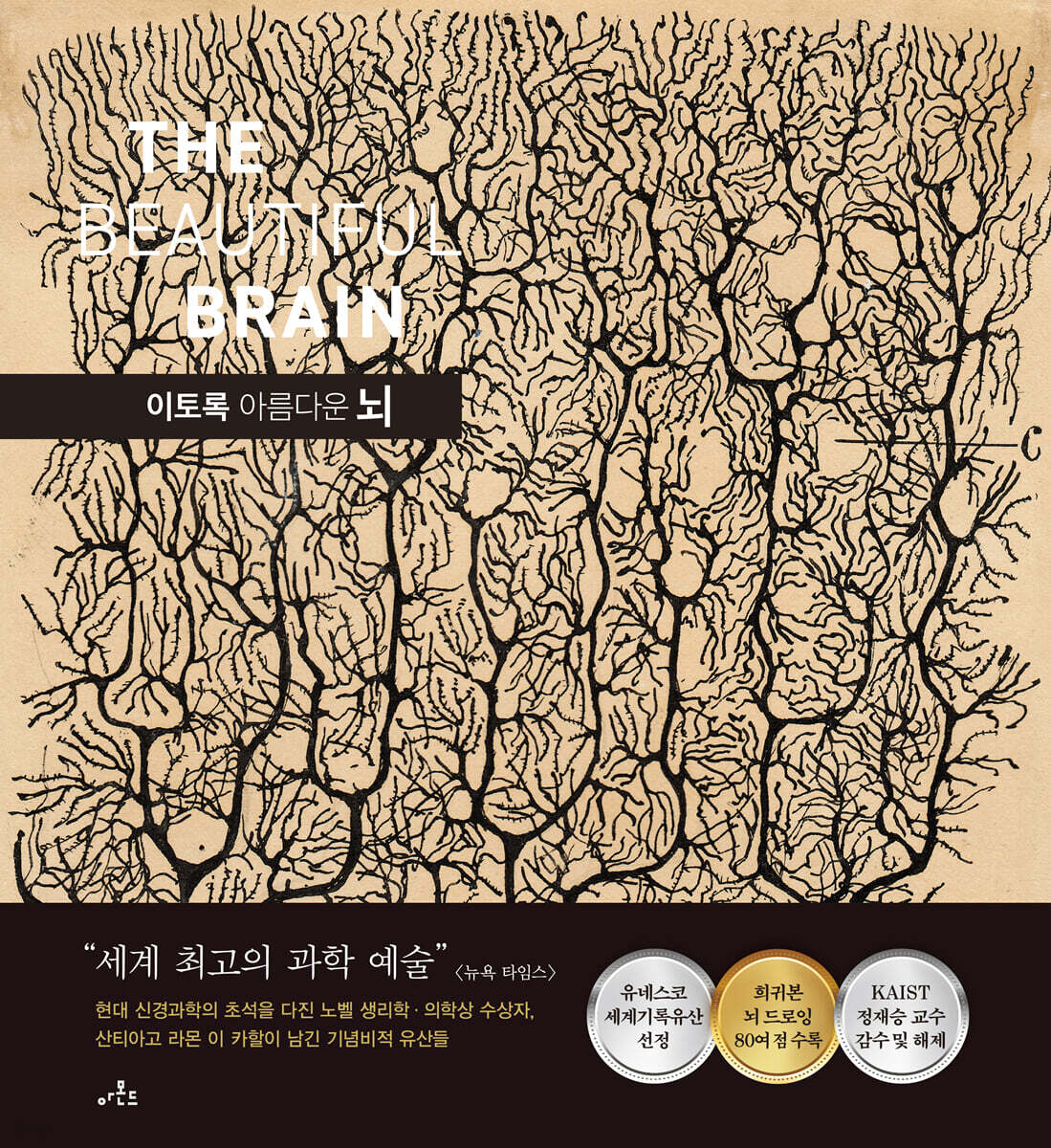
This book contains over 80 illustrations, from Ramón y Cajal's most representative drawing, 'Pyramidal Neurons of the Cerebral Cortex', to rare illustrations that have never been published before.
Here lies the vast and beautiful legacy of a pioneer who, before anyone else, explored the 1.4 kilograms of space contained within our bodies and walked the boundless forest of the nervous system.
Includes over 80 rare brain drawings
Nobel Prize winner in Physiology or Medicine,
The Life and Paintings of Ramon y Cajal, the Father of Neuroscience
Scientist and artist Santiago Ramón y Cajal, a compulsive doodler and meticulous observer, obsessively explored the brain, creating hand-drawn drawings of its structure as we know it today.
He also proposed 'neuronism', which states that the brain is made up of individual cells, and in 1906 the Nobel Committee awarded him the 'Nobel Prize in Physiology or Medicine' in recognition of his research achievements.
In 1997, the paintings and records he left behind were selected as UNESCO Memory of the World.
This book contains over 80 illustrations, from Ramón y Cajal's most representative drawing, 'Pyramidal Neurons of the Cerebral Cortex', to rare illustrations that have never been published before.
Here lies the vast and beautiful legacy of a pioneer who, before anyone else, explored the 1.4 kilograms of space contained within our bodies and walked the boundless forest of the nervous system.
- You can preview some of the book's contents.
Preview
index
The Beautiful Brain - Eric A.
Newman, Alfonso Araque, and Janet M.
Dubinsky
Santiago Ramón y Cajal - Larry W.
Swanson
Drawing the Beautiful Brain - Lindell King and Eric Himmel
Pictures
The cells that make up the brain
sensory system
neuron pathways
Development and Pathology
The Beautiful Brain We See Now - Janet M.
Dubinsky
Acknowledgements
Unlock - The Scientist Who Painted the Picture, The Artist Who Saw the Brain
References
index
Newman, Alfonso Araque, and Janet M.
Dubinsky
Santiago Ramón y Cajal - Larry W.
Swanson
Drawing the Beautiful Brain - Lindell King and Eric Himmel
Pictures
The cells that make up the brain
sensory system
neuron pathways
Development and Pathology
The Beautiful Brain We See Now - Janet M.
Dubinsky
Acknowledgements
Unlock - The Scientist Who Painted the Picture, The Artist Who Saw the Brain
References
index
Detailed image

Into the book
What is remarkable is that Ramón y Cajal's detailed brain drawings remain relevant even today, a century later.
The reason we still consult and include his paintings is because they possess an unrivaled level of clarity and ability to express universal concepts.
A single painting by Ramón y Cajal often explains a basic principle or a sequence of events more clearly and concisely than dozens of photographs.
--- p.9
The brain is such an important object that in the late 19th century, the most talented scientists in Europe were absorbed in uncovering its secrets.
This was a very challenging and controversial task.
Even if things went well and we were able to see a part of the brain under a microscope, interpreting it was extremely difficult.
To borrow a metaphor favored by Ramón y Cajal, imagine entering a forest of a hundred billion trees with only a sketchbook, spending several years observing a few of them each day, each so tangled and indistinguishable from the next, and then trying to compile a pocket guide to that forest.
You won't make any progress if you simply draw what you see every day.
You have to build in your head the rules of the forest's composition, and then you have to be able to precisely compare what you see with those rules, and you have to be flexible enough to modify the concepts you've held in your head based on what you observe.
This combination of difficult reasoning and drawing skills was by far the best of those who did the same work, and Ramón y Cajal, after exploring the Forest of Nerves, created the finest portable guide to that forest.
--- p.26
Just as da Vinci's curiosity in opening up the human body and drawing what he saw symbolizes the Renaissance, Ramón y Cajal's human insight in depicting the complex information processing circuitry created by constantly changing biological tissue symbolizes our times.
Since Ramón y Cajal, we have witnessed mounting evidence that there may be a literal truth to the notion of a brain as vast and mysterious as the universe, a metaphor favored by poets for centuries.
What we see in his paintings today are not mere diagrams or assertions, but landscapes clearly depicted for the first time, as witnessed by someone who traveled to the farthest reaches of that boundless frontier.
--- p.32
The dendritic spines are one of Ramón y Cajal's most important discoveries.
When he stained neurons with the Golgi technique, he saw that the dendrites of the neurons were covered with fine, hair-like spines.
Other contemporaries believed that these spines were byproducts of the Golgi staining process and did not exist in living cells.
To counter that claim, Ramón y Cajal demonstrated that dendritic spines were visible even when dyed in a completely different way.
--- p.49
One of Ramón y Cajal's important contributions to neuroscience was his inference of the direction in which information flows within the brain.
A neuron consists of a cell body, a series of thick, branch-like projections called dendrites, and a long, thin axon.
Ramón y Cajal deduced that information flows from dendrites to the cell body and from the cell body to the axon.
--- p.88
Without Ramón y Cajal's neuronism and dynamic polarization theory, we would not have our modern understanding of how the brain works.
--- p.126
Neuroscience has made steady progress in the century since Ramón y Cajal discovered that neurons are the individual units that transmit signals in cellular circuits.
We can now 'see' more inside the brain than Ramón y Cajal could with his tools.
He also gained an understanding, though not perfect, of how the neurons and synapses he identified communicate with each other within the body at a microscopic, molecular level.
But the connectome, the "wiring diagram" of the entire brain that varies depending on each individual's experience, has not yet been fully deciphered.
We don't know how a 1.4-kilogram brain made of water, oil, small molecules, and proteins can perform so many calculations while using so little energy.
The reason we still consult and include his paintings is because they possess an unrivaled level of clarity and ability to express universal concepts.
A single painting by Ramón y Cajal often explains a basic principle or a sequence of events more clearly and concisely than dozens of photographs.
--- p.9
The brain is such an important object that in the late 19th century, the most talented scientists in Europe were absorbed in uncovering its secrets.
This was a very challenging and controversial task.
Even if things went well and we were able to see a part of the brain under a microscope, interpreting it was extremely difficult.
To borrow a metaphor favored by Ramón y Cajal, imagine entering a forest of a hundred billion trees with only a sketchbook, spending several years observing a few of them each day, each so tangled and indistinguishable from the next, and then trying to compile a pocket guide to that forest.
You won't make any progress if you simply draw what you see every day.
You have to build in your head the rules of the forest's composition, and then you have to be able to precisely compare what you see with those rules, and you have to be flexible enough to modify the concepts you've held in your head based on what you observe.
This combination of difficult reasoning and drawing skills was by far the best of those who did the same work, and Ramón y Cajal, after exploring the Forest of Nerves, created the finest portable guide to that forest.
--- p.26
Just as da Vinci's curiosity in opening up the human body and drawing what he saw symbolizes the Renaissance, Ramón y Cajal's human insight in depicting the complex information processing circuitry created by constantly changing biological tissue symbolizes our times.
Since Ramón y Cajal, we have witnessed mounting evidence that there may be a literal truth to the notion of a brain as vast and mysterious as the universe, a metaphor favored by poets for centuries.
What we see in his paintings today are not mere diagrams or assertions, but landscapes clearly depicted for the first time, as witnessed by someone who traveled to the farthest reaches of that boundless frontier.
--- p.32
The dendritic spines are one of Ramón y Cajal's most important discoveries.
When he stained neurons with the Golgi technique, he saw that the dendrites of the neurons were covered with fine, hair-like spines.
Other contemporaries believed that these spines were byproducts of the Golgi staining process and did not exist in living cells.
To counter that claim, Ramón y Cajal demonstrated that dendritic spines were visible even when dyed in a completely different way.
--- p.49
One of Ramón y Cajal's important contributions to neuroscience was his inference of the direction in which information flows within the brain.
A neuron consists of a cell body, a series of thick, branch-like projections called dendrites, and a long, thin axon.
Ramón y Cajal deduced that information flows from dendrites to the cell body and from the cell body to the axon.
--- p.88
Without Ramón y Cajal's neuronism and dynamic polarization theory, we would not have our modern understanding of how the brain works.
--- p.126
Neuroscience has made steady progress in the century since Ramón y Cajal discovered that neurons are the individual units that transmit signals in cellular circuits.
We can now 'see' more inside the brain than Ramón y Cajal could with his tools.
He also gained an understanding, though not perfect, of how the neurons and synapses he identified communicate with each other within the body at a microscopic, molecular level.
But the connectome, the "wiring diagram" of the entire brain that varies depending on each individual's experience, has not yet been fully deciphered.
We don't know how a 1.4-kilogram brain made of water, oil, small molecules, and proteins can perform so many calculations while using so little energy.
--- p.207
Publisher's Review
An unprecedented achievement in modern scientific history! A groundbreaking meeting of science and art!
He devoted himself to brain research for over 50 years and left behind 3,000 brain anatomical maps.
The life and paintings of neuroscientist and artist Santiago Ramón y Cajal
The hidden giant of science,
Shifting the fundamental paradigm of neuroscience
The brain is the central organ that enables human thought, emotion, and behavior, but its structure and operation have long remained unknown.
Over the years, countless scientists have dedicated their lives to understanding how humans think, feel emotions, and decide how to act—in other words, to accurately understand the brain.
Santiago Ramon y Cajal (1852-1934), a Spanish physician and scientist, is a pioneering figure known as the father of neuroscience, the study of the brain.
Ramón y Cajal approached brain research in a more daring way than anyone else.
Holding a pen in his hand, he observed the smallest unit of the brain, the nerve cell, through a microscope and recorded it in a detailed drawing.
Based on his observations and inferences, Ramón y Cajal directly refuted the existing 'Reticular Theory' that the brain is connected like a giant mesh network, and discovered that it is made up of individual cellular units called 'neurons'.
The 'Neuron Doctrine' he proposed was an innovative discovery that fundamentally changed the paradigm of neuroscience.
This concept, which adorns the introduction of neuroscience textbooks today, serves as the foundation and starting point for brain research.
《THE BEAUTIFUL BRAIN》(Almond Publishing) condenses Ramón y Cajal's discoveries and the extraordinary visual legacy he left behind into one volume.
Ramón y Cajal's achievements in uncovering the structure and components of the brain were a turning point in the history of science, comparable to Charles Darwin's theory of evolution and Louis Pasteur's bacteriology, yet his name is relatively unknown.
In that sense, “This Beautiful Brain” is a book that revives the voice of Santiago Ramón y Cajal, a hidden giant in the scientific world.
From neuronalism to dynamic polarization theory,
A scientist who discovered concepts essential to understanding how human thought, behavior, and emotions are formed.
Ramón y Cajal not only proposed 'neuronalism', which states that the brain is made up of individual cells called neurons, but also presented important theories about the principles of information transmission between neurons.
He discovered that neural information flows in a certain direction within a neuron (from the dendrite to the cell body, and then to the axon), and organized this into the 'dynamic polarization theory'.
This theory shows that neurons are not simply isolated cells, but interact through directed flow to form a network.
These insights have become an essential starting point for understanding how human thoughts, actions, and emotions are formed.
Ramón y Cajal's achievements caused a great stir in the academic world at the time.
In 1906, he was awarded the Nobel Prize in Physiology or Medicine, together with Golgi, for their work on the structure of the nervous system.
But his achievements don't end with just awards.
Through his research on the nervous system, he not only scientifically proved that the brain is made up of individual cells, but also left this in a visual format that anyone could understand.
This was an example that showed the possibility that science could reach a wider audience through the language of art.
How Science Transforms into Art
A collection of scientific experiments filled with precision and a collection of sensory and wondrous works of art.
What made Santiago Ramón y Cajal's research special was that he recorded the neurons he observed in a unique way.
He succeeded in clearly revealing nerve cells by improving the staining method devised by Camillo Golgi of Italy at the time.
And instead of simply describing the shapes of the cells he observed in words, he drew them by hand, leaving behind precise drawings.
According to Ramón y Cajal, he created over 12,000 drawings of brains, of which only about 2,900 survive today.
His drawings vividly depict the countless branches, projections, and fine connections of neurons, and they are more than just records.
Paintings are the most accurate means of conveying scientific facts, while also being works of art that inspire wonder in the viewer.
This work, which depicted the structural features and connection patterns of cells in such detail, provided later researchers with a visual foundation for understanding how the brain works.
At the same time, the visual language he left behind in his drawings became a tool for intuitively explaining the complexities of brain science to the public.
"This Beautiful Brain" contains over 80 drawings, including his most representative brain drawing, "Pyramidal Neurons of the Cerebral Cortex," as well as drawings that have never been shown to the public before.
Through his paintings, we can see firsthand how scientific inquiry can be elevated to art.
The science of penetrating the possibilities beyond phenomena,
A book that broadens your understanding of the world
This book blurs the lines between science and art, proving that we can simultaneously pursue knowledge and beauty.
Ramón y Cajal's drawings reveal the workings of the brain more clearly than today's high-resolution brain scans, yet they are as moving as works of art.
Ramón y Cajal did not leave the appearance of cells that could be observed under a microscope as mere 'facts'.
He envisioned possibilities beyond what we see, including the interactions and signal flows that occur between cells.
This is an example of how scientists understand the world, and at the same time, it reminds us how we can solve complex problems with imagination.
His theories and drawings remain a starting point and source of inspiration for modern neuroscientists.
Today we live in a world of constant connectivity and information flow.
Just as neurons in the brain exchange signals through synapses, human society is also intertwined with invisible networks.
"This Beautiful Brain" invites us to view this complexity not with fear, but with beauty.
It clearly shows that science is not just a discipline that accumulates facts, but an insight that allows us to see the world with new eyes.
Professor Jaeseung Jeong of KAIST evaluates Kahal's work in the following way:
“It contains the joy of observing, constructing, and reproducing, the method of bringing hypotheses from the head to the fingertips, and the aesthetics of scientific thinking that requires both reason and aesthetics.”
Ultimately, reading “This Beautiful Brain” is not simply about confirming the achievements of a scientist.
It is an experience that broadens your understanding of the world and simultaneously revives your scientific imagination and artistic sensibility.
This is why Ramón y Cajal's paintings and studies, despite being products of 100 years ago, still retain their relevance.
He devoted himself to brain research for over 50 years and left behind 3,000 brain anatomical maps.
The life and paintings of neuroscientist and artist Santiago Ramón y Cajal
The hidden giant of science,
Shifting the fundamental paradigm of neuroscience
The brain is the central organ that enables human thought, emotion, and behavior, but its structure and operation have long remained unknown.
Over the years, countless scientists have dedicated their lives to understanding how humans think, feel emotions, and decide how to act—in other words, to accurately understand the brain.
Santiago Ramon y Cajal (1852-1934), a Spanish physician and scientist, is a pioneering figure known as the father of neuroscience, the study of the brain.
Ramón y Cajal approached brain research in a more daring way than anyone else.
Holding a pen in his hand, he observed the smallest unit of the brain, the nerve cell, through a microscope and recorded it in a detailed drawing.
Based on his observations and inferences, Ramón y Cajal directly refuted the existing 'Reticular Theory' that the brain is connected like a giant mesh network, and discovered that it is made up of individual cellular units called 'neurons'.
The 'Neuron Doctrine' he proposed was an innovative discovery that fundamentally changed the paradigm of neuroscience.
This concept, which adorns the introduction of neuroscience textbooks today, serves as the foundation and starting point for brain research.
《THE BEAUTIFUL BRAIN》(Almond Publishing) condenses Ramón y Cajal's discoveries and the extraordinary visual legacy he left behind into one volume.
Ramón y Cajal's achievements in uncovering the structure and components of the brain were a turning point in the history of science, comparable to Charles Darwin's theory of evolution and Louis Pasteur's bacteriology, yet his name is relatively unknown.
In that sense, “This Beautiful Brain” is a book that revives the voice of Santiago Ramón y Cajal, a hidden giant in the scientific world.
From neuronalism to dynamic polarization theory,
A scientist who discovered concepts essential to understanding how human thought, behavior, and emotions are formed.
Ramón y Cajal not only proposed 'neuronalism', which states that the brain is made up of individual cells called neurons, but also presented important theories about the principles of information transmission between neurons.
He discovered that neural information flows in a certain direction within a neuron (from the dendrite to the cell body, and then to the axon), and organized this into the 'dynamic polarization theory'.
This theory shows that neurons are not simply isolated cells, but interact through directed flow to form a network.
These insights have become an essential starting point for understanding how human thoughts, actions, and emotions are formed.
Ramón y Cajal's achievements caused a great stir in the academic world at the time.
In 1906, he was awarded the Nobel Prize in Physiology or Medicine, together with Golgi, for their work on the structure of the nervous system.
But his achievements don't end with just awards.
Through his research on the nervous system, he not only scientifically proved that the brain is made up of individual cells, but also left this in a visual format that anyone could understand.
This was an example that showed the possibility that science could reach a wider audience through the language of art.
How Science Transforms into Art
A collection of scientific experiments filled with precision and a collection of sensory and wondrous works of art.
What made Santiago Ramón y Cajal's research special was that he recorded the neurons he observed in a unique way.
He succeeded in clearly revealing nerve cells by improving the staining method devised by Camillo Golgi of Italy at the time.
And instead of simply describing the shapes of the cells he observed in words, he drew them by hand, leaving behind precise drawings.
According to Ramón y Cajal, he created over 12,000 drawings of brains, of which only about 2,900 survive today.
His drawings vividly depict the countless branches, projections, and fine connections of neurons, and they are more than just records.
Paintings are the most accurate means of conveying scientific facts, while also being works of art that inspire wonder in the viewer.
This work, which depicted the structural features and connection patterns of cells in such detail, provided later researchers with a visual foundation for understanding how the brain works.
At the same time, the visual language he left behind in his drawings became a tool for intuitively explaining the complexities of brain science to the public.
"This Beautiful Brain" contains over 80 drawings, including his most representative brain drawing, "Pyramidal Neurons of the Cerebral Cortex," as well as drawings that have never been shown to the public before.
Through his paintings, we can see firsthand how scientific inquiry can be elevated to art.
The science of penetrating the possibilities beyond phenomena,
A book that broadens your understanding of the world
This book blurs the lines between science and art, proving that we can simultaneously pursue knowledge and beauty.
Ramón y Cajal's drawings reveal the workings of the brain more clearly than today's high-resolution brain scans, yet they are as moving as works of art.
Ramón y Cajal did not leave the appearance of cells that could be observed under a microscope as mere 'facts'.
He envisioned possibilities beyond what we see, including the interactions and signal flows that occur between cells.
This is an example of how scientists understand the world, and at the same time, it reminds us how we can solve complex problems with imagination.
His theories and drawings remain a starting point and source of inspiration for modern neuroscientists.
Today we live in a world of constant connectivity and information flow.
Just as neurons in the brain exchange signals through synapses, human society is also intertwined with invisible networks.
"This Beautiful Brain" invites us to view this complexity not with fear, but with beauty.
It clearly shows that science is not just a discipline that accumulates facts, but an insight that allows us to see the world with new eyes.
Professor Jaeseung Jeong of KAIST evaluates Kahal's work in the following way:
“It contains the joy of observing, constructing, and reproducing, the method of bringing hypotheses from the head to the fingertips, and the aesthetics of scientific thinking that requires both reason and aesthetics.”
Ultimately, reading “This Beautiful Brain” is not simply about confirming the achievements of a scientist.
It is an experience that broadens your understanding of the world and simultaneously revives your scientific imagination and artistic sensibility.
This is why Ramón y Cajal's paintings and studies, despite being products of 100 years ago, still retain their relevance.
GOODS SPECIFICS
- Date of issue: September 25, 2025
- Format: Hardcover book binding method guide
- Page count, weight, size: 219 pages | 1,214g | 235*257*22mm
- ISBN13: 9791192465265
- ISBN10: 1192465261
You may also like
카테고리
korean


korean

![GQ KOREA Mark (Monthly): December [2025]](http://librairie.coreenne.fr/cdn/shop/files/8ef265dbbfbf186523ed75ba7319009d.jpg?v=1765340328&width=3840)


