

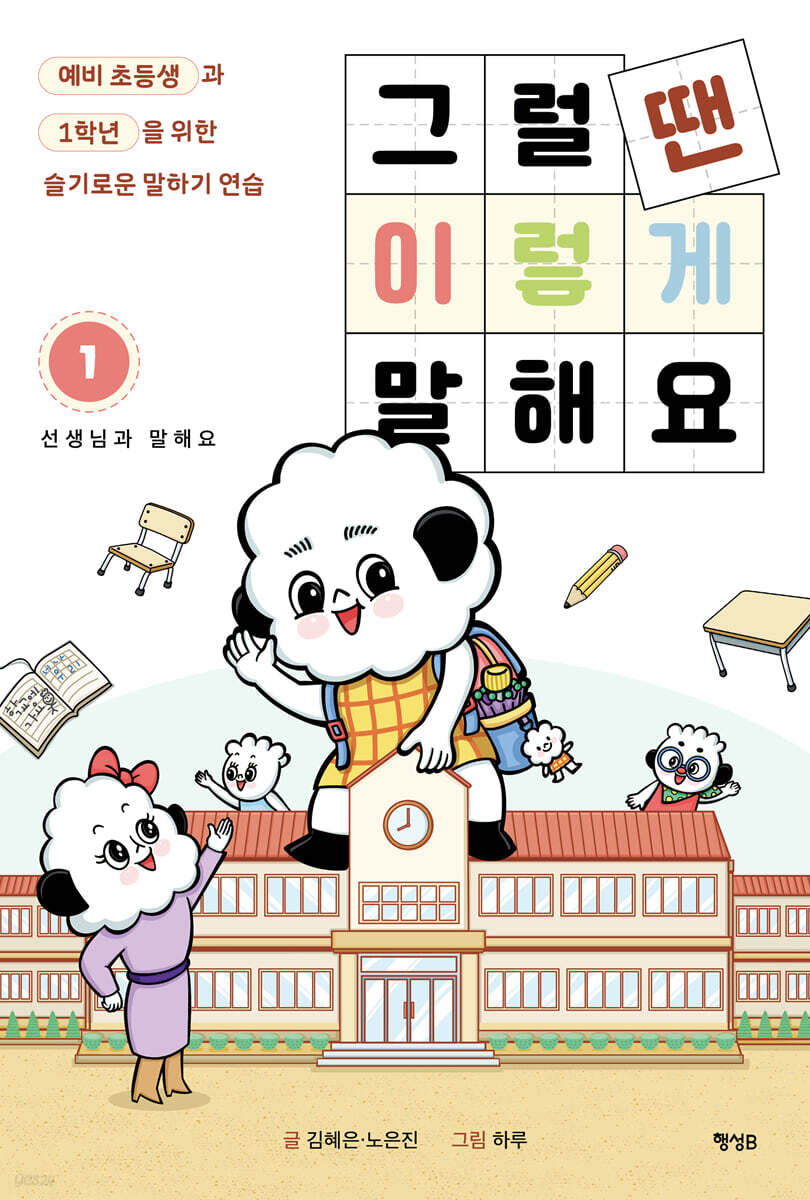
When that happens, say this Part 1: Talk to the teacher
 |
Description
Book Introduction
How to communicate with your teacher, written by two elementary school teachers with over 20 years of experience.
Smart Speaking Practice for Pre-Elementary and First Graders
Every March, children enter school.
Our friends become elementary school students and begin their school life with excitement.
But freshman life isn't always exciting.
Students must find their own classrooms and attend after-school classes that vary daily.
Also, I have to prepare my own supplies and there are more tasks to do.
Doing this much work can be tiring.
I feel upset because I don't listen to the teacher and I don't like the rules.
But if I can express my thoughts and feelings in 'words', I can adapt quickly.
Especially if you can convey your situation to your teacher, you can do well in school.
This book was written by two teachers who are currently teaching elementary school students for pre-elementary school students and first graders.
We've compiled a list of common challenges first graders face in the classroom, on the playground, in the cafeteria, and in the library, along with ways to work with teachers to resolve those situations.
We've also included parenting tips so you can read together at home.
These tips will be useful to parents.
Because you can teach your children to make school life easier.
Smart Speaking Practice for Pre-Elementary and First Graders
Every March, children enter school.
Our friends become elementary school students and begin their school life with excitement.
But freshman life isn't always exciting.
Students must find their own classrooms and attend after-school classes that vary daily.
Also, I have to prepare my own supplies and there are more tasks to do.
Doing this much work can be tiring.
I feel upset because I don't listen to the teacher and I don't like the rules.
But if I can express my thoughts and feelings in 'words', I can adapt quickly.
Especially if you can convey your situation to your teacher, you can do well in school.
This book was written by two teachers who are currently teaching elementary school students for pre-elementary school students and first graders.
We've compiled a list of common challenges first graders face in the classroom, on the playground, in the cafeteria, and in the library, along with ways to work with teachers to resolve those situations.
We've also included parenting tips so you can read together at home.
These tips will be useful to parents.
Because you can teach your children to make school life easier.
- You can preview some of the book's contents.
Preview
index
To first graders and their parents: Enjoy an exciting school life, learning through communication with teachers.
Part 1_I entered school
1. I don't know where the classroom is.
2. Class has started, but I can't see my textbook.
3. I don't know left and right
4. I accidentally pooped my pants.
5. I was late because I overslept.
6. I came to school and I miss my mom.
7. I need to pee during class.
8. I have trouble sitting still in the classroom.
9. I don't know where to go after class.
Part 2_Studying as an elementary school student
10. I can't write in Korean.
11. It's difficult to cut along the line.
12. The colors keep getting crooked.
13. I don't understand the game rules.
14. I have a question I don't know.
15. I didn't bring my homework.
16. I solved all the math problems, but I want to do origami.
17. I didn't finish my homework, but I have to go to school.
18. I wish I could take the dictation test soon.
19. I can't see the writing on the blackboard.
20. I want to write beautifully.
21. My heart races when it's presentation time.
22. My friend was talking nonsense, but I was the only one who got in trouble.
Part 3: After lunch, we go to the library.
23. I want to eat more school lunch.
24. Do I have to eat rice diligently?
25. I don't like spicy food.
26. I accidentally threw the trash in the trash can.
27. I ate food without knowing it was allergic.
28. I can't open the dessert lid.
29. My stomach hurts whenever I eat rice.
30·I want to eat lunch and play on the playground.
31. I want to find my favorite book at the library.
32. I want to read library books at home.
33. I was late for class because I was reading a book.
34. I lost a book I borrowed from the library.
Part 4: Adapting to Group Life and Rules
35. I got confused while running in the hallway.
36. I was the only one who couldn't present.
37. Cell phones must be turned off in the classroom.
38. Mom said not to do milk duty.
39. I hate physical activity time.
40·I don't want to do difficult activities.
41·I was the only one who didn't wear a half-shirt.
42. I don't want to work hard on my homework.
43. The teacher keeps telling me to fix it again.
44. My magic colored pencils disappeared.
45. I didn't bring a jump rope.
Part 5_If you are sick or in an emergency!
46. I got a nosebleed.
47. My head hurts.
48. My friend touched my precious spot.
49. I want to hug my teacher.
50. The zipper is broken, so I can't take my clothes off.
51·I feel bad about being alone in the open parent class.
52. I don't know what to bring to the flea market.
53. It's raining even though I didn't bring an umbrella.
54·Teacher, my mom hit me yesterday.
Part 1_I entered school
1. I don't know where the classroom is.
2. Class has started, but I can't see my textbook.
3. I don't know left and right
4. I accidentally pooped my pants.
5. I was late because I overslept.
6. I came to school and I miss my mom.
7. I need to pee during class.
8. I have trouble sitting still in the classroom.
9. I don't know where to go after class.
Part 2_Studying as an elementary school student
10. I can't write in Korean.
11. It's difficult to cut along the line.
12. The colors keep getting crooked.
13. I don't understand the game rules.
14. I have a question I don't know.
15. I didn't bring my homework.
16. I solved all the math problems, but I want to do origami.
17. I didn't finish my homework, but I have to go to school.
18. I wish I could take the dictation test soon.
19. I can't see the writing on the blackboard.
20. I want to write beautifully.
21. My heart races when it's presentation time.
22. My friend was talking nonsense, but I was the only one who got in trouble.
Part 3: After lunch, we go to the library.
23. I want to eat more school lunch.
24. Do I have to eat rice diligently?
25. I don't like spicy food.
26. I accidentally threw the trash in the trash can.
27. I ate food without knowing it was allergic.
28. I can't open the dessert lid.
29. My stomach hurts whenever I eat rice.
30·I want to eat lunch and play on the playground.
31. I want to find my favorite book at the library.
32. I want to read library books at home.
33. I was late for class because I was reading a book.
34. I lost a book I borrowed from the library.
Part 4: Adapting to Group Life and Rules
35. I got confused while running in the hallway.
36. I was the only one who couldn't present.
37. Cell phones must be turned off in the classroom.
38. Mom said not to do milk duty.
39. I hate physical activity time.
40·I don't want to do difficult activities.
41·I was the only one who didn't wear a half-shirt.
42. I don't want to work hard on my homework.
43. The teacher keeps telling me to fix it again.
44. My magic colored pencils disappeared.
45. I didn't bring a jump rope.
Part 5_If you are sick or in an emergency!
46. I got a nosebleed.
47. My head hurts.
48. My friend touched my precious spot.
49. I want to hug my teacher.
50. The zipper is broken, so I can't take my clothes off.
51·I feel bad about being alone in the open parent class.
52. I don't know what to bring to the flea market.
53. It's raining even though I didn't bring an umbrella.
54·Teacher, my mom hit me yesterday.
Detailed image

Into the book
· I went to school alone today, but I can't see the first grade class I saw yesterday! (Omitted) I can't find my class.
How do you say this?
♥ The school building is large and there are many classrooms, so there are often students who can't find their classrooms.
You should definitely remember your grade and class so that you can find your classroom when that happens.
It would be better if you also remember your homeroom teacher's name.
(syncopation)
When you can't see the classroom, try talking to adults passing by or your older sisters.
Or you can just walk into any part of the school and say something like:
Then everyone will help our friends.
“I’m in class 1, grade 1.
I don't know where the classroom is.
“Please let me know.”
·(Parenting Tip) Depending on the school, parents may accompany their children to the classroom for 1-2 weeks after they enroll. During this time, practicing finding the classroom through various entrances and exits with your child will help them develop a sense of direction.
If you tell your child the location of the places you are going and move with them during your daily life, they will develop a sense of direction and it will be helpful wherever they go.
--- 「1.
"I don't know where the classroom is"
· “If you don’t use your hands, you won’t be able to write properly.” (Omitted) Looking at my notebook, my handwriting is a mess.
I also want to write beautifully like my friend.
What do you do in this situation?
♥ First, learn how to hold a pencil correctly: You need to hold a pencil correctly to write correctly and quickly.
If you hold your pencil incorrectly, you are more likely to not be able to write beautifully and quickly even as you advance in grades.
Second, practice drawing lines: Hold the pencil and practice drawing thick lines by applying force to your hand.
Third, remember the exact stroke order of writing the letters: Remember the exact order of writing the letters that your teacher teaches you and practice it several times.
Fourth, using Korean language activities: After the Korean language activities, there is a section where you can practice writing correctly.
If you consistently practice writing with strength in your hand, you will definitely be able to write beautifully.
·(Parenting Tip) There are many students and parents who are concerned about their handwriting, even in the upper grades.
It will be of great help if you learn how to write correctly in the first grade.
You can think of the first grade curriculum as being all about writing correctly and developing good living habits.
Even if your child finds it difficult, if you practice by increasing the amount little by little every day, he or she will soon be able to write correctly.
And when you learn to write correctly, you will also be able to cut and color well.
--- 「20.
From "I want to write beautifully"
· 'I can't open this.
Who should I ask?' (Omitted) I'm thirsty and want to drink some juice first, but I can't open the lid.
How do you say this?
♥ When first graders are eating, their homeroom teacher is very busy.
Sometimes you have to warn them that fish might have bones, and other times you have to show them how to open a dessert bag.
And sometimes new foods require teaching them how to eat them.
If you pay attention to all your friends in class like this, there are times when the teacher can't see you and can't help you in advance.
In that case, try saying this.
“Teacher, I can’t open the drink cap properly.
help."
And if you look around, you'll definitely find someone who's good at opening drink caps.
Asking a close friend for help is also a good idea.
“Friend, you really open the lid well.
“Can you help me?”
If you praise your friend for something he or she does well and ask him or her to do it for you, he or she will feel good about helping you.
·(Parent Tip) Sometimes, desserts or drinks are served in containers that are difficult to open during meals.
Actually, there is no need to worry about first grade because the teacher will help you most of the time.
However, since you can't inspect it as closely as you can at home, it's a good idea to learn how to open the lid or tear the plastic yourself.
Give yourself frequent opportunities to practice at home, such as opening the lids of various bottles or tearing open the plastic wrap on desserts.
How do you say this?
♥ The school building is large and there are many classrooms, so there are often students who can't find their classrooms.
You should definitely remember your grade and class so that you can find your classroom when that happens.
It would be better if you also remember your homeroom teacher's name.
(syncopation)
When you can't see the classroom, try talking to adults passing by or your older sisters.
Or you can just walk into any part of the school and say something like:
Then everyone will help our friends.
“I’m in class 1, grade 1.
I don't know where the classroom is.
“Please let me know.”
·(Parenting Tip) Depending on the school, parents may accompany their children to the classroom for 1-2 weeks after they enroll. During this time, practicing finding the classroom through various entrances and exits with your child will help them develop a sense of direction.
If you tell your child the location of the places you are going and move with them during your daily life, they will develop a sense of direction and it will be helpful wherever they go.
--- 「1.
"I don't know where the classroom is"
· “If you don’t use your hands, you won’t be able to write properly.” (Omitted) Looking at my notebook, my handwriting is a mess.
I also want to write beautifully like my friend.
What do you do in this situation?
♥ First, learn how to hold a pencil correctly: You need to hold a pencil correctly to write correctly and quickly.
If you hold your pencil incorrectly, you are more likely to not be able to write beautifully and quickly even as you advance in grades.
Second, practice drawing lines: Hold the pencil and practice drawing thick lines by applying force to your hand.
Third, remember the exact stroke order of writing the letters: Remember the exact order of writing the letters that your teacher teaches you and practice it several times.
Fourth, using Korean language activities: After the Korean language activities, there is a section where you can practice writing correctly.
If you consistently practice writing with strength in your hand, you will definitely be able to write beautifully.
·(Parenting Tip) There are many students and parents who are concerned about their handwriting, even in the upper grades.
It will be of great help if you learn how to write correctly in the first grade.
You can think of the first grade curriculum as being all about writing correctly and developing good living habits.
Even if your child finds it difficult, if you practice by increasing the amount little by little every day, he or she will soon be able to write correctly.
And when you learn to write correctly, you will also be able to cut and color well.
--- 「20.
From "I want to write beautifully"
· 'I can't open this.
Who should I ask?' (Omitted) I'm thirsty and want to drink some juice first, but I can't open the lid.
How do you say this?
♥ When first graders are eating, their homeroom teacher is very busy.
Sometimes you have to warn them that fish might have bones, and other times you have to show them how to open a dessert bag.
And sometimes new foods require teaching them how to eat them.
If you pay attention to all your friends in class like this, there are times when the teacher can't see you and can't help you in advance.
In that case, try saying this.
“Teacher, I can’t open the drink cap properly.
help."
And if you look around, you'll definitely find someone who's good at opening drink caps.
Asking a close friend for help is also a good idea.
“Friend, you really open the lid well.
“Can you help me?”
If you praise your friend for something he or she does well and ask him or her to do it for you, he or she will feel good about helping you.
·(Parent Tip) Sometimes, desserts or drinks are served in containers that are difficult to open during meals.
Actually, there is no need to worry about first grade because the teacher will help you most of the time.
However, since you can't inspect it as closely as you can at home, it's a good idea to learn how to open the lid or tear the plastic yourself.
Give yourself frequent opportunities to practice at home, such as opening the lids of various bottles or tearing open the plastic wrap on desserts.
--- 「28.
From "I can't open the dessert lid"
From "I can't open the dessert lid"
Publisher's Review
It was my first time going to school.
How do you say this?
"What to Say in Those Times: Part 1: Talk to Your Teacher" is a book for pre-elementary school students and first graders.
When our children first come to school, many things are unfamiliar.
I met my teacher for the first time and made many new friends.
It's not easy to express my thoughts and feelings in an unfamiliar environment.
But it is absolutely necessary.
This book contains methods for informing the 'Teacher' of the situation and asking for help in various situations.
It was written by two teachers who are currently teaching elementary school students.
This book, consisting of 54 situations, introduces common events that occur at school.
We've included things that happen on the way to and from school, things that happen while studying in the classroom, things that happen in the cafeteria and library, things that happen while playing with friends, and more in a fun way that's tailored to children's perspectives.
There are also cute pictures.
When you encounter difficulties in life, it is really important not to cry or get annoyed and to explain things to your teacher.
That way, the teacher can help our friend.
This book, which covers study, daily life, relationships, and more in detail, will help you express your feelings effectively to your teacher.
And we've included tips so you can read it together at home for each situation.
These tips will help parents navigate their children's school journey more easily.
Essential life study methods for first-graders and communication methods with teachers
There are many challenges our friends face at school, from living to studying.
You may have difficulty with 'learning' such as studying, giving presentations, doing homework, and origami.
You may have difficulty with 'life' tasks such as doing errands, taking off a jumper, opening a drink, or expressing pain.
You may be curious about 'new activities' such as eating school lunch, going to the library, using the playground, or taking milk duty.
Among the difficulties, there are those that can be solved on your own and those that require help from a teacher.
But it's hard to tell first graders apart.
So when something difficult happens, it's a good idea to tell your teacher everything.
How should I put it? This book explains it in detail.
Please explain your situation and feelings well and teach me how to listen to what you say.
A book to help parents, kindergarten teachers, and elementary school teachers
A book that helps first graders reduce the number of mistakes they make at school.
A book that kindly explains the confusing aspects of school life.
·A book that helps you communicate naturally with your teacher.
·A book that helps kindergarten students prepare for first grade in advance.
This book was written by two teachers for the above purpose.
So, it will be helpful not only to children, but also to teachers who are teaching first grade for the first time, kindergarten teachers, and parents preparing their children for elementary school.
Two authors with over 20 years of experience vividly and wisely share what first-graders actually receive in the classroom, what challenges they face, and how teachers and families should respond.
How do you say this?
"What to Say in Those Times: Part 1: Talk to Your Teacher" is a book for pre-elementary school students and first graders.
When our children first come to school, many things are unfamiliar.
I met my teacher for the first time and made many new friends.
It's not easy to express my thoughts and feelings in an unfamiliar environment.
But it is absolutely necessary.
This book contains methods for informing the 'Teacher' of the situation and asking for help in various situations.
It was written by two teachers who are currently teaching elementary school students.
This book, consisting of 54 situations, introduces common events that occur at school.
We've included things that happen on the way to and from school, things that happen while studying in the classroom, things that happen in the cafeteria and library, things that happen while playing with friends, and more in a fun way that's tailored to children's perspectives.
There are also cute pictures.
When you encounter difficulties in life, it is really important not to cry or get annoyed and to explain things to your teacher.
That way, the teacher can help our friend.
This book, which covers study, daily life, relationships, and more in detail, will help you express your feelings effectively to your teacher.
And we've included tips so you can read it together at home for each situation.
These tips will help parents navigate their children's school journey more easily.
Essential life study methods for first-graders and communication methods with teachers
There are many challenges our friends face at school, from living to studying.
You may have difficulty with 'learning' such as studying, giving presentations, doing homework, and origami.
You may have difficulty with 'life' tasks such as doing errands, taking off a jumper, opening a drink, or expressing pain.
You may be curious about 'new activities' such as eating school lunch, going to the library, using the playground, or taking milk duty.
Among the difficulties, there are those that can be solved on your own and those that require help from a teacher.
But it's hard to tell first graders apart.
So when something difficult happens, it's a good idea to tell your teacher everything.
How should I put it? This book explains it in detail.
Please explain your situation and feelings well and teach me how to listen to what you say.
A book to help parents, kindergarten teachers, and elementary school teachers
A book that helps first graders reduce the number of mistakes they make at school.
A book that kindly explains the confusing aspects of school life.
·A book that helps you communicate naturally with your teacher.
·A book that helps kindergarten students prepare for first grade in advance.
This book was written by two teachers for the above purpose.
So, it will be helpful not only to children, but also to teachers who are teaching first grade for the first time, kindergarten teachers, and parents preparing their children for elementary school.
Two authors with over 20 years of experience vividly and wisely share what first-graders actually receive in the classroom, what challenges they face, and how teachers and families should respond.
GOODS SPECIFICS
- Date of issue: November 11, 2025
- Page count, weight, size: 132 pages | 304g | 152*225*10mm
- ISBN13: 9791164713073
- ISBN10: 1164713078
- KC Certification: Certification Type: Conformity Confirmation
You may also like
카테고리
korean


korean

![GQ KOREA Mark (Monthly): December [2025]](http://librairie.coreenne.fr/cdn/shop/files/8ef265dbbfbf186523ed75ba7319009d.jpg?v=1765340328&width=3840)


