

Easy AI for Elementary School Students
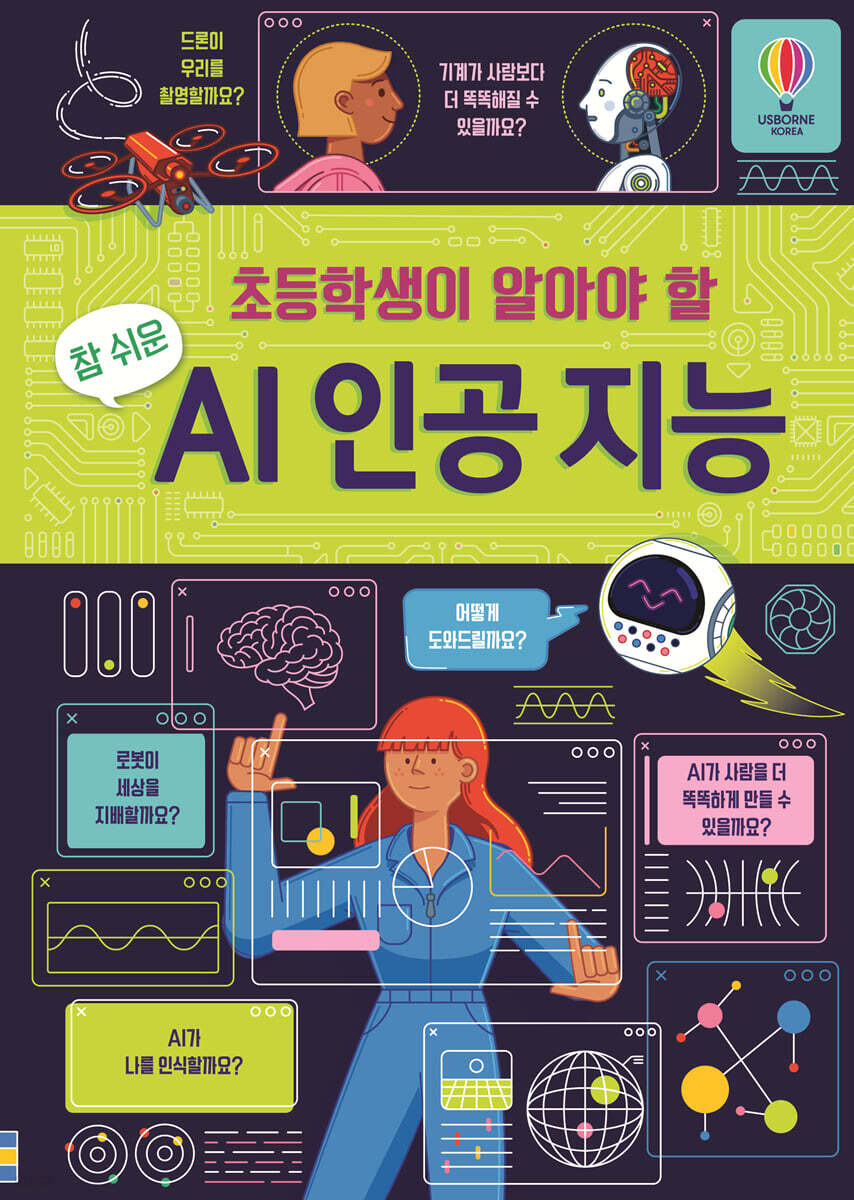 |
Description
Book Introduction
Essential Reading for Elementary School 'SW·AI' Education
What is artificial intelligence (AI) and how will it develop?
How should we perceive AI art?
Will robots take over the world?
Understand the latest science and technology and prepare for the future!
A must-read for advanced elementary applied science students
Understand "artificial intelligence" and discover how it connects to our lives and society! "Easy AI for Elementary School Students," a basic book that explores the definition of AI, machine learning, artificial neural networks, generative AI, and general AI, through case studies, has been published by Usborne Korea.
Concise explanations, abundant examples, and well-structured infographics tailored to elementary school students' level help them effectively understand the principles and key topics of artificial intelligence, which can be difficult to grasp, by exploring them in everyday life.
It goes one step further than understanding the basic concepts of artificial intelligence, which are also related to the elementary education curriculum, and provides a more in-depth understanding of various theories and social phenomena related to artificial intelligence.
Additionally, we will examine the debate surrounding the benefits and harms of artificial intelligence and encourage diverse thinking by asking questions from various perspectives.
Children will be able to develop their thinking, logical, and problem-solving skills through the process of actively exploring artificial intelligence.
The prejudice that AI is difficult and complex is over! Even children who are unfamiliar with AI will gain an easy and engaging understanding of it through this book, and will be able to view various phenomena occurring in the world from a scientific perspective.
What is artificial intelligence (AI) and how will it develop?
How should we perceive AI art?
Will robots take over the world?
Understand the latest science and technology and prepare for the future!
A must-read for advanced elementary applied science students
Understand "artificial intelligence" and discover how it connects to our lives and society! "Easy AI for Elementary School Students," a basic book that explores the definition of AI, machine learning, artificial neural networks, generative AI, and general AI, through case studies, has been published by Usborne Korea.
Concise explanations, abundant examples, and well-structured infographics tailored to elementary school students' level help them effectively understand the principles and key topics of artificial intelligence, which can be difficult to grasp, by exploring them in everyday life.
It goes one step further than understanding the basic concepts of artificial intelligence, which are also related to the elementary education curriculum, and provides a more in-depth understanding of various theories and social phenomena related to artificial intelligence.
Additionally, we will examine the debate surrounding the benefits and harms of artificial intelligence and encourage diverse thinking by asking questions from various perspectives.
Children will be able to develop their thinking, logical, and problem-solving skills through the process of actively exploring artificial intelligence.
The prejudice that AI is difficult and complex is over! Even children who are unfamiliar with AI will gain an easy and engaging understanding of it through this book, and will be able to view various phenomena occurring in the world from a scientific perspective.
- You can preview some of the book's contents.
Preview
index
Page 4 What is artificial intelligence?
Page 8 How far has AI advanced?
Page 10 How will the world change?
Page 13 Chapter 1 How Does AI Work?
Page 35, Chapter 2: AI Around Us
Page 73, Chapter 3: AI That Changes the World
Page 109: The Future of AI
122 Preparing for the Future
Word Explanation on Page 124
Browse page 126
Page 128 People Who Made This Book
Page 8 How far has AI advanced?
Page 10 How will the world change?
Page 13 Chapter 1 How Does AI Work?
Page 35, Chapter 2: AI Around Us
Page 73, Chapter 3: AI That Changes the World
Page 109: The Future of AI
122 Preparing for the Future
Word Explanation on Page 124
Browse page 126
Page 128 People Who Made This Book
Detailed image

Publisher's Review
◆ From the concept of artificial intelligence to various examples of its use, including generative AI and deepfakes.
Everything Elementary School Students Need to Know About Artificial Intelligence
This book, consisting of four chapters, explains in detail everything from basic concepts such as the characteristics and operating principles of artificial intelligence to various cases in which artificial intelligence is utilized, social changes brought about by artificial intelligence, and the latest research topics such as areas for improvement in the future.
In addition to understanding the specific definition and major research topics of 'artificial intelligence', it helps you understand the close influence that artificial intelligence has on humans.
First, we will define artificial intelligence as “technology that enables humans to think and act like humans,” and then we will examine the conditions that artificial intelligence must have and its current level.
Chapter 1 then explores the various ways in which artificial intelligence learns information to acquire the ability to "think."
Chapter 2 examines how AI is being utilized in various fields, including internet search engines, criminal investigations, care robots, and killer robots. Chapter 3 examines the benefits and side effects of widespread use of AI.
Chapter 4 addresses issues that require further discussion, such as whether artificial intelligence can truly become more human-like and how law and ethics should be applied to artificial intelligence.
◆ Be curious about artificial intelligence and constantly ask questions!
'Thinking power', 'logical power', and 'problem-solving power' are improved!
This book explains the development of artificial intelligence technology and provides a wealth of examples of how AI is actually used.
You can learn about representative AI tools in each field and their operating principles, such as 'AlphaGo', which learned to play Baduk on its own, 'ChatGPT', a giant language model, 'Night Cafe' and 'Dali', which generate pictures, and 'Mia', which screens for breast cancer.
On the one hand, as artificial intelligence develops and becomes more closely integrated with human life, it presents problems that need to be solved.
Can we trust what ChatGPT says? Will generative AI take artists' jobs? Who will be held responsible if a self-driving car causes an accident? By exploring diverse discussions and case studies on these intriguing questions, children will develop their own standards for utilizing AI.
It also presents issues related to artificial intelligence that children must know in order to understand society, such as what problems arise in the process of artificial intelligence learning information, how far the use of AI should be allowed, whether it can truly be said that artificial intelligence 'thinks' like humans, and if so, whether it should be granted the same rights as humans.
By reading books and discussing key topics in artificial intelligence with family, friends, and teachers, children will develop their critical thinking, logical, and problem-solving skills.
◆ Friendly explanations and humorous illustrations that are perfect for elementary school students
Colorful and cute illustrations in various formats, such as cartoons, maps, and infographics, capture children's attention.
It presents various concepts, theories, experiments, and cases related to artificial intelligence in an infographic format that combines a cartoon format to help you understand the related content more effectively.
It explains key topics and concepts with concrete illustrations and clear explanations that fit the flow of the story, so that even children who are new to the basic and advanced concepts of artificial intelligence can understand them.
Thanks to this, children can easily accept unfamiliar and difficult terms.
Through case studies and illustrations, you can easily understand knowledge about artificial intelligence and learn about various use cases of how AI is actually used.
The dialogue in the speech bubbles helps you learn effectively by immersing yourself in the story as if you were watching a cartoon.
Everything Elementary School Students Need to Know About Artificial Intelligence
This book, consisting of four chapters, explains in detail everything from basic concepts such as the characteristics and operating principles of artificial intelligence to various cases in which artificial intelligence is utilized, social changes brought about by artificial intelligence, and the latest research topics such as areas for improvement in the future.
In addition to understanding the specific definition and major research topics of 'artificial intelligence', it helps you understand the close influence that artificial intelligence has on humans.
First, we will define artificial intelligence as “technology that enables humans to think and act like humans,” and then we will examine the conditions that artificial intelligence must have and its current level.
Chapter 1 then explores the various ways in which artificial intelligence learns information to acquire the ability to "think."
Chapter 2 examines how AI is being utilized in various fields, including internet search engines, criminal investigations, care robots, and killer robots. Chapter 3 examines the benefits and side effects of widespread use of AI.
Chapter 4 addresses issues that require further discussion, such as whether artificial intelligence can truly become more human-like and how law and ethics should be applied to artificial intelligence.
◆ Be curious about artificial intelligence and constantly ask questions!
'Thinking power', 'logical power', and 'problem-solving power' are improved!
This book explains the development of artificial intelligence technology and provides a wealth of examples of how AI is actually used.
You can learn about representative AI tools in each field and their operating principles, such as 'AlphaGo', which learned to play Baduk on its own, 'ChatGPT', a giant language model, 'Night Cafe' and 'Dali', which generate pictures, and 'Mia', which screens for breast cancer.
On the one hand, as artificial intelligence develops and becomes more closely integrated with human life, it presents problems that need to be solved.
Can we trust what ChatGPT says? Will generative AI take artists' jobs? Who will be held responsible if a self-driving car causes an accident? By exploring diverse discussions and case studies on these intriguing questions, children will develop their own standards for utilizing AI.
It also presents issues related to artificial intelligence that children must know in order to understand society, such as what problems arise in the process of artificial intelligence learning information, how far the use of AI should be allowed, whether it can truly be said that artificial intelligence 'thinks' like humans, and if so, whether it should be granted the same rights as humans.
By reading books and discussing key topics in artificial intelligence with family, friends, and teachers, children will develop their critical thinking, logical, and problem-solving skills.
◆ Friendly explanations and humorous illustrations that are perfect for elementary school students
Colorful and cute illustrations in various formats, such as cartoons, maps, and infographics, capture children's attention.
It presents various concepts, theories, experiments, and cases related to artificial intelligence in an infographic format that combines a cartoon format to help you understand the related content more effectively.
It explains key topics and concepts with concrete illustrations and clear explanations that fit the flow of the story, so that even children who are new to the basic and advanced concepts of artificial intelligence can understand them.
Thanks to this, children can easily accept unfamiliar and difficult terms.
Through case studies and illustrations, you can easily understand knowledge about artificial intelligence and learn about various use cases of how AI is actually used.
The dialogue in the speech bubbles helps you learn effectively by immersing yourself in the story as if you were watching a cartoon.
GOODS SPECIFICS
- Date of issue: August 5, 2025
- Format: Hardcover book binding method guide
- Page count, weight, size: 128 pages | 528g | 175*247*16mm
- ISBN13: 9791171200375
- ISBN10: 1171200374
- KC Certification: Certification Type: Conformity Confirmation
You may also like
카테고리
korean


korean

![GQ KOREA Mark (Monthly): December [2025]](http://librairie.coreenne.fr/cdn/shop/files/8ef265dbbfbf186523ed75ba7319009d.jpg?v=1765340328&width=3840)


