

Nature observation notes that sense the present
 |
Description
Book Introduction
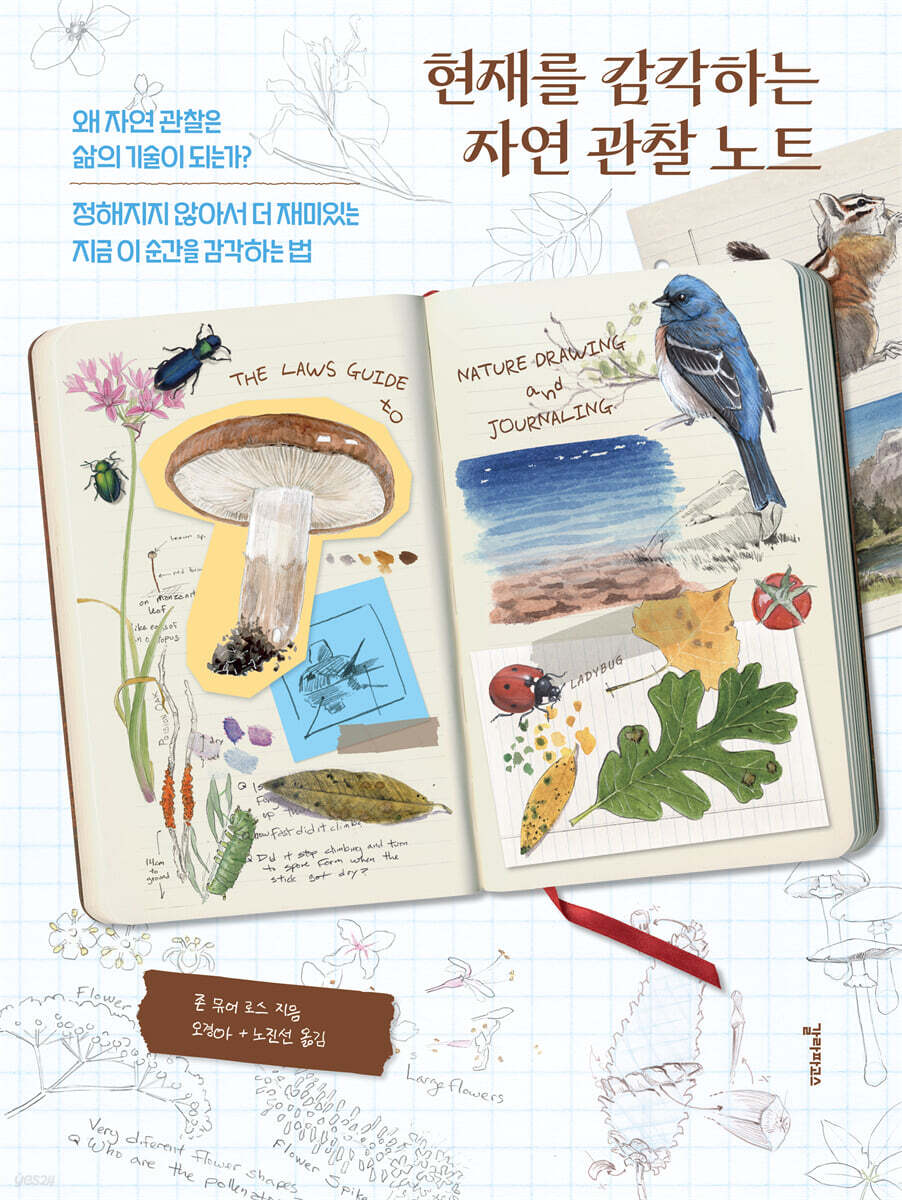
John Muir Ross, a remarkable nature observer with the eye of a naturalist, the mind of a scientist, and the passion of an educator, has developed fascinating observation skills and note-taking know-how over 40 years of exploring nature.
It won the prestigious Forward Indies 'Book of the Year' Gold Medal in the American independent publishing industry, and has become a steady seller, selling over 100,000 copies, which is unusual.
This book, filled with scientific yet fascinating insights from author Rossman, who has struggled with reading and writing since childhood due to dyslexia, will provide great inspiration and tips for those who have wondered how nature observation can become a life skill or have struggled to write observation notes.
By embracing the feeling of "not knowing" and asking questions with the "intentional curiosity" Ross speaks of, we can move closer to the richness of a life filled with mystery.
The book is filled with vivid observational notes from Ross, making it a feast for the eyes just to flip through each page.
It is full of tools that can be easily found in your neighborhood or at stationery stores, as well as various fun ways to use tools, such as natural paints made from stones, and practical know-how to easily draw familiar plants and animals that you have always wanted to draw.
Anyone can record the sparkling moments in their daily lives by lightly scribbling simple notes, symbols, diagrams, etc. in the corner of a notebook.
Amy Tan, author of the American bestselling novel The Joy Luck Club and the birding essay The Backyard Birding Club, says that after participating in a workshop led by Ross, she realized that “the skill for drawing nature was actually an ability I left behind in my childhood.”
Writing nature observation notes doesn't require any special talent or knowledge.
Because there are no right answers, it is free, and every moment is full of unexpected discoveries.
If you have this book with you, even while walking along an ordinary path, a different world will suddenly unfold before your eyes every day.
It won the prestigious Forward Indies 'Book of the Year' Gold Medal in the American independent publishing industry, and has become a steady seller, selling over 100,000 copies, which is unusual.
This book, filled with scientific yet fascinating insights from author Rossman, who has struggled with reading and writing since childhood due to dyslexia, will provide great inspiration and tips for those who have wondered how nature observation can become a life skill or have struggled to write observation notes.
By embracing the feeling of "not knowing" and asking questions with the "intentional curiosity" Ross speaks of, we can move closer to the richness of a life filled with mystery.
The book is filled with vivid observational notes from Ross, making it a feast for the eyes just to flip through each page.
It is full of tools that can be easily found in your neighborhood or at stationery stores, as well as various fun ways to use tools, such as natural paints made from stones, and practical know-how to easily draw familiar plants and animals that you have always wanted to draw.
Anyone can record the sparkling moments in their daily lives by lightly scribbling simple notes, symbols, diagrams, etc. in the corner of a notebook.
Amy Tan, author of the American bestselling novel The Joy Luck Club and the birding essay The Backyard Birding Club, says that after participating in a workshop led by Ross, she realized that “the skill for drawing nature was actually an ability I left behind in my childhood.”
Writing nature observation notes doesn't require any special talent or knowledge.
Because there are no right answers, it is free, and every moment is full of unexpected discoveries.
If you have this book with you, even while walking along an ordinary path, a different world will suddenly unfold before your eyes every day.
- You can preview some of the book's contents.
Preview
index
Acknowledgements
Why do I keep a nature observation journal?
1. Observation and intentional curiosity
Guide to Deeper Observation | Intentional Curiosity
Asking "Why": Creating Alternative Hypotheses
How to Think Like a Naturalist and Scientist
2.
Find a topic to focus your consciousness on
Create a collection or guide | Find patterns and discover exceptions
Recording Events | Creating Maps, Cross-Sections, and Block Landscapes
3.
Ways to Deepen Your Exploration
Writing | Creating Diagrams
Diagramming bird sounds and other sounds
Making a List | Counting and Measuring Quantities
Data Tools | Curiosity Toolkit
4.
Visual thinking and information representation
Grinnell Note-taking | Structuring Your Thoughts
Nature's Blueprint | Page Structure | Learn more about arrows
5.
Observation Journal Kit and Materials
Creating a Nature Observation Kit | Basic Drawing Tools
Choosing the Right Observation Note | Creating Your Own Palette
6.
Drawing nature
A roadmap to realizing your dreams
Puma Skull: Overall Drawing Process
Observe before you draw: Structure and form
Capturing Basic Form: How to Think Like an Artist
Line work: Drawing arcs with elbows, wrists, and fingers
Shading: Observing and Simplifying Light and Shadow | Coloring: Mixing Colors
Detail and Texture | How to Express Three-Dimensional Feeling | Composition
How to draw quickly and tips
7.
Tool-specific techniques
Shading with Pencil | Ratio and Non-Photo Blue Pencil
Sketching with a Pen | Drawing on Toned Paper | Using Colored Pencils
How to Use Watercolors | Creating Bright Details on a Dark Background
Using Gouache | Rock Paint
8.
How to draw animals
Drawing Insects: Insect Anatomy | Drawing a Salamander
Drawing Birds: Drawing a Bluebird | Intricate Patterns and a 45-Degree Side View
Bird Flight | Assembling the Mallard Shape
Drawing Mammals: Understanding More Than Just Appearances
Drawing and Coloring Fur | Expressing Muscles Under the Fur
What to do when an animal moves | Tracking tracks
9.
How to draw wildflowers
Understanding the Symmetric Structure of Flowers | Foreshortening and Flower Form
Drawing Dried Petals | Drawing Irises from Front to Back
Drawing a Dense Cluster of Flowers | Plant Textures | Drawing Mushrooms
10.
How to draw a tree
Drawing a Cylinder and Outline | Donut Outline
Bark and Branch Shapes | Drawing Conifers | Drawing Oak Trees
Rethinking 'Drawing a Tree'
11.
How to Draw Landscapes 346
Small Landscape Sketch | Drawing Rock Formations | Drawing Mountain Landscapes
The Splendor of the Grass | Drawing a Waterfall
Painting Breaking Waves with Watercolors | Observing Clouds
Painting the Sky with Watercolors | Drawing a Sunset
In conclusion
References
Translator's Note
Appendix Portable Data Tools
Why do I keep a nature observation journal?
1. Observation and intentional curiosity
Guide to Deeper Observation | Intentional Curiosity
Asking "Why": Creating Alternative Hypotheses
How to Think Like a Naturalist and Scientist
2.
Find a topic to focus your consciousness on
Create a collection or guide | Find patterns and discover exceptions
Recording Events | Creating Maps, Cross-Sections, and Block Landscapes
3.
Ways to Deepen Your Exploration
Writing | Creating Diagrams
Diagramming bird sounds and other sounds
Making a List | Counting and Measuring Quantities
Data Tools | Curiosity Toolkit
4.
Visual thinking and information representation
Grinnell Note-taking | Structuring Your Thoughts
Nature's Blueprint | Page Structure | Learn more about arrows
5.
Observation Journal Kit and Materials
Creating a Nature Observation Kit | Basic Drawing Tools
Choosing the Right Observation Note | Creating Your Own Palette
6.
Drawing nature
A roadmap to realizing your dreams
Puma Skull: Overall Drawing Process
Observe before you draw: Structure and form
Capturing Basic Form: How to Think Like an Artist
Line work: Drawing arcs with elbows, wrists, and fingers
Shading: Observing and Simplifying Light and Shadow | Coloring: Mixing Colors
Detail and Texture | How to Express Three-Dimensional Feeling | Composition
How to draw quickly and tips
7.
Tool-specific techniques
Shading with Pencil | Ratio and Non-Photo Blue Pencil
Sketching with a Pen | Drawing on Toned Paper | Using Colored Pencils
How to Use Watercolors | Creating Bright Details on a Dark Background
Using Gouache | Rock Paint
8.
How to draw animals
Drawing Insects: Insect Anatomy | Drawing a Salamander
Drawing Birds: Drawing a Bluebird | Intricate Patterns and a 45-Degree Side View
Bird Flight | Assembling the Mallard Shape
Drawing Mammals: Understanding More Than Just Appearances
Drawing and Coloring Fur | Expressing Muscles Under the Fur
What to do when an animal moves | Tracking tracks
9.
How to draw wildflowers
Understanding the Symmetric Structure of Flowers | Foreshortening and Flower Form
Drawing Dried Petals | Drawing Irises from Front to Back
Drawing a Dense Cluster of Flowers | Plant Textures | Drawing Mushrooms
10.
How to draw a tree
Drawing a Cylinder and Outline | Donut Outline
Bark and Branch Shapes | Drawing Conifers | Drawing Oak Trees
Rethinking 'Drawing a Tree'
11.
How to Draw Landscapes 346
Small Landscape Sketch | Drawing Rock Formations | Drawing Mountain Landscapes
The Splendor of the Grass | Drawing a Waterfall
Painting Breaking Waves with Watercolors | Observing Clouds
Painting the Sky with Watercolors | Drawing a Sunset
In conclusion
References
Translator's Note
Appendix Portable Data Tools
Detailed image

Into the book
Actually, I have dyslexia.
You'd be amazed at how many typos there are in the first draft of this manuscript.
As a child, I thought that not being able to read and write properly meant I was stupid.
But even though school was tough, being in nature allowed me to escape the red pen and feel free and secure.
I was completely fascinated by natural history and kept a journal of my discoveries.
Of course, I felt that sketching was better than writing, so my notebook was full of drawings.
I filled my own journal with constant practice, patience, and observation.
(…) This became an opportunity for me to change my thinking about my intellectual abilities.
--- p.6~7
Let's look at the world with clear eyes.
We can see how much beauty we are surrounded by.
Let's love life carefully.
As David Steindl-Last says, you will find that “it is not happiness that makes us grateful, but gratitude that makes us happy.”
Observing and recording things in detail makes me more grateful for what surrounds me.
Because every stroke drawn with brush and pencil comes to life and becomes a song of gratitude as I turn the page.
--- p.9
Keeping a nature observation journal is a way to rediscover the wonders of science.
When we observe and journal, we become relaxed, sit down, and look at something again and again.
How much time do we usually spend being still, quiet, and mindful? The process of journaling allows us to organize our thoughts, gather answers, and ask richer questions.
If you slow down and take enough time to observe and record in your journal, a mysterious world will unfold before your eyes.
At the heart of all science lies endless curiosity and deep observation.
These characteristics lead to the best learning.
Learning that is motivated by an instinctive sense of wonder, a desire to understand, and a capacity for observation.
--- p.10~11
There are three purposes to keeping a nature observation journal.
To see, to remember, to arouse curiosity.
It's not important to be good at drawing.
The benefits of journaling are not found solely in the results you create on the page, but rather in the experiences and thoughts you have while doing it.
--- p.11
Curious exploration stimulates the reward centers of our brains.
This reward center stimulates the release of dopamine and activates the hippocampus, a brain region involved in forming new memories.
As a result, when your curiosity is heightened, you learn more easily and learn more than what you initially were interested in.
Surprisingly, this intense curiosity creates a state of readiness to absorb even irrelevant information that was not originally of interest.
Interest in one subject creates a vortex of curiosity that sucks in even unrelated information, making it easier to integrate and remember.
--- p.17
Instead of embracing ignorance and genuinely wondering and seeking answers, we ignore the questions that arise.
Because it is psychologically safer to stay in a place you already know.
We are often pressured in school to know the answer to every question.
If a student doesn't know the answer, it's assumed that he or she wasn't paying attention or didn't study enough.
Even as adults, struggling for social and professional status, we are still afraid to say we don't know.
In any profession, saying "I don't know" is bound to be a weakness.
Some naturalists name every species they see.
Some doctors give prescriptions for every disease.
Some counselors can provide answers to all your questions.
There is a special word for such people.
liar.
We don't know everything.
The pressure to appear smart and competent prevents us from openly wondering and admitting when we don't know the answer.
It also makes you hesitant to try new things, embrace new ideas, or even learn new skills.
First, we must recognize the pressure that suppresses this curiosity.
It's okay if you don't know the answer.
In fact, that's where the fun begins.
--- p.18~19
“What kind of species is that?” is one of the first questions people ask about nature.
Identifying the names of plants and animals is a challenging and interesting activity.
While species names can be useful for communicating with others, they can also be a trap.
Many bird watchers stop observing the bird the moment they learn its name.
The name is not important.
Identifying species is just the tip of the iceberg of exploration.
You don't necessarily need to know someone's name to ask interesting questions or discover something.
Let's ask as many questions as possible.
It's okay if the answer feels far away at first.
The process of asking questions itself is important.
--- p.19~20
Some indigenous languages of the American West Coast distinguish between knowledge gained through personal experience and knowledge gained through other means.
For example, the Matze people of Peru use different verb forms to express direct experience, inference, guesswork, and information heard from others, and using the wrong verb is considered lying.
English, on the other hand, has only one word that can be used for all these types of knowledge.
This not only weakens the accuracy of the message, but also weakens the sense of ownership over the idea.
If we stop evaluating the sources and basis of our thoughts and beliefs, our knowledge will ultimately be nothing more than a collection of facts.
--- p.30
Keeping a nature observation journal helps build a broad body of knowledge based on one's direct experiences.
If you were asked how I knew when I shared the contents of my observation journal with someone, I would say, “I was there.
You can answer, “I saw it myself.”
Every time you go out into the world with your nature journal, you have the opportunity to gain a deeper understanding of the world through observation and interpretation.
These observations and interpretations are most truthful when approached with humility and scientific honesty.
Tracking and evaluating your own epistemology is a way to safeguard your knowledge with integrity, honesty, and respect.
It's the same with being open to new ideas and changing your mind in the face of evidence.
Let us develop the ability to accumulate knowledge carefully and wisely.
Let's go out, discover new things, and write about them.
--- p.30~31
To deepen your sense of being alive through nature observation, it's also helpful to include personal insights in your journal.
We are beings with senses, through which we live in the world, feel, grow, and change.
Barry Lopez wrote:
“I believe that a person’s way of thinking and personality are deeply influenced by the places they have been, the things they have touched, and the patterns they have observed in nature.” By keeping an observation journal, let’s pay attention not only to what happens in nature but also to what happens within ourselves.
This time spent introspecting ourselves increases our emotional intelligence through self-reflection and deeper awareness.
--- p.65
Remember that drawing is just one tool to deepen your exploration and experience of the natural world.
It is not about creating great works, but about developing the ‘power to see.’
If you discover something new that you have never seen before while drawing, then you have already succeeded.
Before we open our observation journal, let's first get our bearings.
Let go of the idea that you have to draw a nice picture.
Even if you're not a great artist, you can still discover surprising things by keeping an observation journal.
--- p.122
Don't just say, "Wow, that's a really cool painting!" but also say, "Good, artist.
It's quite good.
What the hell did you do here? You've outlined the antlers.
Thanks to that, the shape is a bit more visible.
Changing the thickness of the line is also effective.
The tips of the antlers have been simplified into geometric shapes.
It is a good idea to analyze specifically, such as “the structure around the eyes and nostrils is well-preserved,” and make a list of techniques you want to steal.
--- p.124
The first or second picture of the day is very difficult to draw.
But let's not stop.
It's better to think of this as a kind of 'sacrificial pancake'.
No matter how good a pancake maker is, the first pancake is usually a mess.
Experienced cooks know that the first pancake is the foundation for better pancakes.
The same goes for paintings.
It's okay if you don't like your first sketch.
It takes time to connect your eyes, brain, and hands.
Don't hesitate, just start boldly.
--- p.125
When I draw and explore something, I often discover small moments of beauty and wonder.
Is there a moment when your heart races, laughter erupts, or your mind races? Is it the bird's neck? The movement of a flock? The fading of flower petals from purple to violet? Let's record these moments in our observation journal and treasure them.
The better the painting reflects the elements that truly interest you, the greater the treasure it becomes.
--- p.128
As the day draws to a close, I hope to be able to say that it was a thoughtful and enriching time, deeply connected to the world.
This is your life.
How will you live that life?
You'd be amazed at how many typos there are in the first draft of this manuscript.
As a child, I thought that not being able to read and write properly meant I was stupid.
But even though school was tough, being in nature allowed me to escape the red pen and feel free and secure.
I was completely fascinated by natural history and kept a journal of my discoveries.
Of course, I felt that sketching was better than writing, so my notebook was full of drawings.
I filled my own journal with constant practice, patience, and observation.
(…) This became an opportunity for me to change my thinking about my intellectual abilities.
--- p.6~7
Let's look at the world with clear eyes.
We can see how much beauty we are surrounded by.
Let's love life carefully.
As David Steindl-Last says, you will find that “it is not happiness that makes us grateful, but gratitude that makes us happy.”
Observing and recording things in detail makes me more grateful for what surrounds me.
Because every stroke drawn with brush and pencil comes to life and becomes a song of gratitude as I turn the page.
--- p.9
Keeping a nature observation journal is a way to rediscover the wonders of science.
When we observe and journal, we become relaxed, sit down, and look at something again and again.
How much time do we usually spend being still, quiet, and mindful? The process of journaling allows us to organize our thoughts, gather answers, and ask richer questions.
If you slow down and take enough time to observe and record in your journal, a mysterious world will unfold before your eyes.
At the heart of all science lies endless curiosity and deep observation.
These characteristics lead to the best learning.
Learning that is motivated by an instinctive sense of wonder, a desire to understand, and a capacity for observation.
--- p.10~11
There are three purposes to keeping a nature observation journal.
To see, to remember, to arouse curiosity.
It's not important to be good at drawing.
The benefits of journaling are not found solely in the results you create on the page, but rather in the experiences and thoughts you have while doing it.
--- p.11
Curious exploration stimulates the reward centers of our brains.
This reward center stimulates the release of dopamine and activates the hippocampus, a brain region involved in forming new memories.
As a result, when your curiosity is heightened, you learn more easily and learn more than what you initially were interested in.
Surprisingly, this intense curiosity creates a state of readiness to absorb even irrelevant information that was not originally of interest.
Interest in one subject creates a vortex of curiosity that sucks in even unrelated information, making it easier to integrate and remember.
--- p.17
Instead of embracing ignorance and genuinely wondering and seeking answers, we ignore the questions that arise.
Because it is psychologically safer to stay in a place you already know.
We are often pressured in school to know the answer to every question.
If a student doesn't know the answer, it's assumed that he or she wasn't paying attention or didn't study enough.
Even as adults, struggling for social and professional status, we are still afraid to say we don't know.
In any profession, saying "I don't know" is bound to be a weakness.
Some naturalists name every species they see.
Some doctors give prescriptions for every disease.
Some counselors can provide answers to all your questions.
There is a special word for such people.
liar.
We don't know everything.
The pressure to appear smart and competent prevents us from openly wondering and admitting when we don't know the answer.
It also makes you hesitant to try new things, embrace new ideas, or even learn new skills.
First, we must recognize the pressure that suppresses this curiosity.
It's okay if you don't know the answer.
In fact, that's where the fun begins.
--- p.18~19
“What kind of species is that?” is one of the first questions people ask about nature.
Identifying the names of plants and animals is a challenging and interesting activity.
While species names can be useful for communicating with others, they can also be a trap.
Many bird watchers stop observing the bird the moment they learn its name.
The name is not important.
Identifying species is just the tip of the iceberg of exploration.
You don't necessarily need to know someone's name to ask interesting questions or discover something.
Let's ask as many questions as possible.
It's okay if the answer feels far away at first.
The process of asking questions itself is important.
--- p.19~20
Some indigenous languages of the American West Coast distinguish between knowledge gained through personal experience and knowledge gained through other means.
For example, the Matze people of Peru use different verb forms to express direct experience, inference, guesswork, and information heard from others, and using the wrong verb is considered lying.
English, on the other hand, has only one word that can be used for all these types of knowledge.
This not only weakens the accuracy of the message, but also weakens the sense of ownership over the idea.
If we stop evaluating the sources and basis of our thoughts and beliefs, our knowledge will ultimately be nothing more than a collection of facts.
--- p.30
Keeping a nature observation journal helps build a broad body of knowledge based on one's direct experiences.
If you were asked how I knew when I shared the contents of my observation journal with someone, I would say, “I was there.
You can answer, “I saw it myself.”
Every time you go out into the world with your nature journal, you have the opportunity to gain a deeper understanding of the world through observation and interpretation.
These observations and interpretations are most truthful when approached with humility and scientific honesty.
Tracking and evaluating your own epistemology is a way to safeguard your knowledge with integrity, honesty, and respect.
It's the same with being open to new ideas and changing your mind in the face of evidence.
Let us develop the ability to accumulate knowledge carefully and wisely.
Let's go out, discover new things, and write about them.
--- p.30~31
To deepen your sense of being alive through nature observation, it's also helpful to include personal insights in your journal.
We are beings with senses, through which we live in the world, feel, grow, and change.
Barry Lopez wrote:
“I believe that a person’s way of thinking and personality are deeply influenced by the places they have been, the things they have touched, and the patterns they have observed in nature.” By keeping an observation journal, let’s pay attention not only to what happens in nature but also to what happens within ourselves.
This time spent introspecting ourselves increases our emotional intelligence through self-reflection and deeper awareness.
--- p.65
Remember that drawing is just one tool to deepen your exploration and experience of the natural world.
It is not about creating great works, but about developing the ‘power to see.’
If you discover something new that you have never seen before while drawing, then you have already succeeded.
Before we open our observation journal, let's first get our bearings.
Let go of the idea that you have to draw a nice picture.
Even if you're not a great artist, you can still discover surprising things by keeping an observation journal.
--- p.122
Don't just say, "Wow, that's a really cool painting!" but also say, "Good, artist.
It's quite good.
What the hell did you do here? You've outlined the antlers.
Thanks to that, the shape is a bit more visible.
Changing the thickness of the line is also effective.
The tips of the antlers have been simplified into geometric shapes.
It is a good idea to analyze specifically, such as “the structure around the eyes and nostrils is well-preserved,” and make a list of techniques you want to steal.
--- p.124
The first or second picture of the day is very difficult to draw.
But let's not stop.
It's better to think of this as a kind of 'sacrificial pancake'.
No matter how good a pancake maker is, the first pancake is usually a mess.
Experienced cooks know that the first pancake is the foundation for better pancakes.
The same goes for paintings.
It's okay if you don't like your first sketch.
It takes time to connect your eyes, brain, and hands.
Don't hesitate, just start boldly.
--- p.125
When I draw and explore something, I often discover small moments of beauty and wonder.
Is there a moment when your heart races, laughter erupts, or your mind races? Is it the bird's neck? The movement of a flock? The fading of flower petals from purple to violet? Let's record these moments in our observation journal and treasure them.
The better the painting reflects the elements that truly interest you, the greater the treasure it becomes.
--- p.128
As the day draws to a close, I hope to be able to say that it was a thoughtful and enriching time, deeply connected to the world.
This is your life.
How will you live that life?
--- p.389
Publisher's Review
★A bestseller that created a legend in the independent publishing industry, selling over 100,000 copies★
★Forward Indie 'Book of the Year' (2016) Gold Award Winner★
●Why is nature observation a life skill?
It's more fun because it's not set in stone
How to sense this moment
We often vaguely know that it would be 'good' to look at nature and write down the thoughts that come to mind.
But why exactly is observing and documenting nature beneficial to humans? How can we get started, and how can we make it more profound and engaging?
An empty notebook cannot be filled with anything, and observation begins from there.
There is no such thing as a 'ruined' page in Ross's dictionary.
He draws a duck that is completely curled up, but if he doesn't like it, he cuts the drawing into pieces and adds colors and characteristics.
When the falcon or dragonfly I was drawing flies away, I just draw its silhouette and add a note to decorate my notebook.
When there is no paint, you can make paint on the spot with stones and paint with them.
When writing a nature observation journal like this, you don't have to draw pictures well or be bound by a set framework.
Just as there are no right answers in life, the nature observation journal Ross practices also has no set answers, making every moment free, full of unexpected discoveries, and therefore all the more enjoyable.
In modern society, an individual's time is constantly flowing in a rushed and anxious manner toward a goal, and sometimes it feels like it has stopped completely in the same daily routine.
But natural time flows silently as given, without purpose or expectation.
Ross explores the direction in which buds sprout, records the quiet moments when poppies open and close their petals, and paints the sky at a beautiful sunset, surrendering his body and mind to the time of nature.
And he speaks, draws, and writes without ceasing to feel that he too is a part of that sophisticated and colorful natural world.
A nature observation notebook is a life tool that allows you to “vividly experience the feeling of being alive” in this moment.
“To deepen your sense of being alive through nature observation, it is also helpful to include personal insights in your journal.
We are beings with senses, through which we live in the world, feel, grow, and change.
Barry Lopez wrote:
'I believe that a person's way of thinking and personality are deeply influenced by the places they've been, the things they've touched, and the patterns they've observed in nature.' By keeping a consistent observation journal, let's pay attention not only to what happens in nature but also to what's happening within ourselves.
“This time spent introspecting ourselves enhances our emotional intelligence through self-reflection and deeper awareness.” (From the text)
The moment you begin to read the world through the eyes of nature
“It even changed my thinking about intellectual ability.”
Ross's 40-year journey of nature observation began with his childhood struggle with dyslexia.
Unable to read or write, Ross had a difficult time during his school years, having to study by listening to audiobooks and recorded textbooks for the visually impaired.
There was a time when I thought I was stupid for not being able to read and write.
Because they had to be excluded from all processes of acquiring knowledge and being evaluated for value.
But not being able to read didn't mean my thirst for learning and curiosity died down.
Rather, I was consumed by a desire to persistently explore the world around me.
The diverse natural landscape of the Sierra Nevada, which had been with him since childhood, immediately captured his attention.
Ross, who was captivated by nature journaling, thanks to the support of his warm family and those around him, found that being in nature “allowed me to feel a sense of security and freedom, free from the red pen.” Observing and recording the contours of a bird’s neck, the movement of a flock, or the fading of a flower’s color from purple to violet, he would “feel my heart pounding, my laughter bursting, my heart dancing.”
Dyslexia has helped me “see more, better, or differently” about nature.
The Joy of Chance Encounters, Given by the Sense of "Not Knowing"
A place of science and art unfolding on an ordinary walking path
Slow down, look consciously, ask follow-up questions, and associate things that come to mind.
Observation in the true sense of the word, as Ross puts it, is not simply about looking at an object and drawing it beautifully, but rather about playing with endless curiosity and asking questions.
Ross says that although the word "I don't know" has become embarrassing at some point, the unknown feeling of "I don't know" is the feeling that brings us closer to the richness of life, full of mystery.
Every time you admit that you don't know, you "dance" with new questions that arise, and your world expands along with them.
As Ross explains, looking at the world with "deliberate curiosity" stimulates the brain's reward center and activates the hippocampus, the region of the brain where memories are formed.
This helps moments become etched in your memory and creates a "vortex of curiosity" that helps you absorb information you want to know, as well as information you weren't interested in.
Keeping a nature observation journal with this kind of intentional curiosity can “infuse scientific value” into the records of trivial everyday events.
Moreover, with extreme climate change causing numerous problems worldwide, amateur citizen observations are becoming an important indicator.
Periodic ecological records can also provide useful information for land management and policy making.
In an age overflowing with vast amounts of information, a great deal of knowledge simply passes us by.
New information is pouring in before we can even consider the accuracy or quality of the knowledge.
The habit of thinking scientifically when observing provides a framework for organizing in my head what knowledge I acquire from the objects I encounter in my daily life and how I will apply it.
This “protects our logic from various traps” and helps us build a large body of knowledge.
Learning to think like a scientist isn't as difficult as you might think.
Be willing to be surprised by unexpected discoveries and bravely change your mind if you encounter evidence of error.
“Keeping a nature observation journal is a way to rediscover the beauty of science.
When we observe and journal, we become relaxed, sit down, and look at something again and again.
How much time do we usually spend being still, quiet, and mindful? The process of journaling allows us to organize our thoughts, gather answers, and ask richer questions.
If you slow down and take enough time to observe and record in your journal, a mysterious world will unfold before your eyes.
At the heart of all science lies endless curiosity and deep observation.
These characteristics lead to the best learning.
“Learning that is motivated by an instinctive sense of wonder, a desire to understand, and a capacity for observation.” (From the text)
●I bought a notebook.
I also bought a pen.
What should I do now? Open this book.
Why do my notebooks always seem empty and dull? With this book, I can say goodbye to monotonous observation notes.
The core secret Ross shares is that “if you change your structure, your thinking will change.”
Even when exploring one topic, you can fill your notes with endless elements by changing your perspective and way of thinking.
First, let's choose a light tool.
Whether it's pencils, ballpoint pens, colored pencils, or paints, we'll introduce the key uses of each material in an easy-to-understand manner.
It's okay if you don't have expensive ingredients right now.
You can draw a heron sitting in an oak forest with just three markers with Ross, or make an even more special record by painting with natural paints made by rubbing pebbles.
Also, if you have this book, you don't have to be frustrated that you're not 'born with' drawing skills.
It's full of tips that will help even those who have never drawn before start drawing with confidence.
No matter how closely you look at a bird sleeping curled up in a stream, it is difficult to tell where its wings are or how its neck is wrapped.
In times like these, if you look at it in fragmented form like a stained glass window, you can easily draw a new picture.
Even the most complex leaf can be quickly drawn using a simple method of marking each corner on paper to create a pattern.
The trunk of an old tree with its twisted belly can be vividly depicted by connecting the 'smiling' cylinder and the 'crying' cylinder.
By learning these fun and practical techniques, you'll soon be able to easily draw interesting elements like swiftly flying and hiding animals, dazzling sea foam, damaged spider webs, and clusters of mushrooms.
Meanwhile, you can decorate your observation notes in a pretty way without drawing a perfect picture.
Adding simple and fun elements like weather symbols, memo boxes, arrows, and simple maps to your doodle-like sketches will enrich your observation notes beyond recognition.
Or, capture the changing colors of maple leaves, the growth of mushrooms, and the changing tides and waves on the beach as time passes.
A crow digging through mud to catch bugs is more memorable if you draw it like a four-panel cartoon.
How about diagramming the sounds of nature? "Chichichi, dedede, weeeet." You can also learn how to describe the unique songs of each bird in your observation notebook.
This book is filled with Ross's splendid, real-world observational notes, making it a feast for the eyes and a natural source of inspiration just to flip through each page.
A useful appendix of data tools is included on the last page, which you can take with you on your observation outings.
As many Amazon reviewers have commented, "This is the best teacher I've ever met because he finds a way to show rather than tell," with this book, anyone can start keeping a nature observation journal easily and enjoyably.
Oh Kyung-ah, a renowned Korean garden designer and translator who has written beautiful nature books, said, “While translating, I often thought about wanting to go out into nature with a light notebook in hand.
“I hope you will feel the love for nature that the author conveys, and what it means to leave behind precious moments that once sparkle but will soon disappear through painting,” he said.
This book will open your eyes to nature and become a reliable companion that will help you discover joy in everyday life.
"The Definitive Guide to Keeping a Nature Journal" - Blue Heron Reviews
“It has a powerful cross-cutting appeal across fields such as environmentalism, earth science, hiking, and art education.” —Library Journal
“This beautiful book teaches you how to carefully organize your thoughts, piece together your answers, and ask richer questions.
The goal of this book is to pique our curiosity, and you won't find a better guide.” —Forward Reviews
“The most friendly guide to thinking like a naturalist.
Ross is one of the world's greatest naturalists.” —Earth Island Journal
“This book will be a wonderful resource for those new to drawing and journaling, and even veteran creators will be deeply impressed by Ross’s detailed and specific tips and tricks.
But above all, this book will inspire us to awaken the wonder hidden within us all.” —Lake Tahoe News
“An excellent guide, highly recommended for those who wish to express nature through art.
“It contains the essence of how to properly connect nature observation and painting.” ―Midwest Book Review
★Forward Indie 'Book of the Year' (2016) Gold Award Winner★
●Why is nature observation a life skill?
It's more fun because it's not set in stone
How to sense this moment
We often vaguely know that it would be 'good' to look at nature and write down the thoughts that come to mind.
But why exactly is observing and documenting nature beneficial to humans? How can we get started, and how can we make it more profound and engaging?
An empty notebook cannot be filled with anything, and observation begins from there.
There is no such thing as a 'ruined' page in Ross's dictionary.
He draws a duck that is completely curled up, but if he doesn't like it, he cuts the drawing into pieces and adds colors and characteristics.
When the falcon or dragonfly I was drawing flies away, I just draw its silhouette and add a note to decorate my notebook.
When there is no paint, you can make paint on the spot with stones and paint with them.
When writing a nature observation journal like this, you don't have to draw pictures well or be bound by a set framework.
Just as there are no right answers in life, the nature observation journal Ross practices also has no set answers, making every moment free, full of unexpected discoveries, and therefore all the more enjoyable.
In modern society, an individual's time is constantly flowing in a rushed and anxious manner toward a goal, and sometimes it feels like it has stopped completely in the same daily routine.
But natural time flows silently as given, without purpose or expectation.
Ross explores the direction in which buds sprout, records the quiet moments when poppies open and close their petals, and paints the sky at a beautiful sunset, surrendering his body and mind to the time of nature.
And he speaks, draws, and writes without ceasing to feel that he too is a part of that sophisticated and colorful natural world.
A nature observation notebook is a life tool that allows you to “vividly experience the feeling of being alive” in this moment.
“To deepen your sense of being alive through nature observation, it is also helpful to include personal insights in your journal.
We are beings with senses, through which we live in the world, feel, grow, and change.
Barry Lopez wrote:
'I believe that a person's way of thinking and personality are deeply influenced by the places they've been, the things they've touched, and the patterns they've observed in nature.' By keeping a consistent observation journal, let's pay attention not only to what happens in nature but also to what's happening within ourselves.
“This time spent introspecting ourselves enhances our emotional intelligence through self-reflection and deeper awareness.” (From the text)
The moment you begin to read the world through the eyes of nature
“It even changed my thinking about intellectual ability.”
Ross's 40-year journey of nature observation began with his childhood struggle with dyslexia.
Unable to read or write, Ross had a difficult time during his school years, having to study by listening to audiobooks and recorded textbooks for the visually impaired.
There was a time when I thought I was stupid for not being able to read and write.
Because they had to be excluded from all processes of acquiring knowledge and being evaluated for value.
But not being able to read didn't mean my thirst for learning and curiosity died down.
Rather, I was consumed by a desire to persistently explore the world around me.
The diverse natural landscape of the Sierra Nevada, which had been with him since childhood, immediately captured his attention.
Ross, who was captivated by nature journaling, thanks to the support of his warm family and those around him, found that being in nature “allowed me to feel a sense of security and freedom, free from the red pen.” Observing and recording the contours of a bird’s neck, the movement of a flock, or the fading of a flower’s color from purple to violet, he would “feel my heart pounding, my laughter bursting, my heart dancing.”
Dyslexia has helped me “see more, better, or differently” about nature.
The Joy of Chance Encounters, Given by the Sense of "Not Knowing"
A place of science and art unfolding on an ordinary walking path
Slow down, look consciously, ask follow-up questions, and associate things that come to mind.
Observation in the true sense of the word, as Ross puts it, is not simply about looking at an object and drawing it beautifully, but rather about playing with endless curiosity and asking questions.
Ross says that although the word "I don't know" has become embarrassing at some point, the unknown feeling of "I don't know" is the feeling that brings us closer to the richness of life, full of mystery.
Every time you admit that you don't know, you "dance" with new questions that arise, and your world expands along with them.
As Ross explains, looking at the world with "deliberate curiosity" stimulates the brain's reward center and activates the hippocampus, the region of the brain where memories are formed.
This helps moments become etched in your memory and creates a "vortex of curiosity" that helps you absorb information you want to know, as well as information you weren't interested in.
Keeping a nature observation journal with this kind of intentional curiosity can “infuse scientific value” into the records of trivial everyday events.
Moreover, with extreme climate change causing numerous problems worldwide, amateur citizen observations are becoming an important indicator.
Periodic ecological records can also provide useful information for land management and policy making.
In an age overflowing with vast amounts of information, a great deal of knowledge simply passes us by.
New information is pouring in before we can even consider the accuracy or quality of the knowledge.
The habit of thinking scientifically when observing provides a framework for organizing in my head what knowledge I acquire from the objects I encounter in my daily life and how I will apply it.
This “protects our logic from various traps” and helps us build a large body of knowledge.
Learning to think like a scientist isn't as difficult as you might think.
Be willing to be surprised by unexpected discoveries and bravely change your mind if you encounter evidence of error.
“Keeping a nature observation journal is a way to rediscover the beauty of science.
When we observe and journal, we become relaxed, sit down, and look at something again and again.
How much time do we usually spend being still, quiet, and mindful? The process of journaling allows us to organize our thoughts, gather answers, and ask richer questions.
If you slow down and take enough time to observe and record in your journal, a mysterious world will unfold before your eyes.
At the heart of all science lies endless curiosity and deep observation.
These characteristics lead to the best learning.
“Learning that is motivated by an instinctive sense of wonder, a desire to understand, and a capacity for observation.” (From the text)
●I bought a notebook.
I also bought a pen.
What should I do now? Open this book.
Why do my notebooks always seem empty and dull? With this book, I can say goodbye to monotonous observation notes.
The core secret Ross shares is that “if you change your structure, your thinking will change.”
Even when exploring one topic, you can fill your notes with endless elements by changing your perspective and way of thinking.
First, let's choose a light tool.
Whether it's pencils, ballpoint pens, colored pencils, or paints, we'll introduce the key uses of each material in an easy-to-understand manner.
It's okay if you don't have expensive ingredients right now.
You can draw a heron sitting in an oak forest with just three markers with Ross, or make an even more special record by painting with natural paints made by rubbing pebbles.
Also, if you have this book, you don't have to be frustrated that you're not 'born with' drawing skills.
It's full of tips that will help even those who have never drawn before start drawing with confidence.
No matter how closely you look at a bird sleeping curled up in a stream, it is difficult to tell where its wings are or how its neck is wrapped.
In times like these, if you look at it in fragmented form like a stained glass window, you can easily draw a new picture.
Even the most complex leaf can be quickly drawn using a simple method of marking each corner on paper to create a pattern.
The trunk of an old tree with its twisted belly can be vividly depicted by connecting the 'smiling' cylinder and the 'crying' cylinder.
By learning these fun and practical techniques, you'll soon be able to easily draw interesting elements like swiftly flying and hiding animals, dazzling sea foam, damaged spider webs, and clusters of mushrooms.
Meanwhile, you can decorate your observation notes in a pretty way without drawing a perfect picture.
Adding simple and fun elements like weather symbols, memo boxes, arrows, and simple maps to your doodle-like sketches will enrich your observation notes beyond recognition.
Or, capture the changing colors of maple leaves, the growth of mushrooms, and the changing tides and waves on the beach as time passes.
A crow digging through mud to catch bugs is more memorable if you draw it like a four-panel cartoon.
How about diagramming the sounds of nature? "Chichichi, dedede, weeeet." You can also learn how to describe the unique songs of each bird in your observation notebook.
This book is filled with Ross's splendid, real-world observational notes, making it a feast for the eyes and a natural source of inspiration just to flip through each page.
A useful appendix of data tools is included on the last page, which you can take with you on your observation outings.
As many Amazon reviewers have commented, "This is the best teacher I've ever met because he finds a way to show rather than tell," with this book, anyone can start keeping a nature observation journal easily and enjoyably.
Oh Kyung-ah, a renowned Korean garden designer and translator who has written beautiful nature books, said, “While translating, I often thought about wanting to go out into nature with a light notebook in hand.
“I hope you will feel the love for nature that the author conveys, and what it means to leave behind precious moments that once sparkle but will soon disappear through painting,” he said.
This book will open your eyes to nature and become a reliable companion that will help you discover joy in everyday life.
"The Definitive Guide to Keeping a Nature Journal" - Blue Heron Reviews
“It has a powerful cross-cutting appeal across fields such as environmentalism, earth science, hiking, and art education.” —Library Journal
“This beautiful book teaches you how to carefully organize your thoughts, piece together your answers, and ask richer questions.
The goal of this book is to pique our curiosity, and you won't find a better guide.” —Forward Reviews
“The most friendly guide to thinking like a naturalist.
Ross is one of the world's greatest naturalists.” —Earth Island Journal
“This book will be a wonderful resource for those new to drawing and journaling, and even veteran creators will be deeply impressed by Ross’s detailed and specific tips and tricks.
But above all, this book will inspire us to awaken the wonder hidden within us all.” —Lake Tahoe News
“An excellent guide, highly recommended for those who wish to express nature through art.
“It contains the essence of how to properly connect nature observation and painting.” ―Midwest Book Review
GOODS SPECIFICS
- Date of issue: August 22, 2025
- Page count, weight, size: 396 pages | 188*250*23mm
- ISBN13: 9791193482148
You may also like
카테고리
korean


korean

![GQ KOREA Mark (Monthly): December [2025]](http://librairie.coreenne.fr/cdn/shop/files/8ef265dbbfbf186523ed75ba7319009d.jpg?v=1765340328&width=3840)


