

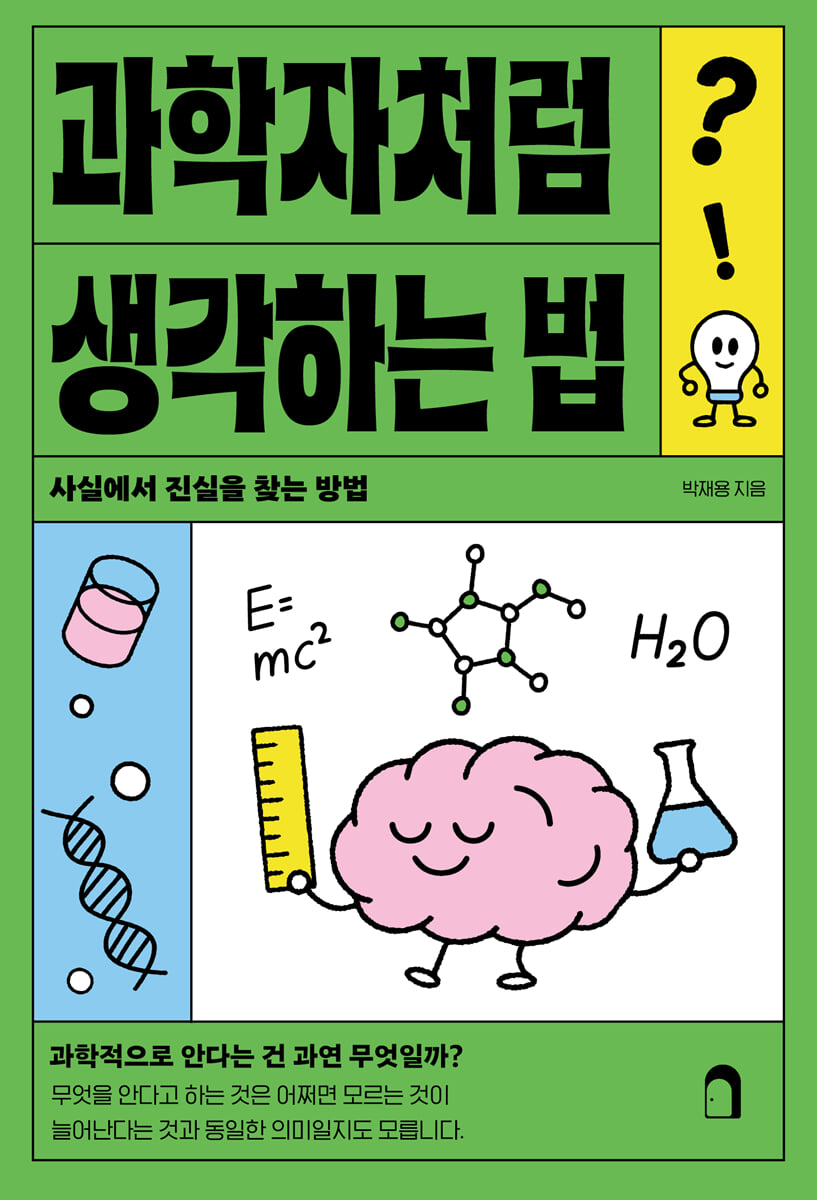
How to Think Like a Scientist
 |
Description
Book Introduction
Science is not knowledge
It's a way of thinking and an attitude toward the world.
Scientific thinking is a way of finding truth in facts.
“What do you want to be when you grow up?” One of the answers that always comes up when asked this question is scientist.
The fact that young people dream of becoming scientists and that science has gained social recognition is partly due to the numerous achievements of science, but it is also the result of the tradition of scientists who have been extremely rigorous in distinguishing truth from falsehood and clearly explaining the basis for their judgment.
So how do scientists observe, judge, and interpret objects and phenomena? What are the attitudes and principles that guide their research? This is often referred to as "scientific methodology."
This book provides an easy and engaging guide to the way scientists view the world, starting with the curiosity to look at the stars and moving on to classification, reproduction, causality, and ethical issues.
And it fosters in young people the 'power of scientific thinking', which is more important than scientific knowledge.
If you carefully examine how to think like a scientist and apply it little by little to various things happening around you, you too will soon become a scientist.
It's a way of thinking and an attitude toward the world.
Scientific thinking is a way of finding truth in facts.
“What do you want to be when you grow up?” One of the answers that always comes up when asked this question is scientist.
The fact that young people dream of becoming scientists and that science has gained social recognition is partly due to the numerous achievements of science, but it is also the result of the tradition of scientists who have been extremely rigorous in distinguishing truth from falsehood and clearly explaining the basis for their judgment.
So how do scientists observe, judge, and interpret objects and phenomena? What are the attitudes and principles that guide their research? This is often referred to as "scientific methodology."
This book provides an easy and engaging guide to the way scientists view the world, starting with the curiosity to look at the stars and moving on to classification, reproduction, causality, and ethical issues.
And it fosters in young people the 'power of scientific thinking', which is more important than scientific knowledge.
If you carefully examine how to think like a scientist and apply it little by little to various things happening around you, you too will soon become a scientist.
- You can preview some of the book's contents.
Preview
index
Opening remarks
Take a closer look
Let's go see the stars
Until I saw the stars through a telescope
How to set the standard?
Things that cannot be measured by Thought Plus
Divide properly
Aristotle's classification of living things
Classification of modern biology
Things that are revealed when shared
Essential and secondary differences in Thought Plus
Try the same thing
alchemy
Doing the same thing is harder than you thought?
If it doesn't work, is it a failure?
Think Plus Digital Twin
Finding the real cause
Willow bark and pain relievers
Detective Conan
Why do tree frogs croak?
A Scientific Analysis of Stray Cats by Saenggak Plus
Cause of error
Generalization of personal experience
Misunderstanding of correlation
The complexity of causality
Thought Plus: A claim that cannot be wrong
Knowing
Do you know tears?
What does it mean to know tears?
Training that looks at various aspects
The Multifaceted Face of the Climate Crisis: Thought Plus
What is science?
Science is not neutral
Who chooses what to study?
Science is a moving forward
I don't know if there is an absolute truth in Thought Plus, but
Closing remarks
Reference books
Take a closer look
Let's go see the stars
Until I saw the stars through a telescope
How to set the standard?
Things that cannot be measured by Thought Plus
Divide properly
Aristotle's classification of living things
Classification of modern biology
Things that are revealed when shared
Essential and secondary differences in Thought Plus
Try the same thing
alchemy
Doing the same thing is harder than you thought?
If it doesn't work, is it a failure?
Think Plus Digital Twin
Finding the real cause
Willow bark and pain relievers
Detective Conan
Why do tree frogs croak?
A Scientific Analysis of Stray Cats by Saenggak Plus
Cause of error
Generalization of personal experience
Misunderstanding of correlation
The complexity of causality
Thought Plus: A claim that cannot be wrong
Knowing
Do you know tears?
What does it mean to know tears?
Training that looks at various aspects
The Multifaceted Face of the Climate Crisis: Thought Plus
What is science?
Science is not neutral
Who chooses what to study?
Science is a moving forward
I don't know if there is an absolute truth in Thought Plus, but
Closing remarks
Reference books
Into the book
As these observations were passed down and accumulated from generation to generation, people came to know more about the stars in the sky and to understand the rules.
I believe that observations like this are the beginning of science.
--- p.15
Although alchemy began as a 'secret sauce' type of research, chemistry has become a field of research that focuses on 'open recipes'.
When anyone conducts an experiment or makes an observation in the same way and gets the same results, this is called 'reproducibility'.
And this 'reproducibility' becomes the basis of science.
--- p.79
It is true that willow bark has analgesic properties, but one of the goals of science is to find out which component in it produces the pain-relieving effect, that is, to find a more precise cause.
That's what science is.
If there's still something you don't know what the real cause is, you dig deeper.
--- p.109
Each individual's experience is shaped by the specific circumstances of their location and time zone, yet we perceive this as common.
I think other people would do the same.
Generalizing such a specific experience is called the 'fallacy of generalization.'
--- p.143
Many people say that science is neither good nor evil.
Therefore, scientists' research and scientific discoveries are neither good nor bad; it depends on who uses them and how.
This serves as a kind of defense for scientists against the social repercussions of their discoveries or inventions.
But is science truly value-neutral? --- p.200
Science is not about finding what ancient people knew but have now forgotten or lost. It is about adding new knowledge to the knowledge accumulated by humanity to increase the knowledge and wisdom of all humanity.
So science is not about looking back, it's about looking forward.
I believe that observations like this are the beginning of science.
--- p.15
Although alchemy began as a 'secret sauce' type of research, chemistry has become a field of research that focuses on 'open recipes'.
When anyone conducts an experiment or makes an observation in the same way and gets the same results, this is called 'reproducibility'.
And this 'reproducibility' becomes the basis of science.
--- p.79
It is true that willow bark has analgesic properties, but one of the goals of science is to find out which component in it produces the pain-relieving effect, that is, to find a more precise cause.
That's what science is.
If there's still something you don't know what the real cause is, you dig deeper.
--- p.109
Each individual's experience is shaped by the specific circumstances of their location and time zone, yet we perceive this as common.
I think other people would do the same.
Generalizing such a specific experience is called the 'fallacy of generalization.'
--- p.143
Many people say that science is neither good nor evil.
Therefore, scientists' research and scientific discoveries are neither good nor bad; it depends on who uses them and how.
This serves as a kind of defense for scientists against the social repercussions of their discoveries or inventions.
But is science truly value-neutral? --- p.200
Science is not about finding what ancient people knew but have now forgotten or lost. It is about adding new knowledge to the knowledge accumulated by humanity to increase the knowledge and wisdom of all humanity.
So science is not about looking back, it's about looking forward.
--- p.215
Publisher's Review
For all adults and teenagers who love science,
Not only in school but also in everyday life
For teenagers who want to think smarter
A book that presents a concrete 'scientific methodology'!
We live in an age of science, and we need scientific thinking.
In modern society, the word scientific is taken to mean 'trustworthy'.
So we strive to be scientifically sound in various fields.
So how can we think like a scientist? Should we just study scientific knowledge?
But science is not knowledge.
It is a way of thinking and an attitude towards the world.
"How to Think Like a Scientist" is a book that helps young people develop the "power of scientific thinking," which is more important than scientific knowledge.
From the curiosity of stargazing to classification, reproduction, causality, and ethical issues, this guide provides an easy and engaging introduction to how scientists view the world.
It will help friends who love science, as well as young people who want to think smarter in their daily lives, develop their thinking power.
This book clearly presents why science is necessary in our time, scientific methods and attitudes, and the properties of science.
As they turn each page of the text's scientific story, young people will be able to approach science more easily and understand its nature.
The beginning of science is to look closely, and you can do it too!
Long ago, people looked at the stars in the night sky and realized that there were certain rules to the movement of the stars.
There are stars that can only be seen in spring, stars that can only be seen in fall, and stars that can be seen all year round.
As these observations were passed down and accumulated from generation to generation, people came to know more about the stars in the sky and to understand the rules.
Of course, when our ancestors first saw natural phenomena, they did not understand scientific causality.
It was just an observation that when something happens, this happens next.
But it was from these very observations that science began.
Observation is not difficult.
Observation is the patient and steady observation of something you are interested in.
And as you develop the habit of observing, your perspective will gradually broaden and you will develop a framework for scientific thinking.
Finding truth in facts,
Science is about understanding the fundamental causal relationships.
Painkillers are the medicine you take when you have a headache or toothache.
So, what did they do in the days before painkillers? They say peeling off the outer bark of a willow tree, crushing the inner bark, and holding it in your mouth will relieve pain.
The people of Mesopotamia, a very long time ago, also knew this fact from experience.
Scientists began to study the analgesic effects of willow bark and discovered a compound called 'salicylic acid'.
However, painkillers like aspirin are not salicylic acid, but a similar but different substance called acetylsalicylic acid.
The salicylic acid in willow bark has an analgesic effect, but it is difficult to take because it causes nausea, and can cause diarrhea or even death if taken in large quantities.
So, we chemically modified it slightly to make it acetylsalicylic acid, which is suitable for oral consumption.
"Chewing willow bark (cause) relieves pain (effect)." While it's true that willow bark has analgesic properties, one of the goals of science is to more precisely determine which component within it produces this effect.
That's what science is.
If there's still something you don't know what the real cause is, you dig deeper.
By uncovering the underlying cause, you can not only discover previously unknown side effects and discover more positive aspects, but also increase the effectiveness of your use.
The process of developing aspirin from willow bark is a good example of the scientific method, attitude, and properties of science.
Not only in school but also in everyday life
For teenagers who want to think smarter
A book that presents a concrete 'scientific methodology'!
We live in an age of science, and we need scientific thinking.
In modern society, the word scientific is taken to mean 'trustworthy'.
So we strive to be scientifically sound in various fields.
So how can we think like a scientist? Should we just study scientific knowledge?
But science is not knowledge.
It is a way of thinking and an attitude towards the world.
"How to Think Like a Scientist" is a book that helps young people develop the "power of scientific thinking," which is more important than scientific knowledge.
From the curiosity of stargazing to classification, reproduction, causality, and ethical issues, this guide provides an easy and engaging introduction to how scientists view the world.
It will help friends who love science, as well as young people who want to think smarter in their daily lives, develop their thinking power.
This book clearly presents why science is necessary in our time, scientific methods and attitudes, and the properties of science.
As they turn each page of the text's scientific story, young people will be able to approach science more easily and understand its nature.
The beginning of science is to look closely, and you can do it too!
Long ago, people looked at the stars in the night sky and realized that there were certain rules to the movement of the stars.
There are stars that can only be seen in spring, stars that can only be seen in fall, and stars that can be seen all year round.
As these observations were passed down and accumulated from generation to generation, people came to know more about the stars in the sky and to understand the rules.
Of course, when our ancestors first saw natural phenomena, they did not understand scientific causality.
It was just an observation that when something happens, this happens next.
But it was from these very observations that science began.
Observation is not difficult.
Observation is the patient and steady observation of something you are interested in.
And as you develop the habit of observing, your perspective will gradually broaden and you will develop a framework for scientific thinking.
Finding truth in facts,
Science is about understanding the fundamental causal relationships.
Painkillers are the medicine you take when you have a headache or toothache.
So, what did they do in the days before painkillers? They say peeling off the outer bark of a willow tree, crushing the inner bark, and holding it in your mouth will relieve pain.
The people of Mesopotamia, a very long time ago, also knew this fact from experience.
Scientists began to study the analgesic effects of willow bark and discovered a compound called 'salicylic acid'.
However, painkillers like aspirin are not salicylic acid, but a similar but different substance called acetylsalicylic acid.
The salicylic acid in willow bark has an analgesic effect, but it is difficult to take because it causes nausea, and can cause diarrhea or even death if taken in large quantities.
So, we chemically modified it slightly to make it acetylsalicylic acid, which is suitable for oral consumption.
"Chewing willow bark (cause) relieves pain (effect)." While it's true that willow bark has analgesic properties, one of the goals of science is to more precisely determine which component within it produces this effect.
That's what science is.
If there's still something you don't know what the real cause is, you dig deeper.
By uncovering the underlying cause, you can not only discover previously unknown side effects and discover more positive aspects, but also increase the effectiveness of your use.
The process of developing aspirin from willow bark is a good example of the scientific method, attitude, and properties of science.
GOODS SPECIFICS
- Date of issue: August 22, 2025
- Page count, weight, size: 224 pages | 256g | 128*188*16mm
- ISBN13: 9791192886992
- ISBN10: 1192886992
You may also like
카테고리
korean


korean

![GQ KOREA Mark (Monthly): December [2025]](http://librairie.coreenne.fr/cdn/shop/files/8ef265dbbfbf186523ed75ba7319009d.jpg?v=1765340328&width=3840)


