

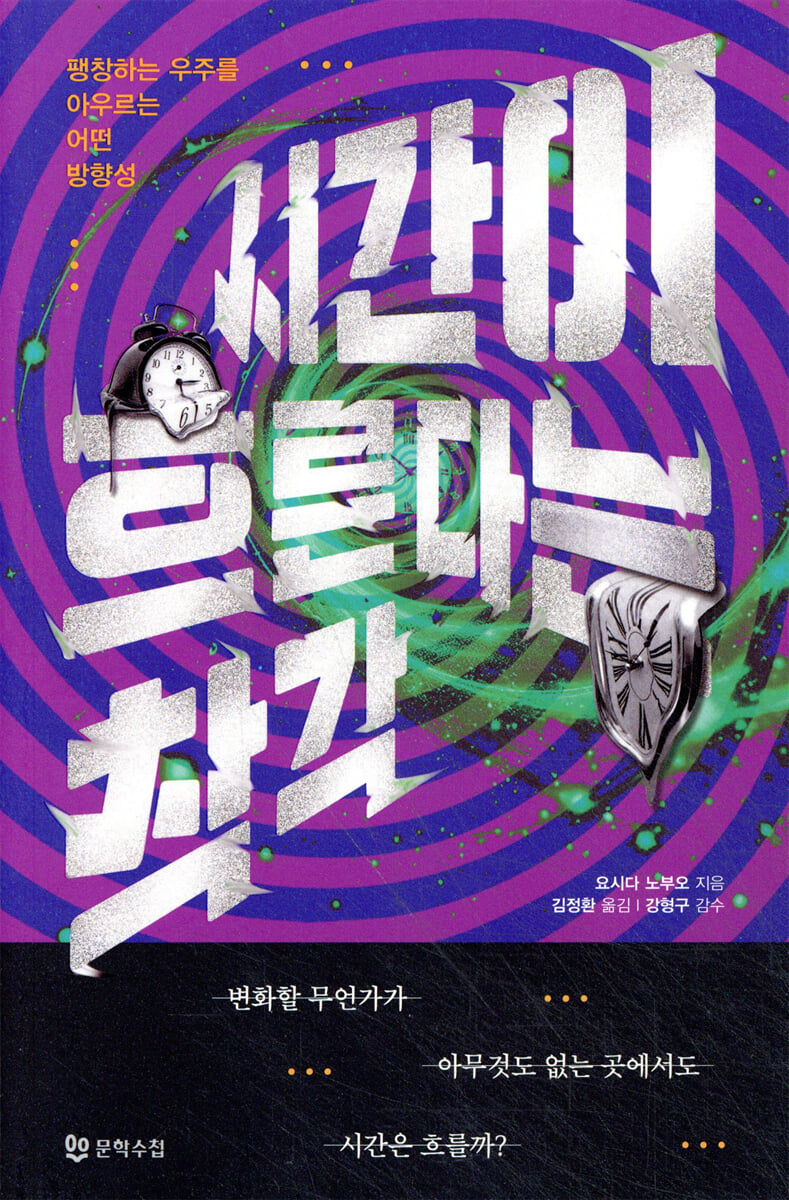
The illusion of time passing
 |
Description
Book Introduction
Correcting the illusion that 'time passes'
The first step toward understanding general relativity
The book, "The Illusion of Time Passing" (original title: "時間" はなぜ存在するのか), which explains in an easy-to-understand way the essence of modern physics that time does not flow but is spread throughout the universe, has been published by Munhak Su-cheop.
Readers interested in physics will be well aware that Newton and Einstein had different ideas about time.
Newton believed that time flowed equally throughout the universe, including Earth, and called this absolute time.
On the other hand, Einstein concluded through his theory of relativity that time does not flow and that different times exist in different places.
And now we know that Einstein was right.
So what exactly is time? Why does it feel like time is flowing? This book answers these questions, starting with the story of when and how time began.
And it answers the ultimate question, 'What is time?'
The first step toward understanding general relativity
The book, "The Illusion of Time Passing" (original title: "時間" はなぜ存在するのか), which explains in an easy-to-understand way the essence of modern physics that time does not flow but is spread throughout the universe, has been published by Munhak Su-cheop.
Readers interested in physics will be well aware that Newton and Einstein had different ideas about time.
Newton believed that time flowed equally throughout the universe, including Earth, and called this absolute time.
On the other hand, Einstein concluded through his theory of relativity that time does not flow and that different times exist in different places.
And now we know that Einstein was right.
So what exactly is time? Why does it feel like time is flowing? This book answers these questions, starting with the story of when and how time began.
And it answers the ultimate question, 'What is time?'
index
Preface: Does time pass even in a place where there is nothing?
CHAPTER 1 ㆍWhere is time?
1.
Rigid Newtonian Time
2.
The stretching of time creates gravity
3.
Einstein's flexible spacetime
CHAPTER 2: The Origin of the Illusion of 'Flowing Time'
1.
The Mystery of the Beginning
2.
The Big Bang is not an explosion
3.
The universe is being destroyed
CHAPTER 3 ㆍCircular Time, Diverging Time
1.
Circulating time
2.
How determined is the future?
3.
Branching time
CHAPTER 4 ㆍTime of Living Things, Time of Humans
1.
The material world also evolves
2.
Time as seen through the history of life
3.
What is time to humans?
CHAPTER 5 ㆍThe End of Time
1.
In the words of a universe that is being destroyed
2.
Humans and Time
References
CHAPTER 1 ㆍWhere is time?
1.
Rigid Newtonian Time
2.
The stretching of time creates gravity
3.
Einstein's flexible spacetime
CHAPTER 2: The Origin of the Illusion of 'Flowing Time'
1.
The Mystery of the Beginning
2.
The Big Bang is not an explosion
3.
The universe is being destroyed
CHAPTER 3 ㆍCircular Time, Diverging Time
1.
Circulating time
2.
How determined is the future?
3.
Branching time
CHAPTER 4 ㆍTime of Living Things, Time of Humans
1.
The material world also evolves
2.
Time as seen through the history of life
3.
What is time to humans?
CHAPTER 5 ㆍThe End of Time
1.
In the words of a universe that is being destroyed
2.
Humans and Time
References
Into the book
In 2020, an experiment was conducted to directly verify how differently time flows by installing high-performance atomic clocks called optical lattice clocks on the ground floor of Tokyo Skytree and on the observatory 450 meters above ground. It was discovered that the clock on the observatory moves 4 billionths of a second faster per day.
It is clear that time passes more slowly the closer you are to the center of the Earth, but the difference is so subtle that it is impossible to perceive.
This is the limit of the amount of time that can be changed by the energy of the celestial body called Earth.
--- p.45
However, from the perspective of human history, the greatest role of general relativity may be to solve the puzzles that appeared in Newton's theory.
Newton thought of space as a vacuum with nothing in it, but the question remains: how can gravity be transmitted if there really is nothing?
The general theory of relativity solved this puzzle by assuming that there is an 'entity' called 'space-time' in space.
--- p.47~48
Objects large enough to be seen by the human eye (or, in technical terms, "macroscopic") are made up of vast numbers of atoms and molecules.
When such objects change naturally without external forces, it is usually a one-way, irreversible process.
This is not because the passage of time brings about some mysterious and irreversible change… …but because statistically, it is ‘extremely probable’ that we will move to a state with a greater number of patterns.
That is, because macroscopic physical phenomena follow statistical laws, the passage of time feels like an irreversible, one-way flow.
--- p.70
If the Big Bang had been a gigantic explosion, there would have been variability in the energy distribution, resulting in the formation of incredibly massive black holes throughout space.
Most large galaxies observed today have supermassive black holes near their centers.
There is also a black hole at the center of our galaxy with an estimated mass of 4 million times that of the sun.
But if the Big Bang had been an explosion with a variance in energy distribution, like a nuclear explosion, then the universe would have been dominated by incomparably supermassive black holes.
It is clear that time passes more slowly the closer you are to the center of the Earth, but the difference is so subtle that it is impossible to perceive.
This is the limit of the amount of time that can be changed by the energy of the celestial body called Earth.
--- p.45
However, from the perspective of human history, the greatest role of general relativity may be to solve the puzzles that appeared in Newton's theory.
Newton thought of space as a vacuum with nothing in it, but the question remains: how can gravity be transmitted if there really is nothing?
The general theory of relativity solved this puzzle by assuming that there is an 'entity' called 'space-time' in space.
--- p.47~48
Objects large enough to be seen by the human eye (or, in technical terms, "macroscopic") are made up of vast numbers of atoms and molecules.
When such objects change naturally without external forces, it is usually a one-way, irreversible process.
This is not because the passage of time brings about some mysterious and irreversible change… …but because statistically, it is ‘extremely probable’ that we will move to a state with a greater number of patterns.
That is, because macroscopic physical phenomena follow statistical laws, the passage of time feels like an irreversible, one-way flow.
--- p.70
If the Big Bang had been a gigantic explosion, there would have been variability in the energy distribution, resulting in the formation of incredibly massive black holes throughout space.
Most large galaxies observed today have supermassive black holes near their centers.
There is also a black hole at the center of our galaxy with an estimated mass of 4 million times that of the sun.
But if the Big Bang had been an explosion with a variance in energy distribution, like a nuclear explosion, then the universe would have been dominated by incomparably supermassive black holes.
--- p.90
Publisher's Review
Why does it feel like time is passing?
There is a certain directionality that encompasses the expanding universe.
Many people associate the passage of time with change.
When something changes, we usually attribute it to the passage of time.
As time passes, change occurs, and the presence of change is evidence of the passage of time.
So, does time flow even in places where nothing changes? Einstein and other modern physicists answer this question as follows.
“There is no place where there is nothing, and time does not flow in the first place.” This book explains step by step what this conclusion reached by modern physicists means.
Chapter 1 explains the transition from Newton's modern science to Einstein's modern physics step by step in three sections: 'Rigid Newton's Time', 'The Stretch and Contraction of Time Creates Gravity', and 'Flexible Einstein's Spacetime'.
Chapter 2 explains why 'time feels like it's passing' using the example of a pendulum that swings back and forth and then stops.
A swinging pendulum is in a 'highly biased' state, with its kinetic energy concentrated only in the weight.
Physical phenomena are unbiased, meaning they progress in the direction of increasing the number of patterns (possibilities) and not the other way around, so the passage of time feels like an irreversible, one-way flow.
Chapter 3 deals with the theme of the cycle and branching of time, and explains the concepts and principles of time machines, wormholes, and time loops that frequently appear in science fiction works.
And it introduces parallel universes as a means of avoiding the 'time paradox', a contradiction that naturally arises when time travel is possible.
Chapters 4 and 5 begin by examining the impact of the birth of the universe on the emergence and evolution of life, and then consider what will happen at the end of the expanding universe, that is, at the end of time.
In 'Time Depicted in Science Fiction Works' at the end of each chapter, we examine time travel devices and time distortion settings depicted in various science fiction works such as novels, animations, and games.
For example, it provides easy-to-understand explanations of whether the wormhole in the movie Interstellar is scientifically possible, and what problems arise with the time loop in the animation The Girl Who Leapt Through Time.
If time is not something that flows, but an entity that exists in all places,
Why do humans only have memories of the past?
According to this book, and according to modern physics, time is a reality that exists everywhere.
If time and space are a rubber canvas on which pictures of physical phenomena are drawn, then time is like the warp that makes up this canvas.
The canvas, woven from the warp and weft of time and space, is like rubber, so it can expand and contract depending on the location. When this happens, the surrounding area cannot be flat, so space-time becomes distorted over a wide area.
If time is not a flow but something that exists throughout the universe, why do humans only have memories of the past? The author explores the origins of time, beginning with the Big Bang.
And the Big Bang, as the name suggests, was not an explosion ('bang'), but rather a uniform state in which everything was equally hot and dense.
As the universe expanded, a very small difference was created between the Big Bang energy scattered faintly throughout space, and as this energy (matter) attracted each other due to universal gravitation, the difference grew larger, eventually creating celestial bodies of gas and a near-vacuum space.
Human memory is formed as the connections between neurons change in response to signals sent by sensory organs.
Changing the connection here requires energy, and life on Earth gets that energy through high-energy molecules that absorb sunlight.
However, stars like the sun were born because the universe began in an orderly, high-energy state called the Big Bang.
Stars formed closer to the Big Bang on the timeline tend to move away from the Big Bang, radiating energy to their surroundings in the form of light.
Because we are using this flow of energy to form memories, the memories we can access at any given moment are limited to information from the past, that is, those closest to the Big Bang on the timeline.
In the universe, which began with the Big Bang and is still expanding, humans are very insignificant beings.
Strictly speaking, in a scientific sense, human effort cannot control time or stop the expansion of the universe.
But even though humans cannot change the universe, they can learn what the universe is.
And that knowledge teaches humans what time is.
There is a certain directionality that encompasses the expanding universe.
Many people associate the passage of time with change.
When something changes, we usually attribute it to the passage of time.
As time passes, change occurs, and the presence of change is evidence of the passage of time.
So, does time flow even in places where nothing changes? Einstein and other modern physicists answer this question as follows.
“There is no place where there is nothing, and time does not flow in the first place.” This book explains step by step what this conclusion reached by modern physicists means.
Chapter 1 explains the transition from Newton's modern science to Einstein's modern physics step by step in three sections: 'Rigid Newton's Time', 'The Stretch and Contraction of Time Creates Gravity', and 'Flexible Einstein's Spacetime'.
Chapter 2 explains why 'time feels like it's passing' using the example of a pendulum that swings back and forth and then stops.
A swinging pendulum is in a 'highly biased' state, with its kinetic energy concentrated only in the weight.
Physical phenomena are unbiased, meaning they progress in the direction of increasing the number of patterns (possibilities) and not the other way around, so the passage of time feels like an irreversible, one-way flow.
Chapter 3 deals with the theme of the cycle and branching of time, and explains the concepts and principles of time machines, wormholes, and time loops that frequently appear in science fiction works.
And it introduces parallel universes as a means of avoiding the 'time paradox', a contradiction that naturally arises when time travel is possible.
Chapters 4 and 5 begin by examining the impact of the birth of the universe on the emergence and evolution of life, and then consider what will happen at the end of the expanding universe, that is, at the end of time.
In 'Time Depicted in Science Fiction Works' at the end of each chapter, we examine time travel devices and time distortion settings depicted in various science fiction works such as novels, animations, and games.
For example, it provides easy-to-understand explanations of whether the wormhole in the movie Interstellar is scientifically possible, and what problems arise with the time loop in the animation The Girl Who Leapt Through Time.
If time is not something that flows, but an entity that exists in all places,
Why do humans only have memories of the past?
According to this book, and according to modern physics, time is a reality that exists everywhere.
If time and space are a rubber canvas on which pictures of physical phenomena are drawn, then time is like the warp that makes up this canvas.
The canvas, woven from the warp and weft of time and space, is like rubber, so it can expand and contract depending on the location. When this happens, the surrounding area cannot be flat, so space-time becomes distorted over a wide area.
If time is not a flow but something that exists throughout the universe, why do humans only have memories of the past? The author explores the origins of time, beginning with the Big Bang.
And the Big Bang, as the name suggests, was not an explosion ('bang'), but rather a uniform state in which everything was equally hot and dense.
As the universe expanded, a very small difference was created between the Big Bang energy scattered faintly throughout space, and as this energy (matter) attracted each other due to universal gravitation, the difference grew larger, eventually creating celestial bodies of gas and a near-vacuum space.
Human memory is formed as the connections between neurons change in response to signals sent by sensory organs.
Changing the connection here requires energy, and life on Earth gets that energy through high-energy molecules that absorb sunlight.
However, stars like the sun were born because the universe began in an orderly, high-energy state called the Big Bang.
Stars formed closer to the Big Bang on the timeline tend to move away from the Big Bang, radiating energy to their surroundings in the form of light.
Because we are using this flow of energy to form memories, the memories we can access at any given moment are limited to information from the past, that is, those closest to the Big Bang on the timeline.
In the universe, which began with the Big Bang and is still expanding, humans are very insignificant beings.
Strictly speaking, in a scientific sense, human effort cannot control time or stop the expansion of the universe.
But even though humans cannot change the universe, they can learn what the universe is.
And that knowledge teaches humans what time is.
GOODS SPECIFICS
- Date of issue: August 27, 2025
- Page count, weight, size: 216 pages | 304g | 128*195*13mm
- ISBN13: 9791173830129
- ISBN10: 117383012X
You may also like
카테고리
korean


korean

![GQ KOREA Mark (Monthly): December [2025]](http://librairie.coreenne.fr/cdn/shop/files/8ef265dbbfbf186523ed75ba7319009d.jpg?v=1765340328&width=3840)


