

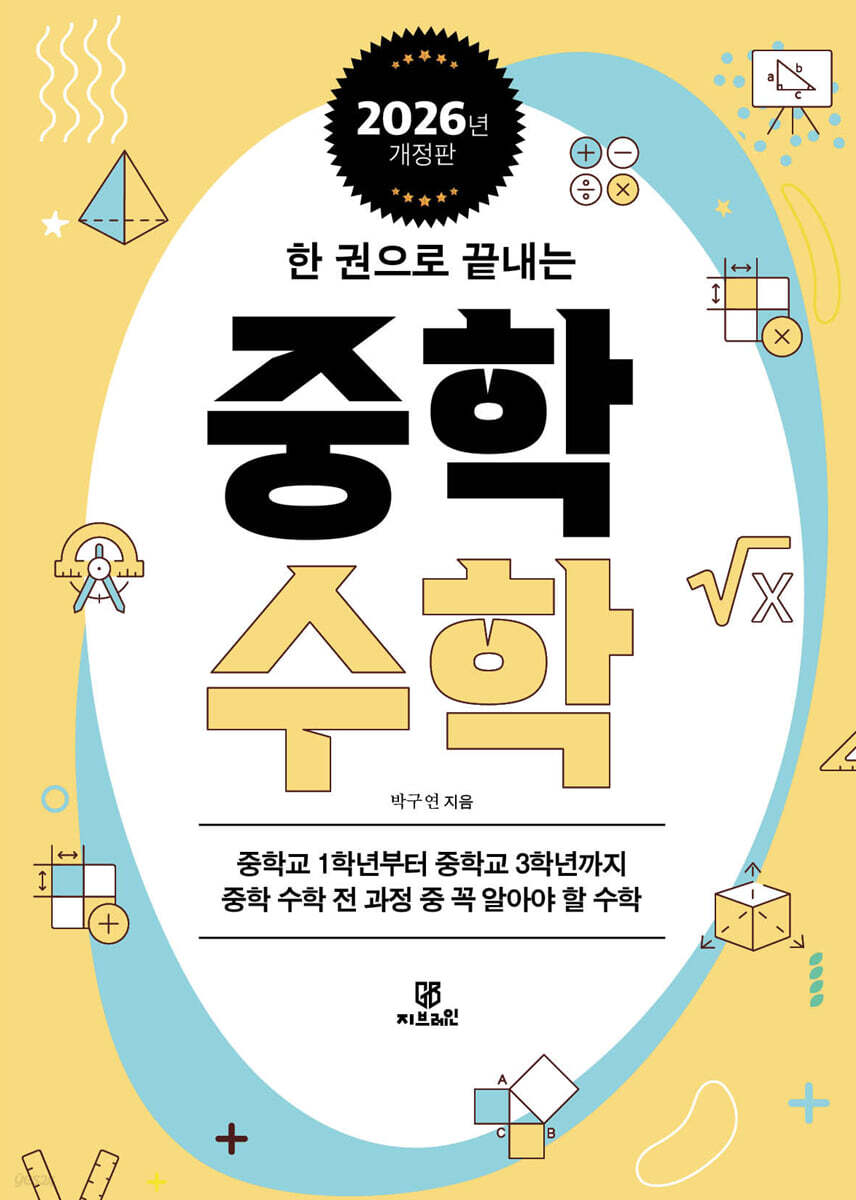
Middle School Math in One Book
 |
Description
Book Introduction
With "Complete Middle School Math in One Book," which contains the core concepts and principles you need to know from the first to third grades of middle school, along with various application examples, let's understand the flow of middle school math as a whole centered on organically connected concepts, and build a solid foundation for mathematical thinking and higher-level mathematics to survive in the AI era!
- You can preview some of the book's contents.
Preview
index
Recommendation 4 Preface 6
Building a foundation in first-grade math
1-1 Properties of Natural Numbers 16
Factors and Multiples 17 Prime Factorization 18 Greatest Common Divisor and Least Common Multiple 24
Knowledge up! Tok Tok: Periodic cicadas use "minorities" as strategic numbers to survive 29
1-2 Integers and Rational Numbers 31
1-3 Linear Equations 43
Literal expressions 43 Monomials and polynomials 49 Equations, equations, and identities 52
Types and Solutions of Linear Equations 58 Applications of Linear Equations 62
1-4 Graphs and Proportions 74
74 Mirroring of Points on the Coordinate Plane 77 Graph Analysis 78
Proportional and Inverse Relationships 84 Using Proportional and Inverse Relationships 93
1-5 Basic Shapes 96
Basic Elements of Geometry 96 Perpendiculars and Perpendiculars 102 Construction 109 Congruence Conditions for Triangles 114
1-6 Plane Figures 117
Polygon 117 Circle and sector 123
1-7 Solid Figures 135
Polyhedrons 135 Regular polyhedrons 137 Solids of revolution 141 Surface area and volume 146 Volume 149
Knowledge Up! Euler's Polyhedron Theorem 152
1-8 Statistics 153
Stem and Leaf Plot 153 Frequency Distribution Table 155 Histogram 157 Relative Frequency and Its Graph 158
Strengthening Second Grade Math Skills
2-1 Rational Numbers and Prime Numbers 164
Rational Numbers and Finite Decimals 164
Calculation of Equation 2-2 169
Exponent Law 170 Calculating Monomials and Polynomials 171 Multiplying and Dividing Polynomials 177
Knowledge up! To destroy the world, move the Tower of Hanoi disks. 183
2-3 Linear Inequality 185
Inequalities and Symbols 185 Properties of Inequalities 186 Linear Inequalities 188 Applications of Linear Inequalities 190
2-4 Simultaneous Linear Equations 197
Systems of Linear Equations with Two Unknown Variables 197 Methods for Solving Systems of Linear Equations 200
Solving Complex Systems of Linear Equations 206 When the Solution is Special 210 Application Problems of Systems of Linear Equations 213
2-5 Linear Functions 222
Function 222 Correspondence and One-to-One Correspondence 223 Domain, Codomain, and Range 225 Definition of Linear Function 226
x-intercept and y-intercept 228 Slope of a line 230 How to find a linear function when given conditions 231
Constant Function 234 Relationship between Linear Functions and Linear Equations 235 Application Problems of Linear Functions 237
2-6 Properties of Triangles 240
Propositions, Definitions, Properties, and Proofs 240 Properties of Triangles 243 Properties of Isosceles Triangles 244 Properties of Equilateral Triangles 247
Conditions for Congruence of Right Triangles 248 Incenter and Circumcenter of Triangles 251 Midpoint Connection Theorem of Triangles 258
2-7 Properties of Squares 263
Properties of Trapezoid 264 Properties of Parallelogram 265 Properties of Rectangle and Rhombus 267
Properties of Squares 270
Similarity of Figures 2-8 272
Conditions for Similarity of Triangles 277 Formulas for Similarity of Right Triangles and Sides 279
282 Ratio of lengths using properties of parallel lines 286 Bisectors of interior and exterior angles of a triangle
Area and Volume Ratio in Similarity 291 Axiom and Scale 292
2-9 Pythagorean Theorem 295
Pythagorean Theorem 295 Applications of the Pythagorean Theorem 305 Shortest Distance 308
Knowledge Up! Tok Tok: Fermat's Last Theorem 313: A Conundrum That Has Baffled Mathematicians for 350 Years
2-10 probability 317
Case 317: The Law of Addition and the Law of Multiplication 318: Various Cases 319
Extraction with and without replacement 327
Completing 3rd Grade Middle School Mathematics
3-1 Real Numbers and Operations 336
Square Root 336 Knowledge Up! Tok Tok: How a Joseon Dynasty Mathematician Calculated Square Roots 345
3-2 Polynomial Multiplication Formulas and Factorization 347
Multiplication Formula 347 Factoring 352 Applications of Factoring 360
3-3 Quadratic Equations 363
Definition of Quadratic Equations 363 Solving Quadratic Equations 364 Applications of Quadratic Equations 370
Knowledge Up! Talk Talk: Communicate with Aliens - Today's Equation 375
3-4 Quadratic Function 378
Finding the equation of a quadratic function when conditions are given 388 Quadratic function application problems 390
3-5 Trigonometric Ratios 392
3-6 Properties of Circles 405
Circles and Lines 405 Inscribed Circles of Triangles 409 Properties of Circumscribed Quadrilaterals 410 Properties of Central Angles 411
The angle between the tangent and the chord is 413
3-7 Statistics 417
Scatterplots and Correlation 419
Math Preliminary Matrix 424
Search 429
Building a foundation in first-grade math
1-1 Properties of Natural Numbers 16
Factors and Multiples 17 Prime Factorization 18 Greatest Common Divisor and Least Common Multiple 24
Knowledge up! Tok Tok: Periodic cicadas use "minorities" as strategic numbers to survive 29
1-2 Integers and Rational Numbers 31
1-3 Linear Equations 43
Literal expressions 43 Monomials and polynomials 49 Equations, equations, and identities 52
Types and Solutions of Linear Equations 58 Applications of Linear Equations 62
1-4 Graphs and Proportions 74
74 Mirroring of Points on the Coordinate Plane 77 Graph Analysis 78
Proportional and Inverse Relationships 84 Using Proportional and Inverse Relationships 93
1-5 Basic Shapes 96
Basic Elements of Geometry 96 Perpendiculars and Perpendiculars 102 Construction 109 Congruence Conditions for Triangles 114
1-6 Plane Figures 117
Polygon 117 Circle and sector 123
1-7 Solid Figures 135
Polyhedrons 135 Regular polyhedrons 137 Solids of revolution 141 Surface area and volume 146 Volume 149
Knowledge Up! Euler's Polyhedron Theorem 152
1-8 Statistics 153
Stem and Leaf Plot 153 Frequency Distribution Table 155 Histogram 157 Relative Frequency and Its Graph 158
Strengthening Second Grade Math Skills
2-1 Rational Numbers and Prime Numbers 164
Rational Numbers and Finite Decimals 164
Calculation of Equation 2-2 169
Exponent Law 170 Calculating Monomials and Polynomials 171 Multiplying and Dividing Polynomials 177
Knowledge up! To destroy the world, move the Tower of Hanoi disks. 183
2-3 Linear Inequality 185
Inequalities and Symbols 185 Properties of Inequalities 186 Linear Inequalities 188 Applications of Linear Inequalities 190
2-4 Simultaneous Linear Equations 197
Systems of Linear Equations with Two Unknown Variables 197 Methods for Solving Systems of Linear Equations 200
Solving Complex Systems of Linear Equations 206 When the Solution is Special 210 Application Problems of Systems of Linear Equations 213
2-5 Linear Functions 222
Function 222 Correspondence and One-to-One Correspondence 223 Domain, Codomain, and Range 225 Definition of Linear Function 226
x-intercept and y-intercept 228 Slope of a line 230 How to find a linear function when given conditions 231
Constant Function 234 Relationship between Linear Functions and Linear Equations 235 Application Problems of Linear Functions 237
2-6 Properties of Triangles 240
Propositions, Definitions, Properties, and Proofs 240 Properties of Triangles 243 Properties of Isosceles Triangles 244 Properties of Equilateral Triangles 247
Conditions for Congruence of Right Triangles 248 Incenter and Circumcenter of Triangles 251 Midpoint Connection Theorem of Triangles 258
2-7 Properties of Squares 263
Properties of Trapezoid 264 Properties of Parallelogram 265 Properties of Rectangle and Rhombus 267
Properties of Squares 270
Similarity of Figures 2-8 272
Conditions for Similarity of Triangles 277 Formulas for Similarity of Right Triangles and Sides 279
282 Ratio of lengths using properties of parallel lines 286 Bisectors of interior and exterior angles of a triangle
Area and Volume Ratio in Similarity 291 Axiom and Scale 292
2-9 Pythagorean Theorem 295
Pythagorean Theorem 295 Applications of the Pythagorean Theorem 305 Shortest Distance 308
Knowledge Up! Tok Tok: Fermat's Last Theorem 313: A Conundrum That Has Baffled Mathematicians for 350 Years
2-10 probability 317
Case 317: The Law of Addition and the Law of Multiplication 318: Various Cases 319
Extraction with and without replacement 327
Completing 3rd Grade Middle School Mathematics
3-1 Real Numbers and Operations 336
Square Root 336 Knowledge Up! Tok Tok: How a Joseon Dynasty Mathematician Calculated Square Roots 345
3-2 Polynomial Multiplication Formulas and Factorization 347
Multiplication Formula 347 Factoring 352 Applications of Factoring 360
3-3 Quadratic Equations 363
Definition of Quadratic Equations 363 Solving Quadratic Equations 364 Applications of Quadratic Equations 370
Knowledge Up! Talk Talk: Communicate with Aliens - Today's Equation 375
3-4 Quadratic Function 378
Finding the equation of a quadratic function when conditions are given 388 Quadratic function application problems 390
3-5 Trigonometric Ratios 392
3-6 Properties of Circles 405
Circles and Lines 405 Inscribed Circles of Triangles 409 Properties of Circumscribed Quadrilaterals 410 Properties of Central Angles 411
The angle between the tangent and the chord is 413
3-7 Statistics 417
Scatterplots and Correlation 419
Math Preliminary Matrix 424
Search 429
Publisher's Review
Middle school mathematics is an essential foundation for advanced and college mathematics, as well as for a variety of future industries like AI, engineering, economics, and data science. Mathematics is an honest discipline where results are proportional to effort. In the AI era, "mathematical thinking" lies at the heart of education.
And middle school mathematics becomes the foundation for developing mathematical thinking skills, problem-solving skills, and logical critical thinking skills.
Therefore, it is most important to lay a solid foundation starting from middle school.
In today's rapidly changing society, driven by AI and data, mathematics is no longer confined to the academic realm; it is becoming a core competency for navigating the future.
The development of digital technology and artificial intelligence requires mathematical thinking, problem-solving skills, and creative and critical thinking as essential elements, and these competencies are fully developed through middle school mathematics education.
The 2022 revised curriculum is designed to help students naturally deepen the mathematical foundations they learned in elementary school and advance to higher-level mathematics and more complex problem solving.
In addition, the Ministry of Education reorganized elementary, middle, and high school mathematics education into four integrated areas: 'Numbers and Operations,' 'Change and Relationships,' 'Shapes and Measurement,' and 'Data and Possibilities,' and strengthened the connection from elementary to high school.
Accordingly, the 2026 revised edition of "Complete Middle School Math in One Volume" covers the entire curriculum from the first to third grades of middle school, systematically reflecting the Ministry of Education's revision direction and grade-by-grade flow.
In particular, the revised curriculum emphasizes close connections with real life and expands the experience of applying mathematical concepts to real-life situations.
For example, the concept of maximum and minimum of quadratic functions was moved from the high school curriculum to the third year of middle school, expanding the opportunity to gradually understand and apply the concept of functions.
This shift goes beyond simple computational skills and focuses on developing the ability to build and interpret mathematical models in complex situations.
The 2026 revised edition of "Complete Middle School Math in One Volume" faithfully reflects these changing curriculum changes, systematically covering the entire curriculum from the first to third grades of middle school in one volume.
This book provides easy-to-understand explanations of key concepts, definitions, and principles for each unit, and is structured to help readers accurately understand concepts and develop problem-solving skills through essential examples and practical problems.
This book is designed for not only first-year middle school students who are just starting middle school math, but also middle and high school students who want to re-establish their math foundations, upper elementary school students who want to learn in advance, and anyone interested in math.
Therefore, the 2026 revised edition of "Complete Middle School Math in One Book" will serve as a tool to help students build confidence in mathematics and develop the mathematical thinking and problem-solving skills required by a changing society, reflecting the direction of the new curriculum.
And middle school mathematics becomes the foundation for developing mathematical thinking skills, problem-solving skills, and logical critical thinking skills.
Therefore, it is most important to lay a solid foundation starting from middle school.
In today's rapidly changing society, driven by AI and data, mathematics is no longer confined to the academic realm; it is becoming a core competency for navigating the future.
The development of digital technology and artificial intelligence requires mathematical thinking, problem-solving skills, and creative and critical thinking as essential elements, and these competencies are fully developed through middle school mathematics education.
The 2022 revised curriculum is designed to help students naturally deepen the mathematical foundations they learned in elementary school and advance to higher-level mathematics and more complex problem solving.
In addition, the Ministry of Education reorganized elementary, middle, and high school mathematics education into four integrated areas: 'Numbers and Operations,' 'Change and Relationships,' 'Shapes and Measurement,' and 'Data and Possibilities,' and strengthened the connection from elementary to high school.
Accordingly, the 2026 revised edition of "Complete Middle School Math in One Volume" covers the entire curriculum from the first to third grades of middle school, systematically reflecting the Ministry of Education's revision direction and grade-by-grade flow.
In particular, the revised curriculum emphasizes close connections with real life and expands the experience of applying mathematical concepts to real-life situations.
For example, the concept of maximum and minimum of quadratic functions was moved from the high school curriculum to the third year of middle school, expanding the opportunity to gradually understand and apply the concept of functions.
This shift goes beyond simple computational skills and focuses on developing the ability to build and interpret mathematical models in complex situations.
The 2026 revised edition of "Complete Middle School Math in One Volume" faithfully reflects these changing curriculum changes, systematically covering the entire curriculum from the first to third grades of middle school in one volume.
This book provides easy-to-understand explanations of key concepts, definitions, and principles for each unit, and is structured to help readers accurately understand concepts and develop problem-solving skills through essential examples and practical problems.
This book is designed for not only first-year middle school students who are just starting middle school math, but also middle and high school students who want to re-establish their math foundations, upper elementary school students who want to learn in advance, and anyone interested in math.
Therefore, the 2026 revised edition of "Complete Middle School Math in One Book" will serve as a tool to help students build confidence in mathematics and develop the mathematical thinking and problem-solving skills required by a changing society, reflecting the direction of the new curriculum.
GOODS SPECIFICS
- Date of issue: August 25, 2025
- Page count, weight, size: 432 pages | 582g | 150*210*23mm
- ISBN13: 9788959798070
- ISBN10: 895979807X
You may also like
카테고리
korean


korean

![GQ KOREA Mark (Monthly): December [2025]](http://librairie.coreenne.fr/cdn/shop/files/8ef265dbbfbf186523ed75ba7319009d.jpg?v=1765340328&width=3840)


