

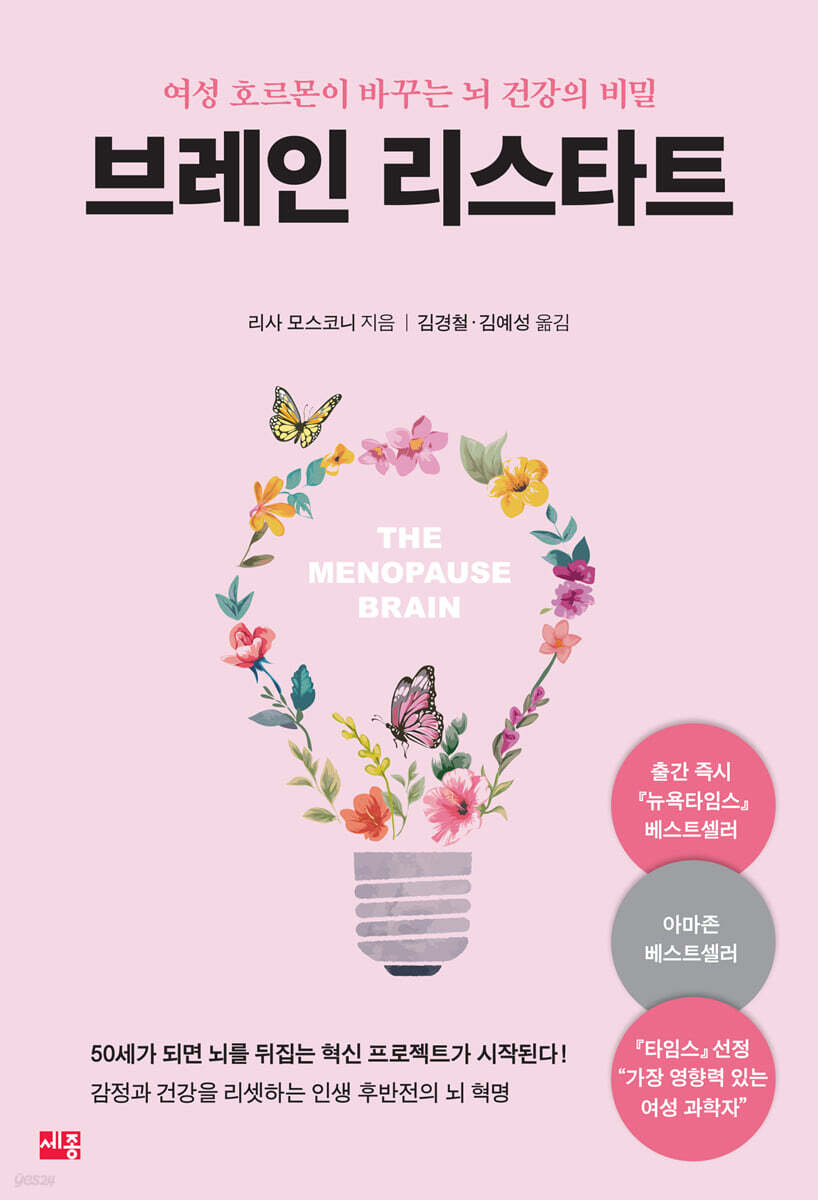
Brain Restart
 |
Description
Book Introduction
“Menopause is a brain-driven hormonal show!”
When you turn 50, a brain-altering innovation project begins!!
A brain revolution in the second half of life that resets emotions and health.
"Menopause isn't just about the ovaries; it's a brain-driven hormonal show!" Brain Restart reveals that menopausal symptoms aren't simply due to the cessation of ovarian function, but rather stem from hormonally driven changes in the brain.
Lisa Mosconi, a world-renowned neuroscientist and leading expert in the field of menopausal brain, emphasizes that menopause is not a time of decline, but rather a turning point in life and a 'second opportunity for maturity' achieved through brain remodeling.
Female hormones are deeply involved in brain function during important periods of life, such as puberty, pregnancy, and menopause, promoting the development of neurological and mental abilities.
From a neurological perspective, the amygdala, the brain's emotional center, appears to be stably regulated during menopause.
As the brain rewires after menopause, women experience greater confidence, peace, and empathy.
As emotional control increases, people become less sensitive to negative or upsetting events, their emotional stability increases, and their life satisfaction increases.
This book goes a step further and sheds new light on menopause by proposing the "Grandmother Hypothesis," which suggests that menopause may actually be the reason humans live longer today, from an evolutionary perspective.
By using menopause as a time to take care of yourself, you can live a vibrant life with a new and improved brain.
The author suggests practical methods for a healthy menopause, including hormone replacement therapy and non-hormonal therapy, proper nutrition intake, and lifestyle habits.
In particular, the book notes that transgender people can also experience menopause due to hormone therapy, and explains 'gender identity support therapy' for them.
This is a field that has been little studied so far, and this book is the first to cover it in the world.
Many celebrities, including Dr. Oh Han-jin, health YouTuber Choi Kyeom, Dr. Lively, Gwyneth Paltrow, and Naomi Watts, have recommended this book.
After reading this book, you will realize that menopause is actually a blessing, a golden opportunity to start life anew with a stronger brain.
When you turn 50, a brain-altering innovation project begins!!
A brain revolution in the second half of life that resets emotions and health.
"Menopause isn't just about the ovaries; it's a brain-driven hormonal show!" Brain Restart reveals that menopausal symptoms aren't simply due to the cessation of ovarian function, but rather stem from hormonally driven changes in the brain.
Lisa Mosconi, a world-renowned neuroscientist and leading expert in the field of menopausal brain, emphasizes that menopause is not a time of decline, but rather a turning point in life and a 'second opportunity for maturity' achieved through brain remodeling.
Female hormones are deeply involved in brain function during important periods of life, such as puberty, pregnancy, and menopause, promoting the development of neurological and mental abilities.
From a neurological perspective, the amygdala, the brain's emotional center, appears to be stably regulated during menopause.
As the brain rewires after menopause, women experience greater confidence, peace, and empathy.
As emotional control increases, people become less sensitive to negative or upsetting events, their emotional stability increases, and their life satisfaction increases.
This book goes a step further and sheds new light on menopause by proposing the "Grandmother Hypothesis," which suggests that menopause may actually be the reason humans live longer today, from an evolutionary perspective.
By using menopause as a time to take care of yourself, you can live a vibrant life with a new and improved brain.
The author suggests practical methods for a healthy menopause, including hormone replacement therapy and non-hormonal therapy, proper nutrition intake, and lifestyle habits.
In particular, the book notes that transgender people can also experience menopause due to hormone therapy, and explains 'gender identity support therapy' for them.
This is a field that has been little studied so far, and this book is the first to cover it in the world.
Many celebrities, including Dr. Oh Han-jin, health YouTuber Choi Kyeom, Dr. Lively, Gwyneth Paltrow, and Naomi Watts, have recommended this book.
After reading this book, you will realize that menopause is actually a blessing, a golden opportunity to start life anew with a stronger brain.
- You can preview some of the book's contents.
Preview
index
Recommendation
A Brain Science Book for Every Woman | Kim Kyung-chul
Preface | Maria Shriver
Part 1: The Second Spring of Life
Chapter 1 You Are Not Crazy
Chapter 2: Breaking Down Stereotypes Surrounding Women and Menopause
Chapter 3: Menopause, the thing no one tells you about
Chapter 4: Menopausal Brain: It's Not Just Your Feelings
Part 2: The Dialogue Between the Brain and Hormones
Chapter 5: The Brain and the Ovaries, Destined Partners
Chapter 6: Understanding Menopause: The 3Ps Rule
Chapter 7: The Twist of Menopause We Never Knew
Chapter 8: Why Does Menopause Exist?
Part 3: Drug Treatment to Help Alleviate Menopausal Symptoms
Chapter 9: Estrogen Therapy: Are There Any Side Effects?
Chapter 10: Hormonal and Non-hormonal Therapies for Managing Menopause
Chapter 11: Cancer Treatment and the "Chemo Brain"
Chapter 12: Gender Identity Supportive Therapy and Cross-Sex Therapy
Part 4: Lifestyle and Health Management for a Vibrant Life
Chapter 13: Exercise Habits to Maintain Good Condition
Chapter 14: Diet and Nutrition for the Menopausal Brain
Chapter 15: Nutritional Supplements and Natural Herbal Ingredients as Alternatives to Hormone Therapy
Chapter 16: Stress Relief and Healthy Sleep Habits
Chapter 17: Environmental Toxins and Estrogen Disruptors to Avoid
Chapter 18: The Magic of Positivity: The Power to Change Your Life
Acknowledgements
After the Move: For the Reblooming Perennials | Kim Ye-seong
main
A Brain Science Book for Every Woman | Kim Kyung-chul
Preface | Maria Shriver
Part 1: The Second Spring of Life
Chapter 1 You Are Not Crazy
Chapter 2: Breaking Down Stereotypes Surrounding Women and Menopause
Chapter 3: Menopause, the thing no one tells you about
Chapter 4: Menopausal Brain: It's Not Just Your Feelings
Part 2: The Dialogue Between the Brain and Hormones
Chapter 5: The Brain and the Ovaries, Destined Partners
Chapter 6: Understanding Menopause: The 3Ps Rule
Chapter 7: The Twist of Menopause We Never Knew
Chapter 8: Why Does Menopause Exist?
Part 3: Drug Treatment to Help Alleviate Menopausal Symptoms
Chapter 9: Estrogen Therapy: Are There Any Side Effects?
Chapter 10: Hormonal and Non-hormonal Therapies for Managing Menopause
Chapter 11: Cancer Treatment and the "Chemo Brain"
Chapter 12: Gender Identity Supportive Therapy and Cross-Sex Therapy
Part 4: Lifestyle and Health Management for a Vibrant Life
Chapter 13: Exercise Habits to Maintain Good Condition
Chapter 14: Diet and Nutrition for the Menopausal Brain
Chapter 15: Nutritional Supplements and Natural Herbal Ingredients as Alternatives to Hormone Therapy
Chapter 16: Stress Relief and Healthy Sleep Habits
Chapter 17: Environmental Toxins and Estrogen Disruptors to Avoid
Chapter 18: The Magic of Positivity: The Power to Change Your Life
Acknowledgements
After the Move: For the Reblooming Perennials | Kim Ye-seong
main
Detailed image

Into the book
So far, it has been discovered that the most common symptoms of menopause are embarrassing ones such as hot flashes, anxiety and depression, sleep disturbances, brain fog, and memory loss.
But the surprising thing is that all these symptoms do not originate from the ovaries, but from an organ you might not expect: the brain.
These symptoms are actually neurological symptoms that occur as the brain changes during menopause.
While your ovaries play a key role in menopause, it's your brain that's really in charge.
--- p.26
To give you an idea of how dire the situation was when we began our research, there had never been a single study comparing women's brains before and after menopause.
So we rolled up our sleeves, turned on our brain scanners, and started exploring this new territory.
As a result, significant progress has been made in proving that women's brains age differently from men's brains, and that menopause plays a key role in this process.
Indeed, these studies have revealed that menopause is a neurologically active process that affects the brain in very unique ways.
--- p.32
Every time a woman becomes pregnant, there is a hormonal fireworks display, and after giving birth, it decreases dramatically.
After that, hormone levels rise again and we continue on a relatively stable voyage until we reach the most turbulent of the big Ps, menopause.
Eventually, menopause passes and estrogen declines, replaced by other hormones.
We often think of these hormonal activities as ovarian-driven, but the brain sees things differently.
For years, our brains have been on a hormonal roller coaster with our ovaries, making for a pretty intense journey for both body and mind.
--- p.117
Brain development, which begins under the direction of DNA, begins in the womb, before we are even born.
Here's an interesting fact.
At first glance, every child's brain is exactly like a woman's brain.
Yes, that's right.
I understand correctly.
The female brain is nature's default setting.
(Darwin, explain this too!) Only after the testosterone surge does the male brain begin to develop masculine characteristics, which means it is designed to respond better to testosterone, as we discussed in the previous chapter.
--- p.118
Other evidence suggests that menopause may actually be the reason humans live as long as they do today.
In fact, prehistoric grandmothers were not just ordinary grandmothers.
These were grandmothers who were 'naturally selected'.
Natural selection means survival of the fittest, and these women were strong enough to survive multiple births and had the genetic traits to survive past menopause.
According to the theory, these traits were passed down to children and grandchildren, so grandmothers' longevity genes were passed down to the next generation.
Over time, these survival advantages may have promoted evolutionary change.
(……) Studies of killer whales that live past menopause support the grandmother hypothesis.
--- p.155
That means transgender men can become pregnant if they don't use contraception, and they will eventually go through menopause.
As we explore new ways to respect gender flexibility, we face the reality that physiological sex and gender identity may not necessarily align.
The important thing to remember is that anyone born with ovaries and who experiences menstruation will eventually experience menopause.
Here we encounter a phenomenon called double conversion.
One is the transition to gender identity, and the other is the transition to menopause.
--- p.227
Women who exercise regularly experience a significant reduction in sweating and discomfort, even when they experience hot flashes.
In a study of 3,500 Latin American women, those who regularly exercised moderately were 28 percent less likely to experience severe hot flashes than those who exercised less.11 A sample study of more than 400 Australian women found that women who exercised daily experienced 49 percent fewer hot flashes than those who were very inactive.
--- p.242
Thoughts soon become reality.
If you fear menopause as a painful, life-sucking process, you may naturally be more sensitive to its symptoms and feel their intensity more intensely.
Even when treatments are available, you may experience less benefit.
Conversely, if you believe that menopause is just a process, that there will be changes but that things will eventually get better, you're likely to get through it much more smoothly than you expect.
It is never in vain to pay attention to the beliefs we have.
--- p.359
If you, who are reading this right now, are feeling depressed for no reason or feeling unfamiliar with yourself, it is not your fault.
Your brain, your body, your life are going through a period of change right now.
Even though you may feel alone on that path, there are certainly others walking the same path as you, and this book will walk alongside you.
But the surprising thing is that all these symptoms do not originate from the ovaries, but from an organ you might not expect: the brain.
These symptoms are actually neurological symptoms that occur as the brain changes during menopause.
While your ovaries play a key role in menopause, it's your brain that's really in charge.
--- p.26
To give you an idea of how dire the situation was when we began our research, there had never been a single study comparing women's brains before and after menopause.
So we rolled up our sleeves, turned on our brain scanners, and started exploring this new territory.
As a result, significant progress has been made in proving that women's brains age differently from men's brains, and that menopause plays a key role in this process.
Indeed, these studies have revealed that menopause is a neurologically active process that affects the brain in very unique ways.
--- p.32
Every time a woman becomes pregnant, there is a hormonal fireworks display, and after giving birth, it decreases dramatically.
After that, hormone levels rise again and we continue on a relatively stable voyage until we reach the most turbulent of the big Ps, menopause.
Eventually, menopause passes and estrogen declines, replaced by other hormones.
We often think of these hormonal activities as ovarian-driven, but the brain sees things differently.
For years, our brains have been on a hormonal roller coaster with our ovaries, making for a pretty intense journey for both body and mind.
--- p.117
Brain development, which begins under the direction of DNA, begins in the womb, before we are even born.
Here's an interesting fact.
At first glance, every child's brain is exactly like a woman's brain.
Yes, that's right.
I understand correctly.
The female brain is nature's default setting.
(Darwin, explain this too!) Only after the testosterone surge does the male brain begin to develop masculine characteristics, which means it is designed to respond better to testosterone, as we discussed in the previous chapter.
--- p.118
Other evidence suggests that menopause may actually be the reason humans live as long as they do today.
In fact, prehistoric grandmothers were not just ordinary grandmothers.
These were grandmothers who were 'naturally selected'.
Natural selection means survival of the fittest, and these women were strong enough to survive multiple births and had the genetic traits to survive past menopause.
According to the theory, these traits were passed down to children and grandchildren, so grandmothers' longevity genes were passed down to the next generation.
Over time, these survival advantages may have promoted evolutionary change.
(……) Studies of killer whales that live past menopause support the grandmother hypothesis.
--- p.155
That means transgender men can become pregnant if they don't use contraception, and they will eventually go through menopause.
As we explore new ways to respect gender flexibility, we face the reality that physiological sex and gender identity may not necessarily align.
The important thing to remember is that anyone born with ovaries and who experiences menstruation will eventually experience menopause.
Here we encounter a phenomenon called double conversion.
One is the transition to gender identity, and the other is the transition to menopause.
--- p.227
Women who exercise regularly experience a significant reduction in sweating and discomfort, even when they experience hot flashes.
In a study of 3,500 Latin American women, those who regularly exercised moderately were 28 percent less likely to experience severe hot flashes than those who exercised less.11 A sample study of more than 400 Australian women found that women who exercised daily experienced 49 percent fewer hot flashes than those who were very inactive.
--- p.242
Thoughts soon become reality.
If you fear menopause as a painful, life-sucking process, you may naturally be more sensitive to its symptoms and feel their intensity more intensely.
Even when treatments are available, you may experience less benefit.
Conversely, if you believe that menopause is just a process, that there will be changes but that things will eventually get better, you're likely to get through it much more smoothly than you expect.
It is never in vain to pay attention to the beliefs we have.
--- p.359
If you, who are reading this right now, are feeling depressed for no reason or feeling unfamiliar with yourself, it is not your fault.
Your brain, your body, your life are going through a period of change right now.
Even though you may feel alone on that path, there are certainly others walking the same path as you, and this book will walk alongside you.
--- p.375
Publisher's Review
★ Immediately after publication, it became an Amazon and New York Times bestseller.
★ The latest work by Lisa Mosconi, named “the most influential female scientist” by Time Magazine
★ Nominated for the 2024 Goodreads Choice Awards Nonfiction category
★ Highly recommended by Dr. Oh Han-jin, health YouTuber Choi Kyeom, and Gwyneth Paltrow.
“Menopause is not the end, it’s a new beginning!”
After 50, a woman's brain actually becomes stronger.
Every woman experiences menopause.
Currently, approximately 1 billion women worldwide are experiencing menopause, spending approximately 40 percent of their lives in this state.
Despite the fact that many women experience a variety of symptoms, the social perception of menopause is still negative and seen as something to be avoided.
This book shatters the conventional wisdom that menopause is an end from a neurological perspective and reveals that it is actually a new beginning.
Lisa Mosconi, a neuroscientist and leading expert in the field of menopausal brain, draws on cutting-edge brain imaging research and extensive clinical experience to scientifically demonstrate how menopause changes the brain, demonstrating the interplay between estrogen and the brain and the impact and significance of brain energy on women's lives.
It delicately weaves together topics such as neuroscience, endocrinology, mental health, cognitive function, and quality of life, and clearly explains how the female brain is restructured before and after menopause.
And it presents specific, actionable strategies for menopausal women to live in harmony with their newly changed brain state.
All the organs in our body are closely connected, so symptoms or diseases that appear in one organ affect the functions of other organs.
This means that all symptoms and diseases are interconnected.
However, Western medicine treats diseases and organs by dividing them into specialized areas, so there is almost no research that looks at menopause from a brain science perspective.
Although the author is a neurologist, he explains female hormones in more detail and with more friendliness than an obstetrician/gynecologist.
This scientifically based study specifically explains the phenomenon of brain functions being switched on and off and reorganized according to dynamic changes in hormones.
Menopause is nature's wisdom for the survival of humanity.
The 'Grandmother Hypothesis' from an Evolutionary Perspective
This book takes a completely new look at menopause, a period that has long been perceived as something to be avoided or suppressed.
The message of this book is groundbreaking in that it traces the cause of menopausal symptoms such as facial flushing, insomnia, depression, brain fog, forgetfulness, and mood swings not simply to the decline of the reproductive organs, but to changes in the brain.
As the brain rewires after menopause, women experience greater self-confidence, improved emotional control, and heightened empathy skills.
As a result, emotional stability increases and life satisfaction also increases.
This book approaches menopause from an evolutionary perspective to explain its positive aspects.
The author views menopause from a new perspective, not as an evolutionary mistake but as an “evolutionary adaptation,” and cites the “grandmother hypothesis” (Christine Hawkes) to emphasize that grandmothers have contributed greatly to the survival of the human race by caring for their grandchildren even after their duty to raise their own children has ended.
Studies of killer whales living past menopause support the grandmother hypothesis.
This stems from the ability to perceive the thoughts and intentions of others (theory of mind) and the ability to be considerate (empathy), which are particularly evident in menopausal women.
As such, menopause is one of the most important neurological changes in a woman's life, and understanding what happens in the brain can help you manage and embrace it.
If you know how to take care of yourself—with proper exercise, nutrition, and a healthy mindset—you can harness your newly strengthened brain to create a meaningful and vibrant new life.
“It’s not hormones, it’s your brain rhythms that are changing.”
Menopause is a powerful 'neurological transition'
Although the original title of this book is 'Menopause Brain', the author does not only talk about menopause.
It delicately explains the changes in the mind and brain of women according to the menstrual cycle (before and after ovulation) that begins during puberty.
During each of the three life transitions of every woman—puberty, pregnancy, and perimenopause—an active dialogue takes place between hormones and the brain.
Estrogen is involved in numerous brain processes beyond its role in reproduction.
The adolescent brain is prone to irritability and mood swings, while the mature female brain helps develop memory and flexible communication skills based on the ability to regulate emotions stably.
The strong maternal instincts and postpartum depression during pregnancy and parenting, and the deepened empathy that comes with menopause, are all created by the roller coaster-like interactions between hormones and the brain.
The life of a woman, who is so strongly influenced by hormones, enters a stable period of complete independence from hormones after menopause.
Therefore, menopause is not a negative sign that menstruation has ended.
It is a 'renaissance' for women who are free from the monthly inconveniences, worries about pregnancy, and the responsibilities of childcare.
The author introduces hormone replacement therapy, non-hormonal therapy, nutritional intake and lifestyle habits, and positive mindset training as practical methods for a healthy menopause.
Menopause due to masculinization and feminization treatments is no exception for transgender people.
The book also describes 'gender identity support therapy' for transgender people receiving hormone therapy.
The author's Q&A with patients in the clinic is also included in the text to help readers address their questions about menopause.
This book is a must-read for women who are about to enter or have already entered menopause, as well as children whose mothers are going through menopause and husbands whose wives experience emotional changes according to the menstrual cycle.
★ The latest work by Lisa Mosconi, named “the most influential female scientist” by Time Magazine
★ Nominated for the 2024 Goodreads Choice Awards Nonfiction category
★ Highly recommended by Dr. Oh Han-jin, health YouTuber Choi Kyeom, and Gwyneth Paltrow.
“Menopause is not the end, it’s a new beginning!”
After 50, a woman's brain actually becomes stronger.
Every woman experiences menopause.
Currently, approximately 1 billion women worldwide are experiencing menopause, spending approximately 40 percent of their lives in this state.
Despite the fact that many women experience a variety of symptoms, the social perception of menopause is still negative and seen as something to be avoided.
This book shatters the conventional wisdom that menopause is an end from a neurological perspective and reveals that it is actually a new beginning.
Lisa Mosconi, a neuroscientist and leading expert in the field of menopausal brain, draws on cutting-edge brain imaging research and extensive clinical experience to scientifically demonstrate how menopause changes the brain, demonstrating the interplay between estrogen and the brain and the impact and significance of brain energy on women's lives.
It delicately weaves together topics such as neuroscience, endocrinology, mental health, cognitive function, and quality of life, and clearly explains how the female brain is restructured before and after menopause.
And it presents specific, actionable strategies for menopausal women to live in harmony with their newly changed brain state.
All the organs in our body are closely connected, so symptoms or diseases that appear in one organ affect the functions of other organs.
This means that all symptoms and diseases are interconnected.
However, Western medicine treats diseases and organs by dividing them into specialized areas, so there is almost no research that looks at menopause from a brain science perspective.
Although the author is a neurologist, he explains female hormones in more detail and with more friendliness than an obstetrician/gynecologist.
This scientifically based study specifically explains the phenomenon of brain functions being switched on and off and reorganized according to dynamic changes in hormones.
Menopause is nature's wisdom for the survival of humanity.
The 'Grandmother Hypothesis' from an Evolutionary Perspective
This book takes a completely new look at menopause, a period that has long been perceived as something to be avoided or suppressed.
The message of this book is groundbreaking in that it traces the cause of menopausal symptoms such as facial flushing, insomnia, depression, brain fog, forgetfulness, and mood swings not simply to the decline of the reproductive organs, but to changes in the brain.
As the brain rewires after menopause, women experience greater self-confidence, improved emotional control, and heightened empathy skills.
As a result, emotional stability increases and life satisfaction also increases.
This book approaches menopause from an evolutionary perspective to explain its positive aspects.
The author views menopause from a new perspective, not as an evolutionary mistake but as an “evolutionary adaptation,” and cites the “grandmother hypothesis” (Christine Hawkes) to emphasize that grandmothers have contributed greatly to the survival of the human race by caring for their grandchildren even after their duty to raise their own children has ended.
Studies of killer whales living past menopause support the grandmother hypothesis.
This stems from the ability to perceive the thoughts and intentions of others (theory of mind) and the ability to be considerate (empathy), which are particularly evident in menopausal women.
As such, menopause is one of the most important neurological changes in a woman's life, and understanding what happens in the brain can help you manage and embrace it.
If you know how to take care of yourself—with proper exercise, nutrition, and a healthy mindset—you can harness your newly strengthened brain to create a meaningful and vibrant new life.
“It’s not hormones, it’s your brain rhythms that are changing.”
Menopause is a powerful 'neurological transition'
Although the original title of this book is 'Menopause Brain', the author does not only talk about menopause.
It delicately explains the changes in the mind and brain of women according to the menstrual cycle (before and after ovulation) that begins during puberty.
During each of the three life transitions of every woman—puberty, pregnancy, and perimenopause—an active dialogue takes place between hormones and the brain.
Estrogen is involved in numerous brain processes beyond its role in reproduction.
The adolescent brain is prone to irritability and mood swings, while the mature female brain helps develop memory and flexible communication skills based on the ability to regulate emotions stably.
The strong maternal instincts and postpartum depression during pregnancy and parenting, and the deepened empathy that comes with menopause, are all created by the roller coaster-like interactions between hormones and the brain.
The life of a woman, who is so strongly influenced by hormones, enters a stable period of complete independence from hormones after menopause.
Therefore, menopause is not a negative sign that menstruation has ended.
It is a 'renaissance' for women who are free from the monthly inconveniences, worries about pregnancy, and the responsibilities of childcare.
The author introduces hormone replacement therapy, non-hormonal therapy, nutritional intake and lifestyle habits, and positive mindset training as practical methods for a healthy menopause.
Menopause due to masculinization and feminization treatments is no exception for transgender people.
The book also describes 'gender identity support therapy' for transgender people receiving hormone therapy.
The author's Q&A with patients in the clinic is also included in the text to help readers address their questions about menopause.
This book is a must-read for women who are about to enter or have already entered menopause, as well as children whose mothers are going through menopause and husbands whose wives experience emotional changes according to the menstrual cycle.
GOODS SPECIFICS
- Date of issue: August 20, 2025
- Page count, weight, size: 408 pages | 514g | 151*220*22mm
- ISBN13: 9788984078789
- ISBN10: 8984078786
You may also like
카테고리
korean


korean

![GQ KOREA Mark (Monthly): December [2025]](http://librairie.coreenne.fr/cdn/shop/files/8ef265dbbfbf186523ed75ba7319009d.jpg?v=1765340328&width=3840)


