

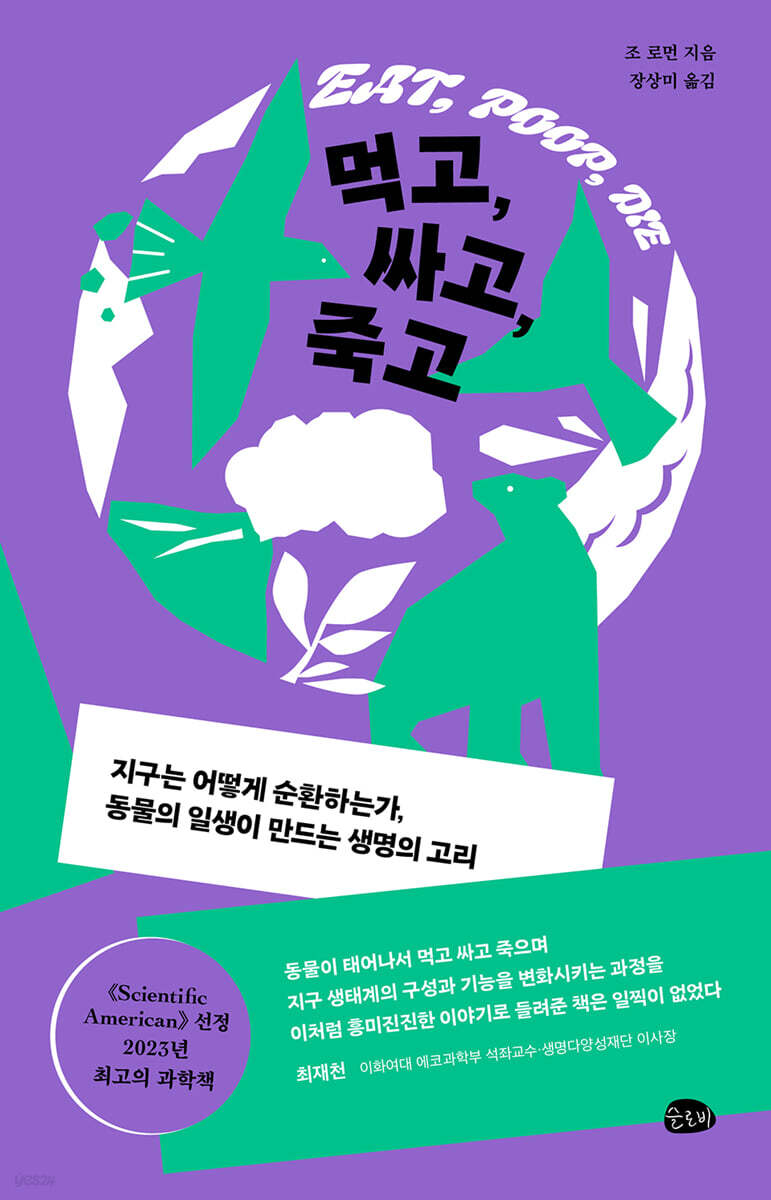
Eat, shit, die
 |
Description
Book Introduction
All animals eat, excrete, and die.
But what happens next? Ecologist Joe Roman relentlessly explores nature's hidden cycles, often overlooked.
In the place where animals excrete and disappear, new life sprouts, and the excrement and carcasses left behind are transformed into energy and nutrients through movement and decomposition.
It flows through the ecosystem and forms a hidden cycle.
The author reflects that this invisible flow is the fundamental driving force that keeps the Earth alive.
From Iceland's newly formed volcanic islands to the backyards of insect-filled homes, he travels the world, vividly capturing the life experiences of animals and researchers.
While dealing with weighty topics, humor, admiration, sadness, and insight naturally permeate the writing, forcing readers to step outside their comfort zone and revisit the living world.
Sharp observation, brisk narrative, and three-dimensional storytelling allow us to gain a deeper understanding of the hidden connections and meanings within nature.
Nature is circulating, eating, excreting, and dying even at this very moment.
Looking beyond this simple repetition provides crucial clues to understanding the ecological crisis we face and finding solutions.
Excretion, dead bodies, decomposition, carbon, nitrogen, climate, biodiversity.
As we follow the intertwined chain of these key elements, we ultimately arrive at a single question:
“How is the Earth alive?”
But what happens next? Ecologist Joe Roman relentlessly explores nature's hidden cycles, often overlooked.
In the place where animals excrete and disappear, new life sprouts, and the excrement and carcasses left behind are transformed into energy and nutrients through movement and decomposition.
It flows through the ecosystem and forms a hidden cycle.
The author reflects that this invisible flow is the fundamental driving force that keeps the Earth alive.
From Iceland's newly formed volcanic islands to the backyards of insect-filled homes, he travels the world, vividly capturing the life experiences of animals and researchers.
While dealing with weighty topics, humor, admiration, sadness, and insight naturally permeate the writing, forcing readers to step outside their comfort zone and revisit the living world.
Sharp observation, brisk narrative, and three-dimensional storytelling allow us to gain a deeper understanding of the hidden connections and meanings within nature.
Nature is circulating, eating, excreting, and dying even at this very moment.
Looking beyond this simple repetition provides crucial clues to understanding the ecological crisis we face and finding solutions.
Excretion, dead bodies, decomposition, carbon, nitrogen, climate, biodiversity.
As we follow the intertwined chain of these key elements, we ultimately arrive at a single question:
“How is the Earth alive?”
- You can preview some of the book's contents.
Preview
index
Introducing Joe Roman, a talking ecologist. ㆍ Choi Jae-cheon
1.
In the first land
2.
Into the deep sea
3.
Eat, spawn, and die
4.
The Heart - How Animals Move the Earth
5.
Planet of the Chickens - Feathers Covering the Earth
6.
Everyone poops and dies
7.
Reading a book on the beach
8.
singing tree
9.
It looks like it will be cloudy and drizzly.
10.
Sea otters and hydrogen bombs
To those who have walked this book with me: Joe Roman
To meet all living things again ㆍ Jang Sang-mi
References
List of human and biological names
1.
In the first land
2.
Into the deep sea
3.
Eat, spawn, and die
4.
The Heart - How Animals Move the Earth
5.
Planet of the Chickens - Feathers Covering the Earth
6.
Everyone poops and dies
7.
Reading a book on the beach
8.
singing tree
9.
It looks like it will be cloudy and drizzly.
10.
Sea otters and hydrogen bombs
To those who have walked this book with me: Joe Roman
To meet all living things again ㆍ Jang Sang-mi
References
List of human and biological names
Detailed image

Into the book
Animals are the heart of the earth.
They run tirelessly, transporting nutrients to all corners of the globe.
In our bodies, blood primarily performs this role, but in the natural ecosystem, feces and urine, scattered like a painting by American abstract expressionist painter Jackson Pollock, take on this role.
Unlike plants, animals change the diversity and chemical composition of ecosystems simply by eating and moving.
They graze plants, hunt herbivores, and sometimes create an atmosphere of fear by their very existence, driving geochemical cycles.
Even after death, we enrich the web of life through body donation.
--- p.6 「Recommendation.
Introducing Joe Roman, a talking ecologist.
Ten years after its creation, there was little vegetation left on Surtsey.
(…) like the Icelandic highlands, which NASA once used as a training ground for astronauts.
Even if plants did appear, they could not survive because there was little nitrogen in the soil.
But the change was beginning quietly.
Unbeknownst to anyone, even while the crater was still active, a clue to solving the nitrogen problem appeared.
A pair of common gulls, common on the main island of Iceland, landed on the black rocky shore.
--- p.20 「Chapter 1.
"In the First Land"
Whales are global travelers, linking the marine ecosystem between deep and shallow waters, polar and tropical seas.
Not only that, it is also a being that connects the sea and the land.
Whale carcasses that wash up on the shore provide a valuable source of nutrition for terrestrial animals.
Bald eagles and ravens peck at the skin, and wolves devour the organs.
Crabs dig into the crevices left by large scavengers and build nests.
(…) Since the industrial hunting began in the 19th century, marine mammal populations have plummeted, forcing South America's scavenger birds to eat guanacos and, if available, the carcasses of livestock such as horses, cows, and sheep.
In the North Pacific, where prey is dwindling, the California condor is endangered.
--- p.104~105 「Chapter 2.
"Into the deep sea"
I missed the simplicity of Surtsey.
There, the arrival time and abundance information of all species are well recorded.
But complex ecosystems like those in the Pacific Northwest, home to thousands of species, are a different story. Direct and indirect interactions between species can number in the billions.
Direct effects are relatively easy to observe.
(…) But indirect impacts spread through the food web, from plants and animals to fungi, just as dead salmon affect the pollination of aquatic plants and the productivity of trees.
Salmon, bear, and tree create a beautiful story.
--- p.146~147 「Chapter 3.
Eat, spawn, and die
Trees grow from the tips of their trunks, but grasses and sedges grow from the bottom, closer to the roots.
So even if herbivores eat the grass, the plants can grow again.
Of course, symbiosis does not only proceed in this form.
(…) Bison return the nutrients they obtain from grazing to the pasture through their excrement.
In particular, they mainly eat grass just before it wilts, which helps promote plant growth and keep the grassland green.
Moreover, the nutrients excreted by buffalo are in a form that is much more absorbable than those coming directly from dead plants.
The nitrogen contained in buffalo dung is quickly cycled through the soil, allowing plants to absorb it more efficiently, and these plants then become food for many animals.
--- p.161 「Chapter 4.
The Heart - How Animals Move the Earth
We are now living in the 'age of birds'.
However, they cannot fly and rarely see sunlight.
In the case of chickens, 50 billion are slaughtered worldwide each year, and in the United States alone, 8 billion broilers are raised annually.
In the Broiler Belt, which stretches from Maryland to Texas, chickens raised for slaughter are raised in flocks of more than 10,000 and spend their entire lives indoors.
(…) From the moment they hatch until they die, chickens live in an environment with nothing but poultry, droppings, and food, without ever seeing fresh air or natural light.
(…) Earth could be called the ‘Chicken Planet’.
Or perhaps it could be called the 'planet of the cows'.
Whatever it was, many of the animals on this land were domesticated.
--- p.194 Chapter 5.
Planet of the Chickens - Feathers Covering the Earth
Feces and urine usually flow into a septic tank along with the toilet water for treatment, or through sewer pipes to the sea.
This is our daily cycle.
But there is one last 'release' left here.
It is death.
The body of a dead human being is cremated in a coffin or placed in the ground or in a wall.
And all of this comes with significant environmental costs (carbon emissions and various pollutants).
So, can't we also contribute to the cycle of returning to nature? After years of research, the Forensic Osteology Laboratory at Western Carolina University, better known as the "Body Farm," has developed an optimal method for composting human remains.
--- p.239 Chapter 6.
Everyone poops and dies.
Long Island's South Shore may seem a far cry from crystal-clear waters and vibrant Hawaiian beaches.
But there was a similar pollution incident on this coast too.
In the 1970s, sewage sludge washed up on Jones Beach, a famous beach in New York.
At that time, reports emerged of human waste, oil slicks, medical waste, and hypodermic needles being found on beaches and in the sea.
It was the result of the city's long-standing headache being pushed out to the sea.
--- p.240 「Chapter 7.
Reading a book on the beach
We often think of nature as quiet, but a healthy planet is inherently noisy.
The air of Surtsey is filled with the sound of seagulls and fulmars bringing nutrients from the sea.
The sound of a whale's exhalation in the fog is so overwhelming that it is difficult to find the direction of the sound or traces of its excrement.
The sound of parrotfish gnawing on coral fills the coral reefs of Hawaii.
The hooting of an owl heard from the Suwanee River in the middle of the night is so shrill that it is not just scary but awe-inspiring.
In Vermont, where I live, frogs tell us the seasons.
--- p.275 「Chapter 8.
"The Singing Tree"
Animals are more than just numbers and movement paths.
Their personalities, preferences, and behaviors bring about a wide variety of changes to the ecosystem.
(…) From aggressive mice to adventurous seabirds, individual animals move through their ecosystems, either following traditions or taking risks.
Some wolves, pumas, and badgers prefer beavers as food, and when they hunt beavers, which are called ecosystem engineers, it causes huge ripples throughout the ecosystem.
Bold rodents can carry acorns far from oak trees to hide them, but the journey can be dangerous if there are many predators nearby.
On the other hand, timid squirrels are more likely to survive because they hide nuts near their homes.
--- p.310~311 「Chapter 9.
It looks like it will be cloudy and drizzle.
Fish, including salmon, bring marine nutrients upstream by dying and excreting waste.
These nutrients are dispersed to the surrounding area by predatory bears, scavengers, and insects. Large animals such as bison, which migrate seasonally, spread the nutrients they consume from the grasslands, creating a green wave.
(…) Indigenous communities around the world have coexisted with animals for hundreds of generations, respecting their migration habits and routes in the savannas, African savannas, and Amazon.
The future of animal conservation will unfold by expanding these relationships. To create an environment where animals can move naturally again, we must address the barriers that fences, roads, dams, and villages block their migration.
They run tirelessly, transporting nutrients to all corners of the globe.
In our bodies, blood primarily performs this role, but in the natural ecosystem, feces and urine, scattered like a painting by American abstract expressionist painter Jackson Pollock, take on this role.
Unlike plants, animals change the diversity and chemical composition of ecosystems simply by eating and moving.
They graze plants, hunt herbivores, and sometimes create an atmosphere of fear by their very existence, driving geochemical cycles.
Even after death, we enrich the web of life through body donation.
--- p.6 「Recommendation.
Introducing Joe Roman, a talking ecologist.
Ten years after its creation, there was little vegetation left on Surtsey.
(…) like the Icelandic highlands, which NASA once used as a training ground for astronauts.
Even if plants did appear, they could not survive because there was little nitrogen in the soil.
But the change was beginning quietly.
Unbeknownst to anyone, even while the crater was still active, a clue to solving the nitrogen problem appeared.
A pair of common gulls, common on the main island of Iceland, landed on the black rocky shore.
--- p.20 「Chapter 1.
"In the First Land"
Whales are global travelers, linking the marine ecosystem between deep and shallow waters, polar and tropical seas.
Not only that, it is also a being that connects the sea and the land.
Whale carcasses that wash up on the shore provide a valuable source of nutrition for terrestrial animals.
Bald eagles and ravens peck at the skin, and wolves devour the organs.
Crabs dig into the crevices left by large scavengers and build nests.
(…) Since the industrial hunting began in the 19th century, marine mammal populations have plummeted, forcing South America's scavenger birds to eat guanacos and, if available, the carcasses of livestock such as horses, cows, and sheep.
In the North Pacific, where prey is dwindling, the California condor is endangered.
--- p.104~105 「Chapter 2.
"Into the deep sea"
I missed the simplicity of Surtsey.
There, the arrival time and abundance information of all species are well recorded.
But complex ecosystems like those in the Pacific Northwest, home to thousands of species, are a different story. Direct and indirect interactions between species can number in the billions.
Direct effects are relatively easy to observe.
(…) But indirect impacts spread through the food web, from plants and animals to fungi, just as dead salmon affect the pollination of aquatic plants and the productivity of trees.
Salmon, bear, and tree create a beautiful story.
--- p.146~147 「Chapter 3.
Eat, spawn, and die
Trees grow from the tips of their trunks, but grasses and sedges grow from the bottom, closer to the roots.
So even if herbivores eat the grass, the plants can grow again.
Of course, symbiosis does not only proceed in this form.
(…) Bison return the nutrients they obtain from grazing to the pasture through their excrement.
In particular, they mainly eat grass just before it wilts, which helps promote plant growth and keep the grassland green.
Moreover, the nutrients excreted by buffalo are in a form that is much more absorbable than those coming directly from dead plants.
The nitrogen contained in buffalo dung is quickly cycled through the soil, allowing plants to absorb it more efficiently, and these plants then become food for many animals.
--- p.161 「Chapter 4.
The Heart - How Animals Move the Earth
We are now living in the 'age of birds'.
However, they cannot fly and rarely see sunlight.
In the case of chickens, 50 billion are slaughtered worldwide each year, and in the United States alone, 8 billion broilers are raised annually.
In the Broiler Belt, which stretches from Maryland to Texas, chickens raised for slaughter are raised in flocks of more than 10,000 and spend their entire lives indoors.
(…) From the moment they hatch until they die, chickens live in an environment with nothing but poultry, droppings, and food, without ever seeing fresh air or natural light.
(…) Earth could be called the ‘Chicken Planet’.
Or perhaps it could be called the 'planet of the cows'.
Whatever it was, many of the animals on this land were domesticated.
--- p.194 Chapter 5.
Planet of the Chickens - Feathers Covering the Earth
Feces and urine usually flow into a septic tank along with the toilet water for treatment, or through sewer pipes to the sea.
This is our daily cycle.
But there is one last 'release' left here.
It is death.
The body of a dead human being is cremated in a coffin or placed in the ground or in a wall.
And all of this comes with significant environmental costs (carbon emissions and various pollutants).
So, can't we also contribute to the cycle of returning to nature? After years of research, the Forensic Osteology Laboratory at Western Carolina University, better known as the "Body Farm," has developed an optimal method for composting human remains.
--- p.239 Chapter 6.
Everyone poops and dies.
Long Island's South Shore may seem a far cry from crystal-clear waters and vibrant Hawaiian beaches.
But there was a similar pollution incident on this coast too.
In the 1970s, sewage sludge washed up on Jones Beach, a famous beach in New York.
At that time, reports emerged of human waste, oil slicks, medical waste, and hypodermic needles being found on beaches and in the sea.
It was the result of the city's long-standing headache being pushed out to the sea.
--- p.240 「Chapter 7.
Reading a book on the beach
We often think of nature as quiet, but a healthy planet is inherently noisy.
The air of Surtsey is filled with the sound of seagulls and fulmars bringing nutrients from the sea.
The sound of a whale's exhalation in the fog is so overwhelming that it is difficult to find the direction of the sound or traces of its excrement.
The sound of parrotfish gnawing on coral fills the coral reefs of Hawaii.
The hooting of an owl heard from the Suwanee River in the middle of the night is so shrill that it is not just scary but awe-inspiring.
In Vermont, where I live, frogs tell us the seasons.
--- p.275 「Chapter 8.
"The Singing Tree"
Animals are more than just numbers and movement paths.
Their personalities, preferences, and behaviors bring about a wide variety of changes to the ecosystem.
(…) From aggressive mice to adventurous seabirds, individual animals move through their ecosystems, either following traditions or taking risks.
Some wolves, pumas, and badgers prefer beavers as food, and when they hunt beavers, which are called ecosystem engineers, it causes huge ripples throughout the ecosystem.
Bold rodents can carry acorns far from oak trees to hide them, but the journey can be dangerous if there are many predators nearby.
On the other hand, timid squirrels are more likely to survive because they hide nuts near their homes.
--- p.310~311 「Chapter 9.
It looks like it will be cloudy and drizzle.
Fish, including salmon, bring marine nutrients upstream by dying and excreting waste.
These nutrients are dispersed to the surrounding area by predatory bears, scavengers, and insects. Large animals such as bison, which migrate seasonally, spread the nutrients they consume from the grasslands, creating a green wave.
(…) Indigenous communities around the world have coexisted with animals for hundreds of generations, respecting their migration habits and routes in the savannas, African savannas, and Amazon.
The future of animal conservation will unfold by expanding these relationships. To create an environment where animals can move naturally again, we must address the barriers that fences, roads, dams, and villages block their migration.
--- p.343~344 「Chapter 10.
The Otter and the Hydrogen Bomb
The Otter and the Hydrogen Bomb
Publisher's Review
★ A delightful ecological exploration by the Rachel Carson Environmental Book Award-winning author.
★ Selected as one of the best science textbooks of 2023 by Scientific American
★ A book highly praised by world-renowned scholars, including Choi Jae-cheon and Elizabeth Colbert!
The true dynamics of the ecosystem we didn't know about
A story that began with poop, leading to the future of the Earth.
1963, Surtsey, a volcanic island that rose in the middle of the North Atlantic.
A seagull lands where there was no life, and life begins from its droppings.
Starting with this scene, the author travels around the world, meticulously tracing how the 'traces' left behind by animals as they eat, poop, and die have driven the Earth's cycle.
Traces left by animals do not disappear.
Following this, life grows, energy moves, and nature's great cycle is completed.
Whale droppings fertilize the ocean, salmon carcasses leave nitrogen in the forests, and the mass deaths of insects change the vegetation along the river and provide food for other life.
This book depicts another natural blueprint centered on 'excretion and decomposition' rather than the hierarchy of the food chain.
The trace is soon a cycle.
The author calls these animals “ecosystem engineers.”
Beings that leave behind what they have eaten, spread nutrients even after death, and continue life to the next life.
Our neglect of that role has been a truly great ecological loss.
This is supported by numerous examples, such as how whale dung smells differently depending on its diet, forests reconstructed from bear and salmon remains, and grasslands revived from bison dung.
The traces we have taken for granted are actually the fuel of life.
The unusual radiation levels measured at bird breeding grounds in Antarctica are a stark reminder that even a small, insignificant trace can destabilize the entire Earth system.
This is because nitrogen and organic matter in excrement affect soil and marine microbial communities, disrupting the balance of the Earth's systems.
This book asks fundamental questions from that unfamiliar and small starting point.
“How is the Earth alive?”
Disappearing animals, broken cycles
A crack formed where a giant life form left behind
Reconnecting the Cycle: How Animals and Humans Can Coexist
Once upon a time, large animals such as whales, elephants, buffalo, and bears roamed the fields and seas of the Earth.
As they moved, they scattered energy and nutrients across the land and sea, and the Earth breathed along with their movements.
But now, their absence leaves deep traces, and the land and sea are increasingly showing cracks.
In oceans where whales have disappeared, the carbon cycle is disrupted, and in grasslands where bison have left, the flow of nitrogen and phosphorus has stopped.
The land where circulation has stopped can no longer breathe.
Just one giant body disappears, and the flow of the entire ecosystem changes.
Nature is made up of such an intricate and delicate network of connections.
And at the center of it all are traces of things we have taken for granted, like excrement or corpses.
The author uses scientific examples to reveal that whale droppings, bear carcasses, and seabird guano are key driving forces of the Earth, and calls them back to being ecosystem "engineers."
What we have thought of as carelessly discarded waste are actually precise components that make natural circulation possible.
If we broaden our perspective, this cycle does not stop at individual lives.
The flow of rewilding, in which animals that had disappeared return to their original places, slowly reconnects the broken cycle.
Grasses are coming back to life in the grasslands where bison have returned, rivers are changing their course in forests where wolves have restored their habitats, and shellfish, seaweed, and marine life are recovering along the coasts where sea otters have returned.
The message the author conveys as we follow the restoration site is clear.
The force that sets the Earth moving again is not some complex artificial system, but life itself, which was meant to be there in the first place.
This book quietly persuades readers by explaining, step by step, the reasons why we must revisit the "place of animals" in this day and age, using scientific insights and real-life stories.
Thanks to the storytelling that transcends information and emotion, science and culture, readers not only understand this book intellectually, but also find ways to live alongside their "non-human neighbors" as members of the ecosystem.
Reconnect with living nature
Death and the Cycle—A Path into the Vast Network of Life
Salmon swim thousands of kilometers up the ocean to spawn and then die.
Maggots swarming on the corpse, bears licking it, and vegetation growing from the bear's feces.
When one death leads to a chain of countless lives, nature comes back to life.
Even human death is no exception.
New funeral methods, such as natural burial and ecological burial, which are attracting attention recently, are practices that aim to return even the human body to the ecosystem.
On the return line of soil and roots, insects and bacteria, death is no longer destruction but a cycle.
The author uses quiet, yet powerful language to remind us that even our last moments can contribute to the restoration of the Earth's vitality.
The breath of life that flows between death and rebirth, excretion and decomposition.
Can humans re-enter that loop? In this story, we discover a small doorway back to nature, even in a handful of insignificant feces, and encounter a time of transition, a time to become part of life.
《Eat, Poop, Die》 quietly suggests a way for humans to reconnect with nature within this vast network.
“The simple act of returning death to the cycle is the beginning of our reconnection with nature.”
■ Key contents by chapter
ㆍIn the first land
Surtsey, the suddenly rising volcanic island of Iceland.
Life begins with the droppings of a single seagull that flies into an empty land.
It was none other than the traces of animals that transformed the wasteland into a living space where plants grow and insects move.
The author vividly follows how the cycle of life begins on the island.
ㆍInto the deep sea
Whales eat on the ocean floor, excrete on the top, and when they die, they sink to the bottom of the sea.
This simple act stores carbon, nourishes plankton, and saves the ocean.
But the human whaling industry has eliminated this massive 'ocean pump', and the vacuum is slowly destroying the marine ecosystem.
ㆍEat, spawn, and die
Salmon return from the sea to the rivers to spawn, and their carcasses become food for bears and insects, enriching the forests.
Animals that travel long distances to reach their destination, such as eels and sea turtles, also circulate nutrients from the ocean into the terrestrial ecosystem through their death.
This chapter shows how 'death' becomes the starting point of another life.
ㆍHeart - How animals move around the Earth
Herds of bison once filled the North American continent.
Their movements allowed the grasslands to breathe and spread nitrogen and phosphorus into the soil.
But when the buffalo disappeared, the prairies also declined.
It examines how the presence of large animals affects the vitality and climate adaptability of the land, and highlights the void left by their absence.
ㆍPlanet of the Chicken - Earth
covered with feathers
Most of the animals that cover the Earth today are livestock, especially chickens.
Humans have become the largest nutrient movers in the ecosystem, and livestock farming and environmental destruction have even caused geological changes.
Now that we have become the 'Planet of the Chicken,' we face the changes brought about by the human-centered biological transition.
ㆍEveryone poops and dies
All life leaves behind a trace.
Feces and corpses are key resources in the ecosystem and puzzle pieces that complete the cycle of life.
Modern humans are breaking this cycle.
From sewer systems to funeral cultures to soil degradation, this chapter asks why the vital activity of "cleaning up" must be restored now.
Reading a book on the beach
Coastal ecosystems are the connection between the sea and the land.
It shows how the droppings and carcasses of seabirds, seals, and marine animals affect the plants, soil, and biodiversity of the beach.
At the same time, it depicts the possibility of nature and community recovery through the process of culture and environment disappearing and then recovering together on a Hawaiian beach.
ㆍSinging Tree
The song of cicadas, which have returned to the ground after 17 years, reminds us that insects are also a driving force in the ecosystem.
The lives of insects, which remain underground, emerge in groups, and then die to revive the earth, are part of a small but enormous cycle.
Through insects that eat, cry, and disappear, we see again the value of ‘small creatures.’
ㆍIt looks like it will be cloudy and drizzle.
A large flock of crickets is dying in a lake in Iceland.
The corpse revives the soil and makes grass grow.
Scientific experiments are also presented to show how the life cycle of insects changes the local ecosystem, and how the presence of predators exerts 'psychological pressure' on the ecosystem and even affects the circulation of substances.
Sea otters and hydrogen bombs
Sea otters, as predators, are the regulators of the ecosystem.
The story of the sea otter's return from the brink of extinction symbolizes the hope of 'rewilding.'
Human efforts to save sea otters amidst the crisis of hydrogen bomb testing raise the question of what we can do to restore the ecosystem.
★ Selected as one of the best science textbooks of 2023 by Scientific American
★ A book highly praised by world-renowned scholars, including Choi Jae-cheon and Elizabeth Colbert!
The true dynamics of the ecosystem we didn't know about
A story that began with poop, leading to the future of the Earth.
1963, Surtsey, a volcanic island that rose in the middle of the North Atlantic.
A seagull lands where there was no life, and life begins from its droppings.
Starting with this scene, the author travels around the world, meticulously tracing how the 'traces' left behind by animals as they eat, poop, and die have driven the Earth's cycle.
Traces left by animals do not disappear.
Following this, life grows, energy moves, and nature's great cycle is completed.
Whale droppings fertilize the ocean, salmon carcasses leave nitrogen in the forests, and the mass deaths of insects change the vegetation along the river and provide food for other life.
This book depicts another natural blueprint centered on 'excretion and decomposition' rather than the hierarchy of the food chain.
The trace is soon a cycle.
The author calls these animals “ecosystem engineers.”
Beings that leave behind what they have eaten, spread nutrients even after death, and continue life to the next life.
Our neglect of that role has been a truly great ecological loss.
This is supported by numerous examples, such as how whale dung smells differently depending on its diet, forests reconstructed from bear and salmon remains, and grasslands revived from bison dung.
The traces we have taken for granted are actually the fuel of life.
The unusual radiation levels measured at bird breeding grounds in Antarctica are a stark reminder that even a small, insignificant trace can destabilize the entire Earth system.
This is because nitrogen and organic matter in excrement affect soil and marine microbial communities, disrupting the balance of the Earth's systems.
This book asks fundamental questions from that unfamiliar and small starting point.
“How is the Earth alive?”
Disappearing animals, broken cycles
A crack formed where a giant life form left behind
Reconnecting the Cycle: How Animals and Humans Can Coexist
Once upon a time, large animals such as whales, elephants, buffalo, and bears roamed the fields and seas of the Earth.
As they moved, they scattered energy and nutrients across the land and sea, and the Earth breathed along with their movements.
But now, their absence leaves deep traces, and the land and sea are increasingly showing cracks.
In oceans where whales have disappeared, the carbon cycle is disrupted, and in grasslands where bison have left, the flow of nitrogen and phosphorus has stopped.
The land where circulation has stopped can no longer breathe.
Just one giant body disappears, and the flow of the entire ecosystem changes.
Nature is made up of such an intricate and delicate network of connections.
And at the center of it all are traces of things we have taken for granted, like excrement or corpses.
The author uses scientific examples to reveal that whale droppings, bear carcasses, and seabird guano are key driving forces of the Earth, and calls them back to being ecosystem "engineers."
What we have thought of as carelessly discarded waste are actually precise components that make natural circulation possible.
If we broaden our perspective, this cycle does not stop at individual lives.
The flow of rewilding, in which animals that had disappeared return to their original places, slowly reconnects the broken cycle.
Grasses are coming back to life in the grasslands where bison have returned, rivers are changing their course in forests where wolves have restored their habitats, and shellfish, seaweed, and marine life are recovering along the coasts where sea otters have returned.
The message the author conveys as we follow the restoration site is clear.
The force that sets the Earth moving again is not some complex artificial system, but life itself, which was meant to be there in the first place.
This book quietly persuades readers by explaining, step by step, the reasons why we must revisit the "place of animals" in this day and age, using scientific insights and real-life stories.
Thanks to the storytelling that transcends information and emotion, science and culture, readers not only understand this book intellectually, but also find ways to live alongside their "non-human neighbors" as members of the ecosystem.
Reconnect with living nature
Death and the Cycle—A Path into the Vast Network of Life
Salmon swim thousands of kilometers up the ocean to spawn and then die.
Maggots swarming on the corpse, bears licking it, and vegetation growing from the bear's feces.
When one death leads to a chain of countless lives, nature comes back to life.
Even human death is no exception.
New funeral methods, such as natural burial and ecological burial, which are attracting attention recently, are practices that aim to return even the human body to the ecosystem.
On the return line of soil and roots, insects and bacteria, death is no longer destruction but a cycle.
The author uses quiet, yet powerful language to remind us that even our last moments can contribute to the restoration of the Earth's vitality.
The breath of life that flows between death and rebirth, excretion and decomposition.
Can humans re-enter that loop? In this story, we discover a small doorway back to nature, even in a handful of insignificant feces, and encounter a time of transition, a time to become part of life.
《Eat, Poop, Die》 quietly suggests a way for humans to reconnect with nature within this vast network.
“The simple act of returning death to the cycle is the beginning of our reconnection with nature.”
■ Key contents by chapter
ㆍIn the first land
Surtsey, the suddenly rising volcanic island of Iceland.
Life begins with the droppings of a single seagull that flies into an empty land.
It was none other than the traces of animals that transformed the wasteland into a living space where plants grow and insects move.
The author vividly follows how the cycle of life begins on the island.
ㆍInto the deep sea
Whales eat on the ocean floor, excrete on the top, and when they die, they sink to the bottom of the sea.
This simple act stores carbon, nourishes plankton, and saves the ocean.
But the human whaling industry has eliminated this massive 'ocean pump', and the vacuum is slowly destroying the marine ecosystem.
ㆍEat, spawn, and die
Salmon return from the sea to the rivers to spawn, and their carcasses become food for bears and insects, enriching the forests.
Animals that travel long distances to reach their destination, such as eels and sea turtles, also circulate nutrients from the ocean into the terrestrial ecosystem through their death.
This chapter shows how 'death' becomes the starting point of another life.
ㆍHeart - How animals move around the Earth
Herds of bison once filled the North American continent.
Their movements allowed the grasslands to breathe and spread nitrogen and phosphorus into the soil.
But when the buffalo disappeared, the prairies also declined.
It examines how the presence of large animals affects the vitality and climate adaptability of the land, and highlights the void left by their absence.
ㆍPlanet of the Chicken - Earth
covered with feathers
Most of the animals that cover the Earth today are livestock, especially chickens.
Humans have become the largest nutrient movers in the ecosystem, and livestock farming and environmental destruction have even caused geological changes.
Now that we have become the 'Planet of the Chicken,' we face the changes brought about by the human-centered biological transition.
ㆍEveryone poops and dies
All life leaves behind a trace.
Feces and corpses are key resources in the ecosystem and puzzle pieces that complete the cycle of life.
Modern humans are breaking this cycle.
From sewer systems to funeral cultures to soil degradation, this chapter asks why the vital activity of "cleaning up" must be restored now.
Reading a book on the beach
Coastal ecosystems are the connection between the sea and the land.
It shows how the droppings and carcasses of seabirds, seals, and marine animals affect the plants, soil, and biodiversity of the beach.
At the same time, it depicts the possibility of nature and community recovery through the process of culture and environment disappearing and then recovering together on a Hawaiian beach.
ㆍSinging Tree
The song of cicadas, which have returned to the ground after 17 years, reminds us that insects are also a driving force in the ecosystem.
The lives of insects, which remain underground, emerge in groups, and then die to revive the earth, are part of a small but enormous cycle.
Through insects that eat, cry, and disappear, we see again the value of ‘small creatures.’
ㆍIt looks like it will be cloudy and drizzle.
A large flock of crickets is dying in a lake in Iceland.
The corpse revives the soil and makes grass grow.
Scientific experiments are also presented to show how the life cycle of insects changes the local ecosystem, and how the presence of predators exerts 'psychological pressure' on the ecosystem and even affects the circulation of substances.
Sea otters and hydrogen bombs
Sea otters, as predators, are the regulators of the ecosystem.
The story of the sea otter's return from the brink of extinction symbolizes the hope of 'rewilding.'
Human efforts to save sea otters amidst the crisis of hydrogen bomb testing raise the question of what we can do to restore the ecosystem.
GOODS SPECIFICS
- Date of issue: July 25, 2025
- Page count, weight, size: 380 pages | 472g | 135*210*24mm
- ISBN13: 9791187135371
- ISBN10: 1187135372
You may also like
카테고리
korean


korean

![GQ KOREA Mark (Monthly): December [2025]](http://librairie.coreenne.fr/cdn/shop/files/8ef265dbbfbf186523ed75ba7319009d.jpg?v=1765340328&width=3840)


