

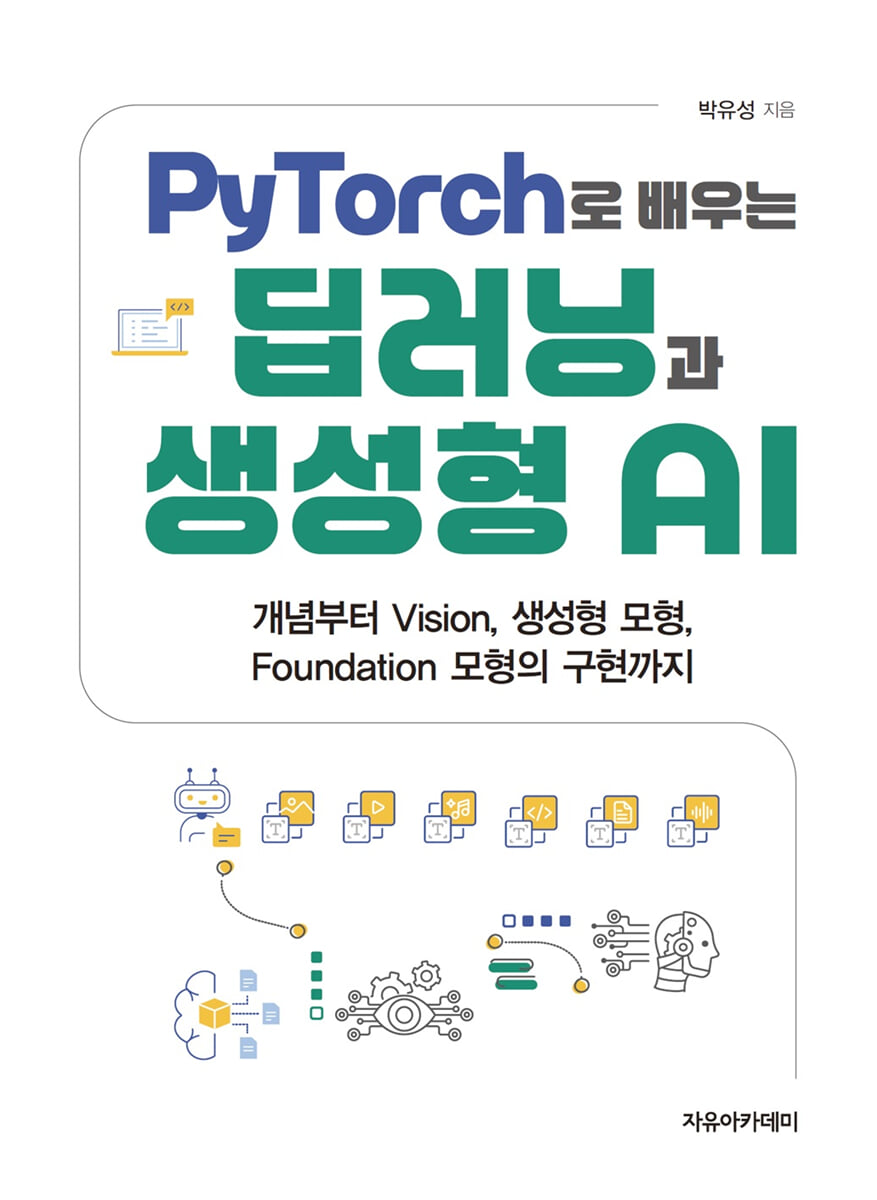
Deep Learning and Generative AI with PyTorch
 |
Description
Book Introduction
Generative AI, which has recently attracted attention, such as ChatGPT, Gemini, and Perplexity, is going beyond the level of simple tools and is bringing about profound changes across all areas of society, including science, technology, art, and education.
They are infiltrating many areas of our daily lives as "digital assistants" that understand human language, aid in creative thinking, and support complex problem-solving. AI is no longer the domain of experts alone; it is being utilized by governments, businesses, and individuals alike as a tool for work, learning, and creativity, and its spread is occurring faster than expected.
In fact, generative AI is being used as a practical 'tool for efficiency' in various fields such as corporate customer service, legal review, article writing assistance, paper and document summarization, and coding.
This change is reminiscent of the advent of the personal computer in the 1980s, just a few decades ago.
At the time, computers were specialized tools used by only a very small number of people, but soon Word, Excel, and email became 'common sense' rather than 'technology'.
Deep learning today is like the PCs of that time.
Generative AI is merely one application of a technology called deep learning, but at its core lies the concept of an "artificial neural network," which mimics the human learning structure.
This is based on an understanding of the principles of 'how to learn and predict from data' rather than simply the 'skill' of writing code.
Thanks to generative AI, learning complex library usage and model implementation code has become almost unnecessary knowledge, so understanding the concepts, operating principles, and importance of data processing in the future society is an essential skill.
Understanding how deep learning models learn and how they structure information allows us to critically interpret AI results rather than blindly trusting them.
True digital literacy (AI literacy) is not simply the user's ability to "search for information, write, and generate ideas using generative AI," but the ability to explain why the results were obtained.
They are infiltrating many areas of our daily lives as "digital assistants" that understand human language, aid in creative thinking, and support complex problem-solving. AI is no longer the domain of experts alone; it is being utilized by governments, businesses, and individuals alike as a tool for work, learning, and creativity, and its spread is occurring faster than expected.
In fact, generative AI is being used as a practical 'tool for efficiency' in various fields such as corporate customer service, legal review, article writing assistance, paper and document summarization, and coding.
This change is reminiscent of the advent of the personal computer in the 1980s, just a few decades ago.
At the time, computers were specialized tools used by only a very small number of people, but soon Word, Excel, and email became 'common sense' rather than 'technology'.
Deep learning today is like the PCs of that time.
Generative AI is merely one application of a technology called deep learning, but at its core lies the concept of an "artificial neural network," which mimics the human learning structure.
This is based on an understanding of the principles of 'how to learn and predict from data' rather than simply the 'skill' of writing code.
Thanks to generative AI, learning complex library usage and model implementation code has become almost unnecessary knowledge, so understanding the concepts, operating principles, and importance of data processing in the future society is an essential skill.
Understanding how deep learning models learn and how they structure information allows us to critically interpret AI results rather than blindly trusting them.
True digital literacy (AI literacy) is not simply the user's ability to "search for information, write, and generate ideas using generative AI," but the ability to explain why the results were obtained.
- You can preview some of the book's contents.
Preview
index
Part 1: How Deep Learning Works
Chapter 1: Summary of the Core and Contents of Machine Learning
1.1 ML (machine learning)
1.2 DL (deep learning)
1.3 Reinforcement learning (RL)
Chapter 2: Deep Learning Data and Three Basic Neural Networks
2.1 Pre-processing of data
2.2 Types of data used in deep learning
2.3 Three Core Neural Networks for Hidden Layer Design
Chapter 3 Loss Functions and Optimization
3.1 Output layer and loss function
3.2 Backpropagation
3.3 Optimization Algorithm
Chapter 4: Understanding Pytorch
4.1 Pytorch Grammar and Applications
4.2 Structure of deep learning models and data sets and model storage
4.3 Applications of MLP, RNN, and CNN
Chapter 5: Error Analysis, Hyperparameter Tuning, and Performance Improvement of Deep Learning Models
5.1 Error Analysis
5.2 Data partitioning
5.3 Hyperparameter tuning
5.4 Improving the Performance of Deep Learning Models
Chapter 6: Applications of CNNs and Transfer Learning
6.1 Application of CNN to distinguish human gender
6.2 Previous Learning
6.3 Previous learning and data augmentation
Chapter 7: Pre-Ordering Text Data and Applying RNNs
7.1 Pre-organization process of text data
7.2 Word2Vec, Glove, and Word Embedding
7.3 Application of RNN Model
7.4 Comparison with other RNN models and CNN models
7.5 Summary of pre-processing of text data
Chapter 8: Time Series Analysis Using Mamba, GNN, and KAN Models
8.1 Mamba
8.2 GNN (Graph Neural Network)
8.3 KAN(Komogorov Arnold Network)
8.4 Application to time series data
Chapter 9: Evolution of CNN Architecture
9.1 LeNet-5
9.2 AlexNet
9.3 VGGNet
9.4 ResNet
9.5 Inception
9.6 Stem-Learner-Task Architecture
9.7 The Evolution of Deep Learning
Part 2 Computer Vision
Chapter 10 Object Detection I (R-CNN, Fast R-CNN, Faster R-CNN)
10.1 Upsampling
10.2 Identification of traffic signs
10.3 Object Detection with R-CNN
10.4 Fast R-CNN
10.5 Faster R-CNN
Chapter 11 Object Detection II (YOLO~YOLO12)
11.1 Determining YOLO's true square box and objective variable
11.2 YOLO-v3
11.3 Evolution of YOLO version
Chapter 12: Channel Visualization, Deep Dream, and Style Transfer
12.1 Channel Visualization
12.2 Deep Dream
12.3 Style Prev
Chapter 13: Variational Autoencoders and Diffusion Models
13.1 AutoEncoder
13.2 Variational Autoencoder
13.3 Conditional VAE
13.4 Diffusion Model
Chapter 14 Generative Adversarial Networks (GANs)
14.1 DCGAN
14.2 Cycle GAN
Part 3 LLM
Chapter 15: Seq2Seq Model
15.1 Pre-organization of data
15.2 Sequence-to-sequence learning
15.3 Seq2Seq using Attention
Chapter 16 Transformer
16.1 Transformer input layer
16.2 Transformer's hidden layer
16.3 Application of Transformer
16.4 Korean Chatbot
Chapter 17 Natural Language Models
17.1 Pretraining, fine tuning, few-shot, and zero-shot learning
17.2 Subword Tokenization
17.3 Auto-encoding language model
17.4 Generative Pretrained Transformer (GPT) and Sampling for Text Generation
Chapter 18: ViT, OCR, CLIP, Stable Diffusion, SAM, and In-painting
18.1 ViT (Vision Transformer)
18.2 TrOCR
18.3 CLIP (contrastive language-image pre-training)
18.4 Stable Diffusion Model
18.5 Segmentation Anything Model (SAM)
18.6 In-painting
Chapter 19: Evolution of the LLM Model
19.1 T5 and LlaMA
19.2 Evolution of Transformer Attention
19.3 RWKV
19.4 Adjusting the adequacy of the LLM model
19.5 Retrieval Augmented Generation (RAG)
19.6 Comparison of LLM Models and Open Source LLM
19.7 The Evolution of AI
Chapter 20: Applications of Language Models Using Hugging Face
20.1 How to Select an NLP Model in Transformers
20.2 Application of Language Models Using Hugging Face
20.3 Fine Tuning Using Hugging Face
Chapter 21: Procedures for Creating an LLM and Prompt Engineering
21.1 Procedure for creating an LLM model
21.2 Is a Korean-style LLM necessary?
21.3 Prompt Engineering
References
Search
Chapter 1: Summary of the Core and Contents of Machine Learning
1.1 ML (machine learning)
1.2 DL (deep learning)
1.3 Reinforcement learning (RL)
Chapter 2: Deep Learning Data and Three Basic Neural Networks
2.1 Pre-processing of data
2.2 Types of data used in deep learning
2.3 Three Core Neural Networks for Hidden Layer Design
Chapter 3 Loss Functions and Optimization
3.1 Output layer and loss function
3.2 Backpropagation
3.3 Optimization Algorithm
Chapter 4: Understanding Pytorch
4.1 Pytorch Grammar and Applications
4.2 Structure of deep learning models and data sets and model storage
4.3 Applications of MLP, RNN, and CNN
Chapter 5: Error Analysis, Hyperparameter Tuning, and Performance Improvement of Deep Learning Models
5.1 Error Analysis
5.2 Data partitioning
5.3 Hyperparameter tuning
5.4 Improving the Performance of Deep Learning Models
Chapter 6: Applications of CNNs and Transfer Learning
6.1 Application of CNN to distinguish human gender
6.2 Previous Learning
6.3 Previous learning and data augmentation
Chapter 7: Pre-Ordering Text Data and Applying RNNs
7.1 Pre-organization process of text data
7.2 Word2Vec, Glove, and Word Embedding
7.3 Application of RNN Model
7.4 Comparison with other RNN models and CNN models
7.5 Summary of pre-processing of text data
Chapter 8: Time Series Analysis Using Mamba, GNN, and KAN Models
8.1 Mamba
8.2 GNN (Graph Neural Network)
8.3 KAN(Komogorov Arnold Network)
8.4 Application to time series data
Chapter 9: Evolution of CNN Architecture
9.1 LeNet-5
9.2 AlexNet
9.3 VGGNet
9.4 ResNet
9.5 Inception
9.6 Stem-Learner-Task Architecture
9.7 The Evolution of Deep Learning
Part 2 Computer Vision
Chapter 10 Object Detection I (R-CNN, Fast R-CNN, Faster R-CNN)
10.1 Upsampling
10.2 Identification of traffic signs
10.3 Object Detection with R-CNN
10.4 Fast R-CNN
10.5 Faster R-CNN
Chapter 11 Object Detection II (YOLO~YOLO12)
11.1 Determining YOLO's true square box and objective variable
11.2 YOLO-v3
11.3 Evolution of YOLO version
Chapter 12: Channel Visualization, Deep Dream, and Style Transfer
12.1 Channel Visualization
12.2 Deep Dream
12.3 Style Prev
Chapter 13: Variational Autoencoders and Diffusion Models
13.1 AutoEncoder
13.2 Variational Autoencoder
13.3 Conditional VAE
13.4 Diffusion Model
Chapter 14 Generative Adversarial Networks (GANs)
14.1 DCGAN
14.2 Cycle GAN
Part 3 LLM
Chapter 15: Seq2Seq Model
15.1 Pre-organization of data
15.2 Sequence-to-sequence learning
15.3 Seq2Seq using Attention
Chapter 16 Transformer
16.1 Transformer input layer
16.2 Transformer's hidden layer
16.3 Application of Transformer
16.4 Korean Chatbot
Chapter 17 Natural Language Models
17.1 Pretraining, fine tuning, few-shot, and zero-shot learning
17.2 Subword Tokenization
17.3 Auto-encoding language model
17.4 Generative Pretrained Transformer (GPT) and Sampling for Text Generation
Chapter 18: ViT, OCR, CLIP, Stable Diffusion, SAM, and In-painting
18.1 ViT (Vision Transformer)
18.2 TrOCR
18.3 CLIP (contrastive language-image pre-training)
18.4 Stable Diffusion Model
18.5 Segmentation Anything Model (SAM)
18.6 In-painting
Chapter 19: Evolution of the LLM Model
19.1 T5 and LlaMA
19.2 Evolution of Transformer Attention
19.3 RWKV
19.4 Adjusting the adequacy of the LLM model
19.5 Retrieval Augmented Generation (RAG)
19.6 Comparison of LLM Models and Open Source LLM
19.7 The Evolution of AI
Chapter 20: Applications of Language Models Using Hugging Face
20.1 How to Select an NLP Model in Transformers
20.2 Application of Language Models Using Hugging Face
20.3 Fine Tuning Using Hugging Face
Chapter 21: Procedures for Creating an LLM and Prompt Engineering
21.1 Procedure for creating an LLM model
21.2 Is a Korean-style LLM necessary?
21.3 Prompt Engineering
References
Search
Publisher's Review
This book is divided into three parts with this purpose.
Part 1 covers the fundamental principles of deep learning, including the concept of deep learning, basic structure, parameter estimation and operating principles, model diagnosis and performance improvement techniques, and natural language quantification.
Parts 2 and 3 focus on the application of deep learning to computer vision and language models, including LLM.
Part 2 covers object recognition, which is essential for autonomous vehicles, using the R-CNN series and YOLO-v1 to YOLO-v12, AI art using Deep Dream and style transfer, and data generation and cross-domain using VAE, Diffusion models, and GAN models.
Part 3 covers the transformer, which gave birth to the current cutting-edge generative AI, and its derived pre-trained models such as BERT, GPT, T5, and BART, as well as the use of various pre-trained models using Hugging Face, fine tuning, and Korean models.
Recent generative AI techniques using Transformer, such as ViT, OCR, CLIP, Stable Diffusion, SAM, and In-painting, are also explained and applied in theoretical principles.
In addition, we discussed how the LLM model has evolved since Transformer, and in particular, we divided the development process of Sovereign generative LLMs such as ChatGPT and Gemini into nine stages and explained why a Korean foundation model is needed based on this.
Finally, prompt engineering, which modifies and improves prompts to help AI (foundation LLM) understand the user's intentions and achieve the best results, was discussed with various example prompts from the perspective of five prompting frameworks.
In the future, rather than living in harmony with AI, those who understand and manage it will have more opportunities. It's possible to live without understanding AI.
However, those who understand the principles of AI can lead this change. While effectively utilizing AI is important, we are entering an era where a proper understanding of AI becomes even more crucial.
I hope this book can meet these contemporary needs.
The code provided in this book was written in PyTorch, and the necessary code and data can be downloaded from the Free Academy website (www.freeaca.com).
I would like to express my gratitude to Ms. Im Ja-young and Mr. Park Jin-se for their help in correcting errors and drawing numerous concept diagrams in this book. I also express my love to my wife and family for their silent encouragement and support until the publication of this book.
Part 1 covers the fundamental principles of deep learning, including the concept of deep learning, basic structure, parameter estimation and operating principles, model diagnosis and performance improvement techniques, and natural language quantification.
Parts 2 and 3 focus on the application of deep learning to computer vision and language models, including LLM.
Part 2 covers object recognition, which is essential for autonomous vehicles, using the R-CNN series and YOLO-v1 to YOLO-v12, AI art using Deep Dream and style transfer, and data generation and cross-domain using VAE, Diffusion models, and GAN models.
Part 3 covers the transformer, which gave birth to the current cutting-edge generative AI, and its derived pre-trained models such as BERT, GPT, T5, and BART, as well as the use of various pre-trained models using Hugging Face, fine tuning, and Korean models.
Recent generative AI techniques using Transformer, such as ViT, OCR, CLIP, Stable Diffusion, SAM, and In-painting, are also explained and applied in theoretical principles.
In addition, we discussed how the LLM model has evolved since Transformer, and in particular, we divided the development process of Sovereign generative LLMs such as ChatGPT and Gemini into nine stages and explained why a Korean foundation model is needed based on this.
Finally, prompt engineering, which modifies and improves prompts to help AI (foundation LLM) understand the user's intentions and achieve the best results, was discussed with various example prompts from the perspective of five prompting frameworks.
In the future, rather than living in harmony with AI, those who understand and manage it will have more opportunities. It's possible to live without understanding AI.
However, those who understand the principles of AI can lead this change. While effectively utilizing AI is important, we are entering an era where a proper understanding of AI becomes even more crucial.
I hope this book can meet these contemporary needs.
The code provided in this book was written in PyTorch, and the necessary code and data can be downloaded from the Free Academy website (www.freeaca.com).
I would like to express my gratitude to Ms. Im Ja-young and Mr. Park Jin-se for their help in correcting errors and drawing numerous concept diagrams in this book. I also express my love to my wife and family for their silent encouragement and support until the publication of this book.
GOODS SPECIFICS
- Date of issue: November 5, 2025
- Page count, weight, size: 640 pages | 188*257*26mm
- ISBN13: 9791158087739
- ISBN10: 115808773X
You may also like
카테고리
korean


korean

![GQ KOREA Mark (Monthly): December [2025]](http://librairie.coreenne.fr/cdn/shop/files/8ef265dbbfbf186523ed75ba7319009d.jpg?v=1765340328&width=3840)


