

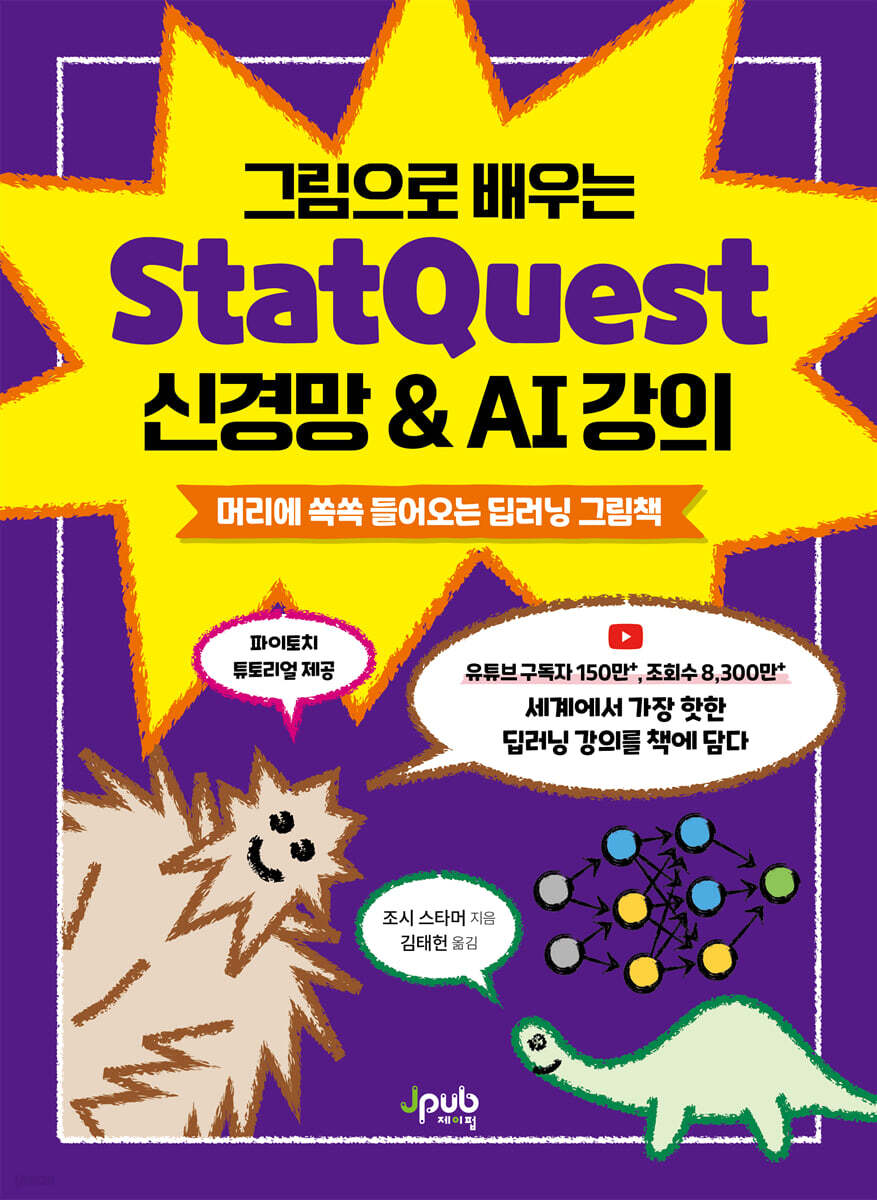
StatQuest Neural Networks & AI Course: Learn Through Pictures
 |
Description
Book Introduction
There's no deep learning course more visual and intuitive than this.
LLMs like ChatGPT are like magic.
How does the magic of generating poetry or writing code with a simple prompt happen? This book breaks down the concepts into easy-to-understand sections, presenting them with intuitive examples and clear illustrations.
Starting from the basics of neural networks and AI, it covers the latest technologies such as image classification and natural language processing step by step. PyTorch tutorials are provided for each major concept, so you can learn how to code neural networks from scratch.
The appendix provides illustrated explanations of mathematical concepts you may have learned in school but have now forgotten.
LLMs like ChatGPT are like magic.
How does the magic of generating poetry or writing code with a simple prompt happen? This book breaks down the concepts into easy-to-understand sections, presenting them with intuitive examples and clear illustrations.
Starting from the basics of neural networks and AI, it covers the latest technologies such as image classification and natural language processing step by step. PyTorch tutorials are provided for each major concept, so you can learn how to code neural networks from scratch.
The appendix provides illustrated explanations of mathematical concepts you may have learned in school but have now forgotten.
- You can preview some of the book's contents.
Preview
index
Translator's Preface iii
Beta Reader Review iv
01 Basic Concepts of Neural Networks and AI!!! 1
02 Weight and Bias Optimization Using Backpropagation!!! 19
03 Neural networks with multiple inputs and outputs!!! 69
04 Simplifying Output Values with ArgMax and SoftMax!!! 83
05 Speed up training with cross entropy!!! 97
06 Image Classification with Convolutional Neural Networks!!! 119
07 Predicting Stock Prices with Recurrent Neural Networks!!! 133
08 Better Stock Price Predictions with Short-Term and Long-Term Memory!!! 153
09 Converting Words to Numbers with Word Embeddings!!! 171
10 Language Translation with Seq2Seq and Encoder-Decoder Models!!! 183
11 Better Language Translation with Attention!!! 199
Translate languages more powerfully with 12 Transformers!!! 213
Generating Massive Text with a Decoder-Only Transformer!!! 255
Classification and Clustering with Encoder-Only Transformers!!! 267
Appendix (something you probably learned in school but have now forgotten)!!! 277
Acknowledgments 354 / References 355 / Index 356
Beta Reader Review iv
01 Basic Concepts of Neural Networks and AI!!! 1
02 Weight and Bias Optimization Using Backpropagation!!! 19
03 Neural networks with multiple inputs and outputs!!! 69
04 Simplifying Output Values with ArgMax and SoftMax!!! 83
05 Speed up training with cross entropy!!! 97
06 Image Classification with Convolutional Neural Networks!!! 119
07 Predicting Stock Prices with Recurrent Neural Networks!!! 133
08 Better Stock Price Predictions with Short-Term and Long-Term Memory!!! 153
09 Converting Words to Numbers with Word Embeddings!!! 171
10 Language Translation with Seq2Seq and Encoder-Decoder Models!!! 183
11 Better Language Translation with Attention!!! 199
Translate languages more powerfully with 12 Transformers!!! 213
Generating Massive Text with a Decoder-Only Transformer!!! 255
Classification and Clustering with Encoder-Only Transformers!!! 267
Appendix (something you probably learned in school but have now forgotten)!!! 277
Acknowledgments 354 / References 355 / Index 356
Detailed image

Into the book
The most basic element when creating a neural network in PyTorch is the tensor.
Tensors are similar to Python lists, but are used to store data, weights, and biases.
The biggest difference between tensors and Python lists is that in tensors, all values must have the same data type.
For example, if you create an integer tensor, all values in it must be integers.
Another big difference is that tensors are optimized for use in neural networks.
--- p.18
Backpropagation consists of two steps.
The first step is to compute the derivative for each parameter to be optimized.
This set of differential values is called the 'gradient'.
The name 'backpropagation' is given because this gradient is calculated from the output layer of the neural network towards the input layer.
/ Then, in the second step, we adjust the parameters using gradient descent or other optimization methods.
This process proceeds iteratively to find the optimal value.
That is, it is a method of gradually improving parameters through several small steps.
--- p.20
The first neural network, created in the 1950s, was a perceptron designed to recognize handwritten digits and letters.
However, these early CNN designs didn't work well in practice until the 1990s because the datasets were too small and the computers were too slow.
Fortunately, however, researchers working on GPUs (graphics processing units) discovered that they could run CNNs much faster. GPUs sped up CNNs, and CNNs became better at image classification, kickstarting the AI revolution we're currently experiencing.
--- p.128
The first encoder-decoder model used LSTM (Sutskever et al.
2018), could be expanded to allow flexibility in the length of input and output sequences… and non-numeric inputs and outputs.
We also used a word embedding network, which allows for easy training.
I will explain how to use the encoder-decoder model to solve the sequence-to-sequence problem.
So, let's create a model that translates English phrases into Spanish phrases.
--- p.184
Now that we know the details of the encoder-decoder model, let's code two layers, each with two LSTMs.
Generating two word embeddings for each of the four tokens can be done with nn.Embedding().
We can create stacks and layers of LSTM units with nn.LSTM().
If you set input_size to 2, you can use all word embedding values as input… and set hidden_size to 2, which receives the same input values, and create two stacks of LSTM units.
By setting num_layers to 2, we can create two stacks of LSTM units... and finally, we can create a fully connected layer with nn.Linear().
--- p.198
To understand the importance of keeping track of word order, imagine if Normalsaurus said... 'Squatch eats pizza.' In this case, Squatch would probably say... "Yum!!!" Conversely, imagine if Normalsaurus said... 'Pizza eats Squatch.' In this case, Squatch would probably say... "Eww!!!" These two sentences use exactly the same words, but have very different meanings.
Therefore, it is very important to keep track of word order.
Let's learn how transformers learn word order using positional encoding!
Tensors are similar to Python lists, but are used to store data, weights, and biases.
The biggest difference between tensors and Python lists is that in tensors, all values must have the same data type.
For example, if you create an integer tensor, all values in it must be integers.
Another big difference is that tensors are optimized for use in neural networks.
--- p.18
Backpropagation consists of two steps.
The first step is to compute the derivative for each parameter to be optimized.
This set of differential values is called the 'gradient'.
The name 'backpropagation' is given because this gradient is calculated from the output layer of the neural network towards the input layer.
/ Then, in the second step, we adjust the parameters using gradient descent or other optimization methods.
This process proceeds iteratively to find the optimal value.
That is, it is a method of gradually improving parameters through several small steps.
--- p.20
The first neural network, created in the 1950s, was a perceptron designed to recognize handwritten digits and letters.
However, these early CNN designs didn't work well in practice until the 1990s because the datasets were too small and the computers were too slow.
Fortunately, however, researchers working on GPUs (graphics processing units) discovered that they could run CNNs much faster. GPUs sped up CNNs, and CNNs became better at image classification, kickstarting the AI revolution we're currently experiencing.
--- p.128
The first encoder-decoder model used LSTM (Sutskever et al.
2018), could be expanded to allow flexibility in the length of input and output sequences… and non-numeric inputs and outputs.
We also used a word embedding network, which allows for easy training.
I will explain how to use the encoder-decoder model to solve the sequence-to-sequence problem.
So, let's create a model that translates English phrases into Spanish phrases.
--- p.184
Now that we know the details of the encoder-decoder model, let's code two layers, each with two LSTMs.
Generating two word embeddings for each of the four tokens can be done with nn.Embedding().
We can create stacks and layers of LSTM units with nn.LSTM().
If you set input_size to 2, you can use all word embedding values as input… and set hidden_size to 2, which receives the same input values, and create two stacks of LSTM units.
By setting num_layers to 2, we can create two stacks of LSTM units... and finally, we can create a fully connected layer with nn.Linear().
--- p.198
To understand the importance of keeping track of word order, imagine if Normalsaurus said... 'Squatch eats pizza.' In this case, Squatch would probably say... "Yum!!!" Conversely, imagine if Normalsaurus said... 'Pizza eats Squatch.' In this case, Squatch would probably say... "Eww!!!" These two sentences use exactly the same words, but have very different meanings.
Therefore, it is very important to keep track of word order.
Let's learn how transformers learn word order using positional encoding!
--- p.216
Publisher's Review
The most accessible introduction to the magical power of artificial intelligence, illustrated in pictures.
A book has been published that unfolds the concepts of neural networks and artificial intelligence, which used to feel complex and abstract, in a pictorial way before our eyes.
Josh Starmer, beloved by data scientists and students worldwide for his StatQuest series, presents an easy-to-understand and intuitive explanation of neural networks and artificial intelligence.
The greatest appeal of this book is ‘clarification, not simplification.’
Equations and symbols are used as they are, but how they work is explained with pictures and analogies, allowing readers to understand the concepts directly through their eyes.
Concepts that seemed difficult in textbooks, such as tensors, backpropagation, SoftMax, and cross entropy, are gradually connected and naturally lead to CNNs, RNNs, LSTMs, and transformers.
Additionally, each chapter includes a PyTorch tutorial, so you can go beyond simply understanding and gain hands-on experience by building your own neural networks.
Math concepts learned in school but forgotten are also explained again in the appendix with pictures, helping to build a solid foundation for everyone from beginners to professionals.
This book transforms neural networks from "magical black boxes" to "visible and tangible tools."
For readers curious about the core principles of the latest AI models, including ChatGPT, this book will provide both intuition and the joy of understanding.
Josh Starmer, known as the "Bob Ross of Data," will inspire readers who feel intimidated by difficult concepts with his signature humor and warm explanations.
Let's explore the vast forest of artificial intelligence without fear with this book.
Key Contents
● Basic concepts of neural networks and AI
● Optimizing weights and biases: Backpropagation
● Organizing output with ArgMax and SoftMax
● Speeding up learning with cross entropy
● Classifying images using convolutional neural networks (CNNs)
● Predicting stocks using recurrent neural networks (RNNs)
● Better stock predictions with long short-term memory (LSTM)
● Converting words to numbers using word embedding
● Language translation with Seq2Seq and encoder-decoder models
● Better language translation with Attention and Transformer
A book has been published that unfolds the concepts of neural networks and artificial intelligence, which used to feel complex and abstract, in a pictorial way before our eyes.
Josh Starmer, beloved by data scientists and students worldwide for his StatQuest series, presents an easy-to-understand and intuitive explanation of neural networks and artificial intelligence.
The greatest appeal of this book is ‘clarification, not simplification.’
Equations and symbols are used as they are, but how they work is explained with pictures and analogies, allowing readers to understand the concepts directly through their eyes.
Concepts that seemed difficult in textbooks, such as tensors, backpropagation, SoftMax, and cross entropy, are gradually connected and naturally lead to CNNs, RNNs, LSTMs, and transformers.
Additionally, each chapter includes a PyTorch tutorial, so you can go beyond simply understanding and gain hands-on experience by building your own neural networks.
Math concepts learned in school but forgotten are also explained again in the appendix with pictures, helping to build a solid foundation for everyone from beginners to professionals.
This book transforms neural networks from "magical black boxes" to "visible and tangible tools."
For readers curious about the core principles of the latest AI models, including ChatGPT, this book will provide both intuition and the joy of understanding.
Josh Starmer, known as the "Bob Ross of Data," will inspire readers who feel intimidated by difficult concepts with his signature humor and warm explanations.
Let's explore the vast forest of artificial intelligence without fear with this book.
Key Contents
● Basic concepts of neural networks and AI
● Optimizing weights and biases: Backpropagation
● Organizing output with ArgMax and SoftMax
● Speeding up learning with cross entropy
● Classifying images using convolutional neural networks (CNNs)
● Predicting stocks using recurrent neural networks (RNNs)
● Better stock predictions with long short-term memory (LSTM)
● Converting words to numbers using word embedding
● Language translation with Seq2Seq and encoder-decoder models
● Better language translation with Attention and Transformer
GOODS SPECIFICS
- Date of issue: November 13, 2025
- Format: Paperback book binding method guide
- Page count, weight, size: 368 pages | 188*257*17mm
- ISBN13: 9791194587835
You may also like
카테고리
korean


korean

![GQ KOREA Mark (Monthly): December [2025]](http://librairie.coreenne.fr/cdn/shop/files/8ef265dbbfbf186523ed75ba7319009d.jpg?v=1765340328&width=3840)


