

Wild
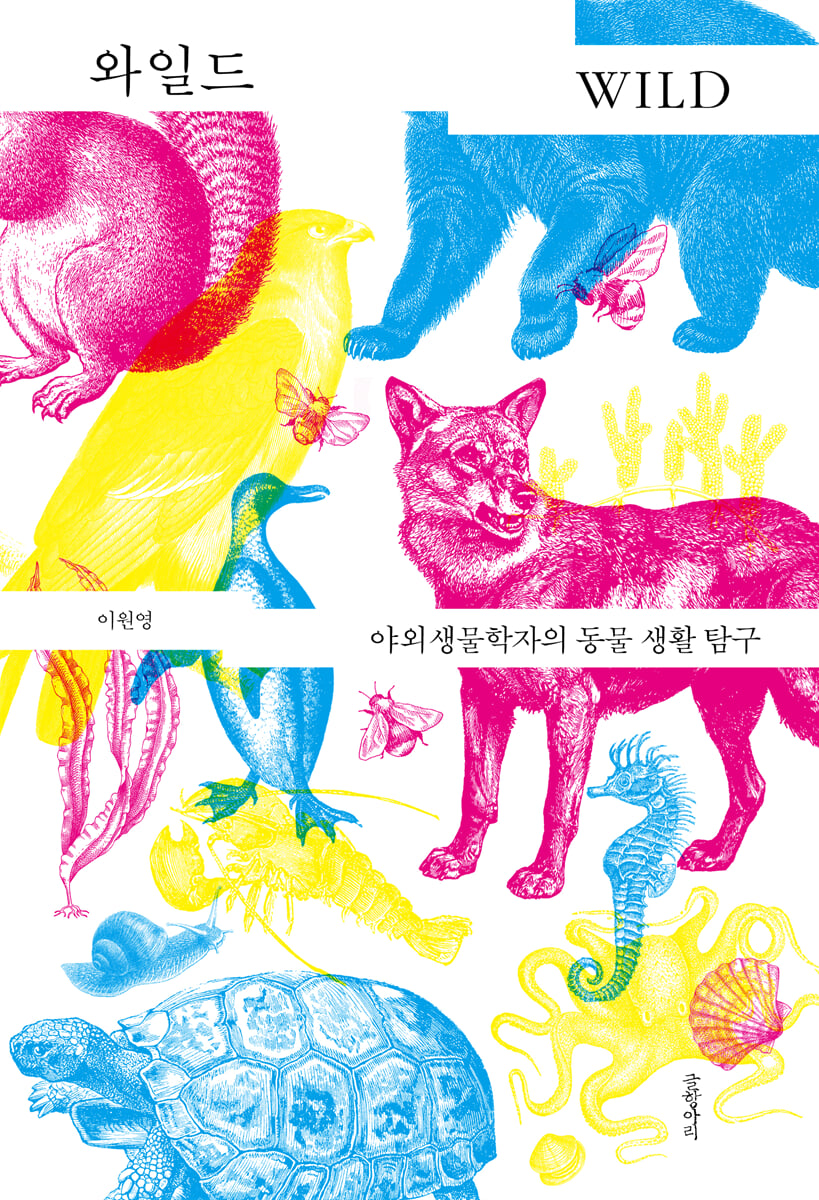 |
Description
Book Introduction
'What is this guy thinking now?
Why am I looking at this guy?'
From microorganisms to apes,
The moment when the protagonist of nature reveals his true nature
The fundamentals and applications of animal behavior that you need to know to have the 'eyes of an observer' to see it.
A full-fledged wildlife exploration guide from animal behaviorist Wonyoung Lee.
The child who vaguely sensed the mystery of life while looking into the compound eyes of a dragonfly became a field biologist whose job it was to observe animals all day long.
He says that any place where animals are alive and moving around becomes a field, and he travels all over the world in search of research species, from the endless ice caps of Antarctica to the uninhabited islands of the South Pacific covered with forests.
A black eye suddenly caught his eye! What should he do now? "Wild: A Field Biologist's Exploration of Animal Life" is science's answer to this unfamiliar encounter.
From color and shape to behavior and emotion, the true nature of animals that we only encounter when we enter the wild and observe them through the eyes of an observer is a living proof of the history of evolution, in which every single one is a code of natural law.
Knowing how to read that code gives you a new perspective on animals.
From there, the questions continue one after another, and we each have our own key to unlock the story of life that is still unknown to the world.
Of course, this is also another key to getting to know ourselves.
Why am I looking at this guy?'
From microorganisms to apes,
The moment when the protagonist of nature reveals his true nature
The fundamentals and applications of animal behavior that you need to know to have the 'eyes of an observer' to see it.
A full-fledged wildlife exploration guide from animal behaviorist Wonyoung Lee.
The child who vaguely sensed the mystery of life while looking into the compound eyes of a dragonfly became a field biologist whose job it was to observe animals all day long.
He says that any place where animals are alive and moving around becomes a field, and he travels all over the world in search of research species, from the endless ice caps of Antarctica to the uninhabited islands of the South Pacific covered with forests.
A black eye suddenly caught his eye! What should he do now? "Wild: A Field Biologist's Exploration of Animal Life" is science's answer to this unfamiliar encounter.
From color and shape to behavior and emotion, the true nature of animals that we only encounter when we enter the wild and observe them through the eyes of an observer is a living proof of the history of evolution, in which every single one is a code of natural law.
Knowing how to read that code gives you a new perspective on animals.
From there, the questions continue one after another, and we each have our own key to unlock the story of life that is still unknown to the world.
Of course, this is also another key to getting to know ourselves.
- You can preview some of the book's contents.
Preview
index
Entering
Chapter 1 The Observer's Eye
Chapter 2: Choosing an Animal Mate
Chapter 3 Animal Mating
Chapter 4 Animal Colors
Chapter 5 Animals that live together
Chapter 6: The Art of Symbiosis
Chapter 7: Moving Animals
Chapter 8: A New Way to Observe Animals
Chapter 9 Cold and Heat
Chapter 10 Animal Sleep
Chapter 11: The Wisdom of Animals
Chapter 12 Animal Communication
Chapter 13 Pain and Sorrow
Chapter 14: The Lost Wild
Chapter 15: The Wild Crisis
main
References
Search
Chapter 1 The Observer's Eye
Chapter 2: Choosing an Animal Mate
Chapter 3 Animal Mating
Chapter 4 Animal Colors
Chapter 5 Animals that live together
Chapter 6: The Art of Symbiosis
Chapter 7: Moving Animals
Chapter 8: A New Way to Observe Animals
Chapter 9 Cold and Heat
Chapter 10 Animal Sleep
Chapter 11: The Wisdom of Animals
Chapter 12 Animal Communication
Chapter 13 Pain and Sorrow
Chapter 14: The Lost Wild
Chapter 15: The Wild Crisis
main
References
Search
Detailed image

Into the book
People who study animals are usually people who love animals so much that they can't help but love them, and as a result, they become deeply emotionally involved in the lives of animals and worry about their well-being.
Whenever I encounter an animal that is the subject of research, I always think about 'relationships'.
Relationships are formed through the interaction between the researcher and the research subject, which involves a process of meeting each other and forming a relationship.
As I continue my research, there are times when I, like Goodall, give names to each animal I develop relationships with.
It may seem odd that a scientist would think about their relationships with animals, but it's hard to imagine an ethologist making proper observations without engaging with animals.
Most scholars who study penguins, like me, are concerned about their future.
In Antarctica, penguin populations are also changing as global warming progresses rapidly.
In the same vein as Jane Goodall's work to protect the African jungle, those who study polar animals also become conservation biologists who advocate for the protection of the Southern Ocean.
--- p.30
The female who wins the competition takes over several males, and the mated female simply lays eggs in the nest and soon leaves.
The remaining male incubates the eggs and raises the chicks alone in the nest.
I first saw a red-bellied godwit outdoors during a field trip to Greenland.
Seeing an adult walking around with its young, I naturally assumed it was a female.
However, when I returned to camp and looked at the illustrations and descriptions in the guide, I saw that the one with the dull feathers with the chicks was a male.
When I saw that, I thought to myself, 'There's a typo in the Pokedex! The author mistakenly wrote the female as a male.'
It was after learning about the life history of the red-bellied sandpiper that I realized I was wrong.
And this incident made me realize how much I had been prejudiced.
Despite observing many animals and seeing countless different types of mating, I still had stereotypes and prejudices about gender roles.
In the animal kingdom, gender roles are not fixed.
It is the history of evolution that living things have gone through and the result of adaptation to the environment, and it can be changed at any time.
--- p.59~60
New Caledonia has a thorny tropical plant of the genus Pandanus.
Crows usually cut one edge of a pandanus leaf to create a long, saw-like shape, with wider or narrower tools made using a standardized method that varies from region to region.
The shape and method of making tools remained consistent across regions, and the possibility of social learning seemed high, as tools of the same shape were made in a specific region for more than 10 years.
In addition to leaves, crows also made hook-shaped stick tools by removing leaves from bent branches. These were stronger and longer than those made from pandanus leaves, and were very useful for catching larvae deep in holes.
Although there have been many speculations since long ago that birds such as magpies and crows might be quite intelligent, the fact that crows actually use tools was first announced to the academic world through Hunt's observation, and this discovery revealed that the evolution of advanced tool technology is not exclusive to primates.
--- p.246
What if a large piece of iceberg suddenly appeared on the way from the breeding grounds to the sea? It would take much longer than usual to get around the iceberg, out to sea, and back again.
A distance that can be traveled in one day can extend to a week.
Icebergs not only block the road, but also block the wind blowing out to sea.
In Antarctica, during summer, winds blowing from the continent out to sea push ice floes floating on the ocean surface outward.
However, if an iceberg blocks the wind, the ice fragments will continue to float on the sea, preventing the water from being visible.
When sea ice blocks the water's surface like this, it becomes difficult for penguins to go out to sea to find food.
Therefore, if a large iceberg forms around the breeding ground, the birds will not be able to obtain enough food to feed their young, and breeding that year will almost certainly fail.
The breeding grounds are overflowing with starving chicks in every nest.
Iceberg fragments pose a catastrophic risk to penguins.
(…) I have seen glaciers melt and collapse before my eyes.
Someone kept clicking the camera shutter, saying it was a spectacular sight, but I could only stand there, unable to do anything, trying to console my increasingly heavy heart.
Because penguins and whales were seen groaning under the broken ice.
Whenever I encounter an animal that is the subject of research, I always think about 'relationships'.
Relationships are formed through the interaction between the researcher and the research subject, which involves a process of meeting each other and forming a relationship.
As I continue my research, there are times when I, like Goodall, give names to each animal I develop relationships with.
It may seem odd that a scientist would think about their relationships with animals, but it's hard to imagine an ethologist making proper observations without engaging with animals.
Most scholars who study penguins, like me, are concerned about their future.
In Antarctica, penguin populations are also changing as global warming progresses rapidly.
In the same vein as Jane Goodall's work to protect the African jungle, those who study polar animals also become conservation biologists who advocate for the protection of the Southern Ocean.
--- p.30
The female who wins the competition takes over several males, and the mated female simply lays eggs in the nest and soon leaves.
The remaining male incubates the eggs and raises the chicks alone in the nest.
I first saw a red-bellied godwit outdoors during a field trip to Greenland.
Seeing an adult walking around with its young, I naturally assumed it was a female.
However, when I returned to camp and looked at the illustrations and descriptions in the guide, I saw that the one with the dull feathers with the chicks was a male.
When I saw that, I thought to myself, 'There's a typo in the Pokedex! The author mistakenly wrote the female as a male.'
It was after learning about the life history of the red-bellied sandpiper that I realized I was wrong.
And this incident made me realize how much I had been prejudiced.
Despite observing many animals and seeing countless different types of mating, I still had stereotypes and prejudices about gender roles.
In the animal kingdom, gender roles are not fixed.
It is the history of evolution that living things have gone through and the result of adaptation to the environment, and it can be changed at any time.
--- p.59~60
New Caledonia has a thorny tropical plant of the genus Pandanus.
Crows usually cut one edge of a pandanus leaf to create a long, saw-like shape, with wider or narrower tools made using a standardized method that varies from region to region.
The shape and method of making tools remained consistent across regions, and the possibility of social learning seemed high, as tools of the same shape were made in a specific region for more than 10 years.
In addition to leaves, crows also made hook-shaped stick tools by removing leaves from bent branches. These were stronger and longer than those made from pandanus leaves, and were very useful for catching larvae deep in holes.
Although there have been many speculations since long ago that birds such as magpies and crows might be quite intelligent, the fact that crows actually use tools was first announced to the academic world through Hunt's observation, and this discovery revealed that the evolution of advanced tool technology is not exclusive to primates.
--- p.246
What if a large piece of iceberg suddenly appeared on the way from the breeding grounds to the sea? It would take much longer than usual to get around the iceberg, out to sea, and back again.
A distance that can be traveled in one day can extend to a week.
Icebergs not only block the road, but also block the wind blowing out to sea.
In Antarctica, during summer, winds blowing from the continent out to sea push ice floes floating on the ocean surface outward.
However, if an iceberg blocks the wind, the ice fragments will continue to float on the sea, preventing the water from being visible.
When sea ice blocks the water's surface like this, it becomes difficult for penguins to go out to sea to find food.
Therefore, if a large iceberg forms around the breeding ground, the birds will not be able to obtain enough food to feed their young, and breeding that year will almost certainly fail.
The breeding grounds are overflowing with starving chicks in every nest.
Iceberg fragments pose a catastrophic risk to penguins.
(…) I have seen glaciers melt and collapse before my eyes.
Someone kept clicking the camera shutter, saying it was a spectacular sight, but I could only stand there, unable to do anything, trying to console my increasingly heavy heart.
Because penguins and whales were seen groaning under the broken ice.
--- p.350~354
Publisher's Review
“People who study animals
“Because we are people who love animals so much”
… … So we headed out into the wild!
An eye that reads the signs of survival and reproduction
A sense of illuminating the stage of evolution
The power of life to endure change!
“Just as wherever there are animals, that place becomes a ‘scene’ for me, the ‘wild’, where animals live according to the laws of nature, is always close to us.
(…) As I work in the wild, I see each and every animal’s behavior as a law of nature and evidence of evolution.
The wilderness is a symbolic space and time where all of our past is preserved and thus also predicts our future.
This book is set in that very wilderness.
The main content is about animals that a field biologist encounters in the wild and how they live.
Is there such a thing as a "method for encountering animals"? While there may be no such rule, there is scientific knowledge and technology that has been developed through countless people who encountered animals in the wild, from prehistoric sites to the research of Charles Darwin and modern science.
Knowing this can help you encounter wild animals in a slightly different way than before, and even create a special connection with them.”
_「Entering」
Eight years after telling stories about polar animals with his first book, "Going to the North Pole in Summer," 'Penguin Doctor' Won-Young Lee has returned with "Wild: A Field Biologist's Exploration of Animal Life."
This time, we're not just talking about penguins.
It's not just about dealing with polar regions.
Not only do they range in species from microbes to apes, but they also range in habitats from street trees in front of houses to the deepest ocean known to man (the Mariana Trench).
This book, whose title is "Wild," takes place in the untamed "wild" and deals with the struggles of various animals that survive and reproduce in their own way there.
All these diverse lives are connected by one keyword: evolution.
From this perspective, every appearance and every action becomes a code to be questioned and interpreted.
Where animals live and move,
That's the scene
“Animals do not stay still in one place, but move freely here and there.
Therefore, any place where animals are alive, moving, and moving around is a field biologist's field.
(…) No matter where I am, since animals don’t come to me, I have no choice but to go find them.” (9) The boy who used to run around the neighborhood catching dragonflies and cicadas as a child has now expanded his scope of exploration to the entire globe, chasing penguins in the Antarctic and geese in the North Pole.
But the way we encounter animals has completely changed.
Unlike my childhood when I was happy to collect insects, I now feel sorry for capturing penguins and worry about their present and future.
As he approaches cautiously and quietly, he watches the animals eat, sleep, rest, play, fight, and love in their true form.
That's how the 'eye of the observer' comes into being.
The author didn't just come across this.
After vowing to no longer torment animals with his 'misguided love', he satiated his curiosity with books and nurtured his dream of becoming a zoologist. He learned how to encounter animals through the scientific knowledge accumulated by his ancestors and previous researchers.
The Cro-Magnon man who painted the Chauvet Cave murals, Charles Darwin who pioneered evolutionary biology, Jane Goodall who first inspired me to dream of becoming an animal behaviorist… …and now, all of them are teachers, including fellow scientists who are uncovering new secrets of animal behavior with cutting-edge technology all over the world.
The gentoo penguins, Antarctica and Sejong, who were personally named, also met in a way taught by science.
This book begins with his journey as a scholar who, little by little, learned how to encounter animals and finally developed the eyes of an observer.
The fundamentals and applications of animal behavior for properly encountering wild animals are the core of this book.
To help readers step into the wild and embark on their own explorations, he has incorporated the science, technology, and knowledge he acquired as an animal behaviorist, the new facts he and his colleagues are uncovering on the front lines today, and the attitudes and tips he has learned through firsthand experience in the field.
“Knowing this allows us to encounter wild animals in a slightly different way than before, and even connect with them in a special way,” the author explains (15).
So this book covers the process and methods of scientifically studying animal behavior.
While examining the main topics of animal behavior, including survival, mating, migration, symbiosis, feeding, and rest, as well as consciousness, emotions, cognitive abilities, and communication, we also discussed animal ethics and the climate crisis, topics directly related to the current crisis in animal life.
The journey features a variety of animals, from microbes to apes, but the species that make up the majority are birds, including penguins, which are part of my research.
This book cites various research cases from scientists around the world, and by following them, you will be able to understand the main stream of animal behavior studies.
Among them, I have introduced in detail new methods of animal behavior research that I use in the field.
In this section, you'll learn new things about the diving behavior, communication, and sleep of polar animals, including penguins, through biologging, and you'll also get a glimpse of the process of using drones to find nests of white-tailed gulls and track pink-footed geese.
Page 15
Follow the geese into the sky,
Follow the seal into the water
This book covers a wide range of topics related to animal life, including mating, color and body type, group living, symbiosis, migratory behavior, body temperature regulation, sleep, cognition and emotion, communication, animal ethics, and the climate crisis.
It may seem long and complicated, but if you put your mind to it, you can read it all in one day.
Because every page is filled with fascinating research cases and vivid animal photos to match.
The detailed descriptions written from the animal's perspective, not a human's, have a fascinating power that makes us imagine what it would be like to live as that animal, and the accompanying photographs show the dynamics of the animal's life, giving color and expression to that imagination.
The red-bellied sandpiper, which competes with the females for several males with their larger bodies and colorful feathers; the wandering albatross, a monogamous bird known to mate for over 50 years; the flower-throated hawk, which mimics the appearance of a honeybee to have the effect of a stinger without a stinger; the lady frog, which usually camouflages itself with a green back and turns its belly over in a dangerous situation to give a red warning; penguins that huddling in extreme environments of -90 degrees Celsius to share body temperature; lions that adjust the size of their group according to their prey; hyenas that recognize individuals and confirm their group affiliation by smelling their anus; the Hawaiian bobtail squid, which glows in the dark sea with the help of the bioluminescent bacteria Vibrio fischeri to reduce the risk of predation; the Arctic tern, which migrates the longest distances on Earth, traveling between Greenland and the Southern Ocean every year; and the black-faced squid, which dives over 600 meters and holds its breath for over 40 minutes. Weddell seals, the Arctic fox that reduces heat loss with its small, plump ears, the bat-eared fox that radiates heat with its large ears in hot Africa, the great frigate bird that sleeps while flying, the New Caledonian crow that makes tools out of tree branches, the howling of wolves, the figure-eight dance of bees, the skin patterns of squid, the infrasound of elephants, the grooming of chimpanzees, the gray parrot that uses human language to express itself… … From the first page to the last, the extraordinary stories of countless animals continue without end.
What makes the lives of various animals even more vivid is the passage where the author introduces his own research.
This book also covers in detail the author's research that was not mentioned in detail in previous publications.
It all started with my first graduate school paper, which revealed that magpies in Gwanaksan Mountain can distinguish humans at the individual level.
While conducting research at the Polar Research Institute, the author analyzed the gut microbiome of penguins and found that it helped them endure the stress of fasting periods, attached biologgers to chinstrap penguins to track their migration routes, added a thermal imaging camera to a drone to identify nests of white-throated gulls, and observed the feather-mowing behavior of pink-footed geese.
Additionally, using over 300 butterfly specimens from the Natural History Museum in London, they discovered a correlation between body coloration and thermoregulation in European butterflies, analyzed the brain waves of chinstrap penguins and discovered that they sleep for an average of 4 seconds each for 11 hours, and attached video cameras to gentoo penguins and confirmed that they communicate with vocal signals at sea.
The significance of such research goes beyond examining a single behavior of a specific study species from an evolutionary perspective.
Polar animals, in particular, are the species that experience the most severe and sensitive impacts of climate change, and research on their feeding activities, communication methods, sleeping patterns, and migration routes is important basic work for studying animal behavioral responses to climate change.
As this work accumulates, animal behavior research will become a reliable basis for conservation strategies that go beyond protecting specific populations or habitats to encompass more species and broader areas, and will have significant ecological and conservation implications.
Contemplating 'Relationships' Within the Objectivity of Science
-Interaction between researchers and research subjects
The author, who says, “I always think about ‘relationships’ when I encounter animals as research subjects,” devotes the latter half of this book to the weighty topics of animal ethics and the climate crisis, which seems like an inevitable development.
To study animal behavior scientifically, one must maintain an objective standpoint and thoroughly maintain the role of an observer.
Researchers are always on guard against introducing subjective interpretations or inadvertently interfering with animal behavior and ecology.
But sometimes awkward situations arise.
People who study animals are usually people who love animals so much that they can't help but love them, and as a result, they become deeply emotionally involved in the lives of animals and worry about their well-being.
(…) Most scholars who study penguins, like me, are concerned about the future of penguins.
In Antarctica, penguin populations are also changing as global warming progresses rapidly.
In the same vein as Jane Goodall's work to protect the African jungle, those who study polar animals also become conservation biologists who advocate for the protection of the Southern Ocean.
_Page 30
As an author who studies wild animals, I cannot help but talk about the crisis in the wild.
This manifests itself at various levels, from the individual (group) level crisis of deprivation of wildness to the global crisis of the destruction of wildness itself.
Cassie the dolphin who held her breath and chose death to escape a life of confinement and training; Baram the lion who was rescued after suffering from poor breeding conditions and extreme starvation, nicknamed the "rib lion"; other animals suffering from physical and mental pain due to extremely reduced activity ranges, severe behavioral restrictions, and breeding conditions that do not take their ecological characteristics into account; and even animals raised for the purpose of experimentation and slaughter. The images of captive animals robbed of their wildness appear throughout the second half of the book, forming a stark contrast to the images of wild animals that display dynamic vitality.
However, as the author points out, animals living in the wild are not immune to danger.
Even in a well-preserved nature, life can barely maintain its place only by constantly adapting and evolving for survival. However, the Anthropocene and climate change—crises that completely shake up our living environment and adaptation methods—have arrived.
Sea turtles, whose eggs are determined by the temperature of the sand, are facing extreme gender imbalances as the sand heats up, putting entire populations at risk of extinction, while monodons are suffocating as they struggle to find breathing holes due to destabilizing sea ice.
Southern great-tailed gulls and emperor penguins, which live in the subantarctic, are found in the Antarctic, and penguin breeding grounds are overflowing with starving chicks in every nest as their foraging routes are blocked by icebergs.
Witnessing this situation, the author says, “What weighs most heavily on my mind as I observe animals in their ever-changing wild environment is the helplessness of being unable to do anything in the face of their crisis.”
But despite this, he tries to speak of meaningful continuation, or rather, hope, by talking about the lives of animals.
At the end of the story of animals suffering in captivity, there is the story of Sandra, an orangutan who was recognized as a legal person and released from the zoo to a wildlife sanctuary.
As I witness the collapsing glaciers with my own eyes and see the specific numbers of penguin populations disappearing from the Earth due to global warming, I promise to 'give a voice' to each and every animal I personally observe and name.
So, while this book is for readers who want to encounter animals in the wild, it is also a voice from the field for research animals.
He says he still doesn't quite know why he observes animals, but perhaps the purpose lies in the fervent desire expressed in his writings.
May all animals in this world live in their own place and in their own way.
This book is an invitation to nature and action for nature, offered by the author, who still roams the wilds today with that wind as his goal.
“Because we are people who love animals so much”
… … So we headed out into the wild!
An eye that reads the signs of survival and reproduction
A sense of illuminating the stage of evolution
The power of life to endure change!
“Just as wherever there are animals, that place becomes a ‘scene’ for me, the ‘wild’, where animals live according to the laws of nature, is always close to us.
(…) As I work in the wild, I see each and every animal’s behavior as a law of nature and evidence of evolution.
The wilderness is a symbolic space and time where all of our past is preserved and thus also predicts our future.
This book is set in that very wilderness.
The main content is about animals that a field biologist encounters in the wild and how they live.
Is there such a thing as a "method for encountering animals"? While there may be no such rule, there is scientific knowledge and technology that has been developed through countless people who encountered animals in the wild, from prehistoric sites to the research of Charles Darwin and modern science.
Knowing this can help you encounter wild animals in a slightly different way than before, and even create a special connection with them.”
_「Entering」
Eight years after telling stories about polar animals with his first book, "Going to the North Pole in Summer," 'Penguin Doctor' Won-Young Lee has returned with "Wild: A Field Biologist's Exploration of Animal Life."
This time, we're not just talking about penguins.
It's not just about dealing with polar regions.
Not only do they range in species from microbes to apes, but they also range in habitats from street trees in front of houses to the deepest ocean known to man (the Mariana Trench).
This book, whose title is "Wild," takes place in the untamed "wild" and deals with the struggles of various animals that survive and reproduce in their own way there.
All these diverse lives are connected by one keyword: evolution.
From this perspective, every appearance and every action becomes a code to be questioned and interpreted.
Where animals live and move,
That's the scene
“Animals do not stay still in one place, but move freely here and there.
Therefore, any place where animals are alive, moving, and moving around is a field biologist's field.
(…) No matter where I am, since animals don’t come to me, I have no choice but to go find them.” (9) The boy who used to run around the neighborhood catching dragonflies and cicadas as a child has now expanded his scope of exploration to the entire globe, chasing penguins in the Antarctic and geese in the North Pole.
But the way we encounter animals has completely changed.
Unlike my childhood when I was happy to collect insects, I now feel sorry for capturing penguins and worry about their present and future.
As he approaches cautiously and quietly, he watches the animals eat, sleep, rest, play, fight, and love in their true form.
That's how the 'eye of the observer' comes into being.
The author didn't just come across this.
After vowing to no longer torment animals with his 'misguided love', he satiated his curiosity with books and nurtured his dream of becoming a zoologist. He learned how to encounter animals through the scientific knowledge accumulated by his ancestors and previous researchers.
The Cro-Magnon man who painted the Chauvet Cave murals, Charles Darwin who pioneered evolutionary biology, Jane Goodall who first inspired me to dream of becoming an animal behaviorist… …and now, all of them are teachers, including fellow scientists who are uncovering new secrets of animal behavior with cutting-edge technology all over the world.
The gentoo penguins, Antarctica and Sejong, who were personally named, also met in a way taught by science.
This book begins with his journey as a scholar who, little by little, learned how to encounter animals and finally developed the eyes of an observer.
The fundamentals and applications of animal behavior for properly encountering wild animals are the core of this book.
To help readers step into the wild and embark on their own explorations, he has incorporated the science, technology, and knowledge he acquired as an animal behaviorist, the new facts he and his colleagues are uncovering on the front lines today, and the attitudes and tips he has learned through firsthand experience in the field.
“Knowing this allows us to encounter wild animals in a slightly different way than before, and even connect with them in a special way,” the author explains (15).
So this book covers the process and methods of scientifically studying animal behavior.
While examining the main topics of animal behavior, including survival, mating, migration, symbiosis, feeding, and rest, as well as consciousness, emotions, cognitive abilities, and communication, we also discussed animal ethics and the climate crisis, topics directly related to the current crisis in animal life.
The journey features a variety of animals, from microbes to apes, but the species that make up the majority are birds, including penguins, which are part of my research.
This book cites various research cases from scientists around the world, and by following them, you will be able to understand the main stream of animal behavior studies.
Among them, I have introduced in detail new methods of animal behavior research that I use in the field.
In this section, you'll learn new things about the diving behavior, communication, and sleep of polar animals, including penguins, through biologging, and you'll also get a glimpse of the process of using drones to find nests of white-tailed gulls and track pink-footed geese.
Page 15
Follow the geese into the sky,
Follow the seal into the water
This book covers a wide range of topics related to animal life, including mating, color and body type, group living, symbiosis, migratory behavior, body temperature regulation, sleep, cognition and emotion, communication, animal ethics, and the climate crisis.
It may seem long and complicated, but if you put your mind to it, you can read it all in one day.
Because every page is filled with fascinating research cases and vivid animal photos to match.
The detailed descriptions written from the animal's perspective, not a human's, have a fascinating power that makes us imagine what it would be like to live as that animal, and the accompanying photographs show the dynamics of the animal's life, giving color and expression to that imagination.
The red-bellied sandpiper, which competes with the females for several males with their larger bodies and colorful feathers; the wandering albatross, a monogamous bird known to mate for over 50 years; the flower-throated hawk, which mimics the appearance of a honeybee to have the effect of a stinger without a stinger; the lady frog, which usually camouflages itself with a green back and turns its belly over in a dangerous situation to give a red warning; penguins that huddling in extreme environments of -90 degrees Celsius to share body temperature; lions that adjust the size of their group according to their prey; hyenas that recognize individuals and confirm their group affiliation by smelling their anus; the Hawaiian bobtail squid, which glows in the dark sea with the help of the bioluminescent bacteria Vibrio fischeri to reduce the risk of predation; the Arctic tern, which migrates the longest distances on Earth, traveling between Greenland and the Southern Ocean every year; and the black-faced squid, which dives over 600 meters and holds its breath for over 40 minutes. Weddell seals, the Arctic fox that reduces heat loss with its small, plump ears, the bat-eared fox that radiates heat with its large ears in hot Africa, the great frigate bird that sleeps while flying, the New Caledonian crow that makes tools out of tree branches, the howling of wolves, the figure-eight dance of bees, the skin patterns of squid, the infrasound of elephants, the grooming of chimpanzees, the gray parrot that uses human language to express itself… … From the first page to the last, the extraordinary stories of countless animals continue without end.
What makes the lives of various animals even more vivid is the passage where the author introduces his own research.
This book also covers in detail the author's research that was not mentioned in detail in previous publications.
It all started with my first graduate school paper, which revealed that magpies in Gwanaksan Mountain can distinguish humans at the individual level.
While conducting research at the Polar Research Institute, the author analyzed the gut microbiome of penguins and found that it helped them endure the stress of fasting periods, attached biologgers to chinstrap penguins to track their migration routes, added a thermal imaging camera to a drone to identify nests of white-throated gulls, and observed the feather-mowing behavior of pink-footed geese.
Additionally, using over 300 butterfly specimens from the Natural History Museum in London, they discovered a correlation between body coloration and thermoregulation in European butterflies, analyzed the brain waves of chinstrap penguins and discovered that they sleep for an average of 4 seconds each for 11 hours, and attached video cameras to gentoo penguins and confirmed that they communicate with vocal signals at sea.
The significance of such research goes beyond examining a single behavior of a specific study species from an evolutionary perspective.
Polar animals, in particular, are the species that experience the most severe and sensitive impacts of climate change, and research on their feeding activities, communication methods, sleeping patterns, and migration routes is important basic work for studying animal behavioral responses to climate change.
As this work accumulates, animal behavior research will become a reliable basis for conservation strategies that go beyond protecting specific populations or habitats to encompass more species and broader areas, and will have significant ecological and conservation implications.
Contemplating 'Relationships' Within the Objectivity of Science
-Interaction between researchers and research subjects
The author, who says, “I always think about ‘relationships’ when I encounter animals as research subjects,” devotes the latter half of this book to the weighty topics of animal ethics and the climate crisis, which seems like an inevitable development.
To study animal behavior scientifically, one must maintain an objective standpoint and thoroughly maintain the role of an observer.
Researchers are always on guard against introducing subjective interpretations or inadvertently interfering with animal behavior and ecology.
But sometimes awkward situations arise.
People who study animals are usually people who love animals so much that they can't help but love them, and as a result, they become deeply emotionally involved in the lives of animals and worry about their well-being.
(…) Most scholars who study penguins, like me, are concerned about the future of penguins.
In Antarctica, penguin populations are also changing as global warming progresses rapidly.
In the same vein as Jane Goodall's work to protect the African jungle, those who study polar animals also become conservation biologists who advocate for the protection of the Southern Ocean.
_Page 30
As an author who studies wild animals, I cannot help but talk about the crisis in the wild.
This manifests itself at various levels, from the individual (group) level crisis of deprivation of wildness to the global crisis of the destruction of wildness itself.
Cassie the dolphin who held her breath and chose death to escape a life of confinement and training; Baram the lion who was rescued after suffering from poor breeding conditions and extreme starvation, nicknamed the "rib lion"; other animals suffering from physical and mental pain due to extremely reduced activity ranges, severe behavioral restrictions, and breeding conditions that do not take their ecological characteristics into account; and even animals raised for the purpose of experimentation and slaughter. The images of captive animals robbed of their wildness appear throughout the second half of the book, forming a stark contrast to the images of wild animals that display dynamic vitality.
However, as the author points out, animals living in the wild are not immune to danger.
Even in a well-preserved nature, life can barely maintain its place only by constantly adapting and evolving for survival. However, the Anthropocene and climate change—crises that completely shake up our living environment and adaptation methods—have arrived.
Sea turtles, whose eggs are determined by the temperature of the sand, are facing extreme gender imbalances as the sand heats up, putting entire populations at risk of extinction, while monodons are suffocating as they struggle to find breathing holes due to destabilizing sea ice.
Southern great-tailed gulls and emperor penguins, which live in the subantarctic, are found in the Antarctic, and penguin breeding grounds are overflowing with starving chicks in every nest as their foraging routes are blocked by icebergs.
Witnessing this situation, the author says, “What weighs most heavily on my mind as I observe animals in their ever-changing wild environment is the helplessness of being unable to do anything in the face of their crisis.”
But despite this, he tries to speak of meaningful continuation, or rather, hope, by talking about the lives of animals.
At the end of the story of animals suffering in captivity, there is the story of Sandra, an orangutan who was recognized as a legal person and released from the zoo to a wildlife sanctuary.
As I witness the collapsing glaciers with my own eyes and see the specific numbers of penguin populations disappearing from the Earth due to global warming, I promise to 'give a voice' to each and every animal I personally observe and name.
So, while this book is for readers who want to encounter animals in the wild, it is also a voice from the field for research animals.
He says he still doesn't quite know why he observes animals, but perhaps the purpose lies in the fervent desire expressed in his writings.
May all animals in this world live in their own place and in their own way.
This book is an invitation to nature and action for nature, offered by the author, who still roams the wilds today with that wind as his goal.
GOODS SPECIFICS
- Date of issue: July 10, 2025
- Page count, weight, size: 432 pages | 674g | 140*205*27mm
- ISBN13: 9791169092104
You may also like
카테고리
korean


korean

![GQ KOREA Mark (Monthly): December [2025]](http://librairie.coreenne.fr/cdn/shop/files/8ef265dbbfbf186523ed75ba7319009d.jpg?v=1765340328&width=3840)


