

10 Equations That Move the World
 |
Description
Book Introduction
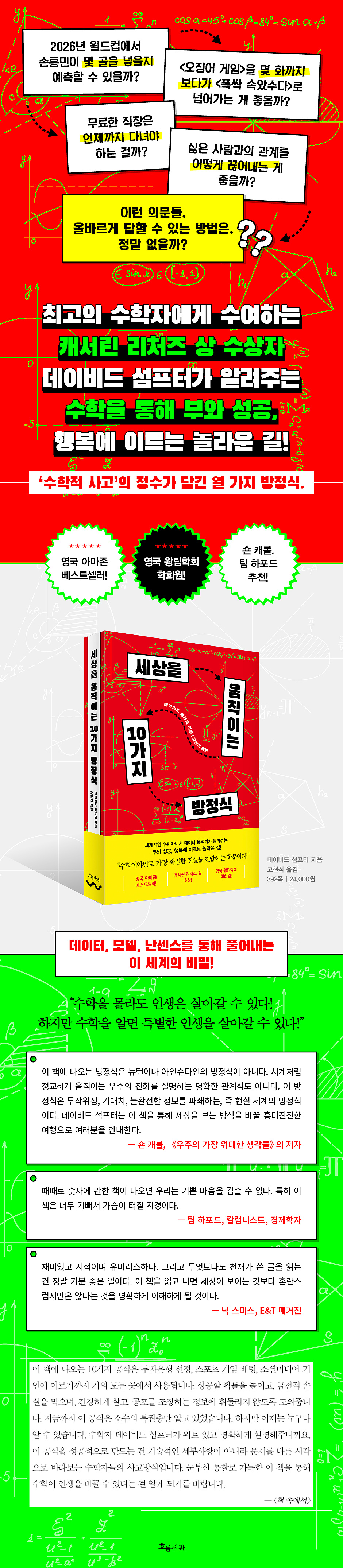
“You can live life without knowing math!”
But if you know math, you can live a special life!”
A world-renowned applied mathematician and data analyst tells us:
The Amazing Path to Wealth, Success, and Happiness from a Mathematical Perspective!
There is a lot of advice out there that suggests a 'formula for success in life'.
This is because most people are curious about the secrets of becoming rich, being happy, building good relationships, and making the right choices and decisions, and they want to apply those secrets to their own lives.
David Sumpter, professor of applied mathematics at Uppsala University in Sweden and one of Europe's most popular mathematicians, argues that there are simple, yet very clear solutions to every problem life throws at us.
It is about looking at the world from a ‘mathematical perspective.’
We view and interpret the world through a specific frame of view.
This is what is commonly called a ‘worldview.’
Professor Sumpter says that no perspective can grasp the real world as accurately and clearly as a mathematical worldview.
The discipline of mathematics establishes a model, a kind of hypothesis, observes the data that supports it, classifies meaningful signals from unnecessary noise, and eliminates nonsense, or information that cannot be verified, thereby constructing a world of perfect, logical order using only numbers and a series of symbols.
In other words, those with a mathematical perspective “state their assumptions, collect data, and present answers.
“People who present a list of reasonable alternatives, the probability of success for each alternative, and think about the next steps to find out more information.”
In the face of the rigorous approach of those seeking truth, psychological biases, hasty judgments, and the confusion of facts and opinions are rejected.
This book presents numerous examples of people who seek to bring about meaningful change in the real world by identifying patterns or trends hidden behind numbers or data.
These include sports data analysts who analyze soccer players' movements to determine their chances of winning, college students who reverse-engineer Instagram algorithms to understand what social networking companies are trying to hide from users, and researchers who use statistical research to uncover the roots of structural racism.
Through the tool of mathematics, they improve athlete performance, sound the alarm about excessive use of social networking services, and provide an objective basis for supporting political correctness.
Even outside of work and research, mathematical thinking can improve our quality of life and guide us in making better choices.
Through the 10 equations in this book, you will learn logically how to trade good stocks without being swayed by market volatility, how to select the best product among many options, how to most efficiently select excellent accommodations on accommodation apps like TripAdvisor, and why you should never cut ties with a friend who badmouths you.
This is a new type of popular education book that anyone who needs a powerful weapon to lead their life in a better direction should read at least once.
But if you know math, you can live a special life!”
A world-renowned applied mathematician and data analyst tells us:
The Amazing Path to Wealth, Success, and Happiness from a Mathematical Perspective!
There is a lot of advice out there that suggests a 'formula for success in life'.
This is because most people are curious about the secrets of becoming rich, being happy, building good relationships, and making the right choices and decisions, and they want to apply those secrets to their own lives.
David Sumpter, professor of applied mathematics at Uppsala University in Sweden and one of Europe's most popular mathematicians, argues that there are simple, yet very clear solutions to every problem life throws at us.
It is about looking at the world from a ‘mathematical perspective.’
We view and interpret the world through a specific frame of view.
This is what is commonly called a ‘worldview.’
Professor Sumpter says that no perspective can grasp the real world as accurately and clearly as a mathematical worldview.
The discipline of mathematics establishes a model, a kind of hypothesis, observes the data that supports it, classifies meaningful signals from unnecessary noise, and eliminates nonsense, or information that cannot be verified, thereby constructing a world of perfect, logical order using only numbers and a series of symbols.
In other words, those with a mathematical perspective “state their assumptions, collect data, and present answers.
“People who present a list of reasonable alternatives, the probability of success for each alternative, and think about the next steps to find out more information.”
In the face of the rigorous approach of those seeking truth, psychological biases, hasty judgments, and the confusion of facts and opinions are rejected.
This book presents numerous examples of people who seek to bring about meaningful change in the real world by identifying patterns or trends hidden behind numbers or data.
These include sports data analysts who analyze soccer players' movements to determine their chances of winning, college students who reverse-engineer Instagram algorithms to understand what social networking companies are trying to hide from users, and researchers who use statistical research to uncover the roots of structural racism.
Through the tool of mathematics, they improve athlete performance, sound the alarm about excessive use of social networking services, and provide an objective basis for supporting political correctness.
Even outside of work and research, mathematical thinking can improve our quality of life and guide us in making better choices.
Through the 10 equations in this book, you will learn logically how to trade good stocks without being swayed by market volatility, how to select the best product among many options, how to most efficiently select excellent accommodations on accommodation apps like TripAdvisor, and why you should never cut ties with a friend who badmouths you.
This is a new type of popular education book that anyone who needs a powerful weapon to lead their life in a better direction should read at least once.
- You can preview some of the book's contents.
Preview
index
Ten Keys to Deciphering Life's Secret Code
Chapter 1 Betting Equation
Chapter 2 Judgment Equation
Chapter 3: Trust Equation
Chapter 4 Technical Equations
Chapter 5: The Influencer Equation
Chapter 6 Market Equations
Chapter 7 Advertising Equation
Chapter 8 Compensation Equation
Chapter 9 Learning Equations
Chapter 10 Universal Equations
Americas
Acknowledgements
Chapter 1 Betting Equation
Chapter 2 Judgment Equation
Chapter 3: Trust Equation
Chapter 4 Technical Equations
Chapter 5: The Influencer Equation
Chapter 6 Market Equations
Chapter 7 Advertising Equation
Chapter 8 Compensation Equation
Chapter 9 Learning Equations
Chapter 10 Universal Equations
Americas
Acknowledgements
Detailed image
Into the book
Using this betting equation means not relying on intuition, and abandoning the idea that you can predict the outcome of a football match, horse race, financial investment, job interview, or even a romantic date with 100% certainty.
There is no way to know for sure what will happen in the future.
Most people have a vague idea that future events are largely determined by chance.
For example, even if the weather forecast says there's a 75% chance of clear skies tomorrow, it's not surprising to suddenly encounter a downpour on your way to work.
But to find the small edges hidden in the probabilities, we need a deeper understanding.
--- p.35
If an outcome is important to you, consider the probability that it will be good or bad.
I recently spoke with a CEO of a 100-person startup that had successfully raised millions of dollars in funding on four separate occasions, and he readily admitted that he and his investors had only a one-in-ten chance of securing long-term returns.
He had worked hard for a long time and dedicated himself to his business, but he was also aware that everything could suddenly fall apart.
Whether you're looking for your dream job or your soulmate, the odds of every tryst or date being consistently successful can be slim.
Because there are always uncontrollable factors in the process.
--- p.36
Two thousand years ago, the Greek philosopher Plato, in his Allegory of the Cave, explained that uncritical humans are chained in a cave and can only see shadows, confusing projections of the real and logical world outside.
This allegory of Plato is often used to illustrate the power of mathematics, and Price took it very seriously.
Price believed that we could discover new truths by accepting that the shadows on the cave walls were not reality.
Our everyday experiences are confusing expressions of a larger truth.
By using data-independent models to think more clearly about the true shape of the world, we can think more clearly about the more chaotic situations—the shadows of everyday life.
--- p.76
The world is full of people offering advice.
(…) But all this advice is structurally flawed.
These pieces of advice are a mix of important information, opinions, and nonsense.
The judgment equation allows us to understand and evaluate the structure of these pieces of advice.
Using judgment equations, these tips are transformed into models that can be tested with data.
We need to listen carefully to other people's opinions, consider alternatives, and gather data to make decisions.
--- p.90
You shouldn't think you can predict with certainty what will happen in life.
Instead, you need to make decisions that are meaningful to you and that you can truly trust.
Then, you must mentally prepare how to deal with an uncertain future.
At this time, we must not forget the noise term.
There will be many ups and downs that are beyond your control.
We must also remember social aspects.
Don't be swayed by hype, and don't be discouraged if your thoughts don't align with the public's.
And finally, we need to remember the signal term.
Because the true value of your investment will always be there, but it won't always be visible.
--- p.241
As more and more aspects of our lives move online, so does the amount of data we have about ourselves.
Facebook collects a ton of information about who you interact with, what you like, where you go, what you buy, and more.
All your social interactions, searches, and spending decisions are stored on Facebook, Google, and Amazon.
This is the world of big data.
We are no longer defined by our age, gender, or birthplace, but by millions of data points that measure our every action and thought.
(…) because companies thought they knew everything about their customers through that data.
But in reality, that wasn't the case.
--- p.269~270
Among the members of TEN, those who contribute the most to society use both soft and cool methods.
That is, they use a soft approach that leverages intuition when deciding which problems to solve, and a cold approach that combines models and data to be honest about the answers they come up with.
They understand the values that people around them hold dear and have paid attention to those values.
There is no way to know for sure what will happen in the future.
Most people have a vague idea that future events are largely determined by chance.
For example, even if the weather forecast says there's a 75% chance of clear skies tomorrow, it's not surprising to suddenly encounter a downpour on your way to work.
But to find the small edges hidden in the probabilities, we need a deeper understanding.
--- p.35
If an outcome is important to you, consider the probability that it will be good or bad.
I recently spoke with a CEO of a 100-person startup that had successfully raised millions of dollars in funding on four separate occasions, and he readily admitted that he and his investors had only a one-in-ten chance of securing long-term returns.
He had worked hard for a long time and dedicated himself to his business, but he was also aware that everything could suddenly fall apart.
Whether you're looking for your dream job or your soulmate, the odds of every tryst or date being consistently successful can be slim.
Because there are always uncontrollable factors in the process.
--- p.36
Two thousand years ago, the Greek philosopher Plato, in his Allegory of the Cave, explained that uncritical humans are chained in a cave and can only see shadows, confusing projections of the real and logical world outside.
This allegory of Plato is often used to illustrate the power of mathematics, and Price took it very seriously.
Price believed that we could discover new truths by accepting that the shadows on the cave walls were not reality.
Our everyday experiences are confusing expressions of a larger truth.
By using data-independent models to think more clearly about the true shape of the world, we can think more clearly about the more chaotic situations—the shadows of everyday life.
--- p.76
The world is full of people offering advice.
(…) But all this advice is structurally flawed.
These pieces of advice are a mix of important information, opinions, and nonsense.
The judgment equation allows us to understand and evaluate the structure of these pieces of advice.
Using judgment equations, these tips are transformed into models that can be tested with data.
We need to listen carefully to other people's opinions, consider alternatives, and gather data to make decisions.
--- p.90
You shouldn't think you can predict with certainty what will happen in life.
Instead, you need to make decisions that are meaningful to you and that you can truly trust.
Then, you must mentally prepare how to deal with an uncertain future.
At this time, we must not forget the noise term.
There will be many ups and downs that are beyond your control.
We must also remember social aspects.
Don't be swayed by hype, and don't be discouraged if your thoughts don't align with the public's.
And finally, we need to remember the signal term.
Because the true value of your investment will always be there, but it won't always be visible.
--- p.241
As more and more aspects of our lives move online, so does the amount of data we have about ourselves.
Facebook collects a ton of information about who you interact with, what you like, where you go, what you buy, and more.
All your social interactions, searches, and spending decisions are stored on Facebook, Google, and Amazon.
This is the world of big data.
We are no longer defined by our age, gender, or birthplace, but by millions of data points that measure our every action and thought.
(…) because companies thought they knew everything about their customers through that data.
But in reality, that wasn't the case.
--- p.269~270
Among the members of TEN, those who contribute the most to society use both soft and cool methods.
That is, they use a soft approach that leverages intuition when deciding which problems to solve, and a cold approach that combines models and data to be honest about the answers they come up with.
They understand the values that people around them hold dear and have paid attention to those values.
--- p.367
Publisher's Review
Is there a secret formula for becoming rich?
How to go viral online naturally?
How long should I keep working at a job that is just free?
How many episodes of a Netflix series should I watch before I skip it?
How much longer should I continue to be in a relationship with someone I hate?
Is there really a way to make the right decision?
Catherine Richards Award winner, awarded to the best mathematician
David Sumpter tells us
The Amazing Path to Wealth, Success, and Happiness Through Math!
A great perspective that will guide your life in a better direction,
About the ten equations that contain the essence of 'mathematical thinking'
In Dan Brown's novel The Da Vinci Code, cryptographer Sophie Neuneud and the protagonist, Professor Robert Langdon, discover a "mathematical code" that could unlock the secret while investigating the murder of her grandfather.
It is the Fibonacci sequence, which can be said to be the mathematical origin of the golden ratio.
In the novel, Sophie Neune's grandfather was the head of the Priory of Sion, a secret society that understood the world through the golden ratio.
Professor Sumpter captures readers' curiosity in the introduction of the book by saying that a secret society like the Priory of Sion in The Da Vinci Code exists in our reality.
The secrets passed down through generations within this secret society are written in a 'specific code' that few fully understand, and the members of the secret society communicate using an obscure script.
They have been with us for centuries, holding power in government, finance, academia, and more recently, the top echelons of technology companies, controlling the lives of ordinary people and sometimes even giving us advice on how to live our lives, living among us.
Professor Sumpter refers to the members of this secret society as "TEN", meaning they are people who have a grasp of the "10 equations that rule the world."
At this point, you might be wondering if Professor Sumpter is a follower of some outrageous conspiracy theory or a self-help guru who talks about wealth and success without any solid evidence.
But you can put aside your suspicious gaze.
The people Professor Sumpter refers to as "TEN" are not members of an unidentified organization with conspiracy theories, but rather a group of people who have tried to understand the world objectively and accurately through "mathematical thinking."
Mathematics teaches us about ourselves and the world we live in.
It is an inconvenient discipline, but it conveys the most certain truth.
“Equations simplify the world by compressing a lot of knowledge into a few symbols.”
This book presents ten equations that concisely reflect the contents of important theories mentioned in the field of applied mathematics, such as logistic regression, Bayes' theorem, binomial distribution and normal distribution, and Markov assumption.
Each of these equations, named 'Betting Equation, Judgment Equation, Trust Equation, Skill Equation, Influencer Equation, Market Equation, Advertising Equation, Reward Equation, Learning Equation, and Universal Equation', are formulas that, as their names suggest, condense the fundamental principles of how to increase the odds of winning in gambling or predict the odds more accurately, how to make better decisions in problems that everyone encounters in life, such as interpersonal relationships or career decisions, and how to become an influencer on social networks.
Although the symbols that make up each equation and the way it is theoretically developed are different, these equations have one thing in common.
The fact is that these are equations created in the process of observing the numerous 'data' that exist in the world and constructing a 'mathematical model' that can explain them.
In other words, models are our hypotheses about the world, and data is a kind of experience that lets us know whether our hypotheses are correct.
However, not all information can be data.
There is information in the world that is impossible to verify in the first place.
Professor Sumpter calls this "nonsense" and advocates that nonsense should be eliminated when establishing mathematical models.
This series of mathematical modeling and trends in statistics and data analysis have had a significant impact on the academic flow of the past century.
For example, research in the social sciences, which used to revolve around discussions of ideology and theoretical discourse, is now shifting toward providing evidence for claims through data such as statistics and quantitative figures.
Not to mention the field of natural science.
The 'confidence intervals' presented in papers and other publications play a significant role in demonstrating that the conclusions reached by researchers are not the result of chance.
Anything that cannot be proven mathematically is no longer considered fact.
The world of logical mathematics meets ‘moral intuition’
Only then will the world be led in a better direction.
However, when we think mathematically, focusing only on data and models, we often encounter moral dilemmas.
The trolley dilemma is a representative example.
The trolley dilemma refers to the dilemma of choosing between a trolley with faulty brakes that could injure five people on the tracks and a trolley that changes direction by turning the tracks, which would only kill one person on the other tracks.
The trolley dilemma poses the question: "Is it ethically justifiable to sacrifice the minority to save the majority?"
The trolley problem reminds us that some real-world questions do not have purely mathematical answers.
While mathematics and logic can provide clear and universal answers, when faced with ethical choices, each individual must decide for himself or herself what constitutes morality.
“Our idea that mathematics is universal is due to its tautological nature, not because mathematics is some deeper truth.
We can't use mathematics like the Ten Commandments.
“It can only be used as a tool for manipulating models and data, as we have done so far in this book.” (p. 366)
So how can we solve this dilemma?
Professor Sumpter suggests that the method is to 'learn to trust and use our moral intuitions.'
Indeed, the author did not hesitate to act on his moral intuition when using the tool of mathematics to study what was happening in the real world and when deciding on the direction of its use.
The author's response to the Cambridge Analytica scandal is a prime example.
This incident occurred in early 2016 when it was revealed that the British political consulting firm Cambridge Analytica had collected data from tens of millions of Facebook users without their consent and used it for political propaganda with the aim of electing Trump as president.
At the time, the incident was seen as a symbolic example of how public opinion could be manipulated by social media.
But Professor Sumpter thought differently.
As he mentioned in his previous work, The Algorithmic Illusion, he argues that fake news and algorithms have little influence on voters.
While it's true that today's individual profiles have become a single piece of data, it's impossible to accurately determine a person's personality and target advertising based solely on a "Like" click.
This is a fact that Professor Sumpter discovered by examining the correlation matrix.
This claim was welcomed by the Trump administration, and in fact, in early 2017, a U.S. Senate committee asked him to appear before a hearing and tell their story—but Professor Sumpter refused to appear.
Beyond this, the book is filled with anecdotes of people using data analysis and mathematical models to find ways to make the world a better place.
This book is an interesting and popular must-read for readers who want to learn how to accurately understand the real world through the tool of mathematics and who agree with the value of using the results of that understanding for the good of the community.
“Understanding equations can occur at many levels.
To truly understand how equations work and how they can be used, we must first delve into some deep mathematical research.
If your goal is to become a data scientist or statistician working for Snapchat, a basketball team, or an investment bank, this journey into technical details is necessary.
This book is just the beginning.
You can also use the ten equations in a different way, a less technical and gentler way.
You might use these equations to guide your decision-making and to shape your way of looking at the world.
I believe that these ten equations can help you become a better person.” (p. 344)
How to go viral online naturally?
How long should I keep working at a job that is just free?
How many episodes of a Netflix series should I watch before I skip it?
How much longer should I continue to be in a relationship with someone I hate?
Is there really a way to make the right decision?
Catherine Richards Award winner, awarded to the best mathematician
David Sumpter tells us
The Amazing Path to Wealth, Success, and Happiness Through Math!
A great perspective that will guide your life in a better direction,
About the ten equations that contain the essence of 'mathematical thinking'
In Dan Brown's novel The Da Vinci Code, cryptographer Sophie Neuneud and the protagonist, Professor Robert Langdon, discover a "mathematical code" that could unlock the secret while investigating the murder of her grandfather.
It is the Fibonacci sequence, which can be said to be the mathematical origin of the golden ratio.
In the novel, Sophie Neune's grandfather was the head of the Priory of Sion, a secret society that understood the world through the golden ratio.
Professor Sumpter captures readers' curiosity in the introduction of the book by saying that a secret society like the Priory of Sion in The Da Vinci Code exists in our reality.
The secrets passed down through generations within this secret society are written in a 'specific code' that few fully understand, and the members of the secret society communicate using an obscure script.
They have been with us for centuries, holding power in government, finance, academia, and more recently, the top echelons of technology companies, controlling the lives of ordinary people and sometimes even giving us advice on how to live our lives, living among us.
Professor Sumpter refers to the members of this secret society as "TEN", meaning they are people who have a grasp of the "10 equations that rule the world."
At this point, you might be wondering if Professor Sumpter is a follower of some outrageous conspiracy theory or a self-help guru who talks about wealth and success without any solid evidence.
But you can put aside your suspicious gaze.
The people Professor Sumpter refers to as "TEN" are not members of an unidentified organization with conspiracy theories, but rather a group of people who have tried to understand the world objectively and accurately through "mathematical thinking."
Mathematics teaches us about ourselves and the world we live in.
It is an inconvenient discipline, but it conveys the most certain truth.
“Equations simplify the world by compressing a lot of knowledge into a few symbols.”
This book presents ten equations that concisely reflect the contents of important theories mentioned in the field of applied mathematics, such as logistic regression, Bayes' theorem, binomial distribution and normal distribution, and Markov assumption.
Each of these equations, named 'Betting Equation, Judgment Equation, Trust Equation, Skill Equation, Influencer Equation, Market Equation, Advertising Equation, Reward Equation, Learning Equation, and Universal Equation', are formulas that, as their names suggest, condense the fundamental principles of how to increase the odds of winning in gambling or predict the odds more accurately, how to make better decisions in problems that everyone encounters in life, such as interpersonal relationships or career decisions, and how to become an influencer on social networks.
Although the symbols that make up each equation and the way it is theoretically developed are different, these equations have one thing in common.
The fact is that these are equations created in the process of observing the numerous 'data' that exist in the world and constructing a 'mathematical model' that can explain them.
In other words, models are our hypotheses about the world, and data is a kind of experience that lets us know whether our hypotheses are correct.
However, not all information can be data.
There is information in the world that is impossible to verify in the first place.
Professor Sumpter calls this "nonsense" and advocates that nonsense should be eliminated when establishing mathematical models.
This series of mathematical modeling and trends in statistics and data analysis have had a significant impact on the academic flow of the past century.
For example, research in the social sciences, which used to revolve around discussions of ideology and theoretical discourse, is now shifting toward providing evidence for claims through data such as statistics and quantitative figures.
Not to mention the field of natural science.
The 'confidence intervals' presented in papers and other publications play a significant role in demonstrating that the conclusions reached by researchers are not the result of chance.
Anything that cannot be proven mathematically is no longer considered fact.
The world of logical mathematics meets ‘moral intuition’
Only then will the world be led in a better direction.
However, when we think mathematically, focusing only on data and models, we often encounter moral dilemmas.
The trolley dilemma is a representative example.
The trolley dilemma refers to the dilemma of choosing between a trolley with faulty brakes that could injure five people on the tracks and a trolley that changes direction by turning the tracks, which would only kill one person on the other tracks.
The trolley dilemma poses the question: "Is it ethically justifiable to sacrifice the minority to save the majority?"
The trolley problem reminds us that some real-world questions do not have purely mathematical answers.
While mathematics and logic can provide clear and universal answers, when faced with ethical choices, each individual must decide for himself or herself what constitutes morality.
“Our idea that mathematics is universal is due to its tautological nature, not because mathematics is some deeper truth.
We can't use mathematics like the Ten Commandments.
“It can only be used as a tool for manipulating models and data, as we have done so far in this book.” (p. 366)
So how can we solve this dilemma?
Professor Sumpter suggests that the method is to 'learn to trust and use our moral intuitions.'
Indeed, the author did not hesitate to act on his moral intuition when using the tool of mathematics to study what was happening in the real world and when deciding on the direction of its use.
The author's response to the Cambridge Analytica scandal is a prime example.
This incident occurred in early 2016 when it was revealed that the British political consulting firm Cambridge Analytica had collected data from tens of millions of Facebook users without their consent and used it for political propaganda with the aim of electing Trump as president.
At the time, the incident was seen as a symbolic example of how public opinion could be manipulated by social media.
But Professor Sumpter thought differently.
As he mentioned in his previous work, The Algorithmic Illusion, he argues that fake news and algorithms have little influence on voters.
While it's true that today's individual profiles have become a single piece of data, it's impossible to accurately determine a person's personality and target advertising based solely on a "Like" click.
This is a fact that Professor Sumpter discovered by examining the correlation matrix.
This claim was welcomed by the Trump administration, and in fact, in early 2017, a U.S. Senate committee asked him to appear before a hearing and tell their story—but Professor Sumpter refused to appear.
Beyond this, the book is filled with anecdotes of people using data analysis and mathematical models to find ways to make the world a better place.
This book is an interesting and popular must-read for readers who want to learn how to accurately understand the real world through the tool of mathematics and who agree with the value of using the results of that understanding for the good of the community.
“Understanding equations can occur at many levels.
To truly understand how equations work and how they can be used, we must first delve into some deep mathematical research.
If your goal is to become a data scientist or statistician working for Snapchat, a basketball team, or an investment bank, this journey into technical details is necessary.
This book is just the beginning.
You can also use the ten equations in a different way, a less technical and gentler way.
You might use these equations to guide your decision-making and to shape your way of looking at the world.
I believe that these ten equations can help you become a better person.” (p. 344)
GOODS SPECIFICS
- Date of issue: July 21, 2025
- Page count, weight, size: 392 pages | 566g | 148*215*25mm
- ISBN13: 9788965967293
- ISBN10: 8965967295
You may also like
카테고리
korean


korean

![GQ KOREA Mark (Monthly): December [2025]](http://librairie.coreenne.fr/cdn/shop/files/8ef265dbbfbf186523ed75ba7319009d.jpg?v=1765340328&width=3840)


