

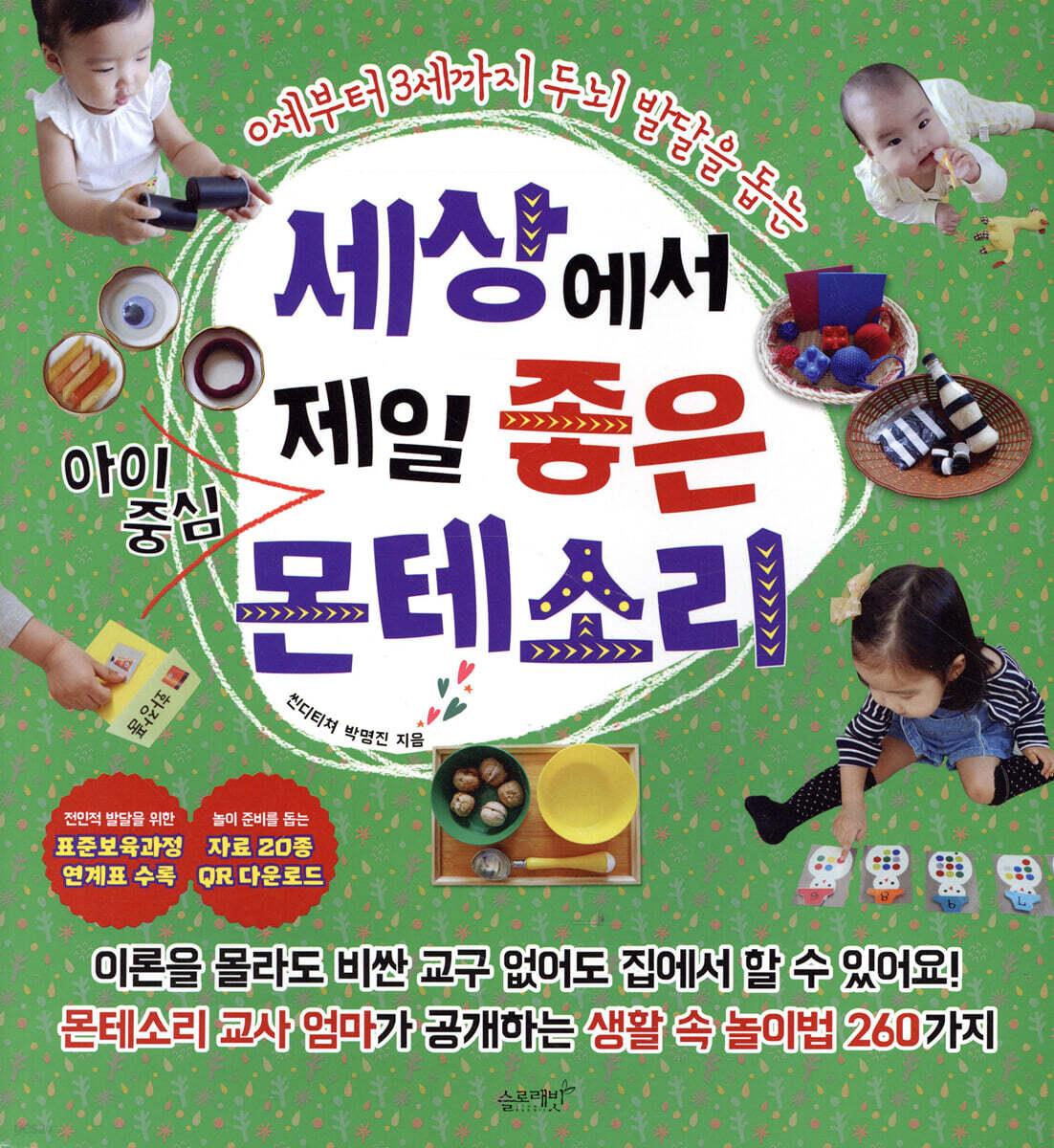
The world's best child-centered Montessori
 |
Description
Book Introduction
You can do it at home without knowing the theory or expensive equipment.
260 Fun Ways to Play in Everyday Life, Revealed by a Montessori Teacher Mom Experience the critical period of brain development for children ages 0 to 3 with Montessori! Montessori education helps children satisfy their curiosity by choosing what they like and guides them to explore the world using various senses. Although Montessori is receiving more attention these days as play-centered and child-centered parenting is emphasized, many parents are hesitant to start due to the preconceived notion that it is difficult to do at home and expensive. No need to worry. Children learn from everything and at every moment, so anyone can start Montessori at home without knowing the theory or having expensive teaching materials. "The World's Best Child-Centered Montessori" was written by a veteran kindergarten teacher who majored in early childhood education and holds Montessori International Teacher Certification, while actually playing with her own child. Unlike commercially available translations or theory-oriented textbooks, it contains vivid step-by-step photos from preparation of teaching materials to the play process. It contains over 260 play methods that can be easily tried in daily life, and for readers who are at a loss as to how to proceed with the play, it also provides conversation methods that will arouse the child's curiosity and interest, thereby increasing usability. Necessary images and audio sources can also be used via QR codes, reducing preparation time for play. How should we navigate the critical period of brain development between ages 0 and 3? Find the answers in this book. |
- You can preview some of the book's contents.
Preview
index
Introduction_Experience the critical period for children aged 0-3 with Montessori.
Five Key Keywords of Montessori Education
Setting up the parish
Frequently Asked Questions
How to use this book
01.
Daily life area
Turning in a hula hoop | Lying down and touching a zip-lock bag | Pulling a sock from a toilet paper roll | Pulling a handkerchief from a plastic bottle | Pulling a shower ball from a mug | Pulling a skewer from a shower ball | Pulling a ribbon from a basket | Pulling a ribbon from a straw cup | Pulling a golf tee from a box | Pulling tape | Pulling a hair roller from a film can | Pulling a cap hanging from a string | Taking a bottle cap off a powdered milk container | Taking an object off a box of chocolates | Taking a hair roller off | Pulling through a string | Tear paper by pulling | Putting a ball into a container | Opening a pot lid | Opening a ring box | Pulling open a cylindrical container | Moving a ball by hand | Putting a hook on and off a toilet paper holder | Putting a bottle cap on a baby bottle | Pushing a pom-pom into a hole | Putting a skewer in a straw cup | Putting a jam lid in a box | Putting a curtain hook in a yogurt container | Putting a button in a piggy bank | Putting a bell in a glass bottle | Putting pasta in a funnel | Walking along a line | Carrying a tray | Threading pencil grips onto skewers | Threading cotton swabs onto straws | Tear off pom-poms and place them in straw cups | Transferring duck dolls with a ladle | Transferring walnuts with an ice cream scoop
Transferring beans with a spoon | Transferring pom-poms with tongs | Opening lids by twisting them | Pour dry things | Pour rice with a funnel | Pour water with a funnel | Setting the table | Setting food with flyers | Using a broom | Practice brushing teeth | Folding a handkerchief | Putting hairpins in | Preparing meals | Taking care of myself | Learning everyday manners | Helping with housework
02.
sensory area
Experience black and white | Shake a rain stick | Shake a plastic bottle maracas | Explore a sensory dice | Explore a sensory finger | Explore a basket | Explore a curiosity pocket | Shake a film can shaker | Explore a lid | Open and close a wet tissue lid sensory board | Experience an object permanence box | Take out a shape puzzle | Touch beans | Find and put together a puzzle in rice | Explore ice | Open and close a pot lid | Open and close an airtight container | Shake a plastic bottle with a marble | Experience colors and shapes with cellophane | Sorting three colors | Experience the same color | Inserting three-color sticks | Inserting four-color spoons | Inserting five-color pom-poms | Hanging card rings by color | Matching two-dimensional and three-dimensional shapes | Completing a shape | Attaching lids of the same shape | Closing lids with same-shaped ones | Putting them together according to size | Comparing the sizes of Matryoshka dolls | Experience three different lengths | Sorting lengths | Predicting objects in plastic | Experience weight | Fitting tactile sticks | Learning tactile expressions |
Tactile Matching | Pick Out the Same Items | Color Puzzle | Shape Sticker Play | Find the Color of the Animal | Role-Play with Shape Money
03.
Number area
Matching ice trays and blocks | Matching toilet paper rolls and ping-pong balls | Matching chocolate boxes and pom-poms | Placing rocks as many as the number of bottle caps from 1 to 5 | Threading skewers as many as the number from 1 to 5 | Learning numbers from 1 to 5 | Finding numbers from 1 to 5 | Matching number blocks from 1 to 5 | Stamping as many stamps as the number from 1 to 5 | Placing blocks as many as the number from 1 to 6 | Threading number rings from 1 to 5 | Moving as many as the number of dice dots | Finding lids with the same number from 1 to 10 | Connecting numbers and quantities from 6 to 10 ① | Connecting numbers and quantities from 6 to 10 ② | Connecting number puzzles from 1 to 10 | Placing rocks as many as the number from 1 to 10 | Dividing and collecting numbers | Experiencing the whole and the part
04.
Language area
Learning words with a 3-step teaching method | Listen to the names of objects and find them | Classify 2-3 types | Classify 4 types | Match large objects and small objects | Match objects with objects | Match objects with pictures | Match pictures with pictures | Match pictures of the same flower | Match shadows | Match outlines | Match animal sounds | Act according to directions | Draw shapes | Match opposites | Classify by topic | Match patterns | Find missing objects
05.
cultural area
Look in the mirror | Know the names of the body parts | Look at family photos | Sort my belongings | Put together a face puzzle | Talk while looking at emotion cards | Talk while looking at growth books | Introduce animals | Listen to animal sounds | Know the appearance of animals | Know the characteristics of animals | Classify animal patterns | Know where animals live | Observe plants | Know the components of the Earth | Connect objects according to the weather | Put together a national flag puzzle | Attach and remove magnets | Experience magnets | Observe things that float and sink | Put stickers | Complete a picture with stickers | Explore clay | Mix paint with a brush | Apply paint with a cotton swab | Make a decalcomania | Use glue and scissors
supplement.
Recommended age-specific play and standard childcare curriculum
Five Key Keywords of Montessori Education
Setting up the parish
Frequently Asked Questions
How to use this book
01.
Daily life area
Turning in a hula hoop | Lying down and touching a zip-lock bag | Pulling a sock from a toilet paper roll | Pulling a handkerchief from a plastic bottle | Pulling a shower ball from a mug | Pulling a skewer from a shower ball | Pulling a ribbon from a basket | Pulling a ribbon from a straw cup | Pulling a golf tee from a box | Pulling tape | Pulling a hair roller from a film can | Pulling a cap hanging from a string | Taking a bottle cap off a powdered milk container | Taking an object off a box of chocolates | Taking a hair roller off | Pulling through a string | Tear paper by pulling | Putting a ball into a container | Opening a pot lid | Opening a ring box | Pulling open a cylindrical container | Moving a ball by hand | Putting a hook on and off a toilet paper holder | Putting a bottle cap on a baby bottle | Pushing a pom-pom into a hole | Putting a skewer in a straw cup | Putting a jam lid in a box | Putting a curtain hook in a yogurt container | Putting a button in a piggy bank | Putting a bell in a glass bottle | Putting pasta in a funnel | Walking along a line | Carrying a tray | Threading pencil grips onto skewers | Threading cotton swabs onto straws | Tear off pom-poms and place them in straw cups | Transferring duck dolls with a ladle | Transferring walnuts with an ice cream scoop
Transferring beans with a spoon | Transferring pom-poms with tongs | Opening lids by twisting them | Pour dry things | Pour rice with a funnel | Pour water with a funnel | Setting the table | Setting food with flyers | Using a broom | Practice brushing teeth | Folding a handkerchief | Putting hairpins in | Preparing meals | Taking care of myself | Learning everyday manners | Helping with housework
02.
sensory area
Experience black and white | Shake a rain stick | Shake a plastic bottle maracas | Explore a sensory dice | Explore a sensory finger | Explore a basket | Explore a curiosity pocket | Shake a film can shaker | Explore a lid | Open and close a wet tissue lid sensory board | Experience an object permanence box | Take out a shape puzzle | Touch beans | Find and put together a puzzle in rice | Explore ice | Open and close a pot lid | Open and close an airtight container | Shake a plastic bottle with a marble | Experience colors and shapes with cellophane | Sorting three colors | Experience the same color | Inserting three-color sticks | Inserting four-color spoons | Inserting five-color pom-poms | Hanging card rings by color | Matching two-dimensional and three-dimensional shapes | Completing a shape | Attaching lids of the same shape | Closing lids with same-shaped ones | Putting them together according to size | Comparing the sizes of Matryoshka dolls | Experience three different lengths | Sorting lengths | Predicting objects in plastic | Experience weight | Fitting tactile sticks | Learning tactile expressions |
Tactile Matching | Pick Out the Same Items | Color Puzzle | Shape Sticker Play | Find the Color of the Animal | Role-Play with Shape Money
03.
Number area
Matching ice trays and blocks | Matching toilet paper rolls and ping-pong balls | Matching chocolate boxes and pom-poms | Placing rocks as many as the number of bottle caps from 1 to 5 | Threading skewers as many as the number from 1 to 5 | Learning numbers from 1 to 5 | Finding numbers from 1 to 5 | Matching number blocks from 1 to 5 | Stamping as many stamps as the number from 1 to 5 | Placing blocks as many as the number from 1 to 6 | Threading number rings from 1 to 5 | Moving as many as the number of dice dots | Finding lids with the same number from 1 to 10 | Connecting numbers and quantities from 6 to 10 ① | Connecting numbers and quantities from 6 to 10 ② | Connecting number puzzles from 1 to 10 | Placing rocks as many as the number from 1 to 10 | Dividing and collecting numbers | Experiencing the whole and the part
04.
Language area
Learning words with a 3-step teaching method | Listen to the names of objects and find them | Classify 2-3 types | Classify 4 types | Match large objects and small objects | Match objects with objects | Match objects with pictures | Match pictures with pictures | Match pictures of the same flower | Match shadows | Match outlines | Match animal sounds | Act according to directions | Draw shapes | Match opposites | Classify by topic | Match patterns | Find missing objects
05.
cultural area
Look in the mirror | Know the names of the body parts | Look at family photos | Sort my belongings | Put together a face puzzle | Talk while looking at emotion cards | Talk while looking at growth books | Introduce animals | Listen to animal sounds | Know the appearance of animals | Know the characteristics of animals | Classify animal patterns | Know where animals live | Observe plants | Know the components of the Earth | Connect objects according to the weather | Put together a national flag puzzle | Attach and remove magnets | Experience magnets | Observe things that float and sink | Put stickers | Complete a picture with stickers | Explore clay | Mix paint with a brush | Apply paint with a cotton swab | Make a decalcomania | Use glue and scissors
supplement.
Recommended age-specific play and standard childcare curriculum
Detailed image

Publisher's Review
How are you spending the critical period of brain development between the ages of 0 and 3?
Experience the wondrous moments of development with Cindy Teacher's Montessori!
Mom! Help me do it myself!
For infants and toddlers, the day goes by in a flash just by feeding, bathing, and putting them to bed.
Fortunately, children learn the skills they need from everything they see, hear, and touch, even without special instruction.
Maria Montessori called this special potential the "absorbent mind."
Especially from birth to age 3, children unconsciously absorb and learn like a sponge. By closely observing what their child is interested in and providing appropriate stimulation, you can help their development.
The child is growing on his own and is constantly talking.
'Mom! Help me do it myself!'
You can achieve Montessori's goals even if you don't have a well-made curriculum!
For a time, Montessori was considered the parish itself, to the point that the image that comes to mind when thinking of 'Montessori' is the expensive wooden parishes lined up in the parish hall.
Cindy Teacher, who shared on Instagram about practicing Montessori with her child using everyday materials that are easy to find, was also bombarded with questions about whether Montessori is possible without specialized teaching aids and whether play goals can be achieved.
The answer is “Absolutely Yes!” Cindy Teacher’s four-year-old, who grew up with Montessori play, and countless mothers who followed Cindy Teacher’s play, prove it.
Prepare for balanced development in daily life, senses, numbers, language, and culture!
This book contains over 260 games, spanning a daily life area where children learn the skills needed for everyday life, a sensory area that builds the foundation for learning ability, a math area that helps develop mathematical thinking, a language area that cultivates four language skills, and a cultural area that explores the world around them.
Depending on the child's developmental level and the resources available to each family, it can be transformed and expanded into hundreds or thousands of different types of play.
Rather than preparing a new parish every time, it is better to gradually build new concepts by modifying familiar ones, which is better for expanding a child's thinking.
The theory is brief and only the key points are covered, and the play method is carefully covered!
A veteran teacher who majored in early childhood education and worked at a Montessori kindergarten wrote this book while playing Montessori games with her own child, so it contains professional and vivid Montessori play know-how.
Instead of simply summarizing the theory with only the essentials, each play introduction carefully includes all the information needed for the play, including materials, how to make the teaching aids, activity methods, and conversations with the child, along with photos.
Get started today with these readily available, everyday materials to provide the right stimulation at the critical times when your child shows interest!
Experience the wondrous moments of development with Cindy Teacher's Montessori!
Mom! Help me do it myself!
For infants and toddlers, the day goes by in a flash just by feeding, bathing, and putting them to bed.
Fortunately, children learn the skills they need from everything they see, hear, and touch, even without special instruction.
Maria Montessori called this special potential the "absorbent mind."
Especially from birth to age 3, children unconsciously absorb and learn like a sponge. By closely observing what their child is interested in and providing appropriate stimulation, you can help their development.
The child is growing on his own and is constantly talking.
'Mom! Help me do it myself!'
You can achieve Montessori's goals even if you don't have a well-made curriculum!
For a time, Montessori was considered the parish itself, to the point that the image that comes to mind when thinking of 'Montessori' is the expensive wooden parishes lined up in the parish hall.
Cindy Teacher, who shared on Instagram about practicing Montessori with her child using everyday materials that are easy to find, was also bombarded with questions about whether Montessori is possible without specialized teaching aids and whether play goals can be achieved.
The answer is “Absolutely Yes!” Cindy Teacher’s four-year-old, who grew up with Montessori play, and countless mothers who followed Cindy Teacher’s play, prove it.
Prepare for balanced development in daily life, senses, numbers, language, and culture!
This book contains over 260 games, spanning a daily life area where children learn the skills needed for everyday life, a sensory area that builds the foundation for learning ability, a math area that helps develop mathematical thinking, a language area that cultivates four language skills, and a cultural area that explores the world around them.
Depending on the child's developmental level and the resources available to each family, it can be transformed and expanded into hundreds or thousands of different types of play.
Rather than preparing a new parish every time, it is better to gradually build new concepts by modifying familiar ones, which is better for expanding a child's thinking.
The theory is brief and only the key points are covered, and the play method is carefully covered!
A veteran teacher who majored in early childhood education and worked at a Montessori kindergarten wrote this book while playing Montessori games with her own child, so it contains professional and vivid Montessori play know-how.
Instead of simply summarizing the theory with only the essentials, each play introduction carefully includes all the information needed for the play, including materials, how to make the teaching aids, activity methods, and conversations with the child, along with photos.
Get started today with these readily available, everyday materials to provide the right stimulation at the critical times when your child shows interest!
GOODS SPECIFICS
- Date of issue: January 25, 2021
- Page count, weight, size: 208 pages | 600g | 220*240*11mm
- ISBN13: 9791186494622
- ISBN10: 118649462X
- KC Certification: Certification Type: Conformity Confirmation
You may also like
카테고리
korean


korean

![GQ KOREA Mark (Monthly): December [2025]](http://librairie.coreenne.fr/cdn/shop/files/8ef265dbbfbf186523ed75ba7319009d.jpg?v=1765340328&width=3840)


