

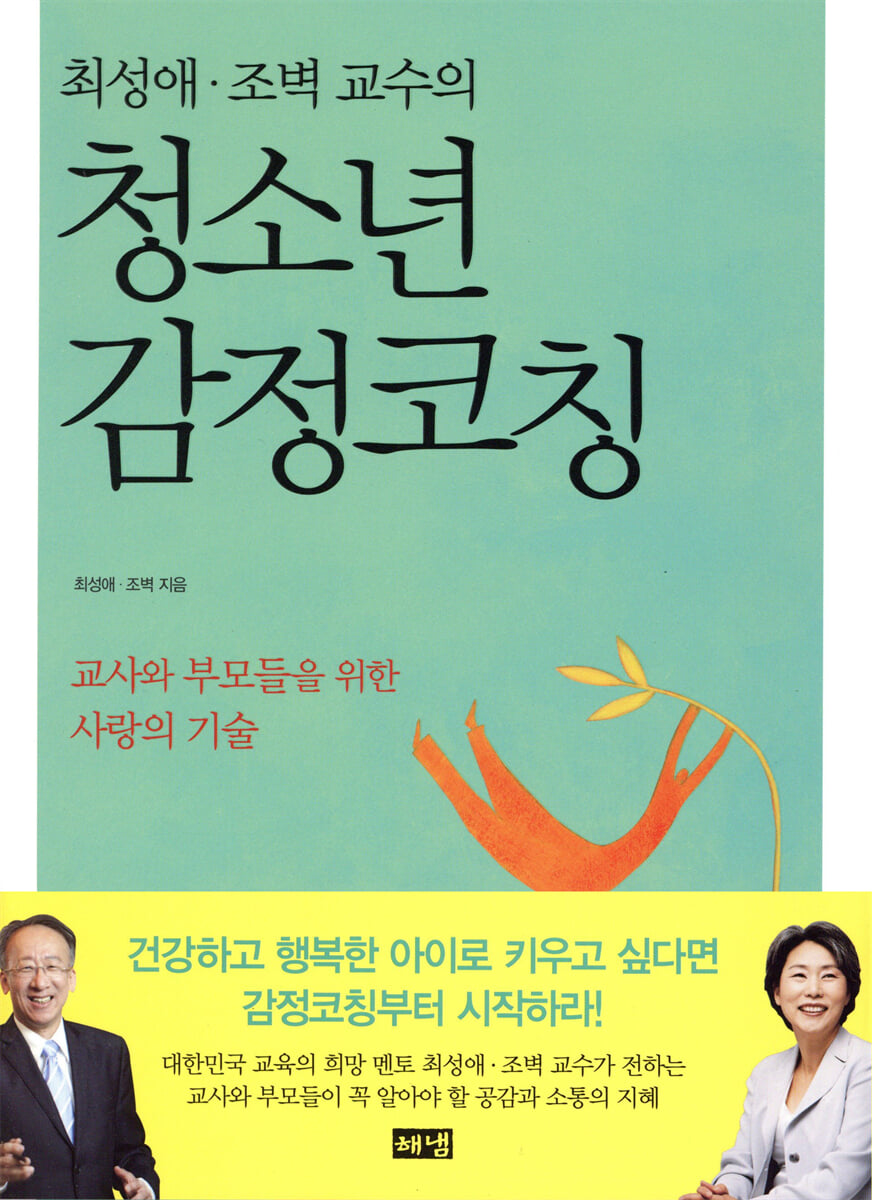
Youth Emotional Coaching
 |
Description
Book Introduction
The youth of South Korea are sick these days.
It is also heartbreaking for teachers and parents to see them easily irritated, depressed, and listless.
How can we raise our youth to be truly healthy and happy? Can we restore the relationship between teachers and parents? Dr. Choi Seong-ae, Korea's leading psychotherapy expert, and Professor Cho Byeok, a world-renowned teaching method expert, present essential emotional coaching know-how for teachers and parents to restore the character of youth and revive their dreams. Emotion coaching, pioneered by child psychologist Dr. Haim Ginert and systematized by Dr. John Gottman, Professor Emeritus of Psychology at the University of Washington, through 30 years of relationship research, is a relationship technique that "empathizes with a child's feelings while setting clear limits on their behavior and guiding them in a desirable direction."
Why do Korean youth need emotional coaching? Because during adolescence, a period of unstable brain and physical development, children who receive emotional coaching can regulate their emotions, reduce stress, and develop positive problem-solving skills.
Additionally, children who regain positivity and self-esteem through emotional coaching have increased concentration, improved academic performance, and are able to develop their true selves and function smoothly in society.
In particular, Dr. Choi Seong-ae, a Gottman Certified Therapist, is a leading authority on emotional coaching and has implemented it in psychological counseling and various healing programs for at-risk youth, verifying its effectiveness and necessity.
Professor Cho Byeok has been suggesting the direction we should take for the future of our youth and the future of our education, as well as strategies for implementing them, and has argued that the restoration of character is more urgent than private education.
The two authors emphasize that 'emotional coaching' is the most necessary measure for our youth, who are crushed by the overheated competition for college entrance.
It is also heartbreaking for teachers and parents to see them easily irritated, depressed, and listless.
How can we raise our youth to be truly healthy and happy? Can we restore the relationship between teachers and parents? Dr. Choi Seong-ae, Korea's leading psychotherapy expert, and Professor Cho Byeok, a world-renowned teaching method expert, present essential emotional coaching know-how for teachers and parents to restore the character of youth and revive their dreams. Emotion coaching, pioneered by child psychologist Dr. Haim Ginert and systematized by Dr. John Gottman, Professor Emeritus of Psychology at the University of Washington, through 30 years of relationship research, is a relationship technique that "empathizes with a child's feelings while setting clear limits on their behavior and guiding them in a desirable direction."
Why do Korean youth need emotional coaching? Because during adolescence, a period of unstable brain and physical development, children who receive emotional coaching can regulate their emotions, reduce stress, and develop positive problem-solving skills.
Additionally, children who regain positivity and self-esteem through emotional coaching have increased concentration, improved academic performance, and are able to develop their true selves and function smoothly in society.
In particular, Dr. Choi Seong-ae, a Gottman Certified Therapist, is a leading authority on emotional coaching and has implemented it in psychological counseling and various healing programs for at-risk youth, verifying its effectiveness and necessity.
Professor Cho Byeok has been suggesting the direction we should take for the future of our youth and the future of our education, as well as strategies for implementing them, and has argued that the restoration of character is more urgent than private education.
The two authors emphasize that 'emotional coaching' is the most necessary measure for our youth, who are crushed by the overheated competition for college entrance.
- You can preview some of the book's contents.
Preview
index
Prologue: Dreaming of a harmonious family, a vibrant school, and a healthy society
Part 1: The Best Gift to Give Your Child: Emotional Coaching
Chapter 1: Accept feelings, but limit actions.
Chapter 2: The Art of Trust: Opening a Child's Heart
Chapter 3: Emotional Coaching: 21st Century Survival: Improving Emotional Intelligence
Part 2: Secrets of the Adolescent Brain That Teachers and Parents Don't Know
Chapter 4: It's normal for adolescents to experience emotional ups and downs.
Chapter 5: Korean youth are a bundle of stress
Chapter 6: Match Your Child's Emotional Level
Part 3: Before looking into a child's heart, look into your own.
Chapter 7: What Type of Teacher/Parent Am I?
Chapter 8: A Child's Behavior Is a Mirror Reflecting Me
Chapter 9: See the Roots of Your Emotions When Dealing with Children
Chapter 10: Don't pass on my wounds
Chapter 11: From ‘I have to do it’ to ‘I want to do it’
Chapter 12: Control Your Emotions in Any Situation
Part 4: Happy Communication with Your Child: 5 Steps to Emotional Coaching
Chapter 13: Emotion Coaching Step 1: Capturing Your Emotions
Chapter 14: Emotional Coaching Step 2: The stronger your emotions, the better the opportunity.
Chapter 15: Emotional Coaching Step 3: Listen to and Empathize with Emotions
Chapter 16: Emotion Coaching Step 4: Name Your Emotions
Chapter 17: Emotion Coaching: Step 5: Leading to Desirable Behavior
Chapter 18: Emotional Coaching through Role Play
Part 5: What You Need to Know for Effective Emotional Coaching
Chapter 19: There Are Times When You Shouldn't Eavesdrop
Chapter 20: Understanding Your Child's Temperament
Chapter 21: Follow Your Child's Developmental Stages
Chapter 22: Look at the child's home environment
Chapter 23: Check Your Child's Attachment Status
Chapter 24: Play that heals attachment damage
Part 6: Children in Crisis: How to Emotionally Coach Them
Chapter 25: Children with Post-Traumatic Stress Disorder
Chapter 26: Children with Attention Deficit Hyperactivity Disorder
Chapter 27: Children Exposed to School Violence and Group Bullying
Chapter 28: Children with Learning Disabilities
Part 7: To plant hope in the future of our youth
Chapter 29: All Children Have Psychological Immunity
Chapter 30: Playing with Children in the Classroom and at Home
Epilogue: Anyone Can Become an Emotionally Coachable Person
Part 1: The Best Gift to Give Your Child: Emotional Coaching
Chapter 1: Accept feelings, but limit actions.
Chapter 2: The Art of Trust: Opening a Child's Heart
Chapter 3: Emotional Coaching: 21st Century Survival: Improving Emotional Intelligence
Part 2: Secrets of the Adolescent Brain That Teachers and Parents Don't Know
Chapter 4: It's normal for adolescents to experience emotional ups and downs.
Chapter 5: Korean youth are a bundle of stress
Chapter 6: Match Your Child's Emotional Level
Part 3: Before looking into a child's heart, look into your own.
Chapter 7: What Type of Teacher/Parent Am I?
Chapter 8: A Child's Behavior Is a Mirror Reflecting Me
Chapter 9: See the Roots of Your Emotions When Dealing with Children
Chapter 10: Don't pass on my wounds
Chapter 11: From ‘I have to do it’ to ‘I want to do it’
Chapter 12: Control Your Emotions in Any Situation
Part 4: Happy Communication with Your Child: 5 Steps to Emotional Coaching
Chapter 13: Emotion Coaching Step 1: Capturing Your Emotions
Chapter 14: Emotional Coaching Step 2: The stronger your emotions, the better the opportunity.
Chapter 15: Emotional Coaching Step 3: Listen to and Empathize with Emotions
Chapter 16: Emotion Coaching Step 4: Name Your Emotions
Chapter 17: Emotion Coaching: Step 5: Leading to Desirable Behavior
Chapter 18: Emotional Coaching through Role Play
Part 5: What You Need to Know for Effective Emotional Coaching
Chapter 19: There Are Times When You Shouldn't Eavesdrop
Chapter 20: Understanding Your Child's Temperament
Chapter 21: Follow Your Child's Developmental Stages
Chapter 22: Look at the child's home environment
Chapter 23: Check Your Child's Attachment Status
Chapter 24: Play that heals attachment damage
Part 6: Children in Crisis: How to Emotionally Coach Them
Chapter 25: Children with Post-Traumatic Stress Disorder
Chapter 26: Children with Attention Deficit Hyperactivity Disorder
Chapter 27: Children Exposed to School Violence and Group Bullying
Chapter 28: Children with Learning Disabilities
Part 7: To plant hope in the future of our youth
Chapter 29: All Children Have Psychological Immunity
Chapter 30: Playing with Children in the Classroom and at Home
Epilogue: Anyone Can Become an Emotionally Coachable Person
Into the book
Practical tips for teachers and parents to truly empathize with children and raise them with love.
If memory, perception, reasoning, and calculation, commonly represented by IQ, are the power of the head, then empathy, communication, understanding, emotional expression, and the ability to deal with relationships can be called emotional intelligence, which is the 'power of the heart.'
It is the ability to recognize, express, and regulate one's own emotions, and to read and empathize with the emotions of others.
Research has shown that people with high emotional intelligence are happier, more successful, healthier, and more influential to others.
This emotional intelligence is also very important for children and adolescents.
But unfortunately, many teenagers today are emotionally exhausted.
One of the most common phrases used at an age when we should be lively and joyful is “I’m so annoyed!”
It is not just the children's fault, but rather a problem with the overall environment, including home, education, and society.
These days, children are burdened with all kinds of stress, including studying and competition, from a young age, and they lack opportunities or experiences to become emotionally enriched.
The good news is that there is hope for emotional fulfillment for these children through emotional coaching.
― From [Chapter 3: 21st Century Survival: Emotional Coaching to Increase Emotional Intelligence]
The frontal lobe, which controls thinking, judgment, planning, impulse control, and emotional regulation, undergoes extensive remodeling and expansion during adolescence.
If we use a house analogy, it can be seen as expanding a 20-pyeong apartment to 100 pyeong.
Why the expansion? By the fourth grade, even with a partially developed frontal lobe, commuting to and from school is no problem. However, as an adult, dealing with the complexities of politics, economics, society, and culture, a 65-square-foot house simply isn't enough.
So, the expansion of the frontal lobe takes place throughout adolescence, and is not fully completed until around age twenty-four for women and thirty for men.
During adolescence, it's normal to feel a bit cluttered and confused, like a house under construction.
As the expansion takes place, the network of brain cells is overproduced, and connections between neurons and synapses occur in great numbers and at a very rapid rate.
As the network becomes over-produced, gray matter doubles in a year, and there are too many synapses connecting neurons, making it difficult to think multi-facetedly.
― [Chapter 4: It is normal for adolescents to have severe emotional ups and downs]
The reductive parent: The child doesn't know what he or she really wants.
Children who grow up under parents and teachers who are reductive and lenient often feel confused and wonder, "My mom says it's okay, but why am I not okay?"
I don't think emotions like sadness or anger are to be trusted.
Suppressive parent: The child is uncomfortable expressing emotions.
Children who grow up with oppressive teachers and parents learn that some emotions are good and some are bad.
So when we feel 'bad' emotions like being sad or angry, we think we are a bad person.
Bystander Parent: Thinks it's okay for the child to behave however they want.
Children who grow up with permissive teachers and parents feel and accept that whatever their feelings are, they are okay.
So far so good.
But there is a side effect of learning that it's okay to act however you want when you feel strong emotions.
Emotion Coaching Parents: Children learn to distinguish between emotions and behaviors.
Children who grow up receiving emotional coaching learn that emotions are valuable and trustworthy.
I believe that other people's feelings are just as precious as my own.
I know and feel a wide range of emotions.
― [Chapter 8: A Child's Behavior is a Mirror Reflecting Me]
To develop into an emotionally coaching parent, you must first understand your own superemotions.
Meta-emotion, simply put, is 'emotion about emotion'.
For example, if a child is crying because he is sad, that is the emotion called 'sadness'.
However, when parents see their child sad, their feelings toward the child's emotions (sadness) are super-emotional.
Parents may feel angry, upset, or embarrassed about making their child cry in front of others.
Some parents may feel frustrated or regretful that they are not able to provide enough care or satisfaction to their children.
Parents can feel a variety of emotions regarding their crying child's emotions, and this is called 'super-emotion'.
My son, now in middle school, is throwing a tantrum and asking to buy me a smartphone.
So my parents were a little upset.
But when I think about it for a moment, I feel a little sad.
You may feel sad thinking, 'Why does my child only ask for expensive things?' and you may feel resentful toward your husband, who does not have much income, because he cannot buy the things his child asks for due to lack of money.
You might be wondering, 'Why didn't my parents give me emotional coaching and make me feel so uncomfortable in emotional situations?'
Or you may feel sorry or regretful for getting angry and yelling.
In this way, feelings about one's own feelings are also super-emotions.
― [Chapter 9: Look at the Roots of Your Emotions When Dealing with Children]
The stronger the emotions your child displays, the better the opportunity for emotion coaching.
When your pet passes away, when your grades are bad, when you are bullied by your friends, you will have strong emotions.
Adults may think, 'What's so great about that?', but for children, it may be the first shocking thing they've ever experienced in their lives and the first time they've felt such strong emotions.
The stronger the emotions a child experiences, the more powerful the hyper-emotional response can be for parents and teachers.
So you can react strongly.
However, if an adult reacts strongly in a situation where a child is experiencing strong emotions, such as “What’s wrong with you?” “Can’t you be quiet?” or “Why are you doing that!”, the child will feel anxious or fearful and show more intense flight or attack responses.
If you provide emotional coaching at this time, you can activate the frontal lobe, which helps you understand and process emotions more slowly.
It is about adults responding gently and calmly to make the child feel safe.
When you feel that your feelings are respected and understood, you feel more secure, and you are able to think and judge more freely and consider desirable alternatives.
― [Chapter 14 Emotional Coaching Step 2: The stronger the emotion expressed, the better the opportunity]
Emotional coaching is not always effective in all situations.
There are times when you shouldn't do it.
It's best not to do emotional coaching when you're pressed for time or have an audience.
If you try to force emotional coaching when you don't have time due to classes, counseling, and various reports, and the student is just starting to open up, you shouldn't say, "Oh, I'm a little busy right now... Let's stop now."
Also, it is best not to do emotional coaching when other people are present.
For example, if a student shows strong emotions in class and you try to talk to them on the spot, both the student and the teacher will become conscious of the other students in the classroom.
It is also best not to do emotional coaching when teachers and parents are very emotional or when relationships with others are not going well.
When you have trouble managing your own emotions, you are overwhelmed by them and don't have the capacity to coach others' emotions.
In such cases, you must calm yourself down first.
You need to calm yourself down and achieve a positive state of mind or at least emotional neutrality before doing emotional coaching.
Additionally, it is best not to provide emotional coaching to parents or teachers in situations where the child's relationship with others is very bad.
For example, if you are feeling extremely bad after a fight with your spouse, it may be dangerous to give your child emotional coaching.
― [Chapter 19 There are times when you should not do emotional coaching]
Emotional coaching is a 'process' that goes through five stages.
A process has a beginning (starting point) and an end (destination).
The end result of emotional coaching is desirable behavior that takes into account the child's developmental stage.
To get to the end well, you must first know your starting point.
The starting point is knowing the child's environment.
When doing emotional coaching, you shouldn't just go through steps 3 and 4 and then move on to step 5.
Repeat steps 3 and 4 several times, empathizing with the child's feelings, and waiting for the child to speak.
Only after listening to the child's circumstances and truly understanding them can we move on to step 5 and guide them toward desirable behaviors that they can empathize with and agree with.
One thing that can significantly shorten this process is knowing the environment your child is in.
This is because a child's emotions and behavior are largely a result of the child's environment (especially the home environment).
In the past, when we talked about family environment, we mainly thought about whether the family was rich or poor.
We also conducted a survey on the home environment, asking questions such as whether there was a television or a refrigerator.
So, while in the past environmental differences were mainly due to economic levels, things are different these days.
Family environments vary greatly depending on whether they are emotionally rich or poor.
The emotional state of children varies depending on how harmonious the couple is and how much they conflict and hate each other.
― [See Chapter 22: The Child's Home Environment]
ADHD, violence, bullying… … focusing only on the “problem” can backfire or cause bigger problems.
If you keep focusing on your children's negative 'behaviors', you will only get stronger negative 'feelings'.
It gets into a vicious cycle.
When dealing with students with learning difficulties, if you focus only on the problem, it will be difficult to break out of the vicious cycle.
When dealing with students with learning difficulties, people often think that learning coaching is needed rather than emotional coaching.
Since most teachers were top students in school, it may be difficult for them to empathize with the feelings and emotions of underachievers.
You might also think that emotionally approaching a student who is struggling with studying, a highly cognitive activity, will not improve their grades.
Children who dislike studying and do poorly at it are not just inefficient learners or have difficulty learning.
Whether it's post-traumatic stress disorder, attachment issues, depression, or stress, the brain circuits that absorb, process, and remember information are often underdeveloped.
Therefore, teachers must first understand the various reasons for learning difficulties and understand children's emotions.
Only then can we provide you with the help you need.
― From [Chapter 28 Children with Learning Difficulties]
If memory, perception, reasoning, and calculation, commonly represented by IQ, are the power of the head, then empathy, communication, understanding, emotional expression, and the ability to deal with relationships can be called emotional intelligence, which is the 'power of the heart.'
It is the ability to recognize, express, and regulate one's own emotions, and to read and empathize with the emotions of others.
Research has shown that people with high emotional intelligence are happier, more successful, healthier, and more influential to others.
This emotional intelligence is also very important for children and adolescents.
But unfortunately, many teenagers today are emotionally exhausted.
One of the most common phrases used at an age when we should be lively and joyful is “I’m so annoyed!”
It is not just the children's fault, but rather a problem with the overall environment, including home, education, and society.
These days, children are burdened with all kinds of stress, including studying and competition, from a young age, and they lack opportunities or experiences to become emotionally enriched.
The good news is that there is hope for emotional fulfillment for these children through emotional coaching.
― From [Chapter 3: 21st Century Survival: Emotional Coaching to Increase Emotional Intelligence]
The frontal lobe, which controls thinking, judgment, planning, impulse control, and emotional regulation, undergoes extensive remodeling and expansion during adolescence.
If we use a house analogy, it can be seen as expanding a 20-pyeong apartment to 100 pyeong.
Why the expansion? By the fourth grade, even with a partially developed frontal lobe, commuting to and from school is no problem. However, as an adult, dealing with the complexities of politics, economics, society, and culture, a 65-square-foot house simply isn't enough.
So, the expansion of the frontal lobe takes place throughout adolescence, and is not fully completed until around age twenty-four for women and thirty for men.
During adolescence, it's normal to feel a bit cluttered and confused, like a house under construction.
As the expansion takes place, the network of brain cells is overproduced, and connections between neurons and synapses occur in great numbers and at a very rapid rate.
As the network becomes over-produced, gray matter doubles in a year, and there are too many synapses connecting neurons, making it difficult to think multi-facetedly.
― [Chapter 4: It is normal for adolescents to have severe emotional ups and downs]
The reductive parent: The child doesn't know what he or she really wants.
Children who grow up under parents and teachers who are reductive and lenient often feel confused and wonder, "My mom says it's okay, but why am I not okay?"
I don't think emotions like sadness or anger are to be trusted.
Suppressive parent: The child is uncomfortable expressing emotions.
Children who grow up with oppressive teachers and parents learn that some emotions are good and some are bad.
So when we feel 'bad' emotions like being sad or angry, we think we are a bad person.
Bystander Parent: Thinks it's okay for the child to behave however they want.
Children who grow up with permissive teachers and parents feel and accept that whatever their feelings are, they are okay.
So far so good.
But there is a side effect of learning that it's okay to act however you want when you feel strong emotions.
Emotion Coaching Parents: Children learn to distinguish between emotions and behaviors.
Children who grow up receiving emotional coaching learn that emotions are valuable and trustworthy.
I believe that other people's feelings are just as precious as my own.
I know and feel a wide range of emotions.
― [Chapter 8: A Child's Behavior is a Mirror Reflecting Me]
To develop into an emotionally coaching parent, you must first understand your own superemotions.
Meta-emotion, simply put, is 'emotion about emotion'.
For example, if a child is crying because he is sad, that is the emotion called 'sadness'.
However, when parents see their child sad, their feelings toward the child's emotions (sadness) are super-emotional.
Parents may feel angry, upset, or embarrassed about making their child cry in front of others.
Some parents may feel frustrated or regretful that they are not able to provide enough care or satisfaction to their children.
Parents can feel a variety of emotions regarding their crying child's emotions, and this is called 'super-emotion'.
My son, now in middle school, is throwing a tantrum and asking to buy me a smartphone.
So my parents were a little upset.
But when I think about it for a moment, I feel a little sad.
You may feel sad thinking, 'Why does my child only ask for expensive things?' and you may feel resentful toward your husband, who does not have much income, because he cannot buy the things his child asks for due to lack of money.
You might be wondering, 'Why didn't my parents give me emotional coaching and make me feel so uncomfortable in emotional situations?'
Or you may feel sorry or regretful for getting angry and yelling.
In this way, feelings about one's own feelings are also super-emotions.
― [Chapter 9: Look at the Roots of Your Emotions When Dealing with Children]
The stronger the emotions your child displays, the better the opportunity for emotion coaching.
When your pet passes away, when your grades are bad, when you are bullied by your friends, you will have strong emotions.
Adults may think, 'What's so great about that?', but for children, it may be the first shocking thing they've ever experienced in their lives and the first time they've felt such strong emotions.
The stronger the emotions a child experiences, the more powerful the hyper-emotional response can be for parents and teachers.
So you can react strongly.
However, if an adult reacts strongly in a situation where a child is experiencing strong emotions, such as “What’s wrong with you?” “Can’t you be quiet?” or “Why are you doing that!”, the child will feel anxious or fearful and show more intense flight or attack responses.
If you provide emotional coaching at this time, you can activate the frontal lobe, which helps you understand and process emotions more slowly.
It is about adults responding gently and calmly to make the child feel safe.
When you feel that your feelings are respected and understood, you feel more secure, and you are able to think and judge more freely and consider desirable alternatives.
― [Chapter 14 Emotional Coaching Step 2: The stronger the emotion expressed, the better the opportunity]
Emotional coaching is not always effective in all situations.
There are times when you shouldn't do it.
It's best not to do emotional coaching when you're pressed for time or have an audience.
If you try to force emotional coaching when you don't have time due to classes, counseling, and various reports, and the student is just starting to open up, you shouldn't say, "Oh, I'm a little busy right now... Let's stop now."
Also, it is best not to do emotional coaching when other people are present.
For example, if a student shows strong emotions in class and you try to talk to them on the spot, both the student and the teacher will become conscious of the other students in the classroom.
It is also best not to do emotional coaching when teachers and parents are very emotional or when relationships with others are not going well.
When you have trouble managing your own emotions, you are overwhelmed by them and don't have the capacity to coach others' emotions.
In such cases, you must calm yourself down first.
You need to calm yourself down and achieve a positive state of mind or at least emotional neutrality before doing emotional coaching.
Additionally, it is best not to provide emotional coaching to parents or teachers in situations where the child's relationship with others is very bad.
For example, if you are feeling extremely bad after a fight with your spouse, it may be dangerous to give your child emotional coaching.
― [Chapter 19 There are times when you should not do emotional coaching]
Emotional coaching is a 'process' that goes through five stages.
A process has a beginning (starting point) and an end (destination).
The end result of emotional coaching is desirable behavior that takes into account the child's developmental stage.
To get to the end well, you must first know your starting point.
The starting point is knowing the child's environment.
When doing emotional coaching, you shouldn't just go through steps 3 and 4 and then move on to step 5.
Repeat steps 3 and 4 several times, empathizing with the child's feelings, and waiting for the child to speak.
Only after listening to the child's circumstances and truly understanding them can we move on to step 5 and guide them toward desirable behaviors that they can empathize with and agree with.
One thing that can significantly shorten this process is knowing the environment your child is in.
This is because a child's emotions and behavior are largely a result of the child's environment (especially the home environment).
In the past, when we talked about family environment, we mainly thought about whether the family was rich or poor.
We also conducted a survey on the home environment, asking questions such as whether there was a television or a refrigerator.
So, while in the past environmental differences were mainly due to economic levels, things are different these days.
Family environments vary greatly depending on whether they are emotionally rich or poor.
The emotional state of children varies depending on how harmonious the couple is and how much they conflict and hate each other.
― [See Chapter 22: The Child's Home Environment]
ADHD, violence, bullying… … focusing only on the “problem” can backfire or cause bigger problems.
If you keep focusing on your children's negative 'behaviors', you will only get stronger negative 'feelings'.
It gets into a vicious cycle.
When dealing with students with learning difficulties, if you focus only on the problem, it will be difficult to break out of the vicious cycle.
When dealing with students with learning difficulties, people often think that learning coaching is needed rather than emotional coaching.
Since most teachers were top students in school, it may be difficult for them to empathize with the feelings and emotions of underachievers.
You might also think that emotionally approaching a student who is struggling with studying, a highly cognitive activity, will not improve their grades.
Children who dislike studying and do poorly at it are not just inefficient learners or have difficulty learning.
Whether it's post-traumatic stress disorder, attachment issues, depression, or stress, the brain circuits that absorb, process, and remember information are often underdeveloped.
Therefore, teachers must first understand the various reasons for learning difficulties and understand children's emotions.
Only then can we provide you with the help you need.
― From [Chapter 28 Children with Learning Difficulties]
--- From the text
Publisher's Review
If you want to raise a healthy and happy child, start with emotional coaching!
From the unknown brain structure of adolescents to the art of empathetic conversation.
Professors Choi Seong-ae and Jo Byeok share everything you need to know about "emotional coaching" to save your child!
Among OECD countries, South Korea has the highest youth suicide rate, the lowest youth happiness index, and one in four youth suffers from emotional instability... South Korean youth are suffering right now.
The hearts of teachers and parents who look at them depressed and listless are also heavy.
How can we raise our youth to be truly healthy and happy? Can we restore the relationship between teachers and parents?
In this regard, Dr. Choi Seong-ae, Korea's leading psychological therapy expert, and Professor Cho Byeok, a world-renowned teaching method expert, present the know-how of emotional coaching that teachers and parents must know to help teenagers restore their character and revive their dreams in "Youth Emotional Coaching by Choi Seong-ae and Professor Cho Byeok."
Emotion coaching was created by child psychologist Dr. Haim Ginert and systematized by Dr. John Gottman, professor emeritus of psychology at Washington State University, through 30 years of relationship research. It is a relationship technique that 'empathizes with a child's feelings but gives clear limits to their behavior and guides them in a desirable direction.'
Why do Korean youth need emotional coaching? Because during adolescence, a period of unstable brain and physical development, children who receive emotional coaching can regulate their emotions, reduce stress, and develop positive problem-solving skills.
Additionally, children who regain positivity and self-esteem through emotional coaching have increased concentration, improved academic performance, and are able to develop their true selves and function smoothly in society.
In particular, Dr. Choi Seong-ae, a Gottman Certified Therapist, is a leading authority on emotional coaching and has implemented it in psychological counseling and various healing programs for at-risk youth, verifying its effectiveness and necessity.
Professor Cho Byeok has been suggesting the direction we should take for the future of our youth and the future of our education, as well as strategies for implementing them, and has argued that the restoration of character is more urgent than private education.
The two authors emphasize that 'emotional coaching' is the most necessary measure for our youth, who are crushed by the overheated competition for college entrance.
To this end, Dr. Choi Seong-ae and Professor Cho Byeok adapted emotional coaching to the educational reality of Korea and designed it so that teachers and parents could easily follow it.
Above all, the effectiveness and methods of emotional coaching are supported by the latest theories in human development, brain science, heart science, and positive psychology.
We introduce methods to enhance the effectiveness of emotional coaching by incorporating clinical experiences such as therapeutic play and relationship therapy.
It also demonstrates step-by-step practice of emotion coaching through rich classroom and home examples.
The five steps of emotional coaching discussed in this book are as follows:
Steps 1 and 2 are to ask the child how he or she is feeling, to capture his or her emotions, and to consider it as a good opportunity for emotional coaching when emotions are revealed.
Steps 3 and 4 are to first approach the child and listen to their feelings through conversation, then look at their feelings rather than their behavior and empathize with them, and then name their feelings so that they can understand their own feelings.
The final five steps ask you to think of alternatives and guide you toward desirable behavior.
This book, which consists of seven parts, contains the definition and effectiveness of emotional coaching in Part 1.
Part 2 reveals the characteristics of the developing adolescent brain and reveals the causes of adolescent speech and behavior that teachers and parents often misunderstand.
Part 3 helps teachers and parents identify what type of caregiver they are and uncover the unknown sources of emotions when dealing with children.
Part 4 shows the five stages of emotional coaching, and Part 5 explains the essential elements that must be understood for effective emotional coaching, such as children's temperaments and home environments.
Part 6 provides methods for healing and changing at-risk youth suffering from symptoms such as PTSD and ADHD, as well as children who exhibit problem behaviors such as violence and bullying, through emotional coaching.
Part 7 introduces games that can be easily played with children in the classroom or at home to increase the effectiveness of emotional coaching.
At a time when youth problems such as bullying, school violence, and suicide are serious, this book will provide teachers and parents with the know-how to restore fundamental relationships with their children and raise them to be happy and self-respecting.
Furthermore, in a world dominated by books about college entrance exams and improving grades, this book will provide an opportunity to connect with children's hearts, serving as a warm guide for teachers, parents, and those involved in education and youth-related work to create happy classrooms, homes, and societies.
5 Steps to Emotional Coaching
“Look at your students and children’s feelings first, not their actions!”
Emotion Coaching Step 1: Capture Your Emotions
- You need to read the child's emotions before their actions.
- It is important to explore or confirm a child's feelings through conversation before judging them.
Emotional Coaching Step 2: The stronger your emotions, the better the opportunity.
- The stronger the emotions your child shows, the better the opportunity.
- Instead of playing the role of a ‘prosecutor’ who scolds the child for his/her mistakes, you should play the role of a ‘lawyer’ who takes the child’s side.
Step 3 of Emotional Coaching: Listen and Empathize
- You must listen carefully to your child's story, accept it, and empathize with their feelings.
- To be good at acceptance, listening, and empathy, caregivers must first become aware of their own feelings and thoughts.
Instead of rushing to solve the problem, we should explore it with open questions.
Emotion Coaching Step 4: Name Your Emotions
- Naming your emotions clarifies them, making them easier to discuss and find ways to cope with.
- To properly name emotions, you need to listen to and empathize with your child sufficiently in Step 3.
Step 5 of Emotional Coaching: Lead to Desired Behavior
- Parents or teachers should not step in and offer solutions, but should ask questions and lead the child to find solutions on his or her own.
From the unknown brain structure of adolescents to the art of empathetic conversation.
Professors Choi Seong-ae and Jo Byeok share everything you need to know about "emotional coaching" to save your child!
Among OECD countries, South Korea has the highest youth suicide rate, the lowest youth happiness index, and one in four youth suffers from emotional instability... South Korean youth are suffering right now.
The hearts of teachers and parents who look at them depressed and listless are also heavy.
How can we raise our youth to be truly healthy and happy? Can we restore the relationship between teachers and parents?
In this regard, Dr. Choi Seong-ae, Korea's leading psychological therapy expert, and Professor Cho Byeok, a world-renowned teaching method expert, present the know-how of emotional coaching that teachers and parents must know to help teenagers restore their character and revive their dreams in "Youth Emotional Coaching by Choi Seong-ae and Professor Cho Byeok."
Emotion coaching was created by child psychologist Dr. Haim Ginert and systematized by Dr. John Gottman, professor emeritus of psychology at Washington State University, through 30 years of relationship research. It is a relationship technique that 'empathizes with a child's feelings but gives clear limits to their behavior and guides them in a desirable direction.'
Why do Korean youth need emotional coaching? Because during adolescence, a period of unstable brain and physical development, children who receive emotional coaching can regulate their emotions, reduce stress, and develop positive problem-solving skills.
Additionally, children who regain positivity and self-esteem through emotional coaching have increased concentration, improved academic performance, and are able to develop their true selves and function smoothly in society.
In particular, Dr. Choi Seong-ae, a Gottman Certified Therapist, is a leading authority on emotional coaching and has implemented it in psychological counseling and various healing programs for at-risk youth, verifying its effectiveness and necessity.
Professor Cho Byeok has been suggesting the direction we should take for the future of our youth and the future of our education, as well as strategies for implementing them, and has argued that the restoration of character is more urgent than private education.
The two authors emphasize that 'emotional coaching' is the most necessary measure for our youth, who are crushed by the overheated competition for college entrance.
To this end, Dr. Choi Seong-ae and Professor Cho Byeok adapted emotional coaching to the educational reality of Korea and designed it so that teachers and parents could easily follow it.
Above all, the effectiveness and methods of emotional coaching are supported by the latest theories in human development, brain science, heart science, and positive psychology.
We introduce methods to enhance the effectiveness of emotional coaching by incorporating clinical experiences such as therapeutic play and relationship therapy.
It also demonstrates step-by-step practice of emotion coaching through rich classroom and home examples.
The five steps of emotional coaching discussed in this book are as follows:
Steps 1 and 2 are to ask the child how he or she is feeling, to capture his or her emotions, and to consider it as a good opportunity for emotional coaching when emotions are revealed.
Steps 3 and 4 are to first approach the child and listen to their feelings through conversation, then look at their feelings rather than their behavior and empathize with them, and then name their feelings so that they can understand their own feelings.
The final five steps ask you to think of alternatives and guide you toward desirable behavior.
This book, which consists of seven parts, contains the definition and effectiveness of emotional coaching in Part 1.
Part 2 reveals the characteristics of the developing adolescent brain and reveals the causes of adolescent speech and behavior that teachers and parents often misunderstand.
Part 3 helps teachers and parents identify what type of caregiver they are and uncover the unknown sources of emotions when dealing with children.
Part 4 shows the five stages of emotional coaching, and Part 5 explains the essential elements that must be understood for effective emotional coaching, such as children's temperaments and home environments.
Part 6 provides methods for healing and changing at-risk youth suffering from symptoms such as PTSD and ADHD, as well as children who exhibit problem behaviors such as violence and bullying, through emotional coaching.
Part 7 introduces games that can be easily played with children in the classroom or at home to increase the effectiveness of emotional coaching.
At a time when youth problems such as bullying, school violence, and suicide are serious, this book will provide teachers and parents with the know-how to restore fundamental relationships with their children and raise them to be happy and self-respecting.
Furthermore, in a world dominated by books about college entrance exams and improving grades, this book will provide an opportunity to connect with children's hearts, serving as a warm guide for teachers, parents, and those involved in education and youth-related work to create happy classrooms, homes, and societies.
5 Steps to Emotional Coaching
“Look at your students and children’s feelings first, not their actions!”
Emotion Coaching Step 1: Capture Your Emotions
- You need to read the child's emotions before their actions.
- It is important to explore or confirm a child's feelings through conversation before judging them.
Emotional Coaching Step 2: The stronger your emotions, the better the opportunity.
- The stronger the emotions your child shows, the better the opportunity.
- Instead of playing the role of a ‘prosecutor’ who scolds the child for his/her mistakes, you should play the role of a ‘lawyer’ who takes the child’s side.
Step 3 of Emotional Coaching: Listen and Empathize
- You must listen carefully to your child's story, accept it, and empathize with their feelings.
- To be good at acceptance, listening, and empathy, caregivers must first become aware of their own feelings and thoughts.
Instead of rushing to solve the problem, we should explore it with open questions.
Emotion Coaching Step 4: Name Your Emotions
- Naming your emotions clarifies them, making them easier to discuss and find ways to cope with.
- To properly name emotions, you need to listen to and empathize with your child sufficiently in Step 3.
Step 5 of Emotional Coaching: Lead to Desired Behavior
- Parents or teachers should not step in and offer solutions, but should ask questions and lead the child to find solutions on his or her own.
GOODS SPECIFICS
- Date of publication: July 18, 2012
- Page count, weight, size: 400 pages | 658g | 172*245*30mm
- ISBN13: 9788965743453
- ISBN10: 8965743451
You may also like
카테고리
korean


korean

![GQ KOREA Mark (Monthly): December [2025]](http://librairie.coreenne.fr/cdn/shop/files/8ef265dbbfbf186523ed75ba7319009d.jpg?v=1765340328&width=3840)


