

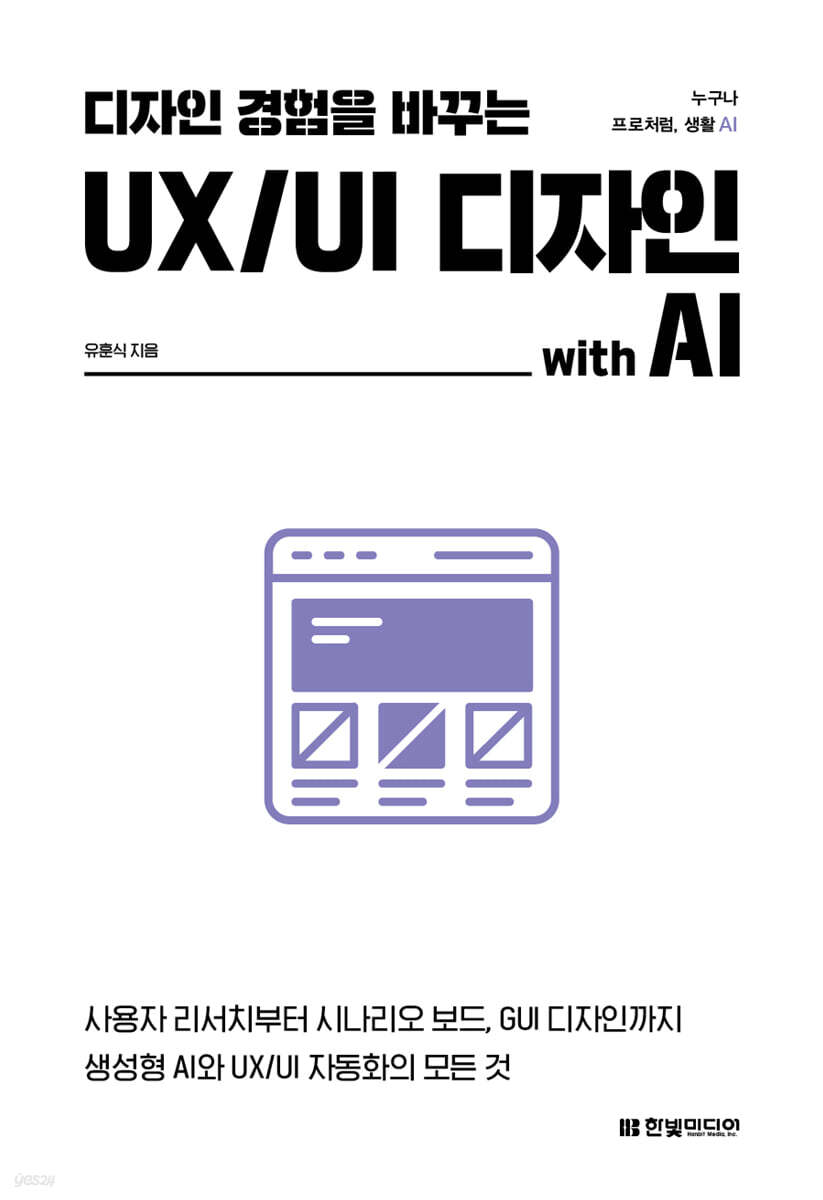
UX/UI Design with AI: Transforming Design Experiences
 |
Description
Book Introduction
One click, one line of sentence
From wireframes, mood boards, icons, and system design.
Looking back at the designer's evolution, we see a journey that expanded from practitioner to decision-maker, from the aesthetic realm to the business realm, and from localized expertise to the holistic field of experience.
So, what kind of designer will the next era demand?
Even as times change, the fundamental ability of a designer remains ‘creativity.’
This book explores how AI can be used across all stages of planning, designing, and developing web/mobile services, allowing UX/UI designers to focus on their core competencies.
You can use language models for heuristic evaluation, user interview analysis, and UX writing, and use image models to draft scenario boards, wireframes, and mood boards.
Additionally, we introduce the most useful and marketable tools among the numerous UX/UI automation tools on the market.
As you follow this journey, you will naturally come to understand the new capabilities designers need in the AI era.
From wireframes, mood boards, icons, and system design.
Looking back at the designer's evolution, we see a journey that expanded from practitioner to decision-maker, from the aesthetic realm to the business realm, and from localized expertise to the holistic field of experience.
So, what kind of designer will the next era demand?
Even as times change, the fundamental ability of a designer remains ‘creativity.’
This book explores how AI can be used across all stages of planning, designing, and developing web/mobile services, allowing UX/UI designers to focus on their core competencies.
You can use language models for heuristic evaluation, user interview analysis, and UX writing, and use image models to draft scenario boards, wireframes, and mood boards.
Additionally, we introduce the most useful and marketable tools among the numerous UX/UI automation tools on the market.
As you follow this journey, you will naturally come to understand the new capabilities designers need in the AI era.
- You can preview some of the book's contents.
Preview
index
Part 1: UX/UI Design in the AI Design Era
Chapter 1: Designing UX/UI with AI Designers
The role of designers living in the present era
The AI Era: Leadership Capabilities in UX/UI Design Organizations
3 Skills UX/UI Designers Need
AI tools for each stage of the UX/UI design process
Part 2: Language Model AI and UX/UI Design
Chapter 2: Understanding AI's Key Language Models
Understanding and Development Trends of LLM
Intimate conversational AI, ChatGPT
Smart AI, Claude
Search Engine Innovation, Perplexity
The Future of Language Model AI
Chapter 3: Prompt Engineering for UX/UI Design
Prompt Engineering for UX/UI
4 Principles for UX/UI Prompt Engineering
Persona technique
Example-based techniques
Fukatsu-style prompt technique (formal technique)
Four types of structure using the four principles
Chapter 4: Practical Applications: AI and UX Research & Insight Generation
Evaluating heuristics
Analyzing User Interviews
Modeling Personas
UX Writing
Synthetic Users for Virtual User Research
Creating a storyboard with Boz
Part 3: Designing UX/UI with Image-Generating AI
Chapter 5: Understanding Image-Generating AI
How Image-Generating AI Is Bringing Innovation to UX/UI Design
Midjourney: The Ultimate Tool for UX/UI Designers
How UX/UI Designers Use Midjourney
Massive open-source AI, stable diffusion
Stable Diffusion Use Cases in UX/UI
Chapter 6: Creating Image Prompts for UX/UI Designers
Creating a character image for your persona
Create identical characters of different styles for scenario boards
Prompts to adjust distance from the character and viewpoint
Creating a UX Scenario Board
Strategically Leveraging AI on UX Scenario Boards
Chapter 7: Practical Applications: Image Models and UI Design
Designing GUI
Complete GUI with 6-step prompts
Designing a Mood Board
Example mood board created with 6-step prompts
Create an icon
Example of an icon created with a 6-step prompt
The era where prompts become assets
Part 4: Shifting the UX/UI Design Paradigm: Designing UI with AI
Chapter 8: The Paradigm of Text-to-UI Design: Galileo AI
Galileo AI: A Paradigm for Text-to-UI Design
Creating UIs with Galileo AI
5 Tips for Improving the Design Quality of Galileo AI
Chapter 9 Text to Wireframe Powerhouse, Relum
Rapid automation in the early stages of design
Key features of Relum
Chapter 10: Bringing All UX Processes Together, UX Pilot
Innovation in design work
Key Features of UX Pilot
Practical Use Cases of UX Pilots
Chapter 11: Creativity: Design Tools in the Era of Multimodal Interaction
Until the advent of multimodal interaction
Creati, a multimodal interaction-based UI design tool
Creativity's main features
Chapter 12: Figma, the UI design powerhouse, made even stronger by AI
New AI Features Introduced in Figma
Figma's AI-powered features
Limitations of Figma's AI Functions and Precautions for Practical Use
Chapter 13: UI Prototyping Tools, Wizards
Democratization of Design
Wizard's main features
Wizard Practical Cases by Organization Size
Chapter 14: Maze, an AI-based user analytics tool
The importance of rapid failure and improvement
Maze's main features
Maze Real-World Case Studies Accelerating the Design Process
The Usefulness and Limitations of Maze
Chapter 15: Webflow, the Paradigm of No-Code UI Design
Webflow, the leader in no-code UI design
Real-World Webflow Case Studies That Save Time and Money
Chapter 16: Bridging the Gap Between Design and Development: Primer
A comprehensive design tool for designers and developers
Primer's main features
From design to deployment, all in one place: Primer's real-world examples.
Part 5: The Future of UX/UI Design in the AI Era
Chapter 17: UX/UI Designers Working with AI
The Changing Role of UX/UI Designers
The evolving role of AI in the UX design industry
Chapter 18: The Future of AI Design
AI Agents and UX Design
AI Orchestration
Chapter 19: Design and Copyright in the AI Era
Copyright Issues in UI Design in the AI Era
UI and Copyright
Copyright Concepts Designers Must Know in the AI Era
Copyright Protection Strategies Designers Need to Know
Chapter 1: Designing UX/UI with AI Designers
The role of designers living in the present era
The AI Era: Leadership Capabilities in UX/UI Design Organizations
3 Skills UX/UI Designers Need
AI tools for each stage of the UX/UI design process
Part 2: Language Model AI and UX/UI Design
Chapter 2: Understanding AI's Key Language Models
Understanding and Development Trends of LLM
Intimate conversational AI, ChatGPT
Smart AI, Claude
Search Engine Innovation, Perplexity
The Future of Language Model AI
Chapter 3: Prompt Engineering for UX/UI Design
Prompt Engineering for UX/UI
4 Principles for UX/UI Prompt Engineering
Persona technique
Example-based techniques
Fukatsu-style prompt technique (formal technique)
Four types of structure using the four principles
Chapter 4: Practical Applications: AI and UX Research & Insight Generation
Evaluating heuristics
Analyzing User Interviews
Modeling Personas
UX Writing
Synthetic Users for Virtual User Research
Creating a storyboard with Boz
Part 3: Designing UX/UI with Image-Generating AI
Chapter 5: Understanding Image-Generating AI
How Image-Generating AI Is Bringing Innovation to UX/UI Design
Midjourney: The Ultimate Tool for UX/UI Designers
How UX/UI Designers Use Midjourney
Massive open-source AI, stable diffusion
Stable Diffusion Use Cases in UX/UI
Chapter 6: Creating Image Prompts for UX/UI Designers
Creating a character image for your persona
Create identical characters of different styles for scenario boards
Prompts to adjust distance from the character and viewpoint
Creating a UX Scenario Board
Strategically Leveraging AI on UX Scenario Boards
Chapter 7: Practical Applications: Image Models and UI Design
Designing GUI
Complete GUI with 6-step prompts
Designing a Mood Board
Example mood board created with 6-step prompts
Create an icon
Example of an icon created with a 6-step prompt
The era where prompts become assets
Part 4: Shifting the UX/UI Design Paradigm: Designing UI with AI
Chapter 8: The Paradigm of Text-to-UI Design: Galileo AI
Galileo AI: A Paradigm for Text-to-UI Design
Creating UIs with Galileo AI
5 Tips for Improving the Design Quality of Galileo AI
Chapter 9 Text to Wireframe Powerhouse, Relum
Rapid automation in the early stages of design
Key features of Relum
Chapter 10: Bringing All UX Processes Together, UX Pilot
Innovation in design work
Key Features of UX Pilot
Practical Use Cases of UX Pilots
Chapter 11: Creativity: Design Tools in the Era of Multimodal Interaction
Until the advent of multimodal interaction
Creati, a multimodal interaction-based UI design tool
Creativity's main features
Chapter 12: Figma, the UI design powerhouse, made even stronger by AI
New AI Features Introduced in Figma
Figma's AI-powered features
Limitations of Figma's AI Functions and Precautions for Practical Use
Chapter 13: UI Prototyping Tools, Wizards
Democratization of Design
Wizard's main features
Wizard Practical Cases by Organization Size
Chapter 14: Maze, an AI-based user analytics tool
The importance of rapid failure and improvement
Maze's main features
Maze Real-World Case Studies Accelerating the Design Process
The Usefulness and Limitations of Maze
Chapter 15: Webflow, the Paradigm of No-Code UI Design
Webflow, the leader in no-code UI design
Real-World Webflow Case Studies That Save Time and Money
Chapter 16: Bridging the Gap Between Design and Development: Primer
A comprehensive design tool for designers and developers
Primer's main features
From design to deployment, all in one place: Primer's real-world examples.
Part 5: The Future of UX/UI Design in the AI Era
Chapter 17: UX/UI Designers Working with AI
The Changing Role of UX/UI Designers
The evolving role of AI in the UX design industry
Chapter 18: The Future of AI Design
AI Agents and UX Design
AI Orchestration
Chapter 19: Design and Copyright in the AI Era
Copyright Issues in UI Design in the AI Era
UI and Copyright
Copyright Concepts Designers Must Know in the AI Era
Copyright Protection Strategies Designers Need to Know
Detailed image

Publisher's Review
Anyone can be a pro,
From zero to complete a product
Generative AI is a tool with endless possibilities, depending on who uses it and how.
Sometimes, I'm a lawyer who helps clients with their consultations, sometimes I'm a smart analyst who neatly organizes everything from suggesting data analysis topics to writing reports without any hesitation, and sometimes I'm a capable producer who can quickly create a video if desired.
We'll show you how to hire a great partner with all these capabilities.
Anyone can become a pro with just one book
Step 1.
Build your skills as a prompt designer with language models with ChatGPT & Claude.
Practical Examples | Heuristic Evaluation, User Interview Analysis, Persona Modeling, UX Writing
Step 2.
Mastering UX/UI Practice with Image Models with Midjourney
Practical Examples | Persona Character Images, Scenario Boards, GUIs, Mood Boards, and Icons
Step 3.
From User Analytics to Interaction, How to Use 9 UX/UI Automation Tools
A look at nine UX/UI automation tools, including Galileo AI, UX Pilot, Webflow, and Figma.
Step 4. A Guide for UX/UI Designers Working with AI
The evolving role of UX/UI designers and the essential copyright concepts designers working with AI need to understand.
Target audience for this book
● Current UX/UI designers who want to automate UX/UI processes
● Applicants who are curious about the product development process using AI
● UX/UI team leaders who need to build a UX/UI team with AI-utilizing capabilities
● POs/PMs who need AI-based strategies to collaborate with design and development teams
Anyone interested in UX/UI using generative AI
From zero to complete a product
Generative AI is a tool with endless possibilities, depending on who uses it and how.
Sometimes, I'm a lawyer who helps clients with their consultations, sometimes I'm a smart analyst who neatly organizes everything from suggesting data analysis topics to writing reports without any hesitation, and sometimes I'm a capable producer who can quickly create a video if desired.
We'll show you how to hire a great partner with all these capabilities.
Anyone can become a pro with just one book
Step 1.
Build your skills as a prompt designer with language models with ChatGPT & Claude.
Practical Examples | Heuristic Evaluation, User Interview Analysis, Persona Modeling, UX Writing
Step 2.
Mastering UX/UI Practice with Image Models with Midjourney
Practical Examples | Persona Character Images, Scenario Boards, GUIs, Mood Boards, and Icons
Step 3.
From User Analytics to Interaction, How to Use 9 UX/UI Automation Tools
A look at nine UX/UI automation tools, including Galileo AI, UX Pilot, Webflow, and Figma.
Step 4. A Guide for UX/UI Designers Working with AI
The evolving role of UX/UI designers and the essential copyright concepts designers working with AI need to understand.
Target audience for this book
● Current UX/UI designers who want to automate UX/UI processes
● Applicants who are curious about the product development process using AI
● UX/UI team leaders who need to build a UX/UI team with AI-utilizing capabilities
● POs/PMs who need AI-based strategies to collaborate with design and development teams
Anyone interested in UX/UI using generative AI
GOODS SPECIFICS
- Date of issue: June 26, 2025
- Page count, weight, size: 496 pages | 742g | 153*223*20mm
- ISBN13: 9791169214025
- ISBN10: 1169214029
You may also like
카테고리
korean


korean

![GQ KOREA Mark (Monthly): December [2025]](http://librairie.coreenne.fr/cdn/shop/files/8ef265dbbfbf186523ed75ba7319009d.jpg?v=1765340328&width=3840)


