

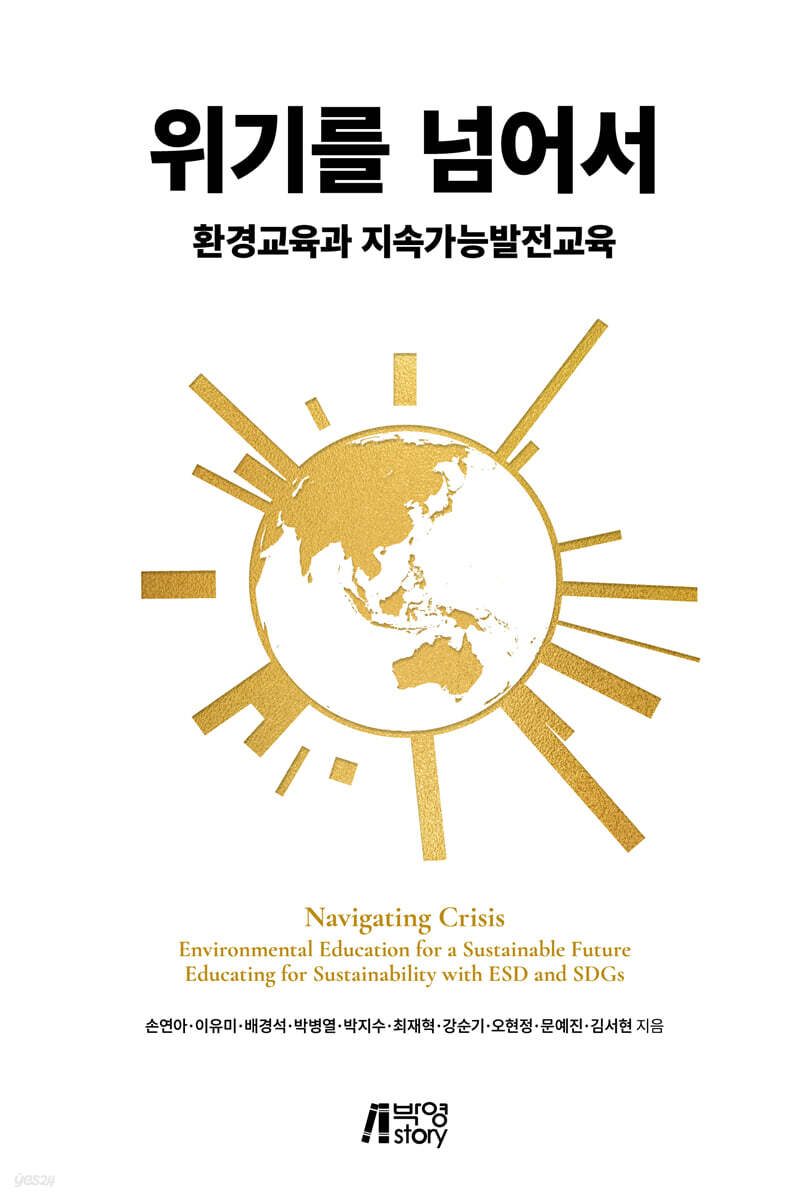
Beyond the crisis
 |
Description
Book Introduction
We believe that education for sustainable development can be a key to solving the complex and diverse problems facing our society, and we aim to present a vision for our journey toward a sustainable future.
Beyond Crisis: Environmental Education and Education for Sustainable Development addresses the global impact and complexity of environmental issues while exploring and providing examples of specific, practical educational solutions at the community level, demonstrating how education can drive change and innovation for a sustainable future.
This book aims to provide a deep understanding of the environmental crisis and practical action plans.
Through environmental and sustainable development education, we hope to empower all of us to take responsibility for the environmental changes that are occurring even now and to bring about practical and innovative change.
We hope this book will serve as a valuable guide on your journey to overcome the environmental crisis and move toward a sustainable future.
Beyond Crisis: Environmental Education and Education for Sustainable Development addresses the global impact and complexity of environmental issues while exploring and providing examples of specific, practical educational solutions at the community level, demonstrating how education can drive change and innovation for a sustainable future.
This book aims to provide a deep understanding of the environmental crisis and practical action plans.
Through environmental and sustainable development education, we hope to empower all of us to take responsibility for the environmental changes that are occurring even now and to bring about practical and innovative change.
We hope this book will serve as a valuable guide on your journey to overcome the environmental crisis and move toward a sustainable future.
index
Chapter 01
Changes in the social and educational environment in an unsustainable era
01 Risk Society and the Unsustainable Era 3
02 Reflections on the Modern Environmental Crisis 14
03 Environmental Crisis and Educational Change 23
Chapter 02
Educational Approaches to Sustainable Society
01 Interdisciplinary, multidisciplinary, and transdisciplinary 35
02 Complexity Theory 42
03 Cultural Approach 44
Chapter 03
Community Engagement Model for a Sustainable Society
01 Triple Helix (TH) Model 73
02 Community-Linked Community of Practice (CoP) Model 85
03 Community Linkage Network Model 94
Chapter 04
Understanding Environmental and Sustainable Development Education
01 Sustainable Development Education 105
02 The Relationship Between Environmental Education and Sustainable Development Education 116
03 The Meaning of Environmental and Sustainable Development Education and the Competencies It Pursues 121
Chapter 05
Strategy for Environmental and Sustainable Development Education
01 Systems Thinking 141
02 Service Learning 155
03 Living Lab 159
04 Living School 16205 Sustainable Happiness and Education Implementation Strategy 170
Chapter 06
Environmental and Sustainable Development Education Cases
01 Case Study of University-Corporation-Local Government-School Collaboration 187
02 City A Environmental Education Week Program Operation Case Study 194
03 Case Study of Youth Environmental Policy Proposal Forum Operation 199
04 Case Study of a University-Education Office-School Collaboration Program 205
05 Case Study: Expansion of University-Centered Sustainable Development Education Programs 217
06 Environmental Education Theater Case Study 226
Changes in the social and educational environment in an unsustainable era
01 Risk Society and the Unsustainable Era 3
02 Reflections on the Modern Environmental Crisis 14
03 Environmental Crisis and Educational Change 23
Chapter 02
Educational Approaches to Sustainable Society
01 Interdisciplinary, multidisciplinary, and transdisciplinary 35
02 Complexity Theory 42
03 Cultural Approach 44
Chapter 03
Community Engagement Model for a Sustainable Society
01 Triple Helix (TH) Model 73
02 Community-Linked Community of Practice (CoP) Model 85
03 Community Linkage Network Model 94
Chapter 04
Understanding Environmental and Sustainable Development Education
01 Sustainable Development Education 105
02 The Relationship Between Environmental Education and Sustainable Development Education 116
03 The Meaning of Environmental and Sustainable Development Education and the Competencies It Pursues 121
Chapter 05
Strategy for Environmental and Sustainable Development Education
01 Systems Thinking 141
02 Service Learning 155
03 Living Lab 159
04 Living School 16205 Sustainable Happiness and Education Implementation Strategy 170
Chapter 06
Environmental and Sustainable Development Education Cases
01 Case Study of University-Corporation-Local Government-School Collaboration 187
02 City A Environmental Education Week Program Operation Case Study 194
03 Case Study of Youth Environmental Policy Proposal Forum Operation 199
04 Case Study of a University-Education Office-School Collaboration Program 205
05 Case Study: Expansion of University-Centered Sustainable Development Education Programs 217
06 Environmental Education Theater Case Study 226
Publisher's Review
Modern society is facing an era of unprecedented change and challenges.
Climate change, biodiversity loss, growing economic inequality, and social polarization pose serious threats to both our generation and future generations, and are critical issues that must be addressed urgently.
These complex problems require fundamental change beyond simple solutions.
Therefore, to solve this problem, we must bring about changes in awareness and behavior throughout society through education. To respond to these contemporary demands, we must explore educational strategies for sustainable development and ways to implement them.
This book was written with the hope of becoming a catalyst for this change.
We believe that education for sustainable development can be a key to solving the complex and diverse problems facing our society, and we aim to present a vision for our journey toward a sustainable future.
By addressing the global impact and complexity of environmental issues while exploring and providing examples of specific, practical educational solutions at the community level, this book demonstrates how education can drive change and innovation for a sustainable future.
Chapter 1 addresses the changing social and educational landscape in an age of unsustainability, analyzing the complex challenges facing modern society and considering how education and society should address these issues.
Taking Ulrich Beck's concept of 'risk society' as a starting point, we analyze the various risks facing modern society.
Here, the term 'risk society' emphasizes that the various risks that arise in the process of modernization should be recognized not as simple individual incidents, but as structural problems that affect the entire society.
This awareness helps us understand how the problems we face today, such as climate change, environmental destruction, and economic inequality, are interconnected.
By carefully examining the characteristics of a risk society and the problems of unsustainable development, it reveals that these issues present new challenges unlike anything we have experienced so far.
Chapter 2 focuses on educational approaches for a sustainable society, addressing the importance of interdisciplinary approaches that connect and integrate diverse academic disciplines to develop novel solutions to complex real-world problems.
We also examine the theoretical foundations of environmental education and sustainable development education, as well as the complexity theory, local culture, and indigenous knowledge that underlie them.
The education discussed here should not simply be a means of imparting knowledge, but a process that helps learners develop the ability to understand the world, think critically, and take responsible actions for a sustainable future.
Therefore, a fundamental shift in the purpose, content, and methodology of education is necessary to address the risks and challenges of modern society.
Education should focus on fostering the ability to comprehensively understand and solve the complex and diverse problems facing our society.
Chapter 3 develops a network model through linkages with local communities and explains how to utilize it.
We focus on a network perspective to address the complex challenges facing our society by strengthening connections between universities and local communities.
This approach can facilitate the development and implementation of educational programs that leverage community resources to address educational, social, and environmental issues while contributing to community development.
Chapter 4 examines what environmental and sustainable development education is.
After taking a comprehensive look at the meaning, importance, characteristics, and history of sustainable development education, we will examine various perspectives on sustainable development education.
Afterwards, we will examine the relationship between environmental education and sustainable development education and take an integrated approach by integrating the two fields.
Chapter 5 deals with strategies for environmental and sustainable development education.
We introduce applicable educational methods that can solve complex problems arising in various fields through integrated environmental, social, and economic thinking.
These educational strategies enable students to view problems from multiple perspectives and find solutions through creative thinking and practice, thereby developing the knowledge, values, and attitudes necessary for a sustainable future.
Chapter 6 introduces examples of environmental and sustainable development education linked to local communities.
It emphasizes the importance of community-linked education that utilizes local resources for education, taking into account regional characteristics such as environment, culture, and economic conditions.
Through concrete examples, it demonstrates how community-linked education can be implemented and what real change and growth it can bring.
This can equip students with the knowledge and skills needed to solve real-world problems and provide a foundation for contributing to the sustainable development of their communities.
This book aims to provide a deep understanding of the environmental crisis and practical action plans.
Through environmental and sustainable development education, we hope to empower all of us to take responsibility for the environmental changes that are occurring even now and to bring about practical and innovative change.
We hope this book will serve as a valuable guide on your journey to overcome the environmental crisis and move toward a sustainable future.
Climate change, biodiversity loss, growing economic inequality, and social polarization pose serious threats to both our generation and future generations, and are critical issues that must be addressed urgently.
These complex problems require fundamental change beyond simple solutions.
Therefore, to solve this problem, we must bring about changes in awareness and behavior throughout society through education. To respond to these contemporary demands, we must explore educational strategies for sustainable development and ways to implement them.
This book was written with the hope of becoming a catalyst for this change.
We believe that education for sustainable development can be a key to solving the complex and diverse problems facing our society, and we aim to present a vision for our journey toward a sustainable future.
By addressing the global impact and complexity of environmental issues while exploring and providing examples of specific, practical educational solutions at the community level, this book demonstrates how education can drive change and innovation for a sustainable future.
Chapter 1 addresses the changing social and educational landscape in an age of unsustainability, analyzing the complex challenges facing modern society and considering how education and society should address these issues.
Taking Ulrich Beck's concept of 'risk society' as a starting point, we analyze the various risks facing modern society.
Here, the term 'risk society' emphasizes that the various risks that arise in the process of modernization should be recognized not as simple individual incidents, but as structural problems that affect the entire society.
This awareness helps us understand how the problems we face today, such as climate change, environmental destruction, and economic inequality, are interconnected.
By carefully examining the characteristics of a risk society and the problems of unsustainable development, it reveals that these issues present new challenges unlike anything we have experienced so far.
Chapter 2 focuses on educational approaches for a sustainable society, addressing the importance of interdisciplinary approaches that connect and integrate diverse academic disciplines to develop novel solutions to complex real-world problems.
We also examine the theoretical foundations of environmental education and sustainable development education, as well as the complexity theory, local culture, and indigenous knowledge that underlie them.
The education discussed here should not simply be a means of imparting knowledge, but a process that helps learners develop the ability to understand the world, think critically, and take responsible actions for a sustainable future.
Therefore, a fundamental shift in the purpose, content, and methodology of education is necessary to address the risks and challenges of modern society.
Education should focus on fostering the ability to comprehensively understand and solve the complex and diverse problems facing our society.
Chapter 3 develops a network model through linkages with local communities and explains how to utilize it.
We focus on a network perspective to address the complex challenges facing our society by strengthening connections between universities and local communities.
This approach can facilitate the development and implementation of educational programs that leverage community resources to address educational, social, and environmental issues while contributing to community development.
Chapter 4 examines what environmental and sustainable development education is.
After taking a comprehensive look at the meaning, importance, characteristics, and history of sustainable development education, we will examine various perspectives on sustainable development education.
Afterwards, we will examine the relationship between environmental education and sustainable development education and take an integrated approach by integrating the two fields.
Chapter 5 deals with strategies for environmental and sustainable development education.
We introduce applicable educational methods that can solve complex problems arising in various fields through integrated environmental, social, and economic thinking.
These educational strategies enable students to view problems from multiple perspectives and find solutions through creative thinking and practice, thereby developing the knowledge, values, and attitudes necessary for a sustainable future.
Chapter 6 introduces examples of environmental and sustainable development education linked to local communities.
It emphasizes the importance of community-linked education that utilizes local resources for education, taking into account regional characteristics such as environment, culture, and economic conditions.
Through concrete examples, it demonstrates how community-linked education can be implemented and what real change and growth it can bring.
This can equip students with the knowledge and skills needed to solve real-world problems and provide a foundation for contributing to the sustainable development of their communities.
This book aims to provide a deep understanding of the environmental crisis and practical action plans.
Through environmental and sustainable development education, we hope to empower all of us to take responsibility for the environmental changes that are occurring even now and to bring about practical and innovative change.
We hope this book will serve as a valuable guide on your journey to overcome the environmental crisis and move toward a sustainable future.
GOODS SPECIFICS
- Date of issue: April 30, 2025
- Page count, weight, size: 256 pages | 150*225*20mm
- ISBN13: 9791165199647
- ISBN10: 1165199645
You may also like
카테고리
korean


korean

![GQ KOREA Mark (Monthly): December [2025]](http://librairie.coreenne.fr/cdn/shop/files/8ef265dbbfbf186523ed75ba7319009d.jpg?v=1765340328&width=3840)


